
Chapter 6: Quadratic Functions
The models we have explored so far, namely, linear, exponential, logarithmic, and power, are monotonic functions, that is, always increasing or always decreasing on their domains. (Remember that we used power functions as models in the first quadrant only.) In this chapter, we investigate problems where the output variable may change from increasing to decreasing, or vice versa. The simplest sort of function that models this behavior is a quadratic function, one that involves the square of the variable.
Around 1600, Galileo began to study the motion of falling objects. He used a ball rolling down an inclined plane or ramp to slow down the motion.
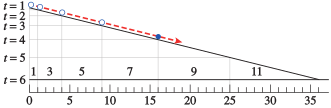
Galileo had no accurate way to measure time; clocks had not been invented yet. So he used water running into a jar to mark equal time intervals. After many trials, Galileo found that the ball traveled unit of distance down the plane in the first time interval, units in the second time interval, units in the third time interval, and so on, as shown in the figure, with the distances increasing through odd units of distance as time went on.
| Time | Distance traveled | Total distance |
|---|---|---|
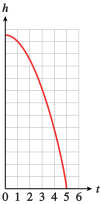
As you can see in the table above, the total distance traveled by the ball is proportional to the square of the time elapsed, . Galileo found that this relationship held no matter how steep he made the ramp. Plotting the height of the ball as a function of time, we obtain a portion of the graph of a quadratic function.
Modeling, Functions, and Graphs by Katherine Yoshiwara (yoshiwarabooks.org), GNU Free Documentation License 1.2 or later. Adapted for the XYZ HTML edition with the authors' permission (recorded 2026-07-04). License: GFDL-1.2-or-later.