
6.1 Factors and -Intercepts
In Height of a Baseball, perhaps you recognized the graph of the baseball's height as a parabola. In this chapter, we shall see that the graph of any quadratic function is a parabola.
In Height of a Baseball, the height of a baseball seconds after being hit was given by
We used a graph to find two times when the baseball was feet high. Can we solve the same problem algebraically?
We are looking for values of that produce in the height equation. So, if we substitute into the height equation, we would like to solve the quadratic equation
This equation cannot be solved by extraction of roots, because there are two terms containing the variable , and they cannot be combined. To solve this equation, we will appeal to a property of our number system, called the zero-factor principle.
Zero-Factor Principle
Can you multiply two numbers together and obtain a product of zero? Only if one of the two numbers happens to be zero. This property of numbers is called the zero-factor principle.
The principle is true even if the numbers and are represented by algebraic expressions, such as or . For example, if
then it must be true that either or . Thus, we can use the zero-factor principle to solve equations.
Example illustrates an important fact about the -intercepts of a graph.
What are the -intercepts of the graph of ?
_____
and
What are the -intercepts of the graph of ?
- and
- and
- and
- and
Graph the function
on a calculator, and use your graph to solve the equation . (Use , .)
Solutions: _____ [Separate different values with a comma.]
Check your answer with the zero-factor principle.
,
Graph the function
with technology, and use your graph to solve the equation . (Use , .) Check your answer with the zero-factor principle.
,
How can you use a graph to factor a quadratic expression?
_____
How can you use a graph to factor a quadratic expression?
Solving Quadratic Equations by Factoring
Before we apply the zero-factor principle to solve a quadratic equation, we must first write the equation so that one side of the equation is zero. Let us introduce some terminology.
Once we have written the equation in standard form, we factor the left side and set each variable factor equal to zero separately. (See Appendix A.8 Factoring Quadratic Trinomials to review factoring.)
We summarize the factoring method for solving quadratic equations as follows.
Solve by factoring:
Solutions: _____ [Separate different values with a comma.]
After rewriting the equation in standard form and then factoring, we find and .
Solve by factoring:
After rewriting the equation in standard form and then factoring, we find .
We can use factoring to solve the equation from Height of a Baseball.
In the solution to Example, the factor does not affect the solutions of the equation at all. You can understand why this is true by looking at some graphs. First, check that the two equations
have the same solutions, and . Then use your graphing calculator to graph the equation
in the window
Notice that when , or . These two points are the -intercepts of the graph. In the same window, now graph
This graph has the same -values when . The factor of stretches the graph vertically but does not change the location of the -intercepts.
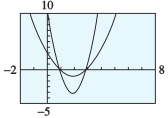
What happens to the -intercepts when you multiply the right side of by 3?
_____
They are unchanged.
What happens to the -intercepts when you multiply the right side of by 3?
- They are tripled.
- They are divided by 3.
- They move 3 units to the right.
- They are unchanged.
The value of the constant factor in the factored form of a quadratic function, , does not affect the location of the -intercepts, because it does not affect the solutions of the equation .
- Solve by factoring.
Solutions: _____ [Separate different values with a comma.] - Solve by factoring.
Solutions: _____ [Separate different values with a comma.] - Graph and together in the window
and locate the horizontal intercepts of each graph.
Horizontal intercepts: _____ [Separate different ordered pairs with a comma.]
- ,
- ,
- ,
- Solve by factoring.
- Solve by factoring.
- Graph and together in the window and locate the horizontal intercepts of each graph.
- ,
- ,
- ,
Explain why the solutions of are not 3 and 6.
_____
Explain why the solutions of are not 3 and 6.
Applications
Here is another example of how quadratic equations arise in applications.
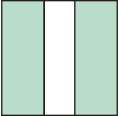
Francine is designing the layout for a botanical garden. The plan includes a square herb garden, with a path 5 feet wide through the center of the garden, as shown above. To include all the species of herbs, the planted area must be 300 square feet. Find the dimensions of the herb garden.
Answer: _____ feet by _____ feet
20 feet by 20 feet.
Francine is designing the layout for a botanical garden. The plan includes a square herb garden, with a path 5 feet wide through the center of the garden, as shown below. To include all the species of herbs, the planted area must be 300 square feet. Find the dimensions of the herb garden.
The dimensions of the planted area are feet by feet. Write an equation about the area of the planted area and solve, to find that the dimensions of the garden are 20 feet by 20 feet.
If the perimeter of a rectangle is 56 inches and its width is inches, what is an expression for its length?
_____
If the perimeter of a rectangle is 56 inches and its width is inches, what is an expression for its length?
Solutions of Quadratic Equations
We have seen that the solutions of the quadratic equation
are and . Thus, if we know the two solutions of a quadratic equation, we can work backward and reconstruct the equation, starting from its factored form. We can then write the equation in standard form by multiplying together the factors.
Which statement is true?
_____
If you know the -intercepts of the graph of , you can write it in factored form.
Which statement is true?
- All rectangles with the same perimeter have the same area.
- The solutions of are 18 and 80.
- If the perimeter of a rectangle is 20 cm, the largest area it can have is 20 sq cm.
- If you know the -intercepts of the graph of , you can write it in factored form.
Find a quadratic equation with integer coefficients whose solutions are and . Use the smallest possible positive coefficient for .
_____
Find a quadratic equation with integer coefficients whose solutions are and . Use the smallest possible positive coefficient for .
Equations Quadratic in Form
The equation
is not quadratic, but if we make the substitution , the equation becomes
An equation is called quadratic in form if we can use a substitution to write it as
where stands for an algebraic expression. Such equations can be solved by the same techniques we use to solve quadratic equations.
We say that the equation in Example, , is quadratic in . We chose the substitution because .
Use the substitution to solve the equation .
Solutions: _____
List all the values that are solutions. Use "sqrt(5)" to get , and use a comma to separate different solutions.
,
Use the substitution to solve the equation .
,
Usually, you can choose the simpler variable term in the equation for the -substitution. For example, in Practice 6 we chose because , which is the first term of the equation. Once you have chosen the -substitution, you should check that the other variable term is then a multiple of ; otherwise, the equation is not quadratic in form.
Usually, you can choose the simpler variable term in the equation for the -substitution. For example, in Practice 6 we chose because , which is the first term of the equation. Once you have chosen the -substitution, you should check that the other variable term is then a multiple of ; otherwise, the equation is not quadratic in form.
Solve the equation , and check the solutions.
Solutions: _____
List all the values that are solutions. Use a comma to separate different solutions.
,
Solve the equation , and check the solutions.
,
Explain why we cannot "cancel" from both sides of the equation . What are the solutions of the equation?
_____
Explain why we cannot "cancel" from both sides of the equation . What are the solutions of the equation?
Section Summary
Vocabulary
Look up the definitions of new terms in the Glossary.
- Quadratic function
- Zero-factor principle
- Standard form
- Factored form
- Multiplicity
- Monotonic
CONCEPTS
- A quadratic equation written as is in standard form.
A quadratic equation written as is in factored form. - Every quadratic equation has two solutions, which may be the same.
- The value of the constant in the factored form of a quadratic equation does not affect the solutions.
- Each solution of a quadratic equation corresponds to a factor in the factored form.
- An equation is called quadratic in form if we can use a substitution to write it as , where stands for an algebraic expression.
STUDY QUESTIONS
- Find a pair of numbers whose product is . Now find a different pair of numbers whose product is . Can you find more such pairs?
- Find a pair of numbers whose product is . What is true about any such pair?
- Before you begin factoring to solve a quadratic equation, what should you do?
- How can you find the -intercepts of the graph of without looking at the graph?
- How many solutions does a quadratic equation have?
- Write a linear equation whose only solution is .
- Write a quadratic equation whose only solution is .
- If you know the solutions of , how can you find the solutions of ?
- Is the equation quadratic in form? Why or why not?
- Delbert says that he can solve the equation by canceling the factor to get . Comment on his method.
SKILLS
Practice each skill in the Homework problems listed.
- Use the zero-factor principle and find -intercepts: #3–10
- Solve quadratic equations by factoring: #11–24
- Use the -intercepts of the graph to factor a quadratic equation: #25–28, 37–40
- Write a quadratic equation with given solutions: #29–36
- Solve applied problems involving quadratic equations: #41–50
- Solve equations that are quadratic in form: #51–62
Homework 6.1
Delbert stands at the top of a -foot cliff and throws his algebra book directly upward with a velocity of feet per second. The height of his book above the ground seconds later is given by the equation
where is in feet.
- Use your calculator to make a table of values for the height function, with increments of second.
- Graph the height function on your calculator. Use your table of values to help you choose appropriate window settings.
- What is the highest altitude Delbert’s book reaches? When does it reach that height? Use the
TRACEfeature to find approximate answers first. Then use the Table feature to improve your estimate. - When does Delbert's book pass him on its way down? (Delbert is standing at a height of feet.) Use the intersect command.
- How long will it take Delbert's book to hit the ground at the bottom of the cliff?
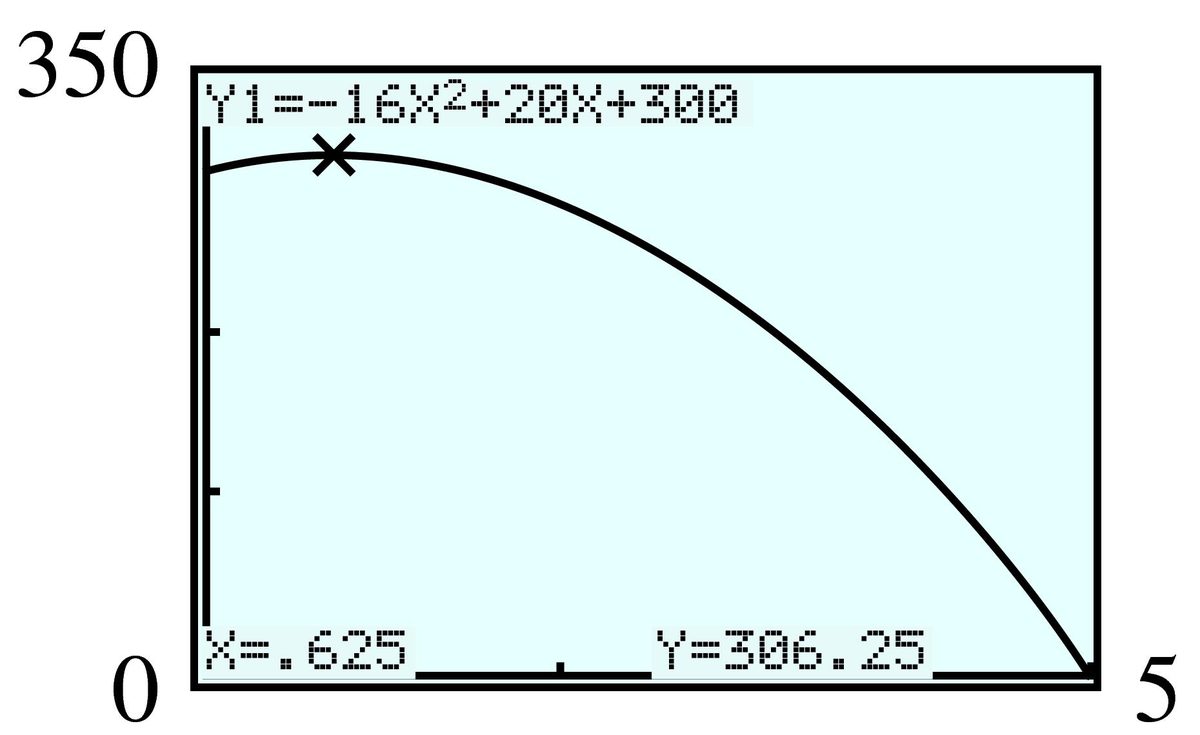
- ft at sec
- sec
- sec
James Bond stands on top of a -foot building and throws a film canister upward to a fellow agent in a helicopter feet above the building. The height of the film above the ground seconds later is given by the formula
where is in feet.
- Use your calculator to make a table of values for the height function, with increments of second.
- Graph the height function on your calculator. Use your table of values to help you choose appropriate window settings.
- How long will it take the film canister to reach the agent in the helicopter? (What is the agent's altitude?) Use the
TRACEfeature to find approximate answers first. Then use the Table feature to improve your estimate. - If the agent misses the canister, when will it pass James Bond on the way down? Use the intersect command.
- How long will it take it to hit the ground?
In Problems 3–10, use a graph to solve the equation . (Use , .) Check your answers with the zero-factor principle.
,
,
,
For Problems 11-24, solve by factoring. (See Algebra Skills Refresher Appendix to review factoring.)
,
,
,
,
,
,
In Problems 25–28, graph each set of functions in the standard window.What do you notice about the -intercepts? Generalize your observation, and test your idea with examples.
The 3 graphs have the same -intercepts. In general, the graph of has the same -intercepts as the graph of .
The 3 graphs have the same -intercepts. In general, the graph of has the same -intercepts as the graph of .
In Problems 29–36, write a quadratic equation whose solutions are given. The equation should be in standard form with integer coefficients.
and
and
and
and
and
and
and
and
For problems 37-40, graph the function in the ZInteger window, and locate the -intercepts of the graph. Use the -intercepts to write the quadratic expression in factored form.
Use the Pythagorean theorem to solve Problems 41 and 42. (See Algebra Skills Refresher Appendix to review the Pythagorean theorem.)
One end of a ladder is feet from the base of a wall, and the other end reaches a window in the wall. The ladder is feet longer than the height of the window.
- Write a quadratic equation about the height of the window.
- Solve your equation to find the height of the window.
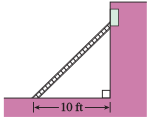
- ft
The diagonal of a rectangle is inches. One side of the rectangle is inches shorter than the other side.
- Write a quadratic equation about the length of the rectangle.
- Solve your equation to find the dimensions of the rectangle.
Use the following formula to answer Problems 43 and 44. If an object is thrown into the air from a height above the ground with an initial velocity , its height seconds later is given by the formula
where is a constant that measures the force of gravity.
A tennis ball is thrown into the air with an initial velocity of feet per second from a height of feet. The value of is .
- Write a quadratic function that gives the height of the tennis ball at time .
- Find the height of the tennis ball at second and at second.
- Write and solve an equation to answer the question: At what time is the tennis ball feet high?
- Use the Table feature on your calculator to verify your answers to parts (b) and (c). (What value of is useful for this problem?)
- Graph your function from part (a) on your calculator. Use your table to help you choose an appropriate window.
- If nobody hits the tennis ball, approximately how long will it be in the air?
- ft; ft
- ; at sec and sec
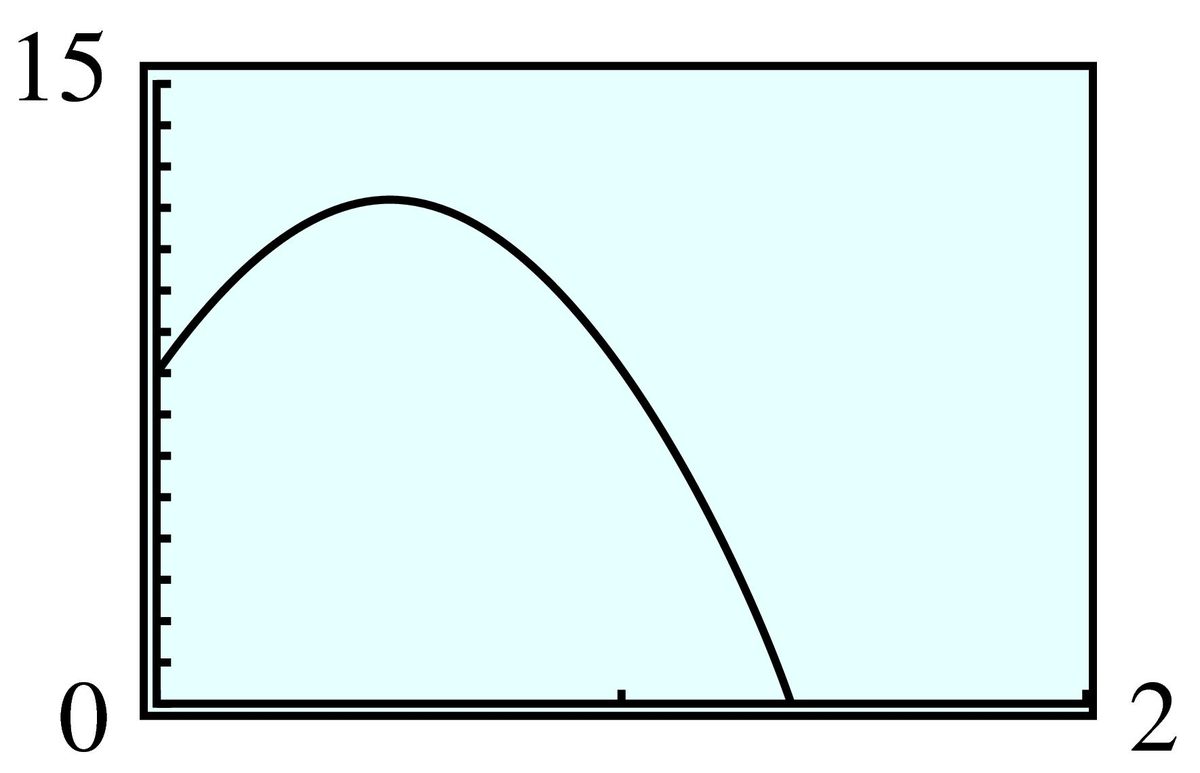
- sec
A mountain climber stands on a ledge feet above the ground and tosses a rope down to a companion clinging to the rock face below the ledge. The initial velocity of the rope is feet per second, and the value of is .
- Write a quadratic function that gives the height of the rope at time .
- What is the height of the rope after second? After second?
- Write and solve an equation to answer the question: How long does it take the rope to reach the second climber, who is feet above the ground?
- Use the Table feature on your calculator to verify your answers to parts (b) and (c). (What value of is useful for this problem?)
- Graph your function from part (a) on your calculator. Use your table to help you choose an appropriate window.
- If the second climber misses the rope, approximately how long will the rope take to reach the ground?
For Problems 45 and 46, you may want to review Investigation, Perimeter and Area, in Modeling with Functions.
A rancher has yards of fence to enclose a rectangular pasture. If the pasture should be square yards in area, what should its dimensions be? We will use 3 methods to solve this problem: a table of values, a graph, and an algebraic equation.
- Make a table by hand that shows the areas of pastures of various widths, as shown here.
Width Length Area
(To find the length of each pasture, ask yourself, What is the sum of the length plus the width if there are yards of fence?) Continue the table until you find the pasture whose area is square yards. - Write an expression for the length of the pasture if its width is . Next, write an expression for the area, , of the pasture if its width is . Graph the equation for on your calculator, and use the graph to find the pasture of area square yards.
- Write an equation for the area, , of the pasture in terms of its width . Solve your equation algebraically for . Explain why there are two solutions.
Width Length Area - , ; yd by yd
- , yd by yd, or yd by yd. There are two solutions because the pasture can be oriented in two directions.
If the rancher in Problem 45 uses a riverbank to border one side of the pasture as shown in the figure, he can enclose square yards with yards of fence. What will the dimensions of the pasture be then? We will use three methods to solve this problem: a table of values, a graph, and an algebraic equation.
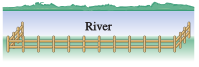
- Make a table by hand that shows the areas of pastures of various widths, as shown here.
Width Length Area
(Be careful computing the length of the pasture: Remember that one side of the pasture does not need any fence!) Continue the table until you find the pasture whose area is square yards. - Write an expression for the length of the pasture if its width is . Next, write an expression for the area, , of the pasture if its width is . Graph the equation for , and use the graph to find the pasture of area square yards.
- Write an equation for the area, , of the pasture in terms of its width . Solve your equation algebraically for .
For Problems 47 and 48, you will need the formula for the volume of a box.
A box is made from a square piece of cardboard by cutting -inch squares from each corner and turning up the edges.
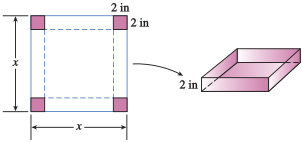
- If the piece of cardboard is inches square, write expressions for the length, width, and height of the box. Then write an expression for the volume, , of the box in terms of .
- Use your calculator to make a table of values showing the volumes of boxes made from cardboard squares of side inches, inches, and so on.
- Graph your function for the volume on your calculator. What happens to as increases?
- Use your table or your graph to find what size cardboard you need to make a box with volume cubic inches.
- Write and solve a quadratic equation to answer part (d).
- , , ,
- As increases, increases.
- inches by inches.
- ,
A length of rain gutter is made from a piece of aluminum feet long and foot wide.
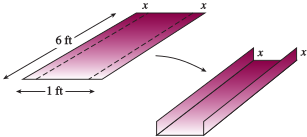
- If a strip of width is turned up along each long edge, write expressions for the length, width, and height of the gutter. Then write an expression for the volume, , of the gutter in terms of .
- Use your calculator to make a table of values showing the volumes of various rain gutters formed by turning up edges of foot, foot, and so on.
- Graph your function for the volume. What happens to as increases?
- Use your table or your graph to discover how much metal should be turned up along each long edge so that the gutter has a capacity of cubic foot of rainwater.
- Write and solve a quadratic equation to answer part (d).
Problems 49 and 50 deal with wildlife management. The annual increase, , in a population often depends on the size of the population, according to the formula
where and are constants related to the fertility of the population and the availability of food.
The annual increase, , in the deer population in a national park is given by
where is the size of the population that year.
- Make a table of values for for . Use increments of in .
- How much will a population of deer increase? A population of deer? A population of deer?
- Use your calculator to graph the annual increase, , versus the size of the population, , for .
- What do the -intercepts tell us about the deer population?
- Estimate the population size that results in the largest annual increase. What is that increase?
- , ,
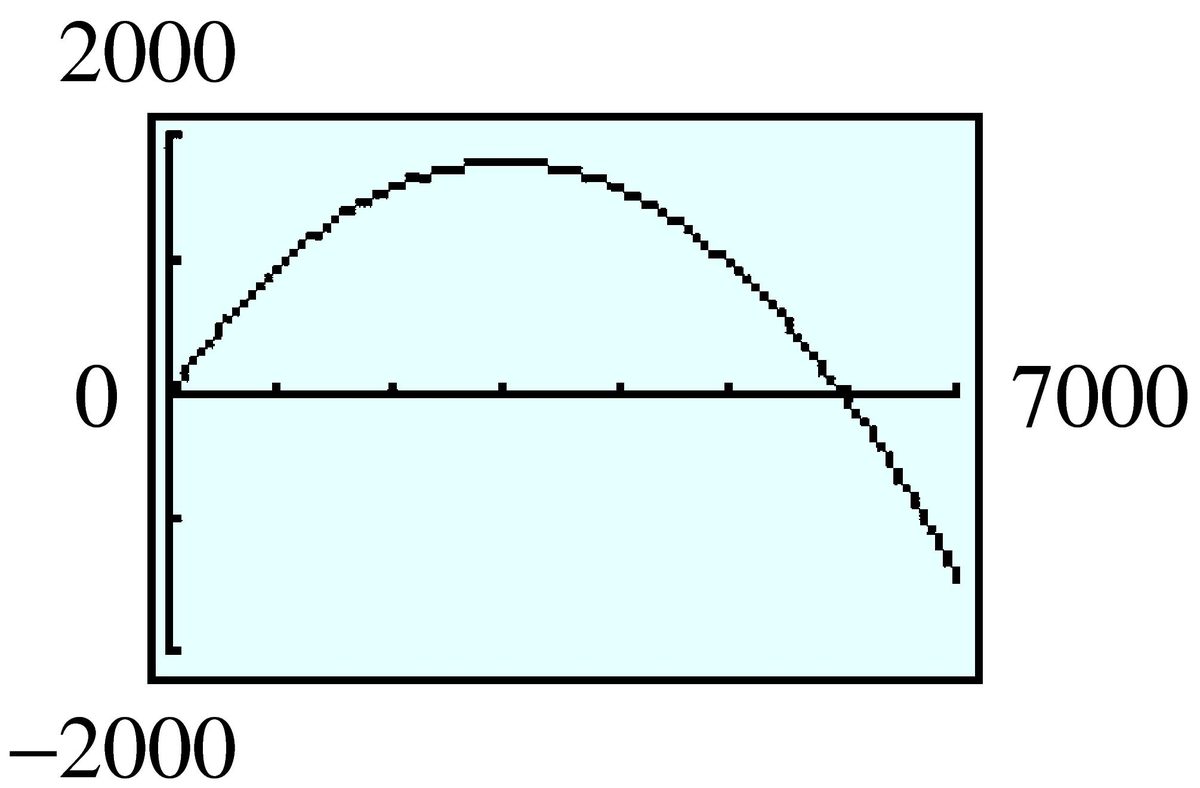
- No increase
- ;
Commercial fishermen rely on a steady supply of fish in their area. To avoid overfishing, they adjust their harvest to the size of the population. The function
gives the annual rate of growth, in tons per year, of a fish population of biomass tons.
- Make a table of values for for . Use increments of in .
- How much will a population of tons increase? A population of tons? A population of tons?
- Use your calculator to graph the annual increase, , versus the size of the population, , for .
- What do the -intercepts tell us about the fish population?
- Estimate the population size that results in the largest annual increase. What is that increase?
For Problems 51-62, use a substitution to solve the equation.
,
,
,
,
,
The sail in the figure is a right triangle of base and height . It has a colored stripe along the hypotenuse and a white triangle of base and height in the lower corner.
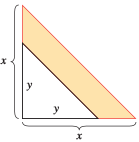
- Write an expression for the area of the colored stripe.
- Express the area of the stripe in factored form.
- If the sail is feet high and the white strip is feet high, use your answer to (b) to calculate mentally the area of the stripe.
- sq ft
An hors d'oeuvres tray has radius , and the dip container has radius , as shown in the figure.
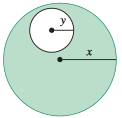
- Write an expression for the area for the chips (shaded region).
- Express the area in factored form.
- If the tray has radius inches and the space for the dip has radius inches, use your answer to part (b) to calculate mentally the area for chips. (Express your answer as a multiple of .)
Modeling, Functions, and Graphs by Katherine Yoshiwara (yoshiwarabooks.org), GNU Free Documentation License 1.2 or later. Adapted for the XYZ HTML edition with the authors' permission (recorded 2026-07-04). License: GFDL-1.2-or-later.