
6.2 Solving Quadratic Equations
Not every quadratic equation can be solved by factoring or by extraction of roots. For example, the expression cannot be factored, so the equation cannot be solved by factoring. For other equations, factoring may be difficult. In this section we learn two methods that can be used to solve any quadratic equation.
Squares of Binomials
In Nonlinear Models we used extraction of roots to solve equations of the form
where the left side of the equation includes the square of a binomial, or a perfect square. We can write any quadratic equation in this form by completing the square.
Consider the following squares of binomials.
| Square of binomial | |||
|---|---|---|---|
| 1. | |||
| 2. | |||
| 3. |
In each case, the square of the binomial is a quadratic trinomial,
Note that the coefficient of the linear term, , is twice the constant in the binomial, and the constant term of the trinomial, , is its square.
What is the linear term of ?
_____
What is the linear term of ?
We would like to reverse the process and write a quadratic expression as the square of a binomial. For example, what constant term can we add to
to produce a perfect square trinomial? Compare the expression to the formula above:
We see that
and
We substitute these values for and into the equation to find
Notice that in the resulting trinomial, the constant term is equal to the square of one-half the coefficient of . In other words, we can find the constant term by taking one-half the coefficient of and then squaring the result. Adding a constant term obtained in this way is called completing the square.
Complete the square by adding an appropriate constant; write the result as the square of a binomial.
- __________
- __________
For part (a): _____, ______
For part (b): _____, ______
Complete the square by adding an appropriate constant; write the result as the square of a binomial.
Solving Quadratic Equations by Completing the Square
Now we will use completing the square to solve quadratic equations. First, we will solve equations in which the coefficient of the squared term is 1. Consider the equation
and follow the steps to find the solutions.
Step 1
Begin by moving the constant term to the other side of the equation, to get
Step 2
Now complete the square on the left. Because
we add to both sides of our equation to get
Step 3
The left side of the equation is now the square of a binomial, namely . We write the left side in its square form and simplify the right side, which gives us
(You can check that this equation is equivalent to the original one; if you expand the left side and collect like terms, you will return to the original equation.)
Step 4
We can now use extraction of roots to find the solutions. Taking square roots of both sides, we get
The solutions are and .
We can also solve by factoring instead of completing the square. Of course, we get the same solutions by either method. In Example, we will solve an equation that cannot be solved by factoring.
What should we add to to create a perfect square?
_____
What should we add to to create a perfect square?
- Follow the steps to solve by completing the square: .
- Write the equation with the constant on the right.
__________ - Complete the square on the left:
_____, _____
Add to both sides.
__________ - Write the left side as a perfect square; simplify the right side.
__________ - Solve by extracting roots.
Solutions: _____
List all the values that are solutions. Use a comma to separate different solutions.
- Write the equation with the constant on the right.
- Find approximations to two decimal places for the solutions.
Solutions: _____
List all the values that are solutions. Use a comma to separate different solutions. - Graph the parabola in the window
- or
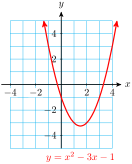
- Follow the steps to solve by completing the square: .
- Write the equation with the constant on the right.
- Complete the square on the left:
Add to both sides. - Write the left side as a perfect square; simplify the right side.
- Solve by extracting roots.
- Find approximations to two decimal places for the solutions.
- Graph the parabola in the window
- or
Explain how to tell whether is the square of a binomial.
_____
Explain how to tell whether is the square of a binomial.
The General Case
Our method for completing the square works only if the coefficient of is . If we want to solve a quadratic equation whose lead coefficient is not , we first divide each term of the equation by the lead coefficient.
What is the first step in solving ?
_____
Divide both sides by 3
What is the first step in solving ?
- Divide by 2.
- Get zero on one side.
- Divide both sides by 3.
- Factor the left side.
- Follow the steps to solve by completing the square:
.
- Divide each term by . Write the equation with the constant on the right.
__________ - Complete the square on the left:
_____, _____
Add to both sides.
__________ - Write the left side as a perfect square; simplify the right side.
__________ - Solve by extracting roots.
Solutions: _____
List all the values that are solutions. Use a comma to separate different solutions.
- Divide each term by . Write the equation with the constant on the right.
- Graph in the window
,
- Follow the steps to solve by completing the square:
.
- Divide each term by . Write the equation with the constant on the right.
- Complete the square on the left:
Add to both sides. - Write the left side as a perfect square; simplify the right side.
- Solve by extracting roots.
- Graph in the window
,
Here is a summary of the steps for solving quadratic equations by completing the square.
How does creating the square of a binomial help us solve a quadratic equation?
_____
How does creating the square of a binomial help us solve a quadratic equation?
Quadratic Formula
Instead of completing the square every time we solve a new quadratic equation, we can complete the square on the general quadratic equation,
and obtain a formula for the solutions of any quadratic equation.
Does ? Why or why not?
_____
No, .
Does ? Why or why not?
- No, it should be .
- Yes, we take the square root of each term.
- No, we cannot take the square root of a negative number.
- No, .
This formula expresses the solutions of a quadratic equation in terms of its coefficients. (The proof of the formula is considered in the Homework problems.) The symbol , read "plus or minus," is used to combine the two equations
into a single equation.
To solve a quadratic equation using the quadratic formula, all we have to do is substitute the coefficients , , and into the formula.
Use the quadratic formula to solve .
Solutions: _____
List all the values that are solutions. Use a comma to separate different solutions.
Use the quadratic formula to solve .
Note that the solutions to this equation are the same as the solutions we found in Practice 2.
Note that the solutions to this equation are the same as the solutions we found in Practice 2.
How can you decide which of the four methods for solving a quadratic equation you should use?
_____
How can you decide which of the four methods for solving a quadratic equation you should use?
Applications
We have now seen four different algebraic methods for solving quadratic equations:
- Factoring
- Extraction of roots
- Completing the square
- Quadratic formula
Factoring and extraction of roots are relatively fast and simple, but they do not work on all quadratic equations. The quadratic formula will work on any quadratic equation.
What is wrong with this statement of the quadratic formula?
_____
should be over .
What is wrong with this statement of the quadratic formula?
- Nothing.
- We should simplify the radical.
- should be over .
- It should be .
In Height of a Baseball, we considered the height of a baseball, given by the equation
Find two times when the ball is at a height of feet. Give your answers to two decimal places.
Answer: _____ sec
List all the times that are solutions. Use a comma to separate different times.
sec, sec
In Height of a Baseball, we considered the height of a baseball, given by the equation
Find two times when the ball is at a height of feet. Give your answers to two decimal places.
sec, sec
Sometimes it is useful to solve a quadratic equation for one variable in terms of the others.
Solve for in terms of .
Solutions: _____
Use a comma to separate different solutions.
Solve for in terms of .
Explain in words how to evaluate the quadratic formula.
_____
Explain in words how to evaluate the quadratic formula.
Section Summary
Vocabulary
Look up the definitions of new terms in the Glossary.
- Quadratic trinomial
- Complete the square
- Quadratic formula
CONCEPTS
- The square of the binomial is a quadratic trinomial,
- We have four methods for solving quadratic equations: extracting of roots, factoring, completing the square, and using the quadratic formula. The first two methods are faster, but they don't work on all equations. The last two methods work on any quadratic equation.
STUDY QUESTIONS
- Name four algebraic methods for solving a quadratic equation.
- Give an example of a quadratic trinomial that is the square of a binomial.
- What number must be added to to make it the square of a binomial?
- After completing the square, how do we finish solving the quadratic equation?
- What is the first step in solving the equation by completing the square?
SKILLS
Practice each skill in the Homework problems listed.
- Solve quadratic equations by completing the square: #3–24
- Solve quadratic equations by using the quadratic formula: #27–36
- Solve problems by writing and solving quadratic equations: #37–44
- Solve formulas: #45–64
Homework 6.2
For Problems 1–2, complete the square and write the result as the square of a binomial.
For Problems 3-18, solve by completing the square.
,
,
,
,
For Problems 19-24, solve by completing the square. Your answers will involve , , or .
- Write an expression for the area of the square in the figure.
- Express the area as a polynomial.
- Divide the square into four pieces whose areas are given by the terms of your answer to part (b).
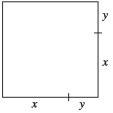
- , , ,

- Write an expression for the area of the shaded region in the figure.
- Express the area in factored form.
- By making one cut in the shaded region, rearrange the pieces into a rectangle whose area is given by your answer to part (b).
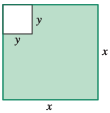
For Problems 23-36, solve using the quadratic formula. Round your answers to three decimal places.
,
,
,
,
,
A car traveling at miles per hour on a dry road surface requires approximately feet to stop, where is given by the function
- Make a table showing the stopping distance, , for speeds of , , , miles per hour. (Use the Table feature of your calculator.)
- Graph the function for in terms of . Use your table values to help you choose appropriate window settings.
- Write and solve an equation to answer the question: If a car must be able to stop in feet, what is the maximum safe speed it can travel? Verify your answer on your graph.
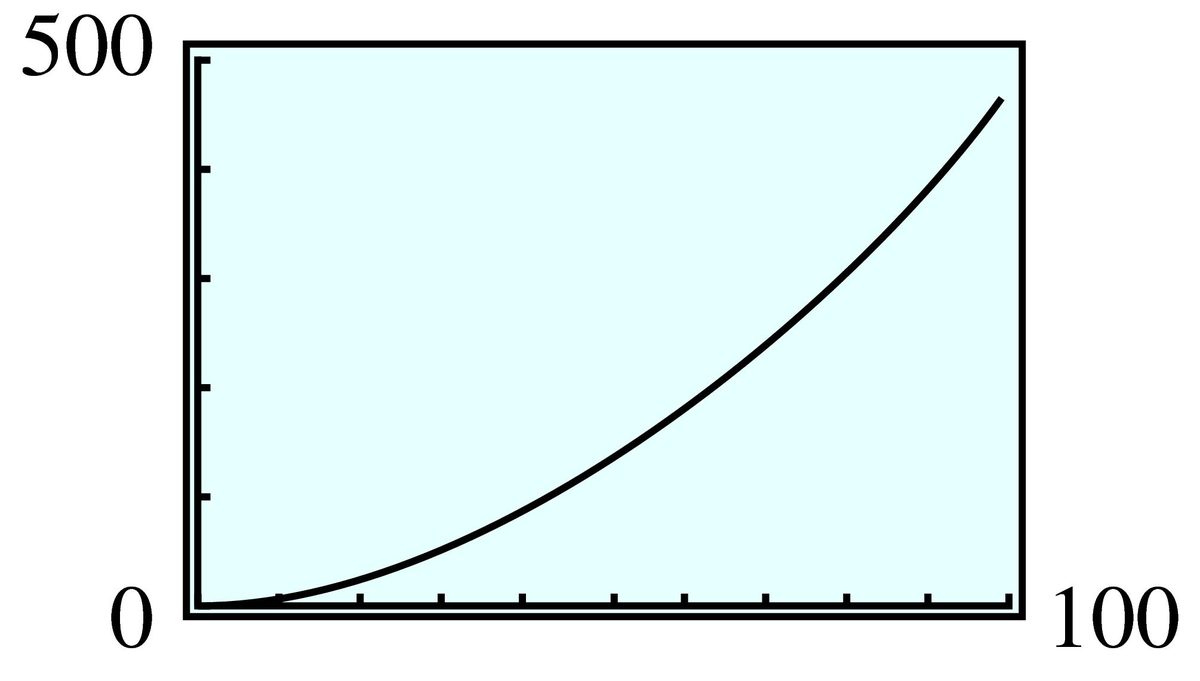
- ; mph
A car traveling at miles per hour on a wet road surface requires approximately feet to stop, where is given by the function
- Make a table showing the stopping distance, , for speeds of , , , miles per hour. (Use the Table feature of your calculator.)
- Graph the function for in terms of . Use your table values to help you choose appropriate window settings.
- Insurance investigators at the scene of an accident find skid marks feet long leading up to the point of impact. Write and solve an equation to discover how fast the car was traveling when it put on the brakes. Verify your answer on your graph.
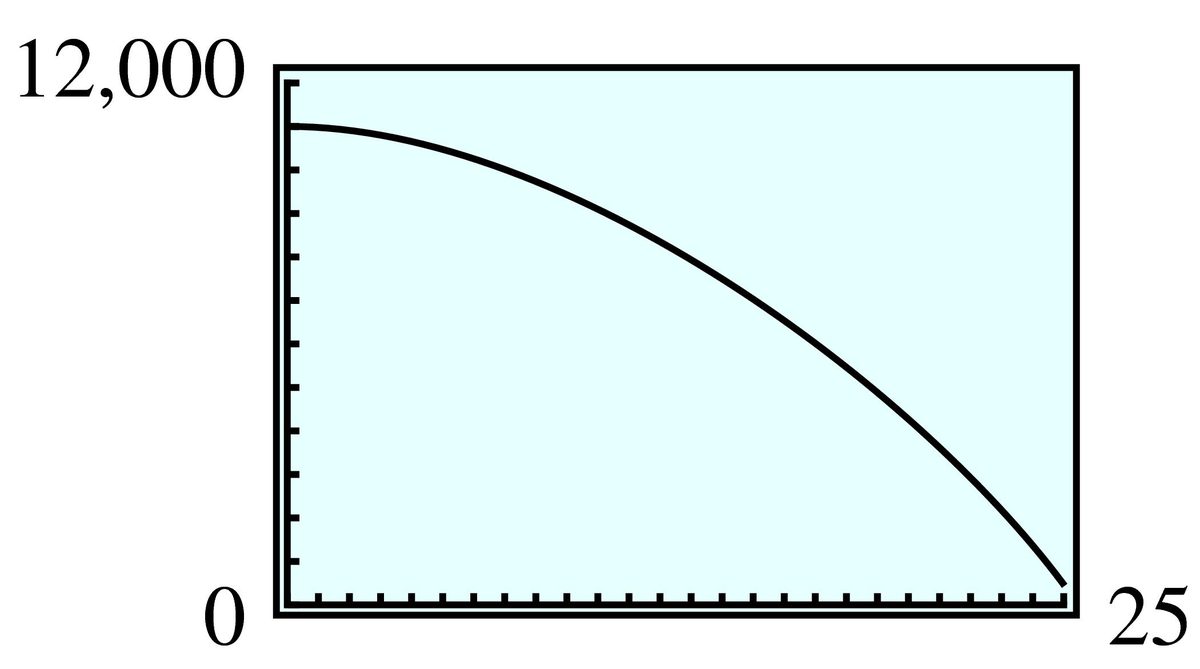
A skydiver jumps out of an airplane at feet. While she is in free-fall, her altitude in feet seconds after jumping is given by the function
- Make a table of values showing the skydiver's altitude at -second intervals after she jumps from the airplane. (Use the Table feature of your calculator.)
- Graph the function. Use your table of values to choose appropriate window settings.
- If the skydiver must open her parachute at an altitude of feet, how long can she free-fall? Write and solve an equation to find the answer.
- If the skydiver drops a marker just before she opens her parachute, how long will it take the marker to hit the ground? (Hint: The marker continues to fall according to the equation given above.)
- Find points on your graph that correspond to your answers to parts (c) and (d).
- ; sec
- sec
A high diver jumps from the -meter springboard. His height in meters above the water seconds after leaving the board is given by the function
- Make a table of values showing the diver's altitude at -second intervals after he jumps from the airplane. (Use the Table feature of your calculator.)
- Graph the function. Use your table of values to choose appropriate window settings.
- How long is it before the diver passes the board on the way down?
- How long is it before the diver hits the water?
- Find points on your graph that correspond to your answers to parts (c) and (d).
A dog trainer has meters of chain link fence. She wants to enclose square meters in three pens of equal size, as shown in the figure.

- Let and represent the length and width, respectively, of the entire area. Write an equation about the amount of chain link fence.
- Solve your equation for in terms .
- Write and solve an equation in for the total area enclosed.
- Find the dimensions of each pen.
- ; ,
- m by m, or m by m
An architect is planning to include a rectangular window topped by a semicircle in his plans for a new house, as shown in the figure. In order to admit enough light, the window should have an area of square feet. The architect wants the rectangular portion of the window to be feet wider than it is tall.

- Let stand for the horizontal width of the window. Write expressions for the height of the rectangular portion and for the radius of the semicircular portion.
- Write an expression for the total area of the window.
- Write and solve an equation to find the width and overall height of the window.
When you look down from a height, say a tall building or a mountain peak, your line of sight is tangent to the Earth at the horizon, as shown in the figure.
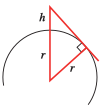
- Suppose you are standing on top of the Petronas Tower in Kuala Lumpur, feet high. How far can you see on a clear day? (You will need to use the Pythagorean theorem and the fact that the radius of the Earth is miles. Do not forget to convert the height of the Petronas Tower to miles.)
- How tall a building should you stand on in order to see miles?
- mi
- mi
- If the radius of the Earth is kilometers, how far can you see from an airplane at an altitude of meters? (Hint: See Problem 43.)
- b. How high would the airplane have to be in order for you to see a distance of kilometers?
For Problems 45-52, use the quadratic formula to solve each equation for the indicated variable.
for
for
for
for
for
for
for
for
For Problems 53-60, solve for in terms of . Use whichever method of solution seems easiest.
For Problems 61-66, solve the formula for the indicated variable.
for
for
for
for
for
for
What is the sum of the two solutions of the quadratic equation ?
The two solutions are given by the quadratic formula.
What is the product of the two solutions of the quadratic equation ?
Do not try to multiply the two solutions given by the quadratic formula! Think about the factored form of the equation
In Problems 69 and 70, we prove the quadratic formula.
Complete the square to find the solutions of the equation . (Your answers will be expressions in and .)
Complete the square to find the solutions of the equation . (Your answers will be expressions in , , and .)
Modeling, Functions, and Graphs by Katherine Yoshiwara (yoshiwarabooks.org), GNU Free Documentation License 1.2 or later. Adapted for the XYZ HTML edition with the authors' permission (recorded 2026-07-04). License: GFDL-1.2-or-later.