
8.5 Linear Programming
The term linear programming was coined in the late 1940s. It describes a relatively young branch of mathematics, compared to subjects such as Euclidean geometry, where the major ideas were already well understood 23 centuries ago. (The Greek mathematician Euclid wrote what can be considered the first geometry textbook about 300 B.C.) Business managers routinely solve linear programming problems for purchasing and marketing strategy, so it is possible that linear programming affects your daily life as much as any other branch of mathematics.
The Objective Function and Constraints
TrailGear would like to maximize its profit from selling hiking boots. The company produces two kinds of hiking boots, a Weekender model, on which it makes $ profit per pair, and a Sierra model, on which it makes $ profit per pair. How many of each model should TrailGear produce each week in order to maximize its profit?
If we let represent the number of Weekender boots and the number of Sierra boots TrailGear produces, then the total weekly profit is given by
This expression for is called the objective function. The goal of a linear programming problem is to maximize or minimize such an objective function, subject to one or more constraints.
If TrailGear had infinite resources and an infinite market, there would be no limit to the profit it could earn by producing more and more hiking boots. However, every business has to consider many factors, including its supplies of labor and materials, overhead and shipping costs, and the size of the market for its product. To keep things simple, we will concentrate on just two of these factors.
Each pair of Weekender boots requires hours of labor to produce, and each pair of Sierra boots requires hours. TrailGear has available hours of labor per week. Thus, and must satisfy the inequality
In addition, suppose that TrailGear's suppliers can provide at most ounces of silicone gel each week, with each pair of Weekenders using ounces and each Sierra model using ounce. This means that
Of course, we will also require that and . These four inequalities are called the constraints of the problem.
Which of these could be an objective function?
_____
Which of these could be an objective function?
Feasible Solutions
We have formulated the original problem into an objective function
and a system of inequalities called the constraints.
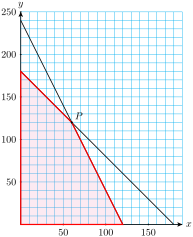
Our goal is to find values for and that satisfy the constraints and produce the maximum value for . We begin by graphing the solutions to the constraint inequalities. These solutions are shown in the shaded region in at right. The points in this region are called feasible solutions because they are the only values we can consider while looking for the maximum value of the objective function .
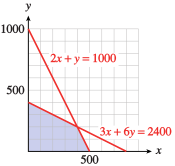
What is the set of feasible solutions?
_____
The set of points that satisfy the constraints is the set of feasible solutions.
What is the set of feasible solutions?
- The vertices of the solution set
- The values of the objective function
- The set of points that satisfy the constraints
- The boundary lines of the inequalities
- Determine which of the points , , , and represent feasible solutions for the TrailGear problem.
_____ Separate different ordered pairs with a comma. - Find the values of the objective function at the feasible solutions in part (a).
At _____
At _____
At _____
- , , and
- At , ; at , ; at ,
- Determine which of the points , , , and represent feasible solutions for the TrailGear problem.
- Find the values of the objective function at the feasible solutions in part (a).
- , , and
- At , ; at , ; at ,
Explain how to find the set of feasible solutions.
_____
Explain how to find the set of feasible solutions.
The Optimum Solutions
We cannot check all of the feasible solutions to see which one results in the largest profit. Fortunately, there is a simple way to find the optimal solution.
Consider the objective function,
Suppose TrailGear would like to make on hiking. It could produce pairs of Sierra boots, or pairs of Weekenders. Or it could produce some of each; for example, pairs of Weekenders and pairs of Sierra boots. In fact, every point on the line
represents a combination of Weekenders and Sierra boots that will yield a profit of $. This line is labeled in the figure below.
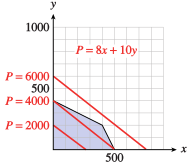
If TrailGear would like to make $ on boots, it should choose a point on the line labeled . Similarly, all the points on the line labeled will yield a profit of $, and so on. Different values of correspond to parallel lines on the graph. Smaller values of correspond to lines near the origin, and larger values of have lines farther from the origin.
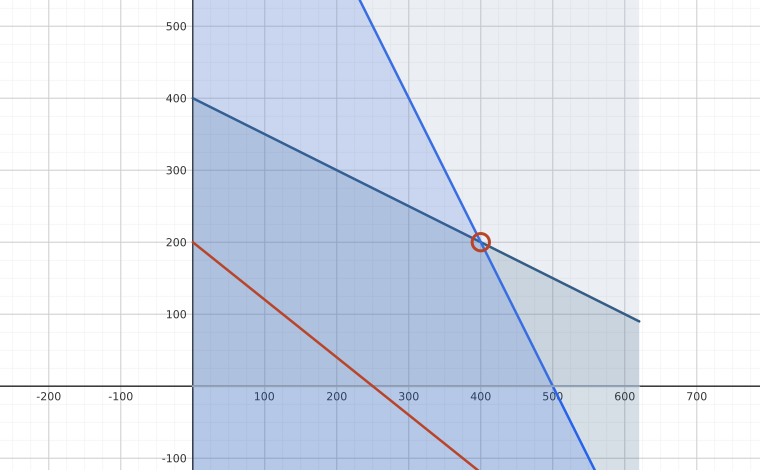
What is an optimal solution?
_____
The largest or smallest value of the objective function in the set of feasible solutions
What is an optimal solution?
- The largest or smallest feasible solution
- The largest or smallest value of the objective function in the set of feasible solutions
- The vertex farthest from the origin
- The largest or smallest constrained -value
- Returning to this section's opening Example regarding TrailGear profits for selling hiking boots, find all feasible solutions for which the objective function has a value of .
_____ - Find all feasible solutions that result in an objective value of .
_____
- None
- Returning to this section's opening Example regarding TrailGear profits for selling hiking boots, find all feasible solutions for which the objective function has a value of .
- Find all feasible solutions that result in an objective value of .
- None
We are only allowed to choose points from the set of feasible solutions. Imagine the parallel lines representing different values of the objective function sweeping across the graph of the feasible solutions. The objective values increase as the lines sweep up across the graph.
What is the last feasible solution the lines intersect before leaving the shaded region? If you study the preceding examples, perhaps you can see that the largest (and smallest) values of the objective function will occur at corner points of the set of feasible solutions. We have not proved this fact, but it is true.
Depending on the exact formula for the objective function, the maximum and minimum values may occur at any of the vertices of the shaded region.
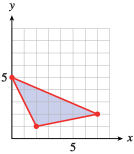
The figure above shows the feasible solutions for a linear programming problem. The objective function is .
- Sketch lines for objective values of , , , and .
- Evaluate the objective function at each vertex of the shaded region.
At _____
At _____
At _____ - Which vertex corresponds to the maximum value of the objective function? _____
What is the maximum value? _____ - Which vertex corresponds to the minimum value of the objective function? _____
What is the minimum value? _____
- A graph is below.
- At , ; at , ; at ,
- The maximum value of occurs at . The maximum value is .
- The minimum value of occurs at . The minimum value is .
Graph for part (a):
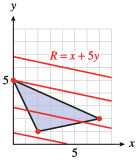
The figure below shows the feasible solutions for a linear programming problem. The objective function is .
- Sketch lines for objective values of , , , and .
- Evaluate the objective function at each vertex of the shaded region.
- Which vertex corresponds to the maximum value of the objective function? What is the maximum value?
- Which vertex corresponds to the minimum value of the objective function? What is the minimum value?
- At , ; at , ; at ,
- The maximum value of occurs at . The maximum value is .
- The minimum value of occurs at . The minimum value is .
We can now formulate a strategy for solving problems by linear programming.
Linear programming is used to
_____
find an optimal solution subject to a set of constraints.
Linear programming is used to
- find the vertices of a region.
- solve a system of inequalities.
- write a set of inequalities in two variables.
- find an optimal solution subject to a set of constraints.
In Example, the set of feasible solutions is an unbounded region.
Find the maximum value of the objective function, , subject to the constraints
Answer: _____
The maximum value is (which occurs at the vertex ).
Find the maximum value of the objective function, , subject to the constraints
The maximum value is (which occurs at the vertex ).
What fact helps us find the optimal solution?
_____
What fact helps us find the optimal solution?
Section Summary
Vocabulary
Look up the definitions of new terms in the Glossary.
- Objective function
- Constraint
- Feasible solution
- Optimal solution
CONCEPTS
- Linear programming is a technique for finding the maximum or minimum value of an objective function, subject to a system of constraints.
- The optimal solution occurs at one of the vertices of the set of feasible solutions.
STUDY QUESTIONS
- Explain the terms objective function, constraints, and feasible solution.
- Explain how to solve a linear programming problem by graphing.
- How can you find the vertices of the set of feasible solutions?
- Where do the maximum and minimum values of the objective function occur?
SKILLS
Practice each skill in the Homework problems listed.
- Find the maximum or minimum value for an objective function and a given set of feasible solutions: #1–12
- Solve a linear programming problem by graphing: #13–32
- Write the objective function and the constraints for a linear programming problem: #19–24
Homework 8.5
For Problems 1–4, find the minimum value of the cost function subject to following constraints:
The graph of the feasible solutions is shown in in the figure.
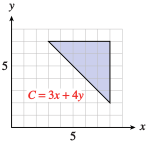
Use a graph to explain why it is impossible in this situation to have a cost as low as $.
Draw the graph of on the graph of the feasible solutions.
The graph of does not intersect the set of feasible solutions.
Use a graph to explain why the cost will not be as great as $.
Draw the graph of on the graph of the feasible solutions.
Use a graph to determine which vertex of the shaded region will correspond to the minimum cost. What is the minimum cost?
; $
Use a graph to determine which vertex of the shaded region will correspond to the maximum cost. What is the maximum cost?
For Problems 5–8, find the minimum value of the profit function subject to the following constraints:
The graph of the feasible solutions is shown in the figure.
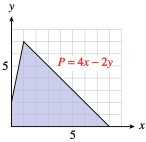
Graph the line that corresponds to a profit of . Find the coordinates of at least one feasible solution that gives a profit of $.
Graph the line that corresponds to a profit of $. Find the coordinates of at least one feasible solution that gives a profit of .
- Which line is farther from the origin, the line for a profit of $ or the line for the profit of $?
- Use a graph to determine which vertex corresponds to a maximum profit.
- Find the maximum profit.
- $
- $
- Use a graph to determine which vertex corresponds to a minimum profit.
- Find the minimum profit.
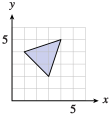
For Problems 9–12, objective functions and the graphs of the feasible solutions are given.
- Use the graph to find the vertex that yields the minimum value of the objective function, and find the minimum value.
- Use the graph to find the vertex that yields the maximum value of the objective function, and find the maximum value.
- ;
- ;
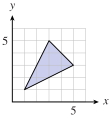
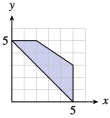
- ;
- ;
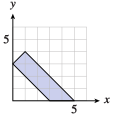
For Problems 13–18,
- Graph the set of feasible solutions.
- Find the vertex that gives the minimum of the objective function, and find the minimum value.
- Find the vertex that gives the maximum of the objective function, and find the maximum value.
Objective function with constraints
b. ; c. ;
Objective function with constraints
Objective function with constraints
b. ; c. ;
Objective function with constraints
Objective function with constraints
b. ; c. ;
Objective function with constraints
For Problems 19–26, solve each linear programming problem by graphing.
- Write a formula for the objective function.
- Write a system of inequalities for the constraints.
- Graph the set of feasible solutions.
- Find the optimum solution.
The math club is selling tickets for a show by a mathemagician. Student tickets will cost $ and faculty tickets will cost $. The ticket receipts must be at least to cover the fee for the performer. An alumna promises to donate one calculator for each student ticket sold and three calculators for each faculty ticket sold. What is the minimum number of calculators that the alumna will donate?
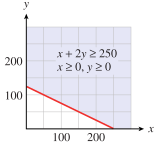
The math department is having a book sale of unwanted textbooks to raise funds for $ in scholarships. Paperback textbooks will be sold for $ and the hardcover textbooks will be sold for $. If paperback texts weigh pounds each and hardcover books weigh pounds each, find the minimum weight of textbooks the department must sell in order to raise its required funds.
Jeannette has acres of farmland for growing wheat or soy. Each acre of wheat requires two hours of labor at harvest time, and each acre of soy needs one hour of labor. Jeannette will have hours of labor available at harvest time. Find the maximum profit Jeannette can make from her two crops if she can get a profit of $ per acre for wheat and $ per acre for soy.
- , , ,
- $
Vassilis has at most $ to invest in two banks. Alpha Bank will pay annual interest and Bank Beta pays annual interest. Alpha Bank will only insure up to $, so Vassilis will invest no more than that with Alpha. What is the maximum amount of interest Vassilis can earn in year?
Gary's pancake recipe includes corn meal and whole wheat flour. Corn meal has grams of linoleic acid and milligrams of niacin per cup. Whole wheat flour has gram of linoleic acid and milligrams of niacin per cup. These two dry ingredients do not exceed cups total. They combine for at least grams of linoleic acid and at least milligrams of niacin. Minimize the number of calories possible in the recipe if corn meal has calories per cup and whole wheat flour has calories per cup.
- , , ,
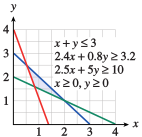
- cal
Cho requires hour of cutting and hours of sewing to make a Batman costume. He requires hours of cutting and hour of sewing to make a Wonder Woman costume. At most hours per day are available for cutting and at most hours per day are available for sewing. At least one costume must be made each day to stay in business. Find Cho's maximum income from selling one day's costumes if a Batman costume costs $ and a Wonder Woman costume costs $.
For Problems 25–30, use a graphing calculator to find approximate values for the maximum and minimum of the objective function.
Objective function with constraints
Maximum ; minimum
Objective function with constraints
Objective function with constraints
Maximum ; minimum
Objective function with constraints
Objective function with constraints
Maximum ; minimum
Objective function with constraints
Modeling, Functions, and Graphs by Katherine Yoshiwara (yoshiwarabooks.org), GNU Free Documentation License 1.2 or later. Adapted for the XYZ HTML edition with the authors' permission (recorded 2026-07-04). License: GFDL-1.2-or-later.