
8.6 Chapter Summary and Review
Key Concepts
- We can solve a linear system by graphing. The solution is the intersection point of the two graphs.
- A linear system may be inconsistent (has no solution), dependent (has infinitely many solutions), or consistent and independent (has one solution).
- We can use a system of equations to solve problems involving two unknown quantities.
- In economics, the price at which the supply and demand are equal is called the equilibrium price.
- The solution to a linear system is an ordered triple.
- A system in triangular form can be solved by back-substitution.
- Gaussian reduction is a generalized form of the elimination method that can be used to reduce a linear system to triangular form.
- linear systems may be inconsistent or dependent.
- We can use a matrix to represent a system of linear equations. Each row of the matrix consists of the coefficients in one of the equations of the system.
- We operate on a matrix by using the elementary row operations.
- We can solve a linear system by matrix reduction.
- To reduce larger matrices, we start with the first row and work our way along the diagonal, using row operations to obtain nonzero entries on the diagonal and zeros below the diagonal entry.
- The solutions of a linear inequality in two variables consist of a half-plane on one side of the line. The line itself is not included if the inequality is strict.
- Once we have graphed the boundary line, we can decide which half-plane to shade by using a test point.
- The solutions to a system of inequalities include all points that are solutions to each inequality in the system. The graph of the system is the intersection of the shaded regions for each inequality in the system
- To describe the solutions of a system of inequalities, it is useful to locate the vertices, or corner points, of the boundary.
- Linear programming is a technique for finding the maximum or minimum value of an objective function, subject to a system of constraints.
- The optimum solution occurs at one of the vertices of the set of feasible solutions.
Chapter 8 Review Problems
For Problems 1–2, solve the system by graphing. Use the ZDecimal window.
For Problems 3–6, solve the system using substitution or elimination.
For Problems 7–10, decide whether the system is inconsistent, dependent, or consistent and independent.
Consistent and independent
Dependent
For Problems 11–16, solve the system using Gaussian reduction.
For Problems 17–22, use matrix reduction to solve the system.
For Problems 23–26, solve the system by finding the reduced row echelon form of the augmented matrix.
For Problems 27–32, solve the problem by writing and solving a system of linear equations in two or three variables.
A math contest exam has 40 questions. A contestant scores points for each correct answer but loses points for each wrong answer. Lupe answered all the questions and her score was . How many questions did she answer correctly?
A game show contestant wins $ for each correct answer he gives but loses $ for each incorrect response. Roger answered questions and won $. How many answers did he get right?
Barbara wants to earn $ a year by investing $ in two accounts, a savings plan that pays annual interest and a high-risk option that pays interest. How much should she invest in each account?
$ at , $ at
An investment broker promises his client a return on her funds. If the broker invests $ in bonds paying interest, how much must he invest in stocks paying interest to keep his promise?
The perimeter of a triangle is centimeters. The length of one side is centimeters shorter than the second side, and the third side is centimeter longer than the second side. Find the length of each side.
cm, cm, cm
A company ships its product to three cities: Boston, Chicago, and Los Angeles. The cost of shipping is $ per crate to Boston, $ per crate to Chicago, and $ per crate to Los Angeles. The company's shipping budget for April is $. It has crates to ship, and demand for its product is twice as high in Boston as in Los Angeles. How many crates should the company ship to each destination?
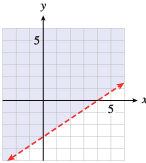
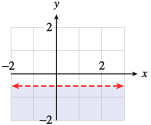
For Problems 33–36, graph the inequality.
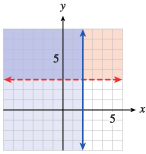
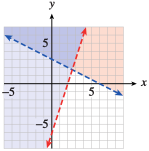
For Problems 37–40, graph the solutions to the system of inequalities.
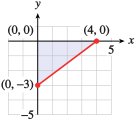
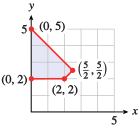
For Problems 41–44,
- Graph the solutions to the system of inequalities.
- Find the coordinates of the vertices.
Ruth wants to provide cookies for the customers at her bookstore. It takes minutes to mix the ingredients for each batch of peanut butter cookies and minutes to bake them. Each batch of granola cookies takes minutes to mix and minutes to bake. Ruth does not want to use the oven more than hours a day or to spend more than hours a day mixing ingredients. Write a system of inequalities for the number of batches of peanut butter cookies and of granola cookies that Ruth can make in one day and graph the solutions.
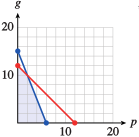
A vegetarian recipe calls for no more than ounces of a combination of tofu and tempeh. Tofu provides grams of protein per ounce and tempeh provides grams of protein per ounce. Graham would like the dish to provide at least grams of protein. Write a system of inequalities for the amount of tofu and the amount of tempeh for the recipe and graph the solutions.
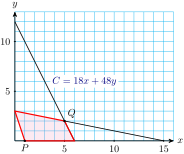
For Problems 47–48,
- Graph the set of feasible solutions.
- Find the vertex that gives the minimum of the objective function, and find the minimum value.
- Find the vertex that gives the maximum of the objective function, and find the maximum value.
Objective function with constraints
- ;
- ;
Objective function with constraints
Ruth wants to provide cookies for the customers at her bookstore. It takes minutes to mix the ingredients for each batch of peanut butter cookies and minutes to bake them. Each batch of granola cookies takes minutes to mix and minutes to bake. Ruth does not want to use the oven more than hours a day or to spend more than hours a day mixing ingredients.
- Write a system of inequalities for the number of batches of peanut butter cookies and granola cookies Ruth can make in one day and graph the solutions.
- Ruth decides to sell the cookies. If she charges ¢ per peanut butter cookie and ¢ per granola cookie, she will sell all the cookies she bakes. Each batch contains cookies. How many batches of each type of cookie should she bake to maximize her income? What is the maximum income?
- , , ,
- batches peanut butter cookies; batches of granola cookies; for $
A vegetarian recipe calls for ounces of a combination of tofu and tempeh. Tofu provides grams of protein per ounce and tempeh provides grams of protein per ounce. Graham would like the dish to provide at least grams of protein.
- Write a system of inequalities for the amount of tofu and the amount of tempeh for the recipe and graph the solutions.
- Suppose that tofu costs ¢ per ounce and tempeh costs ¢ per ounce. What is the least expensive combination of tofu and tempeh Graham can use for the recipe? How much will it cost?
Modeling, Functions, and Graphs by Katherine Yoshiwara (yoshiwarabooks.org), GNU Free Documentation License 1.2 or later. Adapted for the XYZ HTML edition with the authors' permission (recorded 2026-07-04). License: GFDL-1.2-or-later.