
5.3 The Natural Base
We have looked at logarithms with various bases, and in particular we studied the common or base 10 logarithms, which often appear in applications. There is another base for logarithms and exponential functions that is often used in applications. This base is an irrational number called , where
The number is essential for many advanced topics, and it is often called the natural base. It may seem strange to use an irrational number as the base for exponential functions, but just as the irrational number arises naturally in geometry, so does arise in calculus and its applications. At the end of this section we'll look at a specific case of how base occurs, and how its use is connected to the ideas and techniques of calculus.
The Natural Exponential Function
The natural exponential function is the function
Values for can be obtained with a calculator using the key ( 2nd LN on most calculators). For example, you can evaluate by pressing
2nd LN
to confirm the value of given above. (We'll explain why we use the 2nd LN key a little later.)
Try a few more calculations to become familiar with base .
Use your calculator to evaluate the following powers.
- _____
- _____
- _____
Use your calculator to evaluate the following powers. Round to four decimal places.
What about the graph of this new exponential function? Because is a number between and , the graph of lies between the graphs of and . Compare the tables of values and the graphs of the three functions below. For example, note that for , the value of is between and . You can verify the table and graphs on your calculator.
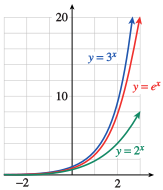
The value of is closest to
_____
7
- The value of is closest to which of these?
- The value of is closest to which of these?
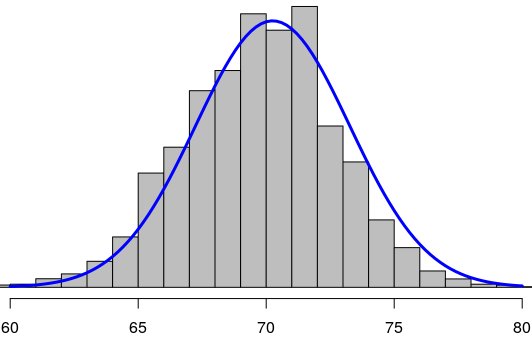
Variations on the natural exponential function occur in many disciplines. For example, the graph in the figure below is called a "bell curve." It is the graph of the normal distribution in statistics.
This next graph is an example of a logistic function, which models population growth with an upper bound.
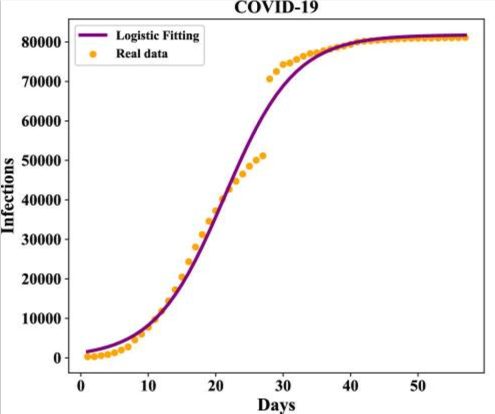
The logistic function shown above models the spread of Covid in China during the 2020 epidemic. It gives the number of infections , in thousands, reported days after January 21, 2020. The equation for this model is
According to the model, how many cases of Covid were reported on February 20 (day )?
58,194 cases
The Natural Logarithmic Function
Recall that each exponential function with base has an inverse function, the logarithmic function with the same base. For example, the function is the inverse of the function . It gives the exponent needed on 2 to give , so that, for instance, , because .
The base logarithm of a number , or , is called the natural logarithm of and is denoted by or . (Why “ln” and not “nl”? The natural logarithm is denoted by “ln” because it stands for “logarithmus naturalis,” which is the Latin for “natural logarithm.”) Here is its official definition.
The natural logarithm of is the exponent to which must be raised to produce . For example, the natural logarithm of , or , is the solution of the equation
You can verify on your calculator that
As is the case with exponential and log functions with other bases, the natural log function, , and the natural exponential function, , “undo” each other, so they are inverse functions. (This is why many calculators use 2nd LN to indicate .)
Use your calculator to evaluate each logarithm. Round your answers to four decimal places.
- _____
- _____
- _____
Use your calculator to evaluate each logarithm. Round your answers to four decimal places.
As usual, we can gain a better understanding of a new function by looking at its graph.
From the graph of you can make the following observations.
- The natural log function has only positive numbers as input values.
- The natural logs of negative numbers and zero are undefined.
- The natural log of a number greater than 1 is positive, while the logs of numbers between 0 and 1 are negative.
Properties of the Natural Logarithm
Natural logs obey the same conversion formulas that work for logs to other bases.
The conversion formulas are just another way of saying the the the natural log function, , and the natural exponential function, , are inverse functions.
In particular,
Which of the following is equivalent to ?
_____
Which of the following is equivalent to ?
We use natural logarithms in the same way that we use logs to other bases. The properties of logarithms that we studied in Properties of Logarithms also apply to logarithms base .
Because the functions and are inverse functions, the following properties are also true.
Simplify each expression. Use "sqrt(x)" to get .
- _____
- _____
Simplify each expression.
- or
Explain why .
_____
Explain why .
Solving Equations
We use the natural logarithm to solve exponential equations with base . The techniques we've learned for solving other exponential equations also apply to equations with base .
Solve each equation. Round your answers to four decimal places.
_____
_____
Solve each equation. Round your answers to four decimal places.
Why is the equation easier to solve than ?
_____
There is a button for log base on the calculator, but not a button for log base 8.
Which statement below explains why the equation is easier to solve than ?
- 8 is larger than 6.5.
- is a constant.
- There is a button for log base on the calculator, but not a button for log base 8.
- Because is an irrational number.
To solve more complicated exponential equations, we isolate the power on one side of the equation before converting to logarithmic form.
Solve
_____
Solve
Isolate the power, take the natural log of both sides, and solve as usual to find
Solve for .
_____
Solve for .
Delbert says that he will begin solving the equation by computing . Is this a good strategy? Why or why not?
_____
Delbert says that he will begin solving the equation by computing . Is this a good strategy? Why or why not?
Exponential Growth and Decay
In Exponential Growth and Decay, we considered functions of the form
which describe exponential growth when and exponential decay when . Exponential growth and decay can also be modeled by functions of the form
where we have substituted for the growth factor , so that
We can find the value of by solving the equation for , to get .
For instance, consider a colony of bacteria grows according to the formula
We can express this function in the form if we set
Thus, the growth law for the colony of bacteria can be written
By graphing both functions on your calculator, you can verify that
are just two ways of writing the same function.
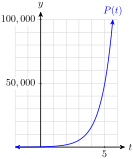
Sometimes exponential growth is given as a percentage, so for example we might say “prices rose by 5% annually.” In this case the growth factor is , where is the percentage rate in decimal form. For a percent decrease, .
From 1994 to 1998, the number of personal computers connected to the Internet grew according to the formula , where in 1994 and is in millions. (Source: Los Angeles Times, September 6, 1999)
- Evaluate _____. By what percent did the number of Internet users grow in one year?
About _____% - Express the growth law in the form .
_____
- ,
From 1994 to 1998, the number of personal computers connected to the Internet grew according to the formula
where in 1994 and is in millions. (Source: Los Angeles Times, September 6, 1999)
- Evaluate . By what percent did the number of Internet users grow in one year?
- Express the growth law in the form . (Hint: .)
- ,
Now, what about exponential decay, where the the decay factor is a number less than 1? If is negative, then is a number less than . For example, if ,
Thus, for negative values of , the function describes exponential decay.
The natural log of a fraction between 0 and 1 is
_____
negative.
The natural log of a number between 0 and 1 is
- positive.
- negative.
- undefined.
- between and .
A scientist isolates grams of krypton-91, which decays according to the formula
, where is in seconds.
- Complete the table of values showing the amount of krypton-91 left at -second intervals over the first minute.
_____ _____ _____ _____ _____ _____ _____ - Use the table to choose a suitable window and graph the function .
- Write and solve an equation to answer the question: How long does it take for 60% of the krypton-91 to decay?
_____
Answer: _____ seconds
If of the krypton-91 has decayed, of the original grams remains.
- A graph is below.
- ; seconds
Graph for part (b):
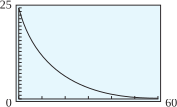
A scientist isolates grams of krypton-91, which decays according to the formula
, where is in seconds.
- Complete the table of values showing the amount of krypton-91 left at -second intervals over the first minute.
- Use the table to choose a suitable window and graph the function .
- Write and solve an equation to answer the question: How long does it take for 60% of the krypton-91 to decay?
Hint: If of the krypton-91 has decayed, of the original grams remains.
-
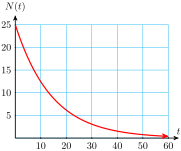
- ; seconds
Explain how to rewrite with the natural base.
_____
Explain how to rewrite with the natural base.
Continuous Compounding
In Section 2.1 we looked at a formula for savings accounts on which the interest is compounded times per year, and we saw that the amount on such an account increased when increased. But there is a limit or upper bound to the amount, no matter how large the value of . At this upper bound we say that the interest is compounded continuously, and the amount is given by the function
where is the principal invested and is the interest rate.
Zelda invested $1000 in an account that pays 4.5% interest compounded continuously. How long will it be before the account is worth $2000?
Answer: about _____ years.
About 15.4 years
Zelda invested $1000 in an account that pays 4.5% interest compounded continuously. How long will it be before the account is worth $2000?
About 15.4 years
Explain why solving exponential equations in base is no harder than solving exponential equations in base 10.
_____
Explain why solving exponential equations in base is no harder than solving exponential equations in base 10.
Section Summary
Vocabulary
Look up the definitions of new terms in the Glossary.
- Natural exponential function
- Natural logarithm
- Continuous compounding
CONCEPTS
- The natural base is an irrational number called , where
- The natural exponential function is the function . The natural log function is the function .
- We use the natural logarithm to solve exponential equations with base .
- Continuous compounding: The amount accumulated in an account after years at interest rate compounded continuously is given by where is the principal invested.
STUDY QUESTIONS
- State the value of to decimal places. Memorize this value.
- Explain why .
- State the formula for exponential growth using base .
- How is the formula for exponential decay in base different from the formula for exponential growth?
SKILLS
Practice each skill in the Homework problems listed.
- Graph exponential functions base : #1–4
- Simplify expressions: #5 and 6
- Solve exponential and log equations base : #7–10, 23–30
- Use the properties of logs and exponents with the natural base: #19–22, 37–40
- Use the natural exponential function in applications: #11–14, 47–58
- Convert between and : #15–18, 41–46
Homework 5.3
For Problems 1–4, use your calculator to complete the table for each function. Then choose a suitable window and graph the function.
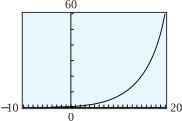
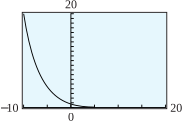
For Problems 5–6, simplify.
For Problems 7–10, solve for . Round your answers to two decimal places.
The number of bacteria in a culture grows according to the function
where is the number of bacteria present at time and is the time in hours.
- Write a growth law for a sample in which bacteria were present initially.
- Make a table of values for in -hour intervals over the first hours.
- Graph .
- How many bacteria were present at hours?
- How much time must elapse (to the nearest tenth of an hour) for the original bacteria to increase to ?
- hrs
Hope invests in a savings account that pays annual interest compounded continuously.
- Write a formula that gives the amount of money in Hope’s account after years.
- Make a table of values for in -year intervals over the first years.
- Graph .
- How much will Hope's account be worth after years?
- How long will it take for the account to grow to ?
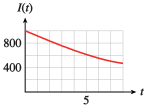
The intensity, (in lumens), of a light beam after passing through centimeters of a filter having an absorption coefficient of is given by the function
- Graph .
- What is the intensity (to the nearest tenth of a lumen) of a light beam that has passed through centimeter of the filter?
- How many centimeters (to the nearest tenth) of the filter will reduce the illumination to lumens?
- lumens
- cm
X-rays can be absorbed by a lead plate so that
where is the X-ray count at the source and is the X-ray count behind a lead plate of thickness inches.
- Graph .
- What percent of an X-ray beam will penetrate a lead plate inch thick?
- How thick should the lead plate be in order to screen out of the X-rays?
For problems 15–18, express each exponential function in the form . Is the function increasing or decreasing? What is its initial value?
; increasing; initial value
; decreasing; initial value
- Fill in the table, rounding your answers to four decimal places.
- Compute the ratio of each function value to the previous one. Explain the result.
- Each ratio is : Increasing -values by a constant corresponds to multiplying the -values of the exponential function by a constant factor of .
- Fill in the table, rounding your answers to four decimal places.
- Compute the ratio of each function value to the previous one. Explain the result.
- Fill in the table, rounding your answers to the nearest integer.
- Subtract each -value from the next one. Explain the result.
- Each difference in -values is approximately : Increasing -values by a constant corresponds to multiplying the -values of the exponential function by a constant factor of . That is, each function value is approximately equal to double the previous one.
- Fill in the table, rounding your answers to the nearest integer.
- Subtract each -value from the next one. Explain the result.
For Problems 23–30, solve. Round your answers to two decimal places.
For Problems 31–36, solve the equation for the specified variable.
for
for
for
for
for
for
- Fill in the table, rounding your answers to three decimal places.
- Subtract each natural logarithm in your table from the next one. (For example, compute .) Explain the result.
- Each difference in function values is approximately : Multiplying -values by a constant factor of corresponds to adding a constant value of ln (10) to the -values of the natural log function.
- Fill in the table, rounding your answers to three decimal places.
- Subtract each natural logarithm in your table from the next one. (For example, compute .) Explain the result.
- Fill in the table, rounding your answers to three decimal places.
- Divide each natural logarithm in your table by . Explain the result.
- Each quotient equals , where . Because , .
- Fill in the table, rounding your answers to three decimal places.
- Divide each natural logarithm in your table by . Explain the result.
For Problems 41–46,
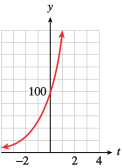
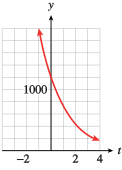
- Express each growth or decay law in the form .
- Check your answer by graphing both forms of the function on the same axes. Do they have the same graph?
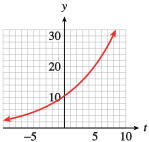
The population of Citrus Valley was in . In , it was .
- What is if in ?
- Use the population in to find the growth factor .
- Write a growth law of the form for the population of Citrus Valley.
- If it continues at the same rate of growth, what will the population be in ?
A copy of Time magazine cost $ in In , the cover price had increased to $.
- What is if in ?
- Use the price in to find the growth factor .
- Find a growth law of the form for the price of Time.
- In , a copy of Time cost $. Did the price of the magazine continue to grow at the same rate from to ?
Cobalt-60 is a radioactive isotope used in the treatment of cancer. A -milligram sample of cobalt-60 decays to milligrams after years.
- Using , find the decay factor for cobalt-60.
- Write a decay law for cobalt-60.
- How much of the original sample will be left after years?
- mg
Weed seeds can survive for a number of years in the soil. An experiment on cultivated land found million weed seeds per acre, and in the following years the experimenters prevented the seeds from coming to maturity and producing new weeds. Four years later, there were million seeds per acre. (Source: Burton, 1998)
- Find the annual decay factor for the number of weed seeds in the soil.
- Write an exponential formula with base for the number of weed seeds that survived after years.
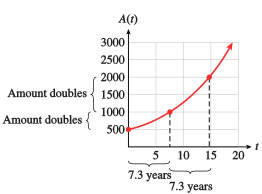
Problems 51–58 are about doubling time and half-life.
Delbert invests $ in an account that pays interest compounded continuously.
- Write a formula for that gives the amount of money in Delbert's account after years.
- How long will it take Delbert's investment to double to $?
- How long will it take Delbert's money to double again, to $?
- Graph and illustrate the doubling time on your graph.
- Choose any point on the graph, then find the point on the graph with vertical coordinate . Verify that the difference in the -coordinates of the two points is the doubling time.
- years
- years
d–e
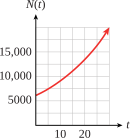
The growth of plant populations can be measured by the amount of pollen they produce. The pollen from a population of pine trees that lived more than years ago in Norfolk, England, was deposited in the layers of sediment in a lake basin and dated with radiocarbon techniques.
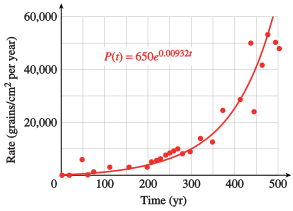
The figure shows the rate of pollen accumulation plotted against time, and the fitted curve . (Source: Burton, 1998)
- What was the annual rate of growth in pollen accumulation?
- Find the doubling time for the pollen accumulation, that is, the time it took for the accumulation rate to double.
- By what factor did the pollen accumulation rate increase over a period of years?
Technetium-99m (Tc-99m) is an artificially produced radionuclide used as a tracer for producing images of internal organs such as the heart, liver, and thyroid. A solution of Tc-99m with initial radioactivity of becquerels (Bq) decays according to the formula
where is in hours.
- How long will it take the radioactivity to fall to half its initial value, or Bq?
- How long will it take the radioactivity to be halved again?
- Graph and illustrate the half-life on your graph.
- Choose any point on the graph, then find the point on the graph with vertical coordinate . Verify that the difference in the -coordinates of the two points is the half-life.
- hours
- hours
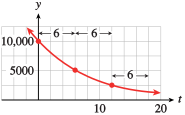
All living things contain a certain amount of the isotope carbon-14. When an organism dies, the carbon-14 decays according to the formula
where is measured in years. Scientists can estimate the age of an organic object by measuring the amount of carbon-14 remaining.
- When the Dead Sea scrolls were discovered in 1947, they had of their original carbon-14. How old were the Dead Sea scrolls then?
- What is the half-life of carbon-14, that is, how long does it take for half of an object's carbon-14 to decay?
The half-life of iodine-131 is approximately days.
- If a sample initially contains grams of iodine-131, how much will it contain after days? How much will it contain after days? After days?
- Use your answers to part (a) to sketch a graph of , the amount of iodine-131 remaining, versus time. (Choose an arbitrary height for on the vertical axis.)
- Calculate , and hence find a decay law of the form , where , for iodine-131.
- , ,
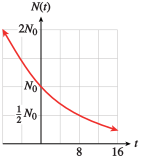
The half-life of hydrogen-3 is years.
- If a sample initially contains grams of hydrogen-3, how much will it contain after years? How much will it contain after years?
- Use your answers to part (a) to sketch a graph of , the amount of hydrogen-3 remaining, versus time. (Choose an arbitrary height for on the vertical axis.)
- Calculate , and hence find a decay law of the form , where , for hydrogen-3.
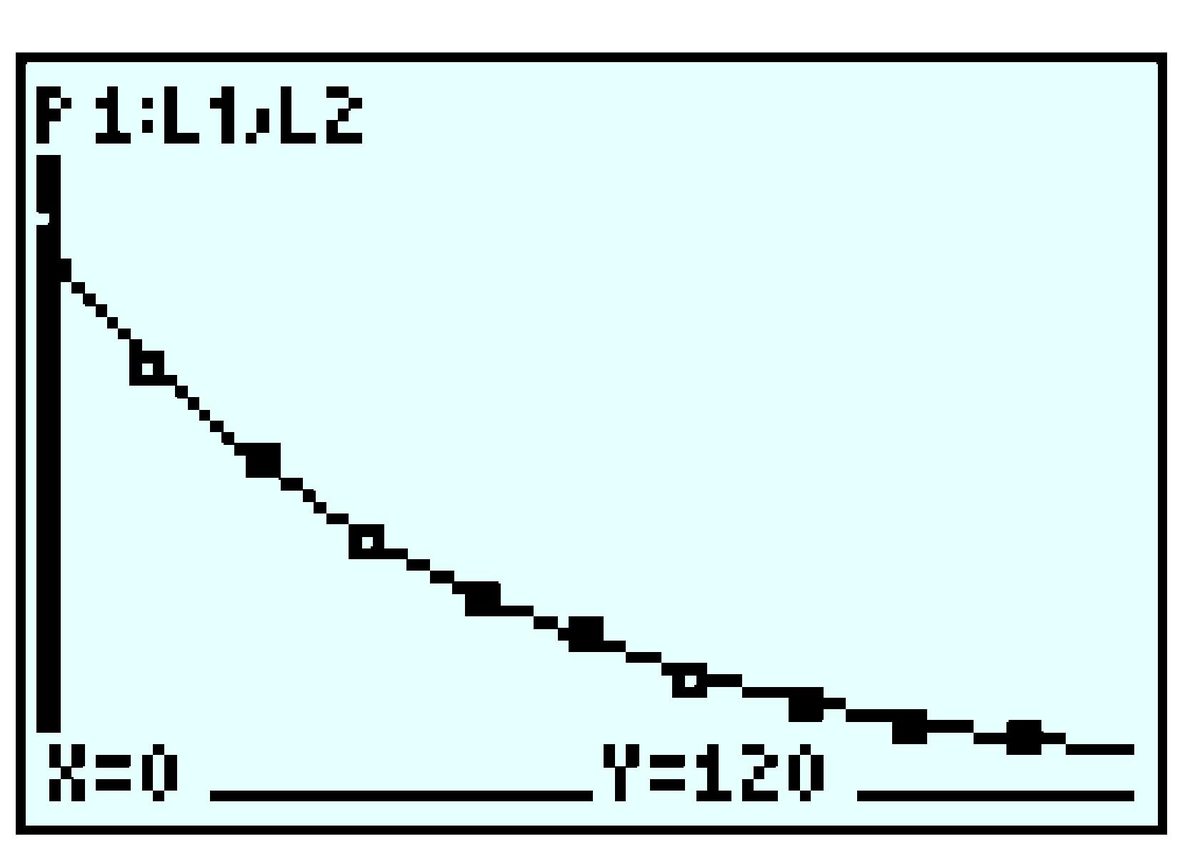
A Geiger counter measures the amount of radioactive material present in a substance. The table shows the count rate for a sample of iodine-128 as a function of time. (Source: Hunt and Sykes, 1984)
| Time (min) | ||||||||||
|---|---|---|---|---|---|---|---|---|---|---|
| Counts/sec |
- Graph the data and use your calculator's exponential regression feature to fit a curve to them.
- Write your equation in the form .
- Calculate the half-life of iodine-128.
- minutes
The table shows the count rate for sodium-24 registered by a Geiger counter as a function of time. (Source: Hunt and Sykes, 1984)
| Time (min) | ||||||||||
|---|---|---|---|---|---|---|---|---|---|---|
| Counts/sec |
- Graph the data and use your calculator's exponential regression feature to fit a curve to them.
- Write your equation in the form .
- Calculate the half-life of sodium-24.
Modeling, Functions, and Graphs by Katherine Yoshiwara (yoshiwarabooks.org), GNU Free Documentation License 1.2 or later. Adapted for the XYZ HTML edition with the authors' permission (recorded 2026-07-04). License: GFDL-1.2-or-later.