
5.2 Logarithmic Functions
Logarithms and Exponents
Before we look at logarithmic functions, let's quickly review exponents and logs. For a particular base, let's say 5, taking a logarithm is the opposite operation for raising to a power. For example, if we raise base 5 to a power of , we get
We can say that a logarithm is actually an exponent. Asking for the log base 5 of 25 is asking "what power of 5, or what exponent on base 5 will give me 25?"
For a more thorough review of logarithms you can refer to Section 4.3.1 .
Which of these could you use to estimate the value of ?
_____
step1
Which of these could you use to estimate the value of ?
- Find multiples of 5.
- Find the fifth root of 378.
- Find powers of 5.
- Divide 378 by 5.
Now we'll consider functions defined in terms of logarithms, or logarithmic functions. For example,
is a logarithmic function. In order to understand logarithmic functions better, we first investigate how they are related to more familiar functions, the exponential functions.
Inverse of the Exponential Function
Inverse functions are really a generalization of inverse operations. For example, raising to the th power and taking th roots are inverse operations. In fact, we use the following rule to define cube roots:
Compare this rule to the definition of inverse functions from Inverse Functions.
In this case, and , and the equations above tell us that the two functions and are inverse functions.
In Exponential Functions, we saw that a similar rule relates the operations of raising a base to a power and taking a base logarithm, because they are inverse operations.
We can now define the logarithmic function, , that takes the log base of its input values. The conversion formulas tell us that the log function, , is the inverse of the exponential function, .
Graphs of Logarithmic Functions
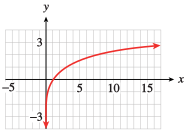
What does the graph of a log function look like? We can use exponential functions to help us.
We can obtain a table of values for by making a table for and then interchanging the columns, as shown in the tables below. You can see that the graphs of and , shown in the figure, are symmetric about the line .
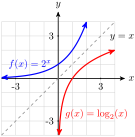
The same procedure works for graphing log functions with any base: If we want to find values for the function , we can find the values for the exponential function , and then interchange the and values in each ordered pair.
Make a table of values and graph the function .
| _____ | _____ | _____ | _____ | _____ |
A graph is below.
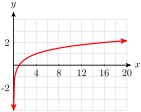
Complete the table of values and graph the function .
What is the -intercept of the graph of ?
_____
There is none: the graph of has no -intercept.
What is the -intercept of the graph of ?
- There is none.
You can also see that while an exponential growth function increases very rapidly for positive input values, its inverse, the logarithmic function, grows extremely slowly.
In addition, the logarithmic function has the following properties.
The domain of the function is
_____
The domain of the function is all positive numbers.
The domain of the function is
- all real numbers.
- all multiples of 3.
- all non-negative numbers.
- all positive numbers.
Why does the function grow so slowly?
_____
Why does the function grow so slowly?
Modeling with Logarithmic Functions
We can use the LOG key on a calculator to evaluate the function .
Which statement is true?
_____
We cannot take the log of a negative number.
Which statement is true?
- The log of a number is never negative.
- We cannot take the log of a negative number.
- The log of a fraction is called a common log.
- The log of 0 is 1.
The formula is used by X-ray technicians to calculate the doubling time of a malignant tumor. is the diameter of the tumor when first detected, is its diameter at the next reading, and is the time interval between readings, in days. Calculate the doubling time of the following tumor: its diameter when first detected was 1 cm, and 7 days later its diameter was 1.05 cm.
_____ days
33 days
The formula
is used by X-ray technicians to calculate the doubling time of a malignant tumor. is the diameter of the tumor when first detected, is its diameter at the next reading, and is the time interval between readings, in days.
Calculate the doubling time of the following tumor: its diameter when first detected was 1 cm, and 7 days later its diameter was 1.05 cm.
33 days
Logarithmic functions are useful for modeling increasing functions that slow down as the input increases.
In the previous Example, we see that although life expectancy has been increasing over time, it has been slowing down or leveling off. In fact, life expectancy in the US actually declined slightly from 78.94 in 2013 to 78.81 in 2018. (What factors may have contributed to this decline?) By 2024 it had rebounded to 79.25. It remains to be seen how well the model predicts life expectancy in the 21st century.
The CDC (Centers for Disease Control and Prevention) provides Growth Charts for the average height and weight of children from age 2 to 20. The average height of girl children is given in centimeters by
where is age in years.
- Graph the height function for .
- Use the height function to complete the table.
_____ _____ _____ _____ _____ - How much is a girl's height expected to increase between the ages of 5 and 10? _____ cm.
Between the ages of 15 and 20? _____ cm.
- A graph is below.
H0 H1 H2 H3 H4 - c1 cm, c2 cm
Graph for part (a):
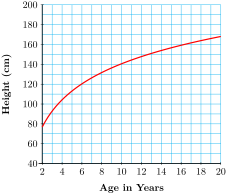
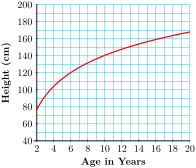
The CDC (Centers for Disease Control and Prevention) provides Growth Charts for the average height and weight of children from age 2 to 20. The average height of girl children is given in centimeters by
where is age in years.
- Graph the height function for .
- Use the height function to complete the table.
- How much is a girl's height expected to increase between the ages of 5 and 10? Between the ages of 15 and 20?
- 28 cm, 11 cm
Logarithmic Equations
A logarithmic equation is one in which the variable appears inside of a logarithm. For example,
is a log equation. To solve a log equation, we can use the conversion equations to rewrite the equation in exponential form.
Solve for the unknown value in each equation.
_____
_____
Solve for the unknown value in each equation.
Imagine the graph of . How far must you travel along the -axis until the -coordinate reaches a height of 5.25?
Answer: Until _____
Do not enter commas, that is, enter "10000" rather than "10,000".
Imagine the graph of . How far must you travel along the -axis until the -coordinate reaches a height of 5.25?
If an equation contains more than one log, we must first combine any expressions involving logs into a single logarithm.
Extraneous solutions can arise whenever we solve a logarithmic equation, especially if there is more than one apparent solution. Therefore, we should always check that a possible solution does not cause one of the logarithms to be undefined. Here are guidelines for solving a logarithmic equation.
Which of these is the first step in solving the equation ?
_____
Which of these is the first step in solving the equation ?
Solve .
_____ [Separate multiple solutions with commas when appropriate.]
Rewrite the left side as a single logarithm.
Rewrite the equation in exponential form.
Solve for .
Check for extraneous solutions.
Solve .
Follow the steps:
Rewrite the left side as a single logarithm.
Rewrite the equation in exponential form.
Solve for .
Check for extraneous solutions.
The solution is .
- We cannot take a logarithm of _____.
- After solving a logarithmic equation, we must check for _____.
- If an equation contains more than one log, we must first combine them into _____.
- If there is only one log involved, we write the equation in _____ form.
- a negative number or zero
- extraneous solutions
- a single logarithm
- exponential form
Fill in the blanks to complete each statement.
- We cannot take a logarithm of ______.
- After solving a logarithmic equation, we must check for ______.
- If an equation contains more than one log, we must first combine them into ______.
- If there is only one log involved, we rewrite the equation in ______ form.
What is an extraneous solution?
_____
What is an extraneous solution?
More About Inverse Functions
Let's take a closer look at the relationship between functions and their inverse functions. In Section 5.1 we saw that an inverse function "undoes" the effects of the function, and vice versa. In other words, if we apply a function and then its inverse to an input, we return to that input. For example, consider the function and its inverse function . We'll start with an input of , first apply the function , and then apply the function to the output. In function notation, that operation looks like this.
We start by applying the innermost function, namely , to get , and then apply , to get . We have returned to out original input.
In Example of Section 5.1 we found that the inverse of the function is
- Show that
- Show that
In each case, start by evaluating the innermost function.
These examples illustrate a general rule about inverse functions.
Because a logarithmic function is the inverse of the exponential function with the same base, each undoes the effect of the other. For example, the function is the inverse of . So, if we start with , apply , and then apply to the result, we return to the original number, 3.
And because and are inverse functions, we can write these operations in one expression as
We evaluate the expression starting with the inside function, , and then compute the log base 2 of the result. Applying the exponential function and then the log function with the same base returne us to the original input.
.
Because the log and the exponential are inverse functions, similar calculations hold for any value of and any base , so that .
Simplify each expression.
- _____
- _____, for
Simplify each expression.
- for
We can also apply the two functions in the opposite order. For example,
To see that this equation is true, we simplify the exponent first. We start with , and apply the log base function. Because , we have
Using function notation, the caluclation above looks ike this.
(Remember the order of operations: do what's inside of parentheses first, to get .) In other words, applying first the log function and then the exponential function returns the original input value.
Of course, a similar equation holds for any positive value of and any base :
Simplify each expression.
- _____
- _____
Simplify each expression.
We summarize these relationships as follows.
In Chapter 4 we solved exponential equations by using the conversion equations to rewrite them in logarithmic form. The fact that gives us another way to think of the solution; we can take the log of both sides of the equation. We'll use this method in the next Example. Recall from Inverse Function Notation in Section 5.1 that the inverse function for a function is often denoted by .
- Find the inverse function for .
_____ - Graph and in the window
- State the domain and range of and . Use "inf" for .
Domain of : _____; Range of : _____
Domain of : _____; Range of : _____
- A graph is below.
- Domain of : ; Range of : all real numbers; Domain of : all real numbers; Range of :
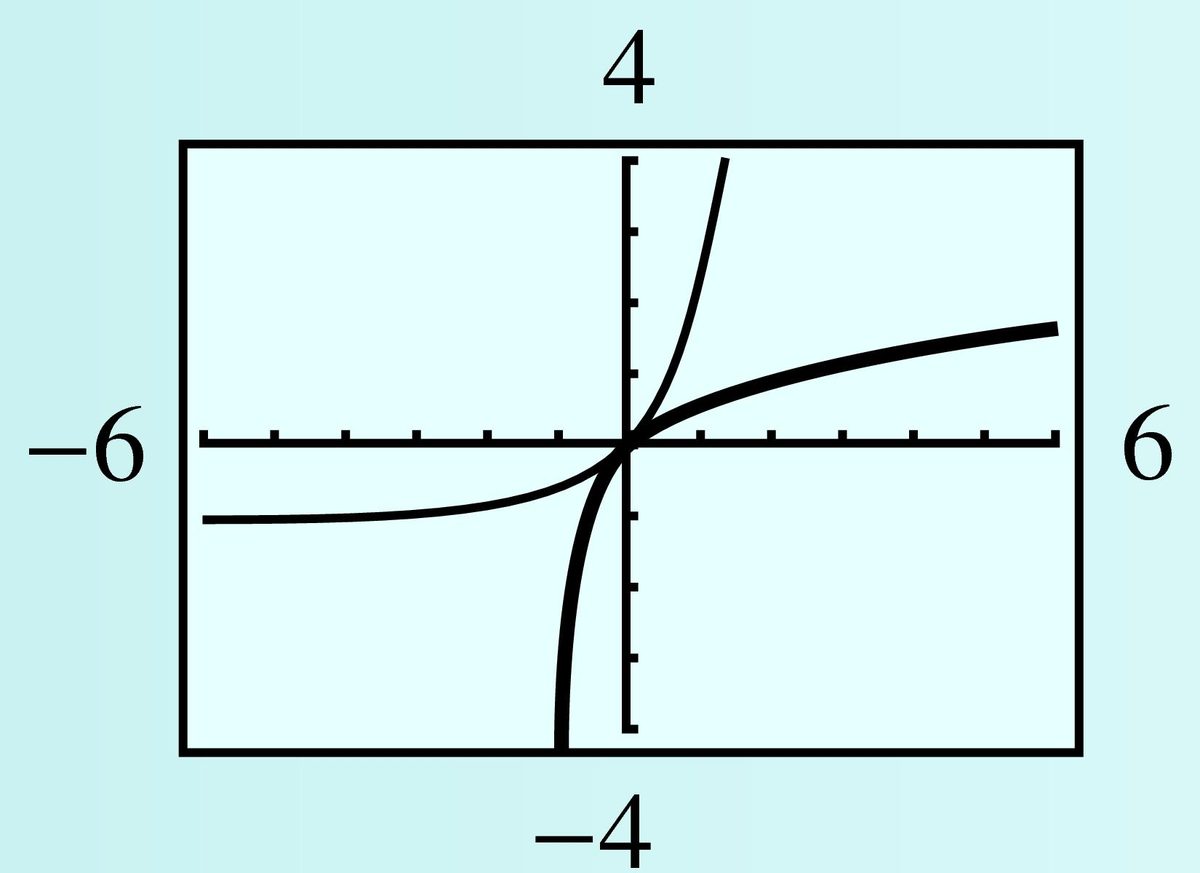
- Find the inverse function for .
- Graph and in the window
- State the domain and range of and .
- Domain of : ; Range of : all real numbers; Domain of : all real numbers; Range of :
Compare the graphs of and , and explain.
_____
Compare the graphs of and , and explain.
Section Summary
Vocabulary
Look up the definitions of new terms in the Glossary.
- Logarithmic function
- Logarithmic equation
- Extraneous solution
CONCEPTS
- We define the logarithmic function, , which takes the log base of its input values. The log function is the inverse of the exponential function .
- A logarithmic equation is one in which the variable appears inside of a logarithm. We can solve logarithmic equations by converting to exponential form.
STUDY QUESTIONS
- Can the output of the function be negative?
- Francine says that . Is she correct? Why or why not?
- Sketch a typical logarithmic function.
-
Simplify:
- Why is the following attempt to solve the equation incorrect?
SKILLS
Practice each skill in the Homework problems listed.
- Evaluate log functions: #1–16, 27 and 28
- Simplify expressions involving logs: #15 and 16, 19, and 20
- Graph logarithmic functions and transformations of log functions: #1–4, 25–28
- Find formulas for inverse functions: #17–24
- Solve logarithmic equations: #29–54
- Solve formulas involving logs: #55–60
Homework 5.2
In Problems 1–4,
- Make tables of values for each exponential function and its inverse logarithmic function.
- Graph both functions on the same set of axes.
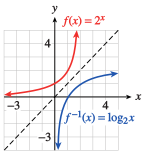
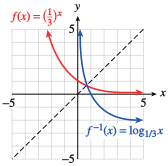
- How large must be before the graph of reaches a height of ?
- How large must be before the graph of reaches a height of ?
- How large must be before the graph of reaches a height of ?
- How large must be before the graph of reaches a height of ?
For what values of is ?
For what values of is ?
In Problems 9–14, . Evaluate.
- is undefined.
Let and .
- Compute .
- Compute .
- Explain why for any .
- Compute .
- Simplify .
- Definition of logarithm base
Let and .
- Compute .
- Compute .
- Explain why for any .
- Compute .
- Simplify .
- If , find .
- If , find .
- If , find .
- If , find .
For Problems 19–20, simplify.
- What is the domain of the function ?
- Find a formula for .
- What is the domain of the function ?
- Find a formula for .
- Find the inverse of the function .
- Show that undoes the effect of on .
- Show that undoes the effect of on .
- Find the inverse of the function .
- Show that undoes the effect of on .
- Show that undoes the effect of on .
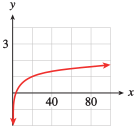
For Problems 25–26, match each graph to its equation.
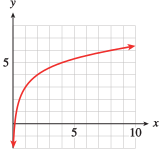
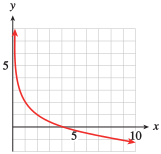
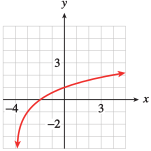
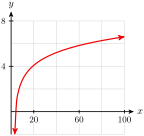
- IV
- I
- II
- III
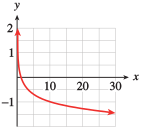
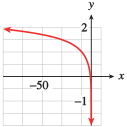
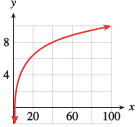
In a psychology experiment, volunteers were asked to memorize a list of nonsense words, then 24 hours later were tested to see how many of the words they recalled. On average, the subjects had forgotten of the words. The researchers found that the more lists their volunteers memorized, the larger the fraction of words they were unable to recall. (Source: Underwood, Scientific American, vol. 210, no. 3)
| Number of lists, | ||||||
|---|---|---|---|---|---|---|
| Percent forgotten, |
- Plot the data. What sort of function seems to fit the data points?
- Psychologists often describe rates of forgetting by logarithmic functions. Graph the function on the same graph with your data. Comment on the fit.
- What happens to the function as grows increasingly large? Does this behavior accurately reflect the situation being modeled?
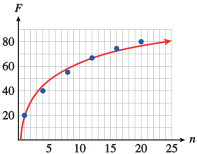
- The graph resembles a logarithmic function. The (translated) log function is close to the points but appears too steep at first and not steep enough after . Overall, it is a good fit.
- grows (more and more slowly) without bound. will eventually exceed per cent, but no one can forget more than of what is learned.
The water velocity at any point in a stream or river is related to the logarithm of the depth at that point. For the Hoback River near Bondurant, Wyoming,
where is the velocity of the water, in feet per second, and is the vertical distance from the stream bed, in feet, at that point. For Pole Creek near Pinedale, Wyoming,
Both streams are feet deep at the locations mentioned. (Source: Leopold, Luna, Wolman, and Gordon, 1992)
- Complete the table of values for each stream.
Distance from bed (feet) Velocity, Hoback
River, (ft/sec)Velocity, Pole Creek (ft/sec) - If you double the distance from the bed, by how much does the velocity increase in each stream?
- Plot both functions on the same graph.
- The average velocity of the entire stream can be closely approximated as follows: Measure the velocity at of the total depth of the stream from the surface and at of the total depth, then average these two values. Find the average velocity for the Hoback River and for Pole Creek.
In Problems 29–30, . Solve for .
For Problems 31–38, convert the logarithmic equation to exponential form.
For Problems 39–46, solve for the unknown value.
For Problems 47–54, solve the logarithmic equation.
No solution
For Problems 55–60, solve for the indicated variable.
, for
, for
, for
, for
, for
, for
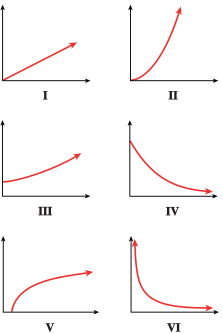
Choose the graph for each function described below.
- The area, , of a pentagon is a quadratic function of the length, , of its side.
- The strength, , of a hurricane varies inversely with its speed, .
- The price of food has increased by every year for a decade.
- The magnitude, , of a star is a logarithmic function of its brightness, .
- The speed of the train increased at a constant rate.
- If you do not practice a foreign language, you lose of the words in your working vocabulary, , each year.
- II
- VI
- III
- V
- I
- IV
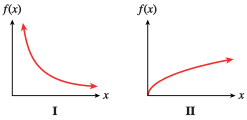
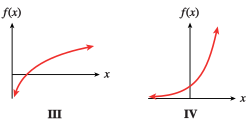
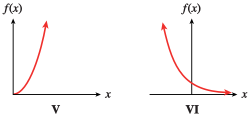
For each of the functions listed below, select the graph of its inverse function, if possible, from the figures labeled I–VI. (The inverse of one of the functions is not shown.)
For Problems 63–64, graph the function on the domain and a suitable range. Which have inverses that are also functions?
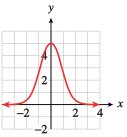
No inverse function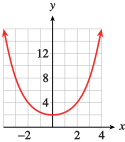
No inverse function
For Problems 65–68, graph the pair of functions on your calculator. Explain the result.
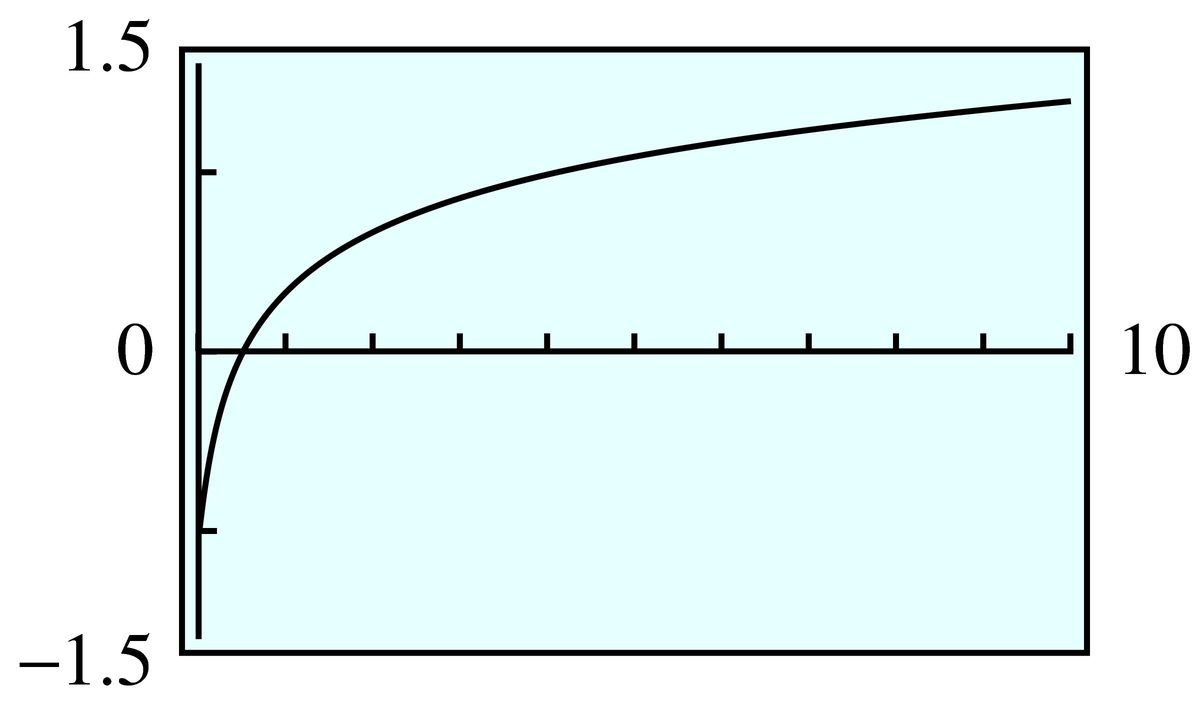
The functions are equal.
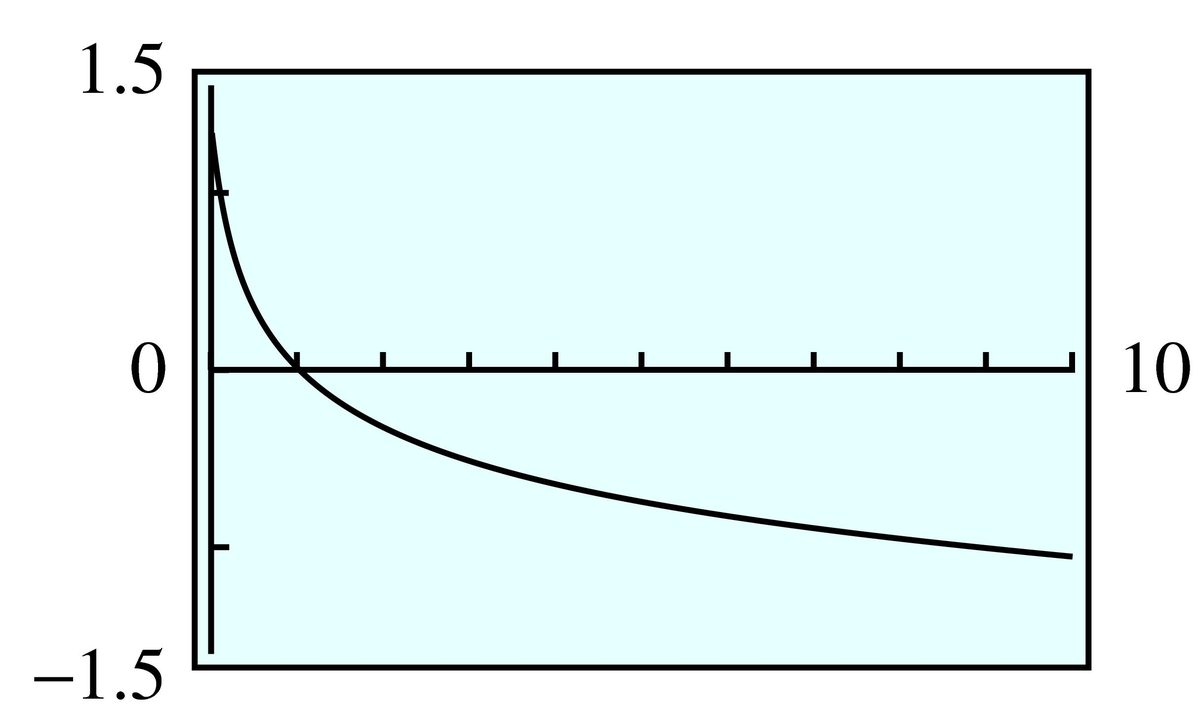
The functions are equal.
- Complete the following table.
- Do you notice a relationship between and ? State the relationship as an equation.
- Complete the following table.
- Do you notice a relationship between and ? State the relationship as an equation.
In Problems 71 and 72, you found relationships between and , and between and . Assuming that those relationships hold for any base, complete the following tables and use them to graph the given functions.
Investigation
Modeling, Functions, and Graphs by Katherine Yoshiwara (yoshiwarabooks.org), GNU Free Documentation License 1.2 or later. Adapted for the XYZ HTML edition with the authors' permission (recorded 2026-07-04). License: GFDL-1.2-or-later.