
10.11 Facts from Geometry
In this section, we review some information you will need from geometry. You are already familiar with the formulas for the area and perimeter of common geometric figures; you can find these formulas in the reference section Geometry formulas.
Right Triangles and the Pythagorean Theorem
A right triangle is a triangle in which one of the angles is a right angle, or . Because the sum of the three angles in any triangle is , this means that the other two angles in a right triangle must have a sum of , or . For instance, if we know that one of the angles in a right triangle is , then the remaining angle must be , or , as shown at right.
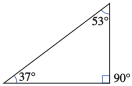
In a right triangle, the longest side is opposite the right angle and is called the hypotenuse. Ordinarily, even if we know the lengths of two sides of a triangle, it is not easy to find the length of the third side (to solve this problem we need trigonometry), but for the special case of a right triangle, there is an equation that relates the lengths of the three sides. This property of right triangles was known to many ancient cultures, and we know it today by the name of a Greek mathematician, Pythagoras, who provided a proof of the result.
Isosceles and Equilateral Triangles
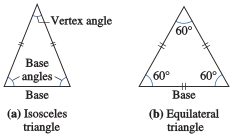
Recall also that an isosceles triangle is one that has at least two sides of equal length. In an isosceles triangle, the angles opposite the equal sides, called the base angles, are equal in measure. In an equilateral triangle, all three sides have equal length, and all three angles have equal measure.
The Triangle Inequality
The longest side in a triangle is always opposite the largest angle, and the shortest side is opposite the smallest angle.
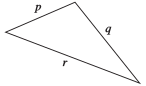
It is also true that the sum of the lengths of any two sides of a triangle must be greater than the third side, or else the two sides will not meet to form a triangle! This fact is called the triangle inequality.
In the triangle at right, we must have that , where , , and are the lengths of the sides of the triangle.
Now we can use the triangle inequality to discover information about the sides of a triangle.
Similar Triangles
Two triangles are said to be similar if their corresponding angles are equal. This means that the two triangles will have the same shape but not necessarily the same size. One of the triangles will be an enlargement or a reduction of the other; so their corresponding sides are proportional.
In other words, for similar triangles, the ratios of the corresponding sides are equal.
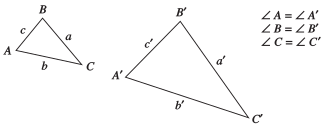
If any two pairs of corresponding angles of two triangles are equal, then the third pair must also be equal, because in both triangles the sum of the angles is . Thus, to show that two triangles are similar, we need only show that two pairs of angles are equal.
Volume and Surface Area
The volume of a three-dimensional object measures its capacity, or how much space it encloses. Volume is measured in cubic units, such as cubic inches or cubic meters.
The volume of a rectangular prism, or box, is given by the product of its length, width, and height. For example, the volume of the box of length inches, width inches, and height inches shown at right is
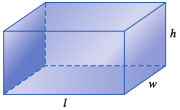
Formulas for the volumes of other common objects can be found inside the front cover of the book.
The surface area of a solid object is the sum of the areas of all the exterior faces of the object. It measures the amount of paper that would be needed to cover the object entirely. Since it is an area, it is measured in square units.
The Distance Formula
By using the Pythagorean theorem, we can derive a formula for the distance between two points, and , in terms of their coordinates. We first label a right triangle, as we did in the example above. Draw a horizontal line through and a vertical line through . These lines meet at a point , as shown below. The -coordinate of is the same as the -coordinate of , and the -coordinate of is the same as the -coordinate of . Thus, the coordinates of are .
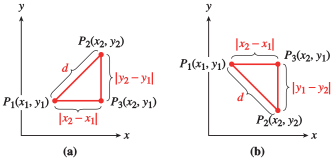
The distance between and is , and the distance between and is . (See The Absolute Value Function to review distance and absolute value.)
These two numbers are the lengths of the legs of the right triangle. The length of the hypotenuse is the distance between and , which we will call . By the Pythagorean theorem,
Taking the (positive) square root of each side of this equation gives us the distance formula.
The Midpoint Formula
If we know the coordinates of two points, we can calculate the coordinates of the point halfway between them using the midpoint formula. Each coordinate of the midpoint is the average of the corresponding coordinates of the two points.
Circles
A circle is the set of all points in a plane that lie at a given distance, called the radius, from a fixed point called the center.
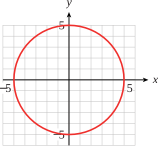
We can use the distance formula to find an equation for a circle. First consider the circle (a) below, whose center is the origin, .
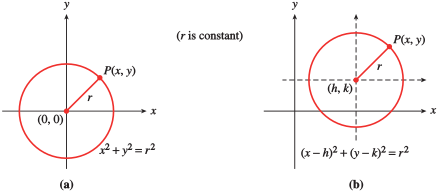
The distance from the origin to any point on the circle is . Therefore,
Or, squaring both sides,
Thus, the equation for a circle of radius centered at the origin is
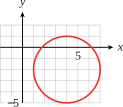
Now consider the circle (b) above, whose center is the point . Every point on the circle lies a distance from , so the equation of the circle is given by the following formula.
This equation is the standard form for a circle of radius with center at . It is easy to graph a circle if its equation is given in standard form.
We can write an equation for any circle if we can find its center and radius.
Section Summary
Vocabulary
Look up the definitions of new terms in the Glossary.
- Right triangle
- Circle
- Surface area
- Isosceles
- Hypotenuse
- Center
- Volume
- Triangle inequality
- Equilateral
SKILLS
Practice each skill in the exercises listed.
- Use properties of triangles: #1–10
- Use similar triangles to solve problems: #11–16
- Calculate volumes and surface areas: #17–20
- Use the distance and midpoint formulas: #21–32
- Sketch a circle: #33–40
- Find the equation for a circle: #41–46
Exercises A.11
For Problems 1-10, use properties of triangles to answer the questions.
One angle of a triangle is larger than another, and the third angle is larger than the smallest. How large is each angle?
One angle of a triangle is twice as large as the second angle, and the third angle is less than the larger of the other two. How large is each angle?
One acute angle of a right triangle is twice the other acute angle. How large is each acute angle?
One acute angle of a right triangle is less than three times the other acute angle. How large is each acute angle?
The vertex angle of an isosceles triangle is less than the sum of the equal angles. How large is each angle?
The vertex angle of an isosceles triangle is less than one of the equal angles. How large is each angle?
The perimeter of an isosceles triangle is 42 centimeters and its base is 12 centimeters long. How long are the equal sides?
cm
The altitude of an equilateral triangle is times its base. If the perimeter of an equilateral triangle is 18 inches, what is its area?
If two sides of a triangle are 6 feet and 10 feet long, what can you say about the length of the third side?
It is more than 4 and less than 16 feet long.
If one of the equal sides of an isosceles triangle is 8 millimeters long, what can you say about the length of the base?
For Problems 11-16, use properties of similar triangles to answer the questions.
A 6-foot man stands 12 feet from a lamppost. His shadow is 9 feet long. How tall is the lamppost?
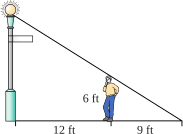
14 ft
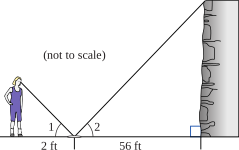
A rock climber estimates the height of a cliff she plans to scale as follows: She places a mirror on the ground so that she can just see the top of the cliff in the mirror while she stands straight. (The angles 1 and 2 formed by the light rays are equal.) She then measures the distance to the mirror (2 feet) and the distance from the mirror to the base of the cliff. If she is 5 feet 6 inches tall, how high is the cliff?
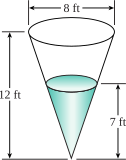
A conical tank is 12 feet deep and the diameter of the top is 8 feet. If the tank is filled with water to a depth of 7 feet, what is the area of the exposed surface of the water?
17.1 sq ft
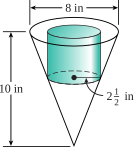
A florist fits a cylindrical piece of foam into a conical vase that is 10 inches high and measures 8 inches across the top. If the radius of the foam cylinder is 212 inches, how tall should it be just to reach the top of the vase?
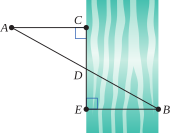
To measure the distance across a river, stand at point and sight across the river to a convenient landmark at . Then measure the distances , , and . If feet, feet, and feet, how wide is the river?
89.23 ft
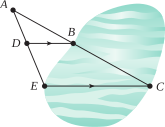
To measure the distance across a lake, stand at point and sight point across the lake, then mark point . Then sight to point and mark point so that is parallel to . If yards, yards, and yards, how wide is the lake?
For Problems 17-20, use formulas to find volumes and surface areas.
- How much helium (in cubic meters) is needed to inflate a spherical balloon to a radius of 1.2 meters?
- How much gelatin (in square centimeters) is needed to coat a spherical pill whose radius is 0.7 centimeter?
- 7.24 cu m
- 6.16 sq cm
- How much storage space is there in a rectangular box whose length is 12.3 inches, whose width is 4 inches, and whose height is 7.3 inches?
- How much marine sealer will be needed to paint a rectangular wooden storage locker with length 6.2 feet, width 5.8 feet, and height 2.6 feet?
- How much grain can be stored in a cylindrical silo whose radius is 6 meters and whose height is 23.2 meters?
- How much paint is needed to cover a cylindrical storage drum whose radius is 15.3 inches and whose height is 4.5 inches?
- 2623.86 cu m
- 1903.43 sq in
- A conical pile of sand is 8.1 feet high and has a radius of 4.6 feet. How much sand is in the pile?
- How much plastic is needed to line a conical funnel with a radius of 16 centimeters and a slant height of 42 centimeters?
For Problems 21-26, find the distance between the given pairs of points, and find the midpoint of the segment joining them.
;
;
;
Leanne is sailing 3 miles west and 5 miles south of the harbor. She heads directly toward an island that is 8 miles west and 7 miles north of the harbor.
- How far is Leanne from the island?
- How far will Leanne be from the harbor when she is halfway to the island?
- 13 miles
- miles
Dominic is 100 meters east and 250 meters north of Kristy. He is walking directly toward a tree that is 220 meters east and 90 meters north of Kristy.
- How far is Dominic from the tree?
- How far will Dominic be from the Kristy when he is halfway to the tree?
For Problems 29-32, sketch a diagram on graph paper, then solve the problem.
Find the perimeter of the triangle with vertices
Find the perimeter of the triangle with vertices , ,
Show that the point is the same distance from and .
Show that the points , and are the vertices of an equilateral triangle.
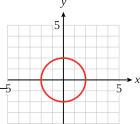
For Problems 33-40, graph the equation.
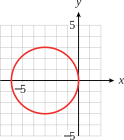
For Problems 41-46, write an equation for the circle with the given properties.
Center at , radius .
Center at , radius .
Center at , one point on the cirlce .
Center at , one point on the cirlce .
Endpoints of a diameter at and .
Endpoints of a diameter at and .
Modeling, Functions, and Graphs by Katherine Yoshiwara (yoshiwarabooks.org), GNU Free Documentation License 1.2 or later. Adapted for the XYZ HTML edition with the authors' permission (recorded 2026-07-04). License: GFDL-1.2-or-later.