
10.12 Properties of Lines
Horizontal and Vertical Lines
Two special cases of linear equations are worth noting. First, an equation such as can be thought of as an equation in two variables,
For each value of , this equation assigns the value to . Thus, any ordered pair of the form is a solution of the equation. For example,
are all solutions of the equation. If we draw a straight line through these points, we obtain the horizontal line shown at left below.
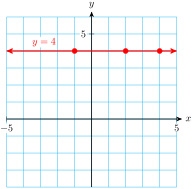
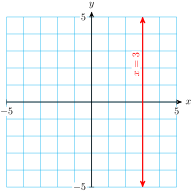
The other special case of a linear equation is of the type , or
Here, only one value is permissible for , namely , while any value may be assigned to . Any ordered pair of the form is a solution of this equation. If we choose two solutions, say and , and draw a straight line through these two points, we have the vertical line shown at right above. In general, we have the following results.
Now let's compute the slopes of the two lines in the previous example. Choose two points on the graph of , say and . Use these points to compute the slope.
The slope of the horizontal line is zero. In fact, the slope of any horizontal line is zero, because the -coordinates of all the points on the line are equal. Thus
On a vertical line, the -coordinates of all the points are equal. For example, two points on the line are and . Using these points to compute the slope, we find
which is undefined. The slope of any vertical line is undefined because the expression equals zero.
Parallel and Perpendicular Lines
Consider the graphs of the equations
shown below.
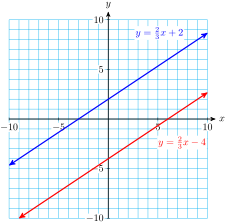
The lines have the same slope, , but different -intercepts. Because slope measures the steepness or inclination of a line, lines with the same slope are parallel.
Now consider the graphs of the equations
shown below.
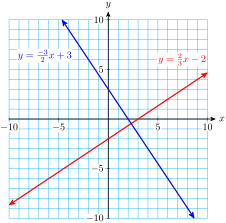
The lines appear to be perpendicular. The relationship between the slopes of perpendicular lines is not as easy to see as the relationship for parallel lines. However, for this example, and . Note that
This relationship holds for any two perpendicular lines with slopes and , as long as and .
We say that is the negative reciprocal of .
Applications to Geometry
These relationships for the slopes of parallel and perpendicular lines can help us solve numerous geometric problems.
Consider the graph of shown below.
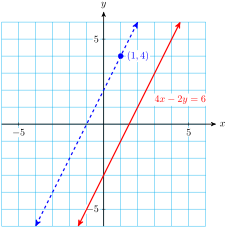
Can we find the equation of the line that is parallel to this line, but passes through the point ? If we can find the slope of the desired line, we can use the slope-intercept formula to find its equation.
Now because the line we want is parallel to the given line, they must have the same slope. To find the slope of the given line, we write its equation in slope-intercept form:
The slope of the given line is . Because the unknown line is parallel to this line, its slope is also . Now we know the slope of the desired line, , and one point on the line, . Substituting these values into the point-slope formula will give us the equation.
Section Summary
Vocabulary
Look up the definitions of new terms in the Glossary.
- Horizontal
- Vertical
- Parallel
- Perpendicular
SKILLS
Practice each skill in the exercises listed.
- Sketch horizontal and vertical lines: #1–6
- Find an equation for a horizontal or vertical line: #7–12
- Identify parallel or perpendicular lines: #15–24
- Find equations for parallel or perpendicular lines: #25–36
Reading Questions
- Give an example of an equation for a vertical line, and for a horizontal line.
- Why is the slope of a vertical line undefined?
- What is the best way to determine whether two lines are parallel?
- Suppose you know the equation of a certain line. Explain how to find the slope of a second line perpendicular to the first line.
Exercises A.12
For Problems 1–6,
- Sketch a rough graph of each equation, and label its intercept.
- State the slope of each line.
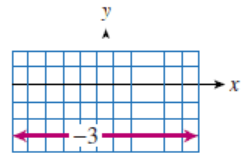
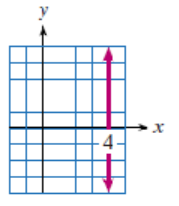
- is undefined
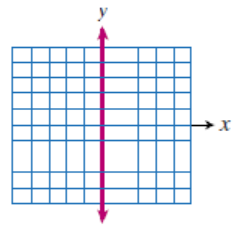
- is undefined
For Problems 7–12, find the equation of the line described.
A vertical line through the point
A horizontal line through the point
The -axis
The -axis
Perpendicular to and intersecting it at
Parallel to the -axis and including the point
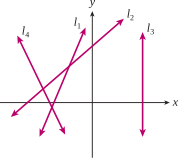
For Problems 13 and 14,
- Determine whether the slope of each line is positive, negative, zero, or undefined.
- List the lines in order of increasing slope.
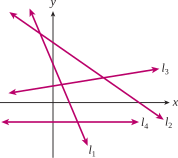
- negative, negative, positive, zero
- Use your calculator to graph the equations and together in the standard window. Do you think the lines are parallel?
- Find the slope of each line in part (a). Are the lines parallel?
- Find the -value for each equation when . What do your answers tell you about the two lines?
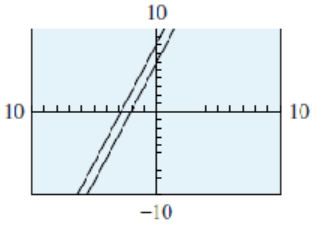
- No
- for both lines. The lines intersect at .
- Use your calculator to graph the equation in the standard window. Do you think the line is horizontal?
- Find the slope and the -intercept of the line in part (a). Is the line horizontal?
- Graph the equation in part (a) in the window
Find the coordinates of two convenient points on the line, and compute its slope using the slope formula.
The slopes of several lines are given below. Which of the lines are parallel to the graph of , and which are perpendicular to it?
parallel: a, g, h; perpendicular: c, f
The slopes of several lines are given below. Which of the lines are parallel to the graph of , and which are perpendicular to it?
In each part, determine whether the two lines are parallel, perpendicular, or neither.
- parallel
- neither
- neither
- parallel
In each part, determine whether the two lines are parallel, perpendicular, or neither.
- Sketch the triangle with vertices and .
- Show that the triangle is a right triangle. (Hint: What should be true about the slopes of the two sides that form the right angle?)
Slope slope slope Hence so the triangle is a right triangle.
- Sketch the triangle with vertices and .
- Show that the triangle is a right triangle. (See the hint for Problem 21.)
- Sketch the quadrilateral with vertices and .
- Show that the quadrilateral is a parallelogram. (Hint: What should be true about the slopes of the opposite sides of the parallelogram?)
Slope slope slope slope Hence and , so the points are the vertices of a parallelogram.
- Sketch the quadrilateral with vertices and .
- Show that the quadrilateral is a parallelogram. (See the hint for Problem 23.)
Show that the line passing through the points and also passes through the point .
Slope slope , so and lie on the same line.
Do the points and lie on the same line? Why or why not?
Use graph paper for Problems 27-30.
- Put the equation into slope-intercept form, and graph the equation.
- What is the slope of any line that is parallel to ?
- On your graph for part (a), sketch by hand a line that is parallel to and passes through the point .
- Use the point-slope formula to write an equation for the line that is parallel to the graph of and passes through the point .
- (sketch)
- Put the equation into slope-intercept form, and graph the equation.
- What is the slope of any line that is parallel to ?
- On your graph for part (a), sketch by hand a line that is parallel to and passes through the point .
- Use the point-slope formula to write an equation for the line that is parallel to the graph of and passes through the point .
- Put the equation into slope-intercept form, and graph the equation.
- What is the slope of any line that is perpendicular to ?
- On your graph for part (a), sketch by hand a line that is perpendicular to and passes through the point .
- Use the point-slope formula to write an equation for the line that is perpendicular to the graph of and passes through the point .
- (sketch)
- Put the equation into slope-intercept form, and graph the equation.
- What is the slope of any line that is perpendicular to ?
- On your graph for part (a), sketch by hand a line that is perpendicular to and passes through the point .
- Use the point-slope formula to write an equation for the line that is perpendicular to the graph of and passes through the point .
Two of the vertices of rectangle are and .
- Find an equation for the line that includes side .
- Find an equation for the line that includes side .
Two of the vertices of rectangle are and .
- Find an equation for the line that includes side .
- Find an equation for the line that includes side .
For Problems 33 and 33, recall from geometry that the altitude from one vertex of a triangle to the opposite side is perpendicular to that side.
- Sketch the triangle with vertices and .
- Find the slope of the side .
- Find the slope of the altitude from point to side .
- Find an equation for the line that includes the altitude from point to side .
- (sketch)
- Sketch the triangle with vertices and .
- Find the slope of the side .
- Find the slope of the altitude from point to side .
- Find an equation for the line that includes the altitude from point to side .
For Problems 35 and 36, recall from geometry that the tangent line to a circle is perpendicular to the radius to the point of tangency.
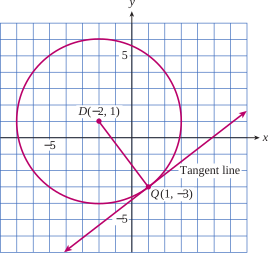
The center of a circle is the point , and is a point on the circle, as shown below. Find the equation of the line tangent to the circle at the point .
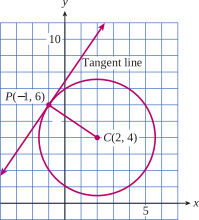
The center of a circle is the point , and is a point on the circle, as shown below. Find the equation of the line tangent to the circle at the point .
In this exercise we will show that parallel lines have the same slope. In the figure below, and are two parallel lines that are neither horizontal nor vertical. Their -intercepts are and . The segments and are constructed parallel to the -and -axes, respectively.
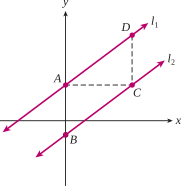
Explain why each of the following statements is true.
- Angle equals angle .
- Angle equals angle .
- Triangle is similar to triangle .
- Right angles are equal.
- Alternate interior angles are equal.
- Two angles of one triangle equal two angles of the other.
- Definition of slope.
- Corresponding sides of similar triangles are proportional.
In this exercise we will show that if two lines with slopes and (where neither line is vertical) are perpendicular, then is the negative reciprocal of . In the figure below, lines and are perpendicular. Their -intercepts are and . The segment is constructed through the point of intersection of and parallel to the -axis.
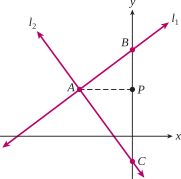
Explain why each of the following statements is true.
- Angles and are complementary.
- Angles and are complementary.
- Angle equals angle .
- Angles and are complementary.
- Angle equals angle .
- Triangle is similar to triangle .
Modeling, Functions, and Graphs by Katherine Yoshiwara (yoshiwarabooks.org), GNU Free Documentation License 1.2 or later. Adapted for the XYZ HTML edition with the authors' permission (recorded 2026-07-04). License: GFDL-1.2-or-later.