
2.6 Domain and Range
Definitions of Domain and Range
In Example of Graphs of Functions, we graphed the function and observed that is undefined for -values less than . For this function, we must choose -values in the interval .
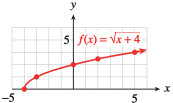
All the points on the graph have -coordinates greater than or equal to , as shown at left. The set of all permissible values of the input variable is called the domain of the function .
We also see that there are no points with negative -values on the graph of : All the points have -values greater than or equal to zero. The set of all outputs or function values corresponding to the domain is called the range of the function. Thus, the domain of the function is the interval , and its range is the interval . In general, we make the following definitions.
Using the notions of domain and range, we restate the definition of a function as follows.
In a function, how many domain elements can be paired with one range element?
_____
It is possible that infinitely many domain elements can be paired with one range element.
In a function, how many domain elements can be paired with one range element?
- One
- Two
- None
- Infinitely many
Finding Domain and Range from a Graph
We can identify the domain and range of a function from its graph. The domain is the set of -values of all points on the graph, and the range is the set of -values.
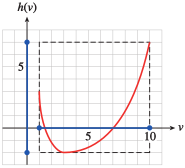
The figure at left shows the graph of the function in Example with the domain values marked on the horizontal axis and the range values marked on the vertical axis. Imagine a rectangle whose length and width are determined by those segments, as shown in the figure. All the points on the graph of the function lie within this rectangle.
The rectangle described above is a convenient window in the plane for viewing the function. Of course, if the domain or range of the function is an infinite interval, we can never include the whole graph within a viewing rectangle and must be satisfied with studying only the important parts of the graph.
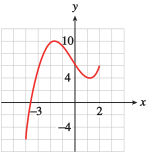
- Draw the smallest viewing window possible around the graph shown above.
- Find the domain and range of the function.
Domain: _____
Range: _____
A graph is shown below.
domain: ; range:
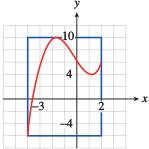
- Draw the smallest viewing window possible around the graph shown above.
- Find the domain and range of the function.
- domain: ;
range:
Sometimes the domain is given as part of the definition of a function.
Graph the function on the domain and give its range.
Range: _____
A graph is below.
range:
A graph of on the domain .
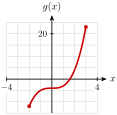
Graph the function on the domain and give its range.
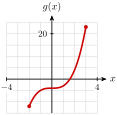
range:
Which function changes concavity on its domain?
_____
The function changes concavity on its domain.
Which function changes concavity on its domain?
Not all functions have domains and ranges that are intervals.
Which function includes all real numbers in its range?
_____
The function includes all real numbers in its range.
Which function includes all real numbers in its range?
In Practice 4 of Functions as Mathematical Models, you wrote a formula for residential water bills, , in Arid, New Mexico:
If the utilities commission imposes a cap on monthly water consumption at HCF, find the domain and range of the function .
Domain: _____
Range: _____
domain: ; range:
In Practice 4 of Functions as Mathematical Models, you wrote a formula for residential water bills, , in Arid, New Mexico:
If the utilities commission imposes a cap on monthly water consumption at HCF, find the domain and range of the function .
domain: ; range:
Do the largest and smallest values in the domain of a function result in the largest and smallest values of the range? Give an example.
_____
Do the largest and smallest values in the domain of a function result in the largest and smallest values of the range? Give an example.
Finding the Domain from a Formula
If the domain of a function is not given as part of its definition, we assume that the domain is as large as possible. We include in the domain all -values that make sense when substituted into the function's formula.
For example, the domain of the function is the interval , because -values less than or greater than result in square roots of negative numbers. You may recognize the graph of as the upper half of the circle , as shown at right.
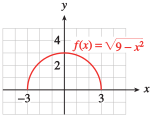
The domain of the function is . What is the domain of the function ?
_____
The domain of is
The domain of the function is . What is the domain of the function ?
- Find the domain of the function .
Domain: _____ - Graph the function in the window
Use your graph and the function's formula to find its range.
Range: _____
Note: This online grading system will not recognize the symbol, only , , , and . So instead of , you could use either the inequalities "x < 0 or x > 0" or the intervals "(-inf,0) U (0,inf)".
- Domain:
A graph is shown below. - Range:
A graph for part (a):
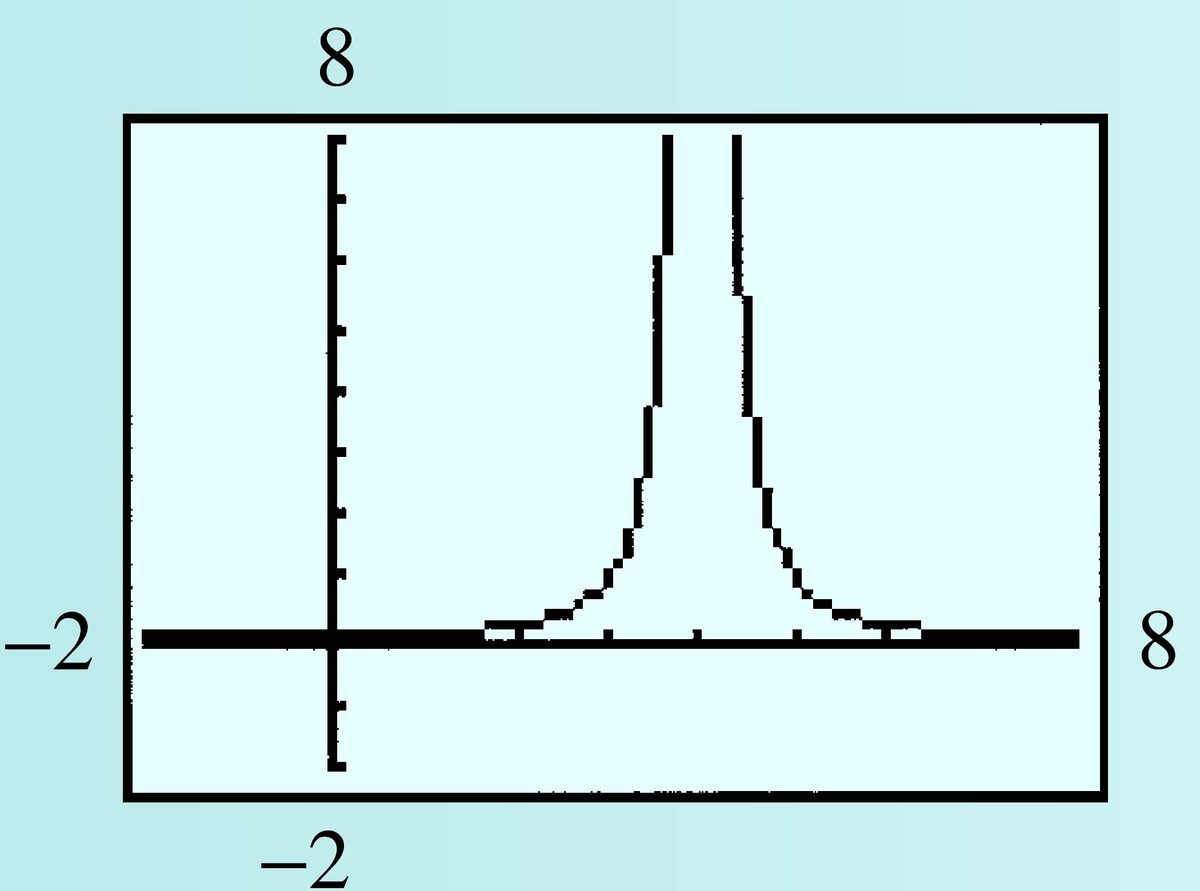
- Find the domain of the function .
- Graph the function in the window Use your graph and the function's formula to find its range.
- Domain:
Range:
For the functions we have studied so far, there are only two operations we must avoid when finding the domain: division by zero and taking the square root of a negative number.
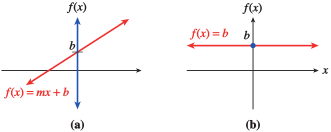
Many common functions have as their domain the entire set of real numbers. In particular, a linear function can be evaluated at any real number value of , so its domain is the set of all real numbers. This set is represented in interval notation as .
The range of the linear function (if ) is also the set of all real numbers, because the graph continues infinitely at both ends, as shown in figure (a). If , then , and the graph of is a horizontal line. In this case, the range consists of a single number, .
Which operations must we examine when finding the domain of a function?
_____
We must examine square roots and division by zero when finding the domain of a function defined by a formula.
Which operations must we examine when finding the domain of a function?
- absolute value and square roots
- square roots and cube roots
- square roots and division by zero
- absolute value and division by zero
State the domain and range of each function:
_____
State the domain and range of each function:
Restricting the Domain
In many applications, we may restrict the domain of a function to suit the situation at hand.
(See Geometry formulas for the formula for the volume of a box.)
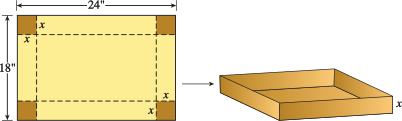
The children in Francine's art class are going to make cardboard boxes. Each child is given a sheet of cardboard that measures 18 inches by 24 inches. To make a box, the child will cut out a square from each corner and turn up the edges, as shown below.
- Write a formula for the volume of the box in terms of , the side of the cut-out square.
_____ - What is the domain of the function? (What are the largest and smallest possible values of ?)
Domain: _____ - Graph the function and estimate its range.
Range: _____
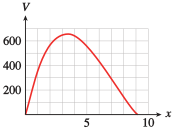
- A graph is below. The range is approximately
A graph for part (c):
The children in Francine's art class are going to make cardboard boxes. Each child is given a sheet of cardboard that measures 18 inches by 24 inches. To make a box, the child will cut out a square from each corner and turn up the edges, as shown below.
- Write a formula for the volume of the box in terms of , the side of the cut-out square. (See Geometry formulas for the formula for the volume of a box.)
- What is the domain of the function? (What are the largest and smallest possible values of ?)
- Graph the function and estimate its range.
The range is approximately
Section Summary
Vocabulary
Look up the definitions of new terms in the Glossary.
- Domain
- Range
- Restricted domain
CONCEPTS
- The domain of a function is the set of permissible values for the input variable.
- The range is the set of function values (that is, values of the output variable) that correspond to the domain values.
- A relationship between two variables is a function if each element of the domain is paired with only one element of the range.
- We can identify the domain and range of a function from its graph. The domain is the set of -values of all points on the graph, and the range is the set of -values.
- If the domain of a function is not given as part of its definition, we assume that the domain is as large as possible.
- In applications, we may restrict the domain and range of a function to suit the situation at hand.
STUDY QUESTIONS
- Explain how to find the domain and range of a function from its graph.
- What is the domain of the function ? What is its range?
- Which of the eight basic functions are increasing on their entire domain? Which are decreasing on their entire domain?
- Which of the eight basic functions are concave up on their entire domain? Which are concave down on their entire domain?
- Which of the eight basic functions can be evaluated at any real number? Which can take on any real number as a function value?
- Which of the eight basic functions can be graphed in one piece, without lifting the pencil from the paper?
SKILLS
Practice each skill in the Homework problems listed.
- Find the domain and range of a function from its graph: #1–16
- Restrict the domain of a function to suit an application: #17–24
- Find the domain of a function from its algebraic formula: #25–30
- Find the corresponding domain value for a given range value: #31–38
- Find the range of a function on a given domain: #39–50
Homework 2.6
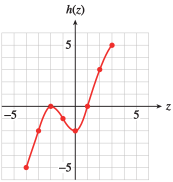
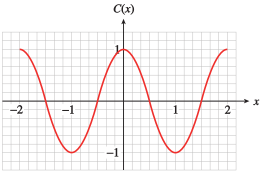
For Problems 1–8, find the domain and range of the function from its graph.
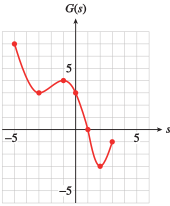
Domain: ; Range:
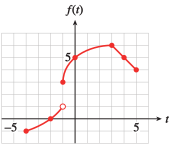
Domain: ; Range:
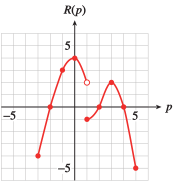
Domain: ; Range:
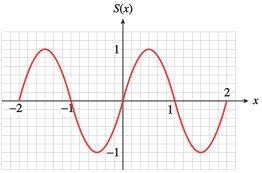
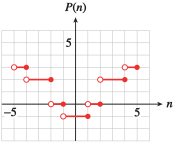
Domain: ; Range:
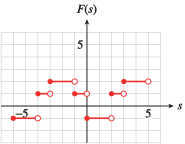
For Problems 9–2, state the domain and range of the basic function.
- Domain: all real numbers; Range: all real numbers
- Domain: all real numbers; Range:
- Domain: all real numbers except zero; Range:
- Domain: all real numbers except zero; Range: all real numbers except zero
The graph shows the elevation of the Los Angeles Marathon course as a function of the distance into the race, . Estimate the domain and range of the function. (Source: Los Angeles Times)
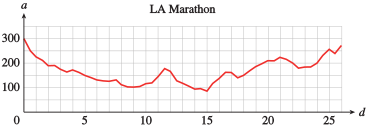
Domain: ; Range:
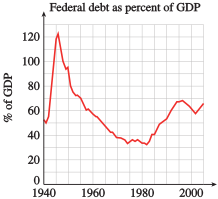
The graph shows the federal debt as a percentage of the gross domestic product, as a function of time, . Estimate the domain and range of the function. (Source: Office of Management and Budget)
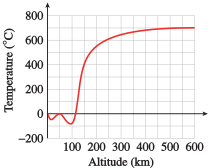
The graph shows the average air temperature as a function of altitude, . Estimate the domain and range of the function. (Source: Ahrens, 1998)
Domain: ; Range:
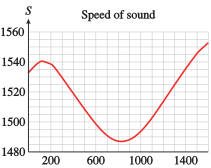
The graph shows the speed of sound in the ocean as a function of depth, . Estimate the domain and range of the function. (Source: Scientific American)
Clinton purchases $ of photographic equipment to set up his studio. He estimates a salvage value of $ for the equipment in years, and for tax purposes he uses straight-line depreciation.
- Write a formula for the value of the equipment, , after years.
- State the domain and range of the function .
- Domain: ; Range:
Leslie plans to invest some money in two CD accounts. The first account pays interest per year, and the second account pays interest per year. Leslie would like to earn $ per year on her investment.
- Write a linear equation in general form that relates , the amount Leslie invests at , and , the amount she invests at .
- Use your equation from part (a) to write as a function of , .
- Find the domain and range of .
The height of a golfball, in feet, seconds after being hit is given by the function .
- Graph the function.
- State the domain and range of the function and explain what they tell us about the golfball.
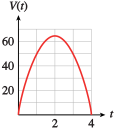
- Domain: ; Range: The ball reaches a height of 64 feet and hits the ground 4 seconds after being hit.
Gameworld is marketing a new boardgame called Synaps. If Gameworld charges dollars for the game, their revenue is given by the function .
- Graph the function.
- State the domain and range of the function and explain what they tell us about the revenue.
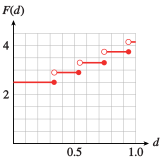
In New York City, taxi cabs charge $2.50 for distances up to mile, plus $0.40 for each additional mile or portion thereof. (Source: www.visitnyc.com)
- Sketch a graph of , which gives taxi fare as a function of distance traveled, on the domain .
- State the range of on that domain.
- How much will it cost Renee to travel by taxi from Columbia University to Rockefeller Center, a distance of 5.7 miles?
- Range:
- $
If you order from Coldwater Creek, the shipping charges are given by the following table.
| Purchase amount | Shipping charge |
|---|---|
| Up to $ | $ |
| $ to $ | $ |
| $ to $ | $ |
| $ to $ | $ |
State the domain and range of , the shipping charge as a function of the purchase amount, .
The Bopp-Busch Tool and Die Company markets its products to individuals, to contractors, and to wholesale distributors. The company offers three different price structures for its toggle bolts. If you order or fewer boxes, the price is $ each. If you order more than but no more than boxes, the price is $ each. If you order more than boxes, the price is $ each. State the domain and range of , the cost of ordering boxes of toggle bolts.
Domain: nonnegative integers; The range includes all whole number multiples of up to , all integer multiples of from to and all integer multiples of from onwards: , ,
The Java Stop uses paper cups at a rate of per day. At opening on Tuesday morning Java Stop has on hand paper cups. On Friday mornings Java Stop takes delivery of a week's worth of cups.
- Write a piecewise function for the number of cups Java Stop has on hand for one week, starting Tuesday morning.
- Graph the function.
- State the domain and range of the function.
For Problems 25–30, find the domain of each function algebraically. Then graph the function, and use the graph to help you find the range.
- domain: ; Range:
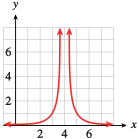
- domain: ; Range:
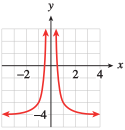
- domain: all real numbers; Range: all real numbers
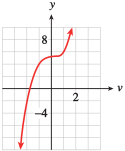
- domain: all real numbers; Range: all real numbers
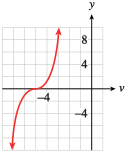
- domain: ; Range:
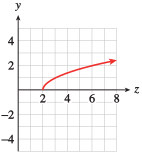
- domain: ; Range:
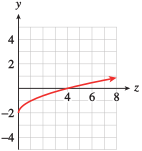
For Problems 31–38, decide whether the given value is in the range of the function. If so, find the domain value(s) that produce each range value.
- Not in range
- or
- Not in range
- Not in range
For Problems 39–50,
- Use a graphing utility to graph each function on the given domain. Using a
TRACEfeature, adjust Ymin and Ymax until you can estimate the range of the function. - Verify your answer algebraically by evaluating the function. State the domain and range in interval notation.
Domain: ; Range:
Domain: ; Range:
Domain: ; Range:
Domain: ; Range:
Domain: ; Range:
Domain: ; Range:
- Show that the graph of is a semicircle.
- State the domain and range of the function.
- Graph the function in the window In what way is the calculator’s graph misleading?
(Hint: Write the equation in the form . See Algebra Skills Refresher Facts from Geometry to review circles.)
- Squaring both sides of the equation gives the equation of the circle centered on the origin with radius , but the points in the third and fourth quadrants are extraneous solutions introduced by squaring. (The original equation allowed only .)
- Domain: ; Range:
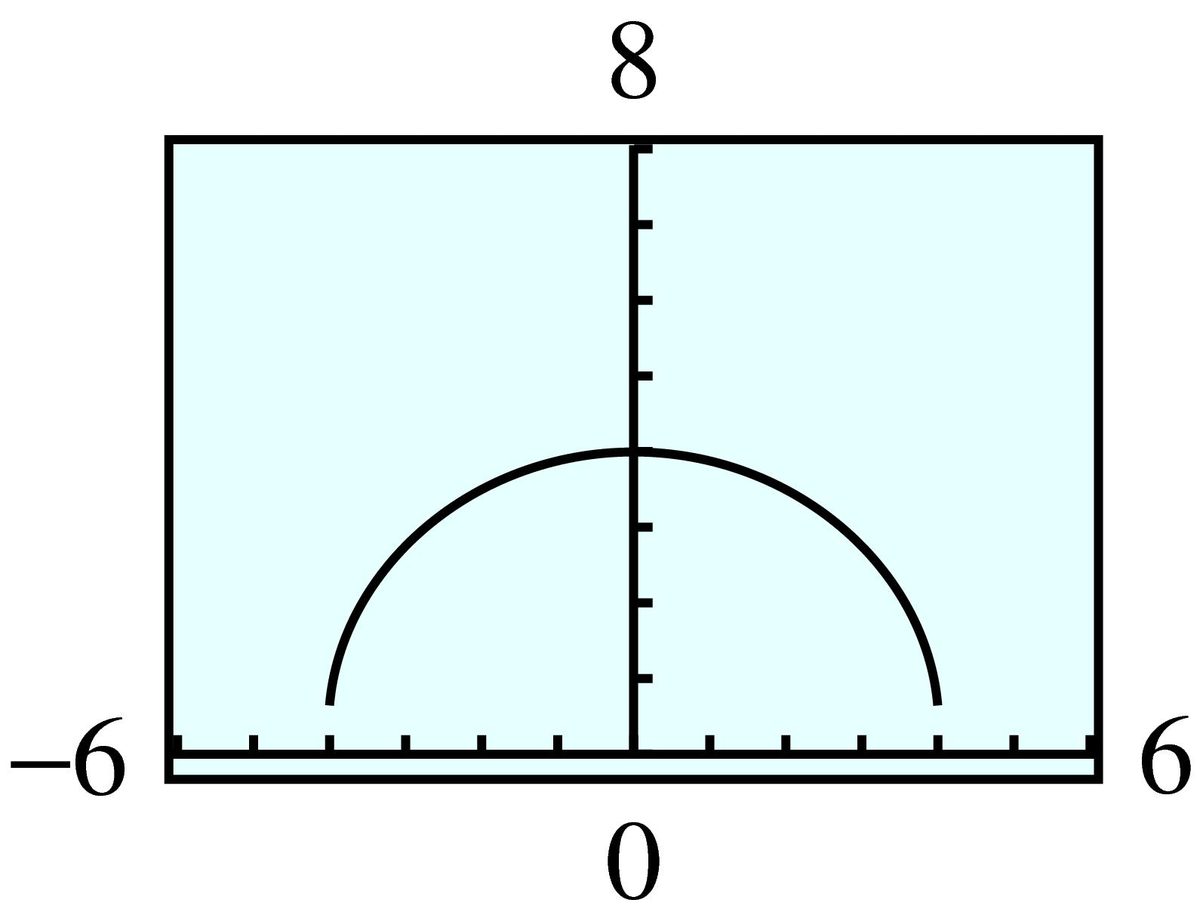
The calculator does not show the graph extending down to the -axis.
- For what values of is the function undefined?
- Graph the function in the standard window. In what way is the calculator's graph misleading?
- Graph the function in the window State the domain and range of the function.
In Problems 53–60, find the domain and range of each transformation of the given function.
- Domain: ; Range:
- Domain: ; Range:
- Domain: ; Range:
- Domain: all real numbers; Range:
- Domain: all real numbers; Range:
- Domain: all real numbers; Range:
The domain of is and the range is .
- Domain: ; Range:
- Domain: ; Range:
- Domain: ; Range:
The domain of is and the range is .
The domain of is and the range is .
- Domain: ; Range:
- Domain: ; Range:
- Domain: ; Range:
The domain of is and the range is .
In Problems 61–64, use a graphing calculator to explore some properties of the basic functions.
- Graph and on the domain and state the range of each function. On the interval , which is greater, or ?
- Graph and on the domain and state the range of each function. On the interval , which is greater, or ?
- Graph and on the domain and state the range of each function. On the interval , which is greater, or ?
- Graph and on the domain and state the range of each function. On the interval , which is greater, or ?
- Graph and on the domain and state the range of each function. On the interval , which is greater, or ?
- Graph and on the domain and state the range of each function. On the interval , which is greater, or ?
- Graph in the ZDecimal window. How does the graph compare to the graph of ?
- Graph in the ZDecimal window. How does the graph compare to the graph of ?
The number of hours of daylight on the summer solstice is a function of latitude in the northern hemisphere. Give the domain and range of the function.
Domain: ; Range:
A semicircular window has a radius of 2 feet. The area of a sector of the window (a pie-shaped wedge) is a function of the angle at the center of the circle. Give the domain and range of this function.
Modeling, Functions, and Graphs by Katherine Yoshiwara (yoshiwarabooks.org), GNU Free Documentation License 1.2 or later. Adapted for the XYZ HTML edition with the authors' permission (recorded 2026-07-04). License: GFDL-1.2-or-later.