
2.5 The Absolute Value Function
Introduction
The absolute value function is used to model problems involving distance. Recall that the absolute value of a number gives the distance from the origin to that number on the number line.
For example, the equation means "the distance between and is units." The number could be to the left or the right of on the number line. Thus, the equation has two solutions, and , as shown below.

To find the absolute value of a number, we can
_____
To find the absolute value of a number, we can find its distance from 0.
To find the absolute value of a number, we can
- change its sign.
- subtract it from 0.
- find its distance from 0.
- square it.
The notation means
_____
The notation means that the distance between and 3 is 5 units.
The notation means
- is 3 units bigger than 5.
- the distance between and 5 is 3 units.
- 5 and 3 are units apart.
- the distance between and 3 is 5 units.
Write each statement using absolute value notation; then illustrate the solutions on a number line.
- is five units away from .
__________ - is at least six units away from .
__________
Use "abs(x)" to get , etc.
A number line is shown below.
A number line is shown below.
Number lines:


Write each statement using absolute value notation; then illustrate the solutions on a number line.
- is five units away from .
- is at least six units away from .


Absolute Value Equations
We can use distances on a number line to solve simple equations such as
First, we factor out the coefficient of , to get . Because of the multiplicative property of the absolute value, namely that , we can write the left side as
which tells us that the distance between and is units, so the solutions are and .
Alternatively, we can use graphs when working with absolute values. For example, we know that the simple equation has two solutions, and .
In fact, we can see from the graph at right that the equation has two solutions if , one solution if , and no solution if .
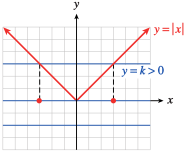
Which statement is true?
_____
Depending on , can equal or .
Which statement is true?
- The graph of has no negative inputs.
- The equation has two solutions.
- Depending on can equal or .
- The graph of is a straight line.
- The graph of is
_____ - Use your graph to solve the equation .
_____
Separate different values with a comma.
- A graph is also shown below for part (b).
- or
A graph for part (b):
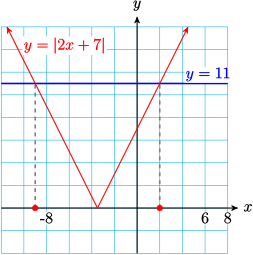
- Graph for .
- Use your graph to solve the equation .
- or
To solve an absolute value equation algebraically, we use the definition of absolute value.
In general, we have the following strategy for solving absolute value equations.
Solve algebraically.
_____
Separate different values with a comma.
or
Solve algebraically.
The absolute value equation is equivalent to two regular equations:
whose solutions are or
Explain how the equation can have two solutions, one solution, or no solutions.
_____
Explain how the equation can have two solutions, one solution, or no solutions.
Absolute Value Inequalities
We can also use graphs to solve absolute value inequalities. Look again at the graph of in figure (a) below.
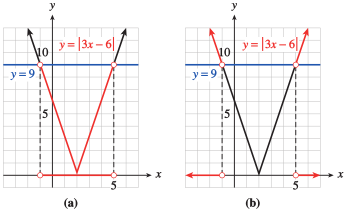
Because of the V-shape of the graph, all points with -values less than lie between the two solutions of , that is, between and . Thus, the solutions of the inequality are . (In the Homework Problems, you will be asked to show this algebraically.)
On the other hand, to solve the inequality , we look for points on the graph with -values greater than . In figure (b), we see that these points have -values outside the interval between and . In other words, the solutions of the inequality are or .
Thus, we can solve an absolute value inequality by first solving the related equation.
If , then
_____
If , then either or .
If , then
- either or .
- .
- either or .
- .
- Solve the inequality
_____ - Solve the inequality
_____
You may use inequality symbols or enter your answers using interval notation. When using interval notation, use "inf" for and use "U" (an upper case letter u) for the union symbol .
- , or
- ; as inequalities, or
- Solve the inequality
- Solve the inequality
- , or
- ; as inequalities, or
Using the Absolute Value in Modeling
In the next Example, we use the absolute value function to model a problem about distances.
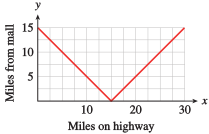
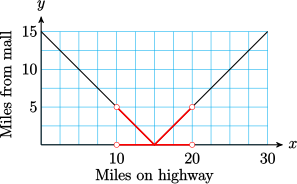
- Use the graph above from the previous example to determine how far Marlene has driven when she is within 5 miles of the mall. Write and solve an absolute value inequality to verify your answer.
Inequality: _____ _____ Note: Use "abs(x)" to get .
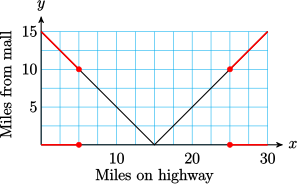
Solution: _____ - Write and solve an absolute value inequality to determine how far Marlene has driven when she is at least miles from the mall.
Inequality: _____ _____ Note: Use "abs(x)" to get .
Solution: _____
You may enter your solutions using inequality symbols or using interval notation. When using inequalities, type in "<=" for , and type in ">=" for . When using interval notation, type "inf" for and type "U" (an upper case letter u) for the union symbol .
- ;
A graph is below. - ; or
A graph is below.
Graphs are below.
- Use the graph above from the previous example to determine how far Marlene has driven when she is within 5 miles of the mall. Write and solve an absolute value inequality to verify your answer.
- Write and solve an absolute value inequality to determine how far Marlene has driven when she is at least miles from the mall.
- ;
- ; or
Measurement Error
If you weigh a sample in chemistry lab, the scale’s digital readout might show grams. But it is unlikely that the sample weighs exactly grams; there is always some error in measured values.
Because the scale shows the weight as grams, we know that the true weight of the sample must be between grams and grams: If the weight were less than grams, the scale would round down to grams, and if the weight were more than grams, the scale would round up to grams. We should report the mass of the sample as grams, which tells the reader that the error in the measurement is no more than grams.
We can also describe this measurement error, or error tolerance, using an absolute value inequality. Because the measured mass can be no more than from , we write
Note that the solution of this inequality is .
Which statement is false?
_____
"The solutions of form a closed interval" is a false statement.
Which statement is false?
- The equation has one solution.
- The statement describes an error tolerance of 0.05 units.
- is equivalent to .
- The solutions of form a closed interval.
The temperature, , in a laboratory must remain between and .
- Write the error tolerance as an absolute value inequality.
Inequality: _____ _____ Note: Use "abs(x)" to get . - For a special experiment, the temperature in degrees celsius must satisfy . Give the interval of possible temperatures.
Interval: _____
You may enter your solutions using inequality symbols or using interval notation. When using inequalities, type in "<=" for , and type in ">=" for . When using interval notation, type "inf" for and type "U" (an upper case letter u) for the union symbol .
The temperature, , in a laboratory must remain between and .
- Write the error tolerance as an absolute value inequality.
- For a special experiment, the temperature in degrees celsius must satisfy . Give the interval of possible temperatures.
What is error tolerance used for, and why do we need it?
_____
What is error tolerance used for, and why do we need it?
Section Summary
Vocabulary
Look up the definitions of new terms in the Glossary.
- Absolute value equation
- Absolute value inequality
- Error tolerance
CONCEPTS
- The absolute value is used to model distance: The distance between two points and is given by .
- The error tolerance in a measurement can be expressed as , or as . Both indicate that .
STUDY QUESTIONS
- Write a function that models the distance between and a fixed point on the number line.
- For what values of does the equation have one solution? No solution?
- If you know that the solutions of are , what are the solutions of ?
- What is the center of the interval ?
- What is the center of the interval ?
SKILLS
Practice each skill in the Homework problems listed.
- Use absolute value notation to write statements about distance: #1–8
- Use graphs to solve absolute value equations and inequalities: #9–12
- Solve absolute value equations: #13–24
- Solve absolute value inequalities: #25–40
- Express error tolerances using absolute value notation: #41–48
- Analyze absolute value functions: #49–56
- Model problems about distance using the absolute value function: #57–60
Homework 2.5
In Problems 1–8,
- Use absolute value notation to write each expression as an equation or an inequality. (It may be helpful to restate each sentence using the word distance.)
- Illustrate the solutions on a number line.
is six units from the origin.

is seven units from the origin.
The distance from to is five units.

The distance from to is two units.
is within three units of .

is no more than one unit from .
is at least unit from .

is more than unit from .
Graph . Use your graph to solve the following equations and inequalities.
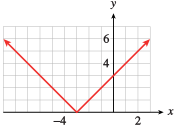
- or
- or
Graph . Use your graph to solve the following equations and inequalities.
Graph . Use your graph to solve the following equations and inequalities.
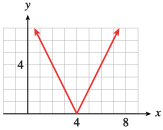
- No solution
- No solution
Graph . Use your graph to solve the following equations and inequalities.
For Problems 13–24, solve.
or
or
or
No solution
No solution
For Problems 25–36, solve.
or
All real numbers
or
No solution
In Problems 37–40, give an interval of possible values for the measurement.
The length, , of a rod is given by , in centimeters.
The mass, , of the device shall be , in grams.
The candle will burn for minutes, where .
The ramp will have angle of inclination , and .
In Problems 41–44, write the error tolerance using absolute values.
The chemical compound must be maintained at a temperature, , between and C.
The diameter, , of the hole shall be in the range of to centimeters.
The subject will receive a dosage from to milligrams of the drug.
The pendulum swings out and back in a time period between and seconds.
An electrical component of a high-tech sensor requires ounce of gold. Assume that the actual amount of gold used, , is not in error by more than ounce. Write an absolute value inequality for the possible error and show the possible values of on a number line.

In a pasteurization process, milk is to be irradiated for seconds. The actual period of irradiation cannot be off by more than second. Write an absolute value inequality for the possible error and show the possible values of on a number line.
In a lab assignment, a student reports that a chemical reaction required minutes to complete. Let represent the actual time of the reaction.
- Write an absolute value inequality for , assuming that the student rounded his answer to the nearest minutes. Give the smallest and largest possible value for .
- Write an absolute value inequality for , assuming that the student rounded his answer to the nearest minute. Give the smallest and largest possible value for .
- Write an absolute value inequality for , assuming that the student rounded his answer to the nearest minute. Give the smallest and largest possible value for .
What is the shortest time that would round to minutes? The greatest time?
- ,
- ,
- ,
An espresso machine has a square metal plate. The side of the plate is cm.
- Write an absolute value inequality for the length of the side, . Give the smallest and largest possible value for .
- Compute the smallest and largest possible area of the plate, including units.
- Write an absolute value inequality for the area, .
- Write the piecewise definition for .
- Use your answer to part (a) to write two inequalities that together are equivalent to .
- Solve the inequalities in part (b) and check that the solutions agree with the solutions of .
- Show that is equivalent to the compound inequality .
- ,
- The solutions are the same.
- Write the piecewise definition for .
- Use your answer to part (a) to write two inequalities that together are equivalent to .
- Solve the inequalities in part (b) and check that the solutions agree with the solutions of .
- Show that is equivalent to the compound inequality or .
- Write the piecewise definition for .
- Use your answer to part (a) to write two inequalities that together are equivalent to .
- Solve the inequalities in part (b) and check that the solutions agree with the solutions of .
- Show that is equivalent to the compound inequality or .
- ,
- or
- The solutions are the same.
- Write the piecewise definition for .
- Use your answer to part (a) to write two inequalities that together are equivalent to .
- Solve the inequalities in part (b) and check that the solutions agree with the solutions of .
- Show that is equivalent to the compound inequality .
For Problems 53–56, graph the function and answer the questions.
- Using your graph, write a piecewise formula for .
- Experiment by graphing for different positive values of and . Make a conjecture about how the graph depends on and .
- Write a piecewise formula for .
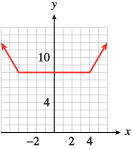
- The graphs looks like like a trough. The middle horizontal section is for , the left side, , has slope and the right side, , has slope .
- Using your graph, write a piecewise formula for .
- Experiment by graphing for different positive values of and . Make a conjecture about how the graph depends on and .
- Using your graph, write a piecewise formula for .
- What is the minimum value of ?
- If , what is the minimum value of ?
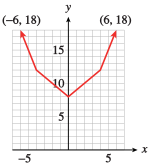
- Using your graph, write a piecewise formula for .
- What is the minimum value of ?
- If , what is the minimum value of ?
Problems 57–60 use the absolute value function to model distance. Use the strategy outlined in Problems 57 and 58 to solve Problems 59 and 60.
A small pottery is setting up a workshop to produce mugs. Three machines are located on a long table, as shown in the figure. The potter must use each machine once in the course of producing a mug. Let represent the coordinate of the potter's station.

- Write expressions for the distance from the potter's station to each of the machines.
- Write a function that gives the sum of the distances from the potter's station to the three machines.
- Graph your function for . Where should the potter stand in order to minimize the distance she must walk to the machines?
- , ,
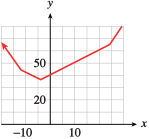
At -coordinate
Suppose the pottery in Problem 57 adds a fourth machine to the procedure for producing a mug, located at in the figure.
- Write and graph a new function for the sum of the potter's distances to the four machines.
- Where should the potter stand now to minimize the distance she has to walk while producing a mug?
Richard and Marian are moving to Parkville to take jobs after they graduate. The main road through Parkville runs east and west, crossing a river in the center of town. Richard's job is located miles east of the river on the main road, and Marian's job is miles west of the river. There is a health club they both like located miles east of the river. If they plan to visit the health club every workday, where should Richard and Marian look for an apartment to minimize their total daily driving distance?
miles east of the river
Romina's Bakery has just signed contracts to provide baked goods for three new restaurants located on Route 28 outside of town. The Coffee Stop is miles north of town center, Sneaky Pete's is miles north, and the Sea Shell is miles south. Romina wants to open a branch bakery on Route 28 to handle the new business, with separate days for each restaurant's weekly delivery. Where should she locate the bakery in order to minimize the distance she must drive for deliveries?
Modeling, Functions, and Graphs by Katherine Yoshiwara (yoshiwarabooks.org), GNU Free Documentation License 1.2 or later. Adapted for the XYZ HTML edition with the authors' permission (recorded 2026-07-04). License: GFDL-1.2-or-later.