
2.1 Nonlinear Models
In Chapter 1, we considered models described by linear functions. In this chapter, we begin our study of nonlinear models.
Solving Nonlinear Equations
When studying nonlinear models, we will need to solve nonlinear equations. For example, in Perimeter and Area we used a graph to solve the quadratic equation
Here is another example. The figure shows a table and a graph for the function .
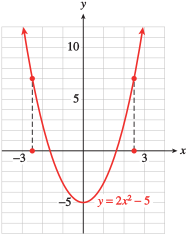
You can see that there are two points on the graph for each -value greater than . For example, the two points with -coordinate are shown. To solve the equation
we need only find the -coordinates of these points. From the graph, the solutions appear to be about and .
How can we solve this equation algebraically? The opposite operation for squaring a number is taking a square root. So we can undo the operation of squaring by extracting square roots. We first solve for to get
and then take square roots to find
The exact solutions are thus and . We can also find decimal approximations for the solutions using a calculator. Rounded to two decimal places, the approximate solutions are and .
Which statement is true?
_____
A quadratic equation may include a linear or a constant term.
Which statement is true?
- A quadratic equation may include a linear or a constant term.
- The solutions of a quadratic equation are always of the form .
- Your calculator gives exact decimal values for square roots of integers.
- The coefficients of a quadratic equation are called parabolas.
In general, we can solve equations of the form by isolating on one side of the equation and then taking the square root of each side. This method for solving equations is called extraction of roots.
Which solutions are approximations?
_____
Which solutions are approximations?
- Solve by extracting roots
.
_____
_____
Note: Use "sqrt(2)" to get , etc. - Give exact answers above; then give approximations rounded to two decimal places.
_____
Note: Enter a comma between solutions.
- Solve by extracting roots .
- Give exact answers; then give approximations rounded to two decimal places.
- We isolate as follows: multiply both sides by 5, add 8 to both sides, then divide both sides by 3. This yields Finally we take square roots.
Use graphs to explain why a linear equation can have only one solution, but a quadratic equation may have two solutions.
_____
Use graphs to explain why a linear equation can have only one solution, but a quadratic equation may have two solutions.
Solving Formulas
We can use extraction of roots to solve many formulas involving the square of the variable.
Find a formula for the radius of a circle in terms of its area.
_____
Note: use "sqrt(2)" to get , and use "pi" to get .
Start with the formula for the area of a circle:
Solve for in terms of .
Find a formula for the radius of a circle in terms of its area. Hint: Start with the formula for the area of a circle, then solve for in terms of .
More Extraction of Roots
Equations of the form
can also be solved by extraction of roots after isolating the squared expression, .
Here is a general strategy for solving equations by extraction of roots.
Solve by extracting roots.
- Give your answers as exact values, separating the solutions with a comma.
_____
Note: Use "sqrt(2)" to get , and take care to use parentheses appropriately.
Use the "Preview My Answers" button to see if you have entered valid syntax. - Find approximations for the solutions to two decimal places, separating the solutions with a comma.
_____
- or
Solve by extracting roots.
- Give your answers as exact values.
- Find approximations for the solutions to two decimal places.
First we isolate the squared expression to get
Finally, we subtract 3 and divide by 5 to solve for .
- or
Which of the following equations cannot be solved by extraction of roots?
_____
The equation cannot be solved by extraction of roots.
Which of the following equations cannot be solved by extraction of roots?
Compound Interest and Inflation
Many savings institutions offer accounts on which the interest is compounded annually. At the end of each year, the interest earned is added to the principal, and the interest for the next year is computed on this larger sum of money.
What is the first step in solving the equation ?
_____
To solve by extraction of roots, we first divide both sides by 2.
What is the first step in solving the equation ?
- Expand .
- Get zero on one side.
- Divide both sides by 2.
- Take the square root of both sides.
The formula for compound interest also applies to the effects of inflation. For instance, if there is a steady inflation rate of 4% per year, in two years an item that now costs $100 will cost
Two years ago, the average cost of dinner and a movie was $42. This year the average cost is $44.99. What was the annual rate of inflation over the past two years?
_____%
, or as a percent, the inflation rate was approximately .
Two years ago, the average cost of dinner and a movie was $42. This year the average cost is $44.99. What was the annual rate of inflation over the past two years?
We solve the equation
to find
The annual inflation rate was approximately .
Other Nonlinear Equations
Because squaring and taking square roots are opposite operations, we can solve the equation
by squaring both sides to get
Similarly, we can solve
by taking the cube root of both sides, because cubing and taking cube roots are opposite operations. Rounding to three places, we find
Delbert squared by entering into his calculator, and got . What went wrong?
_____
To square , Delbert should have put parentheses around .
Delbert squared by entering into his calculator, and got . What went wrong?
- Nothing; that is the right answer.
- He should have put parentheses around .
- He should have put parentheses around .
- You cannot square a negative number on a calculator.
The notion of undoing operations can help us solve a variety of simple nonlinear equations. The operation of taking a reciprocal is its own opposite, so we solve the equation
by taking the reciprocal of both sides to get
What is the reciprocal of ?
_____
The reciprocal of is .
What is the reciprocal of ?
Solve
_____
Solve
We divide both sides by 2 to get
What is the difference between a rational number and an irrational number? Give examples of each. (See the section The Real Number System in Appendix A: Algebra Skills Refresher to review rational and irrational numbers.)
_____
What is the difference between a rational number and an irrational number? Give examples of each. (See the section The Real Number System in Appendix A: Algebra Skills Refresher to review rational and irrational numbers.)
Use the intersect feature to solve the equation . Round your answers to three decimal places. Separate solutions with a comma.
_____
Use the intersect feature to solve the equation . Round your answers to three decimal places.
Section Summary
Vocabulary
Look up the definitions of new terms in the Glossary.
- Quadratic
- Compound interest
- Exact solution
- Perfect square
- Extraction of roots
- Inflation
- Area
- Cube root
- Isolate
- Height
- Perimeter
- Reciprocal
CONCEPTS
- We can give exact answers to a simple nonlinear equation, or we can give decimal approximations.
- Simple nonlinear equations can be solved by undoing the operations on the variable.
STUDY QUESTIONS
- How many square roots does a positive number have?
- What is the first step in solving the equation by extraction of roots?
- Give the exact solutions of the equation , and then give decimal approximations rounded to hundredths.
- State a formula for the amount in an account on which interest is compounded annually.
- Give an example of two rectangles with the same perimeter but different areas.
- The perimeter of a rectangle is meters. Write an expression for the length of the rectangle in terms of its width.
- What is the opposite operation for taking a reciprocal?
- What is the reciprocal of ?
SKILLS
Practice each skill in the Homework problems listed.
- Solve equations by extraction of roots: #1–12, 31–42
- Solve formulas: #13–16, 63–68
- Use the Pythagorean theorem: #19–24
- Solve equations graphically: #25–30
- Solve simple nonlinear equations: #43–54
- Solve problems: #55–62
Homework 2.1
For Problems 1–6, solve by extracting roots. Give exact values for your answers.
For Problems 7–12, solve by extracting roots. Round your answers to two decimal places.
For Problems 13–16, solve the formulas for the specified variable.
, for
, for
, for
, for
For Problems 17 and 18, refer to the geometric formulas in Geometry formulas.
A conical coffee filter is centimeters tall.
- Write a formula for the filter's volume in terms of its widest radius (at the top of the filter).
- Complete the table of values for the volume equation. If you double the radius of the filter, by what factor does the volume increase?
- If the volume of the filter is cubic centimeters, what is its radius?
- Use your calculator to graph the volume equation. Locate the point on the graph that corresponds to the filter in part (c).
The volume increases by a factor of .- cm
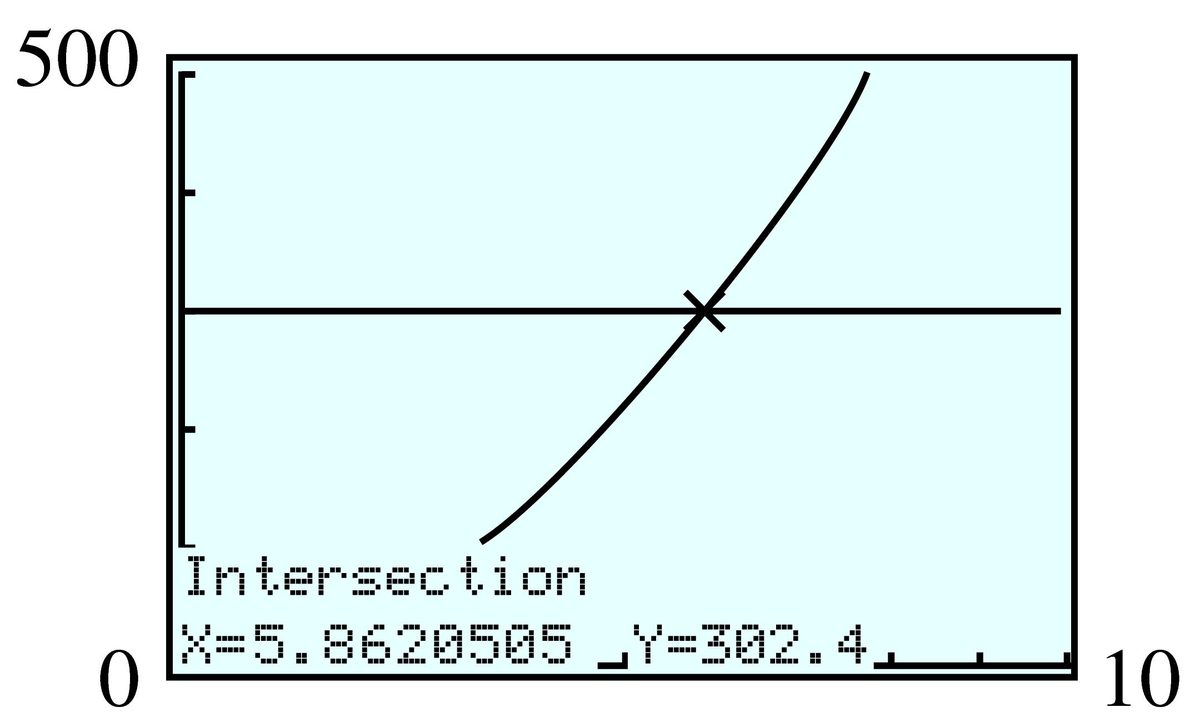
A large bottle of shampoo is centimeters tall and cylindrical in shape.
- Write a formula for the volume of the bottle in terms of its radius.
- Complete the table of values for the volume equation. If you halve the radius of the bottle, by what factor does the volume decrease?
- What radius should the bottle have if it must hold milliliters of shampoo? (One milliliter is equal to 1 cubic centimeter.)
- Use your calculator to graph the volume equation. Locate the point on the graph that corresponds to the bottle in part (c).
For Problems 19–24,
- Make a sketch of the situation described, and label a right triangle.
- Use the Pythagorean theorem to solve each problem. (See Algebra Skills Refresher Facts from Geometry to review the Pythagorean theorem.)
The size of a TV screen is the length of its diagonal. If the width of a -inch TV screen is inches, what is its height?
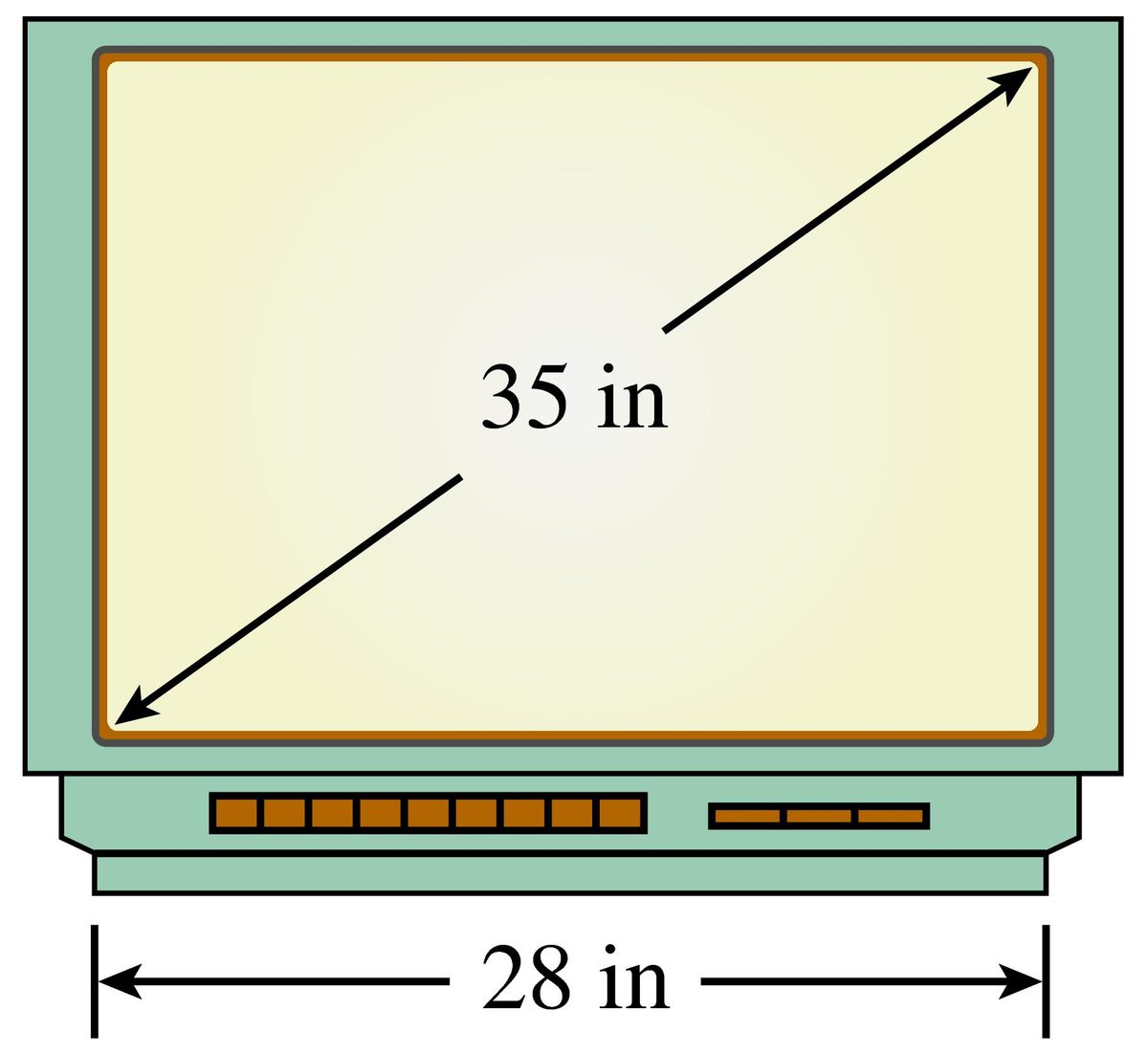
in.
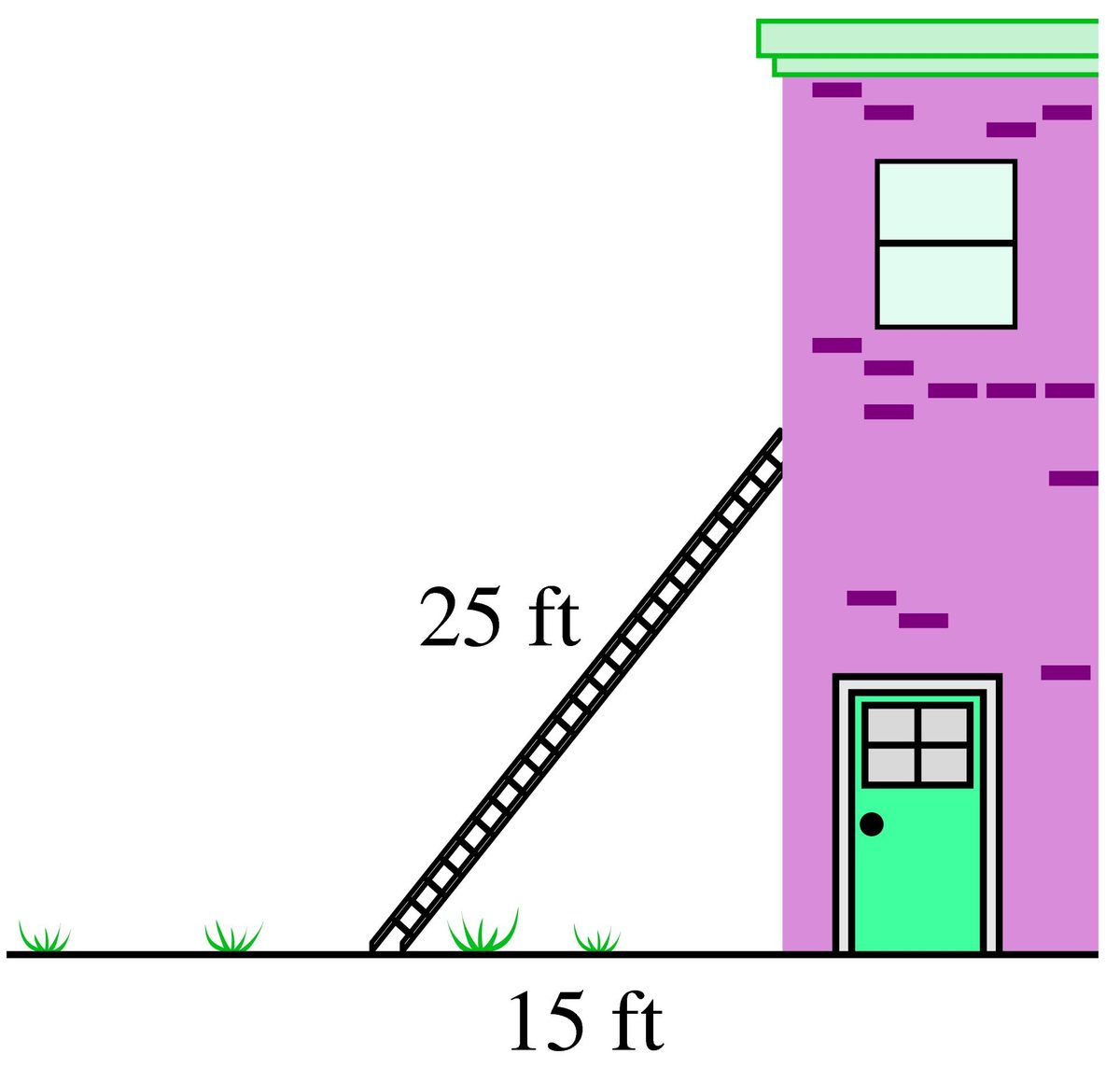
How high on a building will a -foot ladder reach if its foot is feet away from the base of the wall?
If a -meter pine tree casts a shadow of meters, how far is the tip of the shadow from the top of the tree?
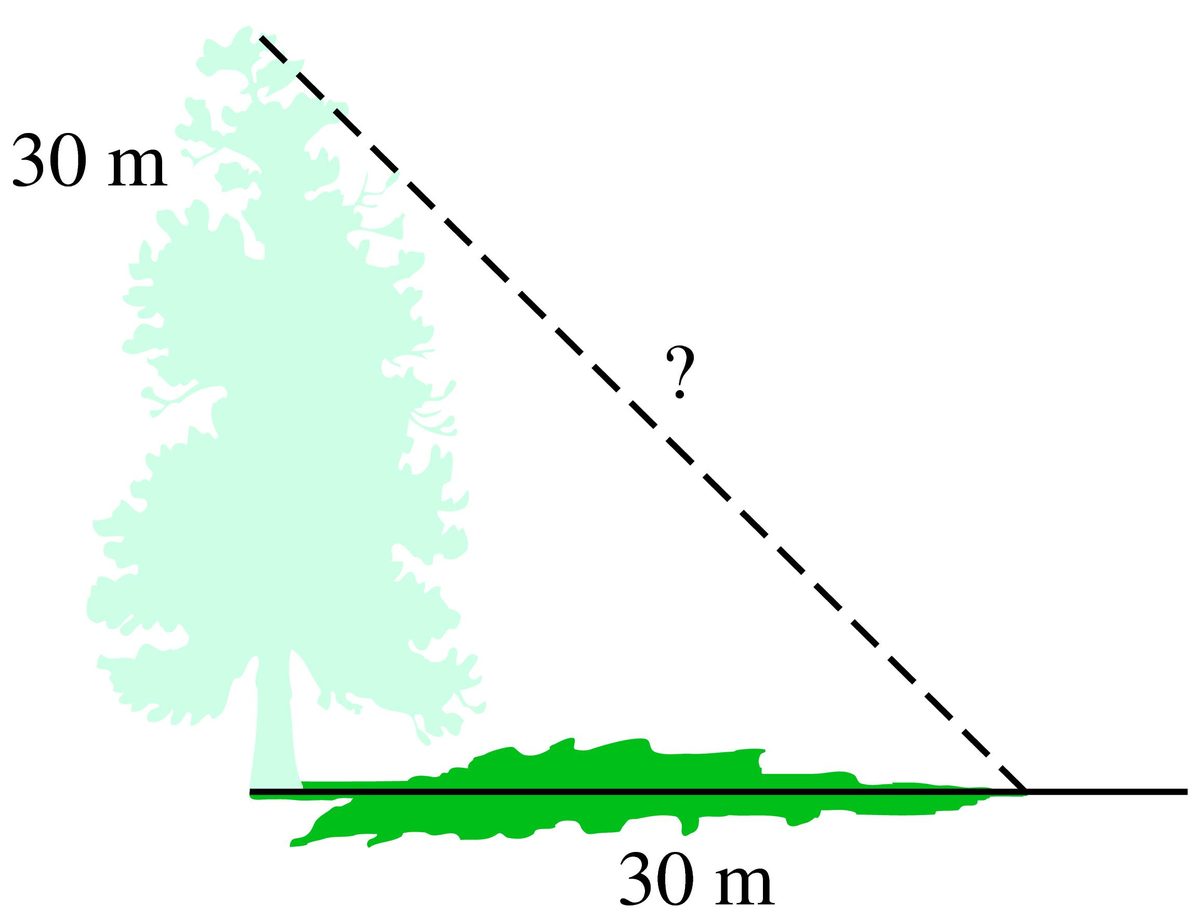
m
A baseball diamond is a square whose sides are feet in length. Find the straight-line distance from home plate to second base.
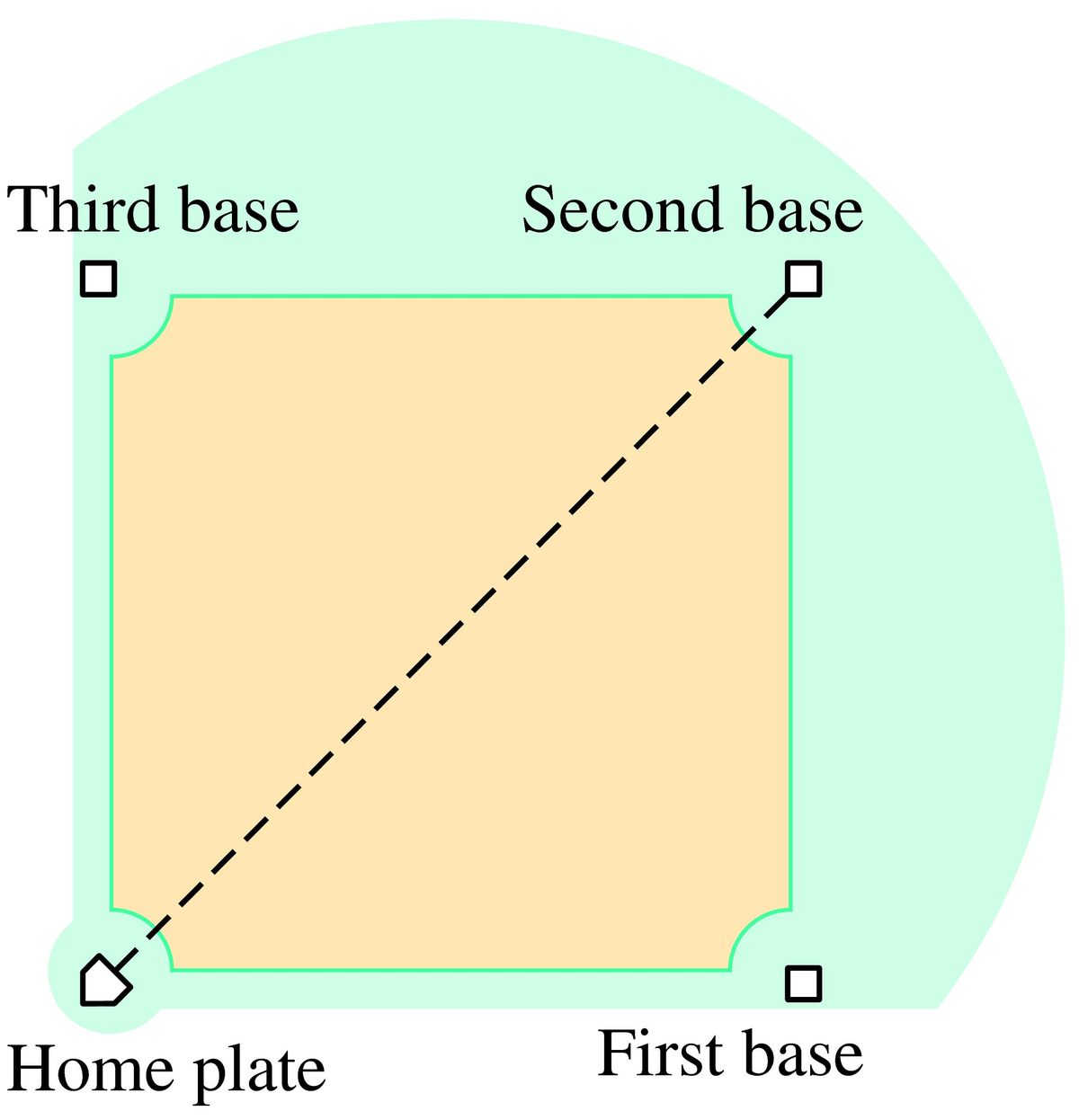
What size square can be inscribed in a circle of radius inches?
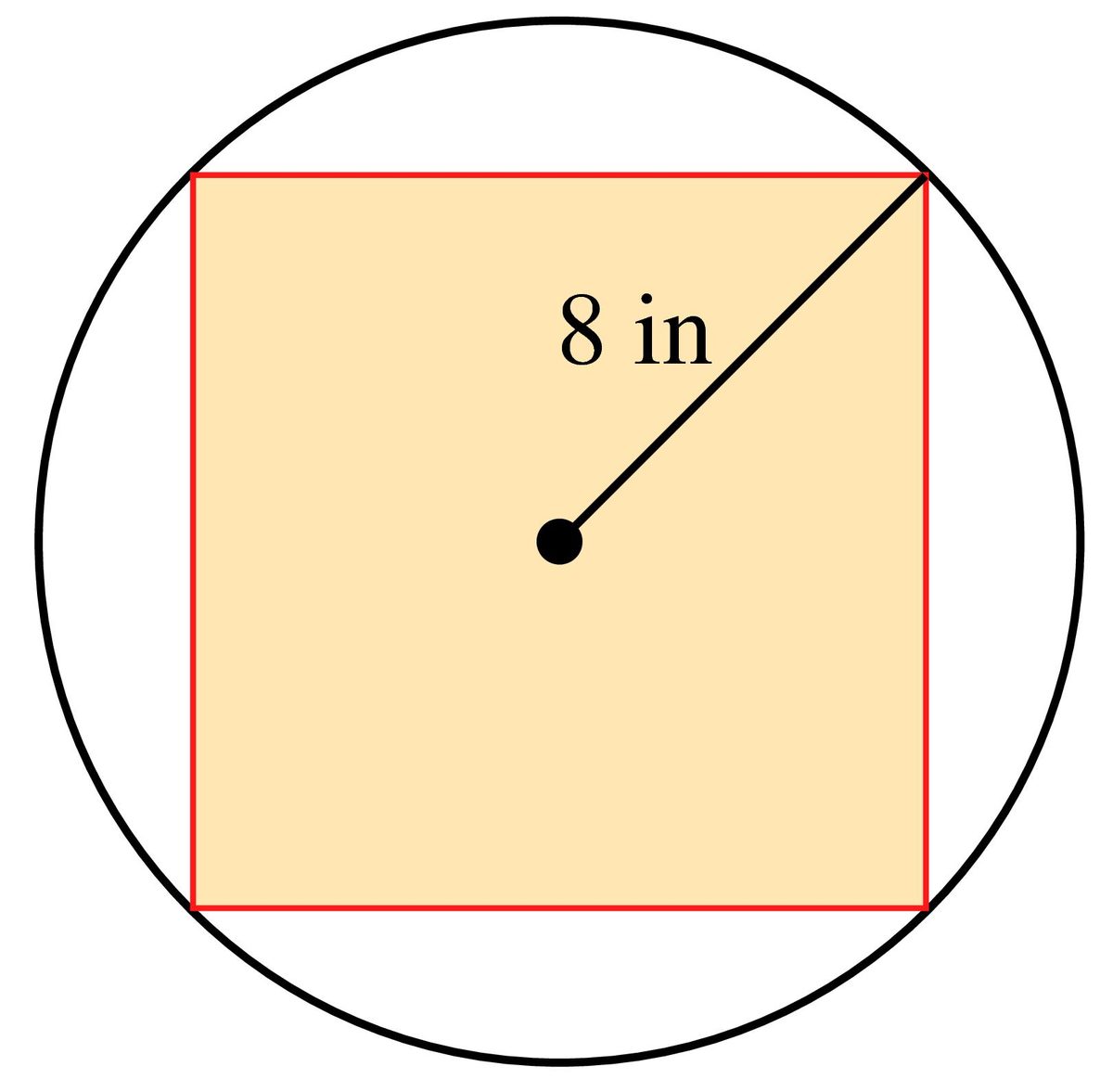
in. by in. in. in.
What size rectangle can be inscribed in a circle of radius 30 feet if the length of the rectangle must be 3 times its width?
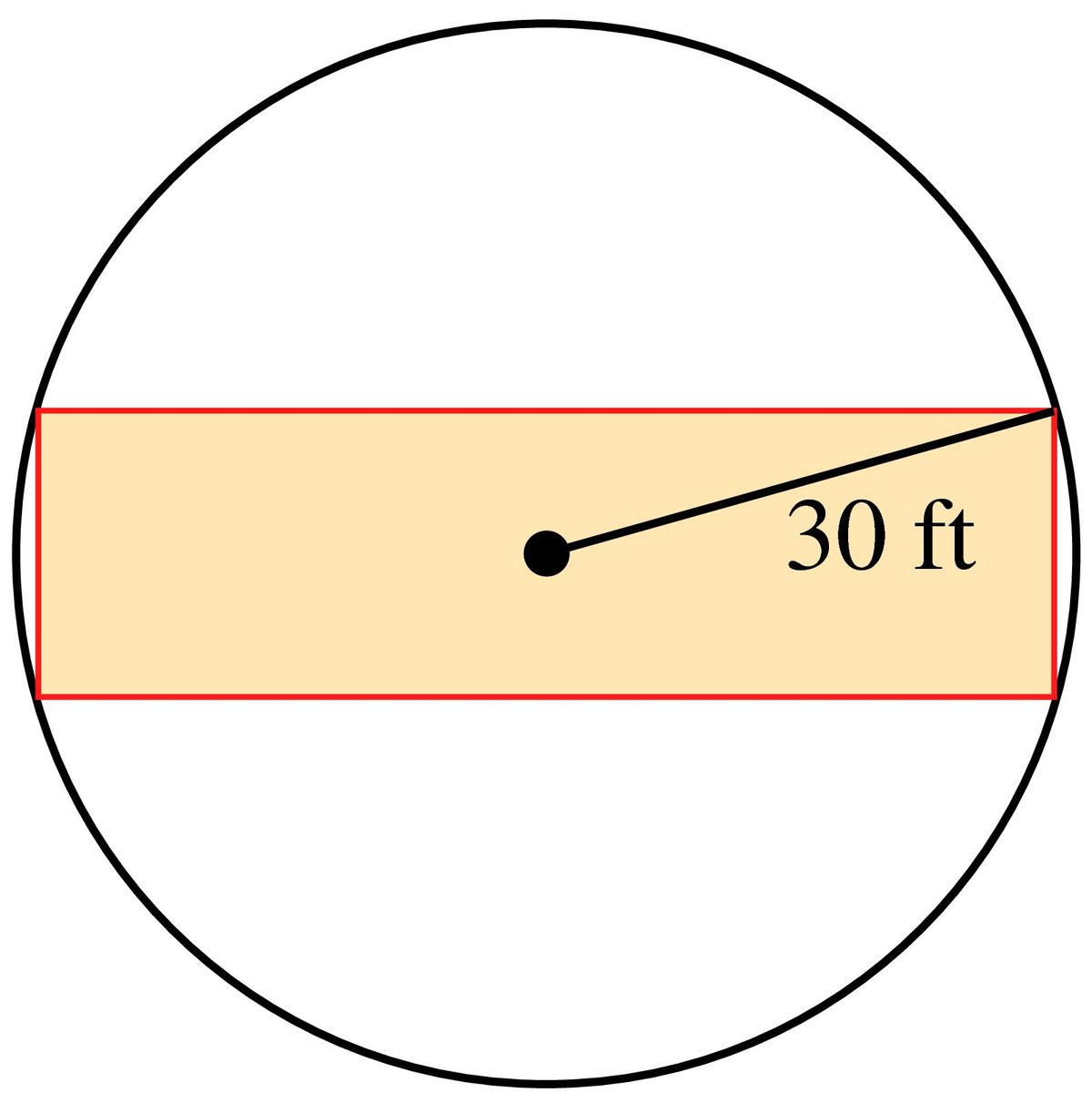
For Problems 25–30,
- Use a calculator or computer to graph the function in the suggested window.
- Use your graph to find two solutions for the given equation. (See Graphs of Functions to review graphical solution of equations.)
- Check your solutions algebraically, using mental arithmetic.
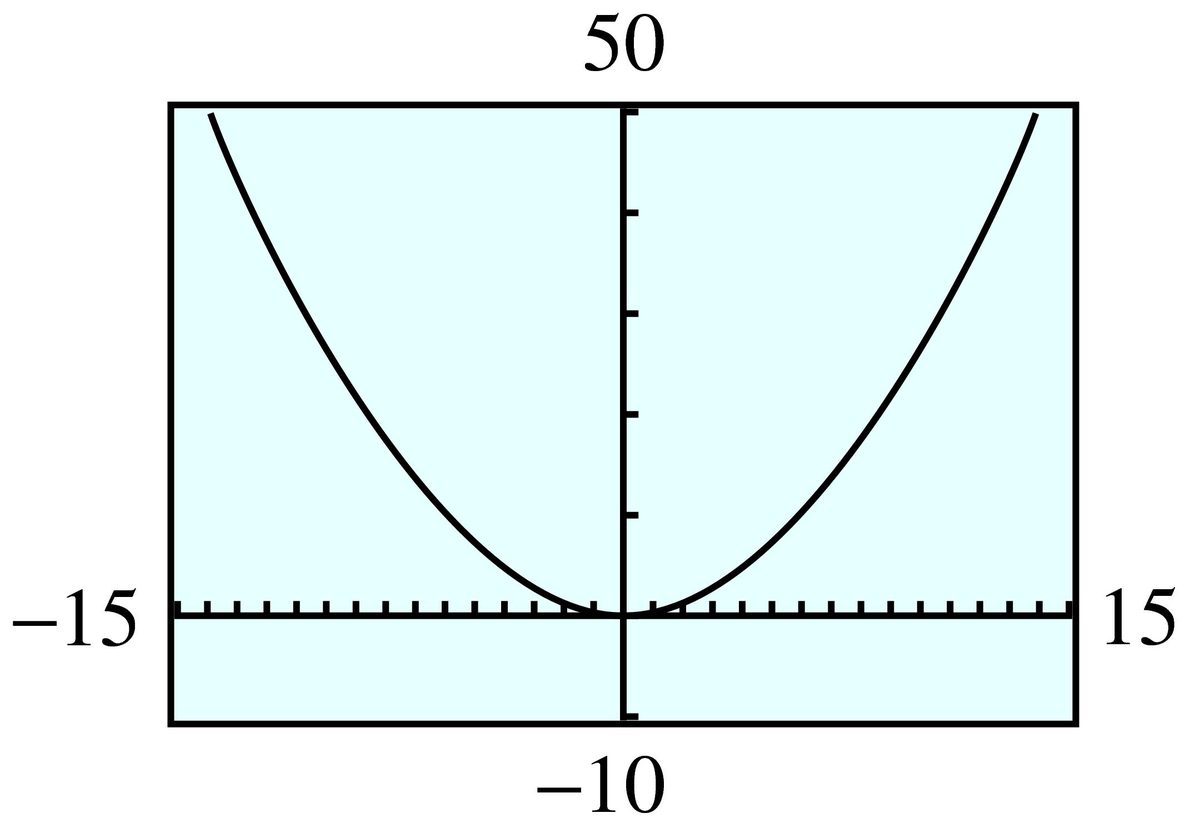
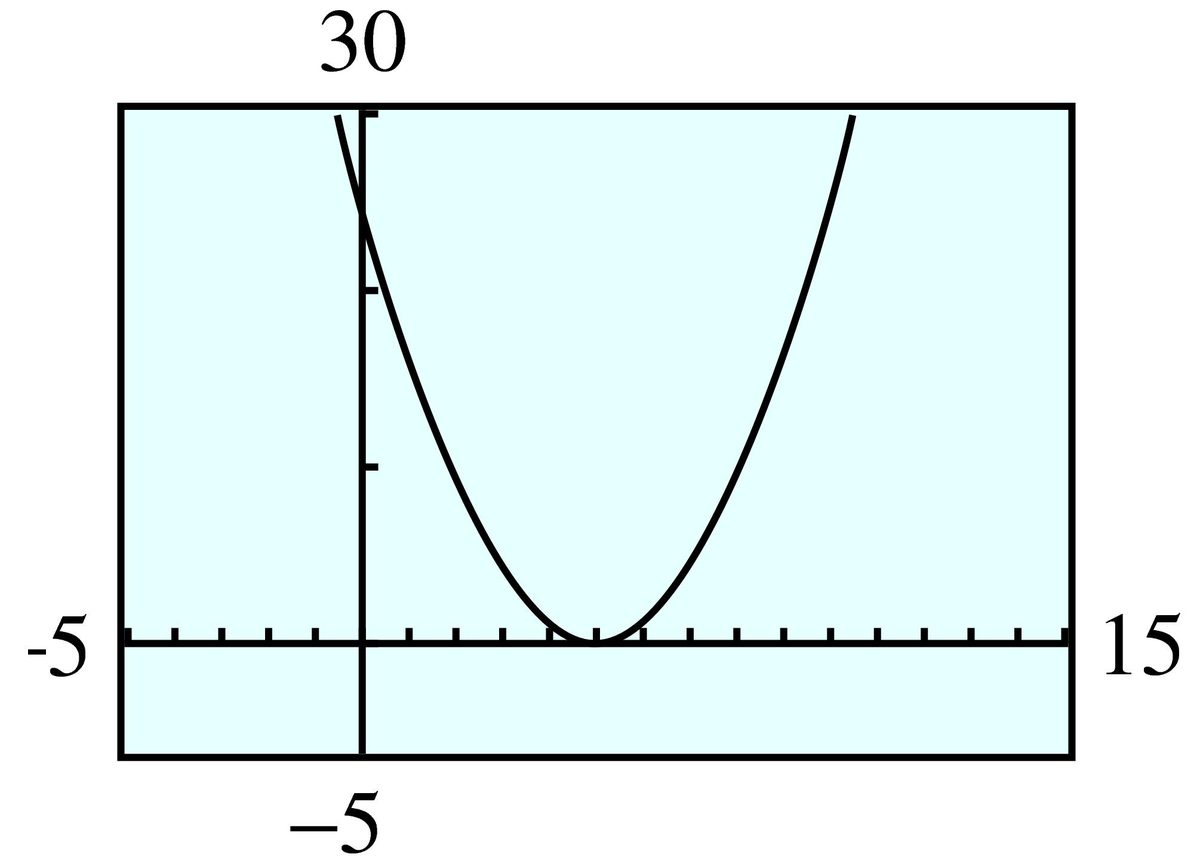
- or
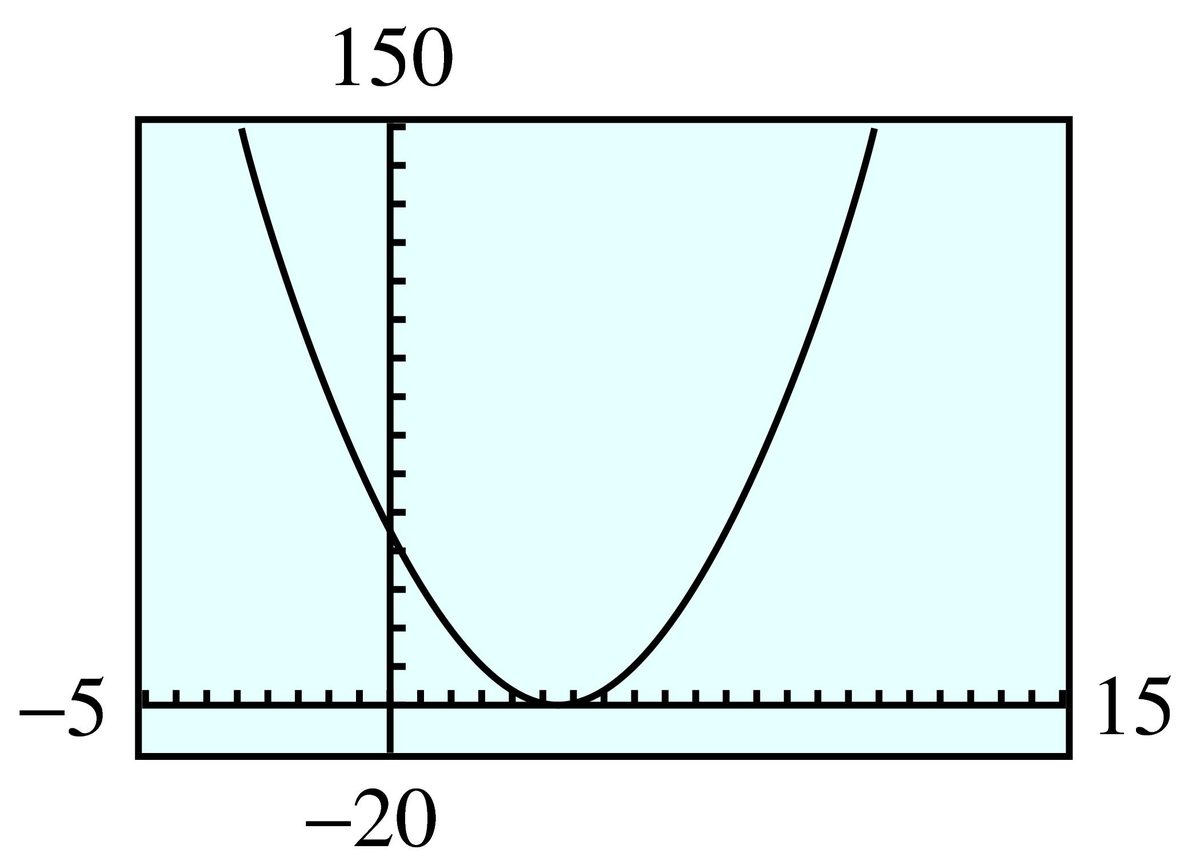
- or
For Problems 31–42, solve by extraction of roots.
For Problems 43–54,
- Solve algebraically.
- Use the intersect feature on a graphing calculator to solve.
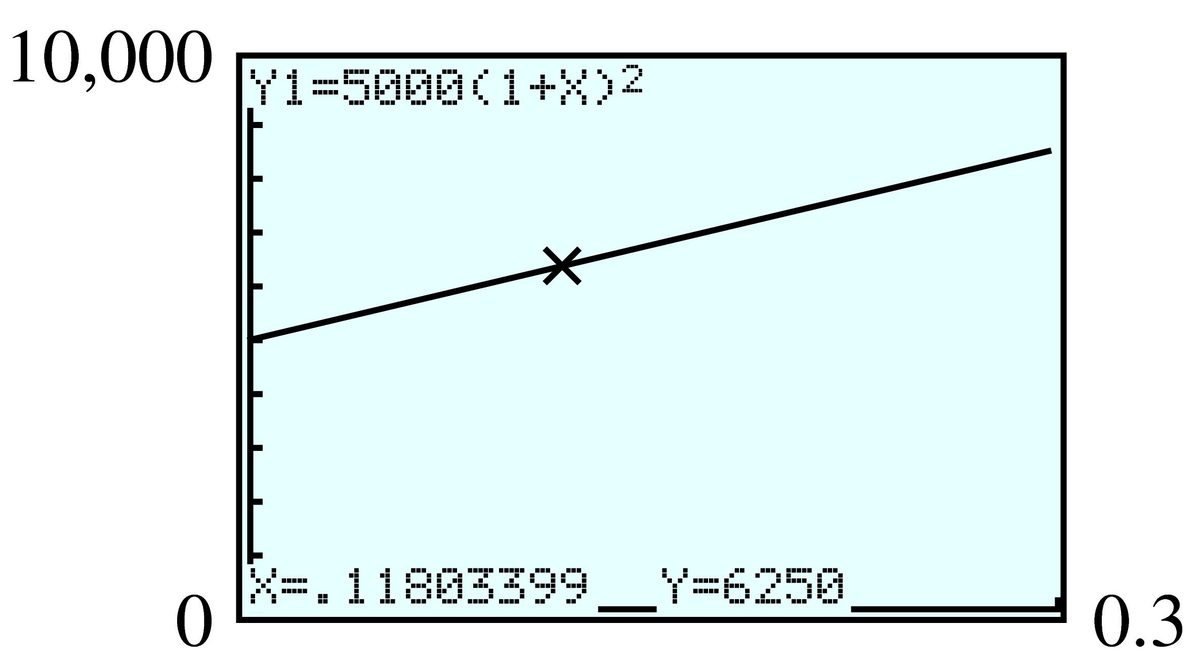
Cyril plans to invest $ in a money market account that pays interest compounded annually.
- Write a formula for the balance, , in Cyril's account after two years as a function of the interest rate, .
- If Cyril would like to have $ in two years, what interest rate must the account pay?
- Use your calculator to graph the formula for Cyril's account balance. Locate the point on the graph that corresponds to the amount in part (b).
You plan to deposit your savings of $ in an account that compounds interest annually.
- Write a formula for the amount in your savings account after two years as a function of the interest rate, .
- To the nearest tenth of a percent, what interest rate will you require if you want your $ to grow to $ in two years?
- Use your calculator to graph the formula for the account balance. Locate the point on the graph that corresponds to the amount in part (b).
Carol's living expenses two years ago were $ per month. This year, the same items cost Carol $ per month. What was the annual inflation rate for the past two years?
Two years ago, the average price of a house in the suburbs was $. This year, the average price is $. What was the annual percent increase in the cost of a house?
A machinist wants to make a metal section of pipe that is millimeters long and has an interior volume of cubic millimeters. If the pipe is millimeters thick, its interior volume is given by the formula
where is the length of the pipe and is its radius. What should the radius of the pipe be?
mm
A storage box for sweaters is constructed from a square sheet of corrugated cardboard measuring inches on a side. The volume of the box, in cubic inches, is
If the box should have a volume of cubic inches, what size cardboard square is needed?
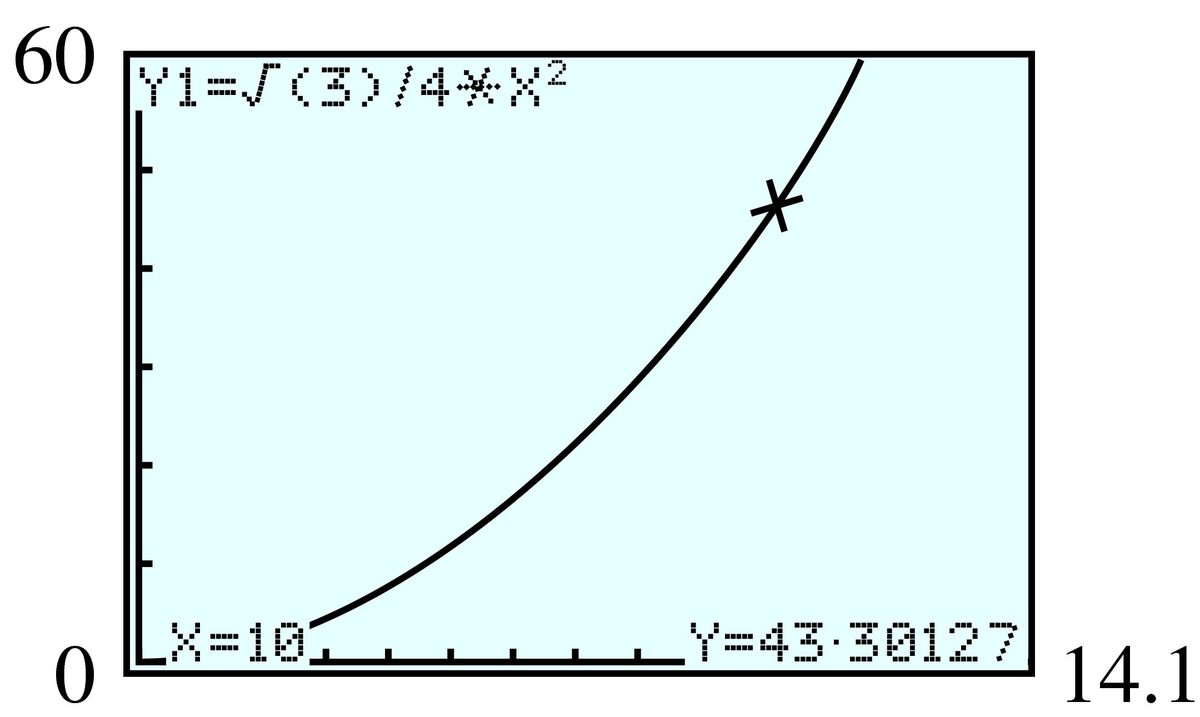
The area of an equilateral triangle is given by the formula , where is the length of the side.
- Find the areas of equilateral triangles with sides of length centimeters, centimeters, and centimeters. First give exact values, then approximations to hundredths.
- Graph the area equation in the window
Use the
TRACEor value feature to verify your answers to part (a). - Trace along the curve to the point . What do the coordinates of this point represent?
- Use your graph to estimate the side of an equilateral triangle whose area is square centimeters.
- Write and solve an equation to answer part (d).
- If the area of an equilateral triangle is square centimeters, what is the length of its side?
- sq cm, sq cm, sq cm
- An equilateral triangle with side cm has area .
- cm
- ;
- cm
The area of the ring in the figure is given by the formula , where is the radius of the outer circle and is the radius of the inner circle.
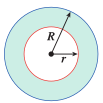
- Suppose the inner radius of the ring is kept fixed at centimeters, but the radius of the outer circle, , is allowed to vary. Find the area of the ring when the outer radius is centimeters, centimeters, and centimeters. First give exact values, then approximations to hundredths.
- Graph the area equation, with r = 4, in the window
Use the
TRACEfeature to verify your answers to part (a). - Trace along the curve to the point . What do the coordinates of this point represent?
- Use your graph to estimate the outer radius of the ring when its area is square centimeters.
- Write and solve an equation to answer part (d).
- If the area of the ring is square centimeters, what is the radius of the outer circle?
For Problems 63–68, solve for in terms of , , and .
You have feet of rope and you want to enclose a rectangular display area against one wall of an exhibit hall. The area enclosed depends on the dimensions of the rectangle you make. Because the wall makes one side of the rectangle, the length of the rope accounts for only three sides. Thus
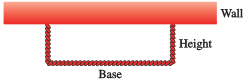
- Complete the table showing the base and the area of the rectangle for the given heights.
Height Base Area Height Base Area - Make a graph with Height on the horizontal axis and Area on the vertical axis. Draw a smooth curve through your data points.
- What is the area of the largest rectangle you can enclose in this way? What are its dimensions? On your graph, label the point that corresponds to this rectangle with the letter .
- Let stand for the height of a rectangle and write algebraic expressions for the base and the area of the rectangle.
- Enter your algebraic expression for the area in your calculator, then use the Table feature to verify the entries in your table in part (a).
- Graph your formula for area on your graphing calculator. Use your table of values and your handdrawn graph to help you choose appropriate
WINDOWsettings. - Use the intersect command to find the height of the rectangle whose area is square feet.
Height Base Area Height Base Area 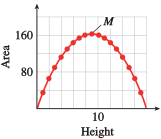
- sq ft, with base ft, height ft
- Base: ; area:
- See (a)
- ft or ft
We are going to make an open box from a square piece of cardboard by cutting -inch squares from each corner and then turning up the edges as shown in the figure.
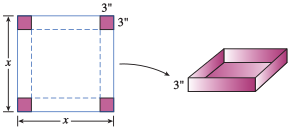
- Complete the table showing the side of the original sheet of cardboard, the dimensions of the box created from it, and the volume of the box.
Side Length
of boxWidth
of boxHeight
of boxVolume
of box
Explain why the side of the cardboard square cannot be smaller than inches. What happens if the cardboard is exactly inches on a side? - Make a graph with Side on the horizontal axis and Volume on the vertical axis. Draw a smooth curve through your data points. (Use your table to help you decide on appropriate scales for the axes.)
- Let represent the side of the original sheet of cardboard. Write algebraic expressions for the dimensions of the box and for its volume.
- Enter your expression for the volume of the box in your calculator; then use the Table feature to verify the values in your table in part (a).
- Graph your formula for volume on your graphing calculator. Use your table of values and your handdrawn graph to help you choose appropriate
WINDOWsettings. - Use the intersect command to find out how large a square of cardboard you need to make a box with volume cubic inches.
- Does your graph have a highest point? What happens to the volume of the box as you increase ?
The jump height, , in meters, achieved by a pole vaulter is given approximately by
, where v is the vaulter's speed in meters per second at the end of his run, and is the gravitational acceleration. (Source: Alexander, 1992)
- Fill in the table of values for jump heights achieved with values of from to meters per second.
- Graph the jump height versus final speed. (Use the table values to help you choose a window for the graph.)
- The jump height should be added to the height of the vaulter's center of gravity (at about hip level) to give the maximum height, , he can clear. For a typical pole vaulter, his center of gravity at the end of the run is meters from the ground. Complete the table of values for maximum heights, , and graph on your graph of .
- A good pole vaulter can reach a final speed of meters per second. What height will he clear?
- In 2016, the world record in pole vaulting, established by Renaud Lavillenie in 2014, was 6.16 meters. What was the vaulter's speed at the end of his run?
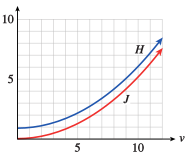
- meters
- meters per second
To be launched into space, a satellite must travel fast enough to escape Earth's gravity. This escape velocity, , satisfies the equation
where is the mass of the satellite, is the mass of the Earth, is the radius of the Earth, and is the universal gravitational constant.
- Solve the equation for in terms of the other variables.
- The equation gives the force of gravity at the Earth's surface. We can use this equation to simplify the expression for : First, multiply both sides of the equation by . You now have an expression for . Substitute this new expression into your formula for .
- The radius of the Earth is about km, and . Calculate the escape velocity from Earth in kilometers per second. Convert your answer to miles per hour. (One kilometer is miles.)
- The radius of the moon is km, and the value of at the moon's surface is . Calculate the escape velocity from the moon in kilometers per second and convert to miles per hour.
Modeling, Functions, and Graphs by Katherine Yoshiwara (yoshiwarabooks.org), GNU Free Documentation License 1.2 or later. Adapted for the XYZ HTML edition with the authors' permission (recorded 2026-07-04). License: GFDL-1.2-or-later.