
2.2 Some Basic Functions
In this section, we study the graphs of some important basic functions. Many functions fall into families or classes of similar functions, and recognizing the appropriate family for a given situation is an important part of modeling.
We begin by reviewing the absolute value.
Absolute Value
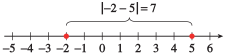
The absolute value is used to discuss problems involving distance. For example, consider the number line shown below. Starting at the origin, we travel in opposite directions to reach the two numbers and , but the distance we travel in each case is the same.
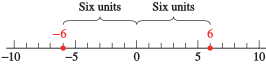
The distance from a number to the origin is called the absolute value of , denoted by . Because distance is never negative, the absolute value of a number is always positive (or zero). Thus, and . In general, we define the absolute value of a number as follows.
If , what can you say about ?
_____
must be zero or negative if .
If , what can you say about ?
- must be zero.
- must be negative.
- must be zero or negative.
- This cannot happen for any value of .
Absolute value bars act like grouping devices in the order of operations: You should complete any operations that appear inside absolute value bars before you compute the absolute value.
Simplify each expression.
- _____
- _____
Simplify each expression.
Examples of Models
Many situations can be modeled by a handful of simple functions. The following examples represent applications of eight useful functions.
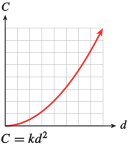
The contractor for a new hotel is estimating the cost of the marble tile for a circular lobby. The cost is a function of the square of the diameter of the lobby.
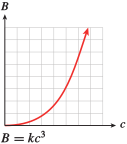
The number of board-feet that can be cut from a Ponderosa pine is a function of the cube of the circumference of the tree at a standard height.
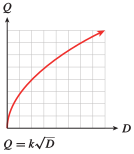
The manager of an appliance store must decide how many coffee-makers to order every quarter. The optimal order size is a function of the square root of the annual demand for coffeemakers.
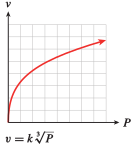
Investors are deciding whether to support a windmill farm. The wind speed needed to generate a given amount of power is a function of the cube root of the power.
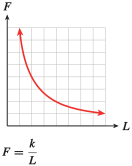
The frequency of the note produced by a violin string is a function of the reciprocal of the length of the string.
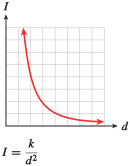
The loudness, or intensity, of the music at a concert is a function of the reciprocal of the square of your distance from the speakers.
The annual return on an investment is a linear function of the interest rate.
You are flying from Los Angeles to New York. Your distance from the Mississippi River is an absolute value function of time.
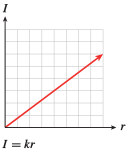
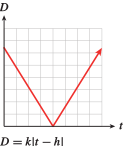
We will consider each of these functions and their applications in more detail in later sections. For now, you should become familiar with the properties of each graph and be able to sketch them easily from memory.
Graphs of Eight Basic Functions
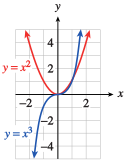
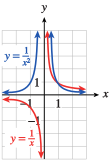
The graphs of the eight basic functions considered in Eight Basic Functions are shown below. Once you know the shape of each graph, you can sketch an accurate picture by plotting a few guidepoints and drawing the curve through those points. Usually, points (or vertical asymptotes!) at , , and make good guidepoints.
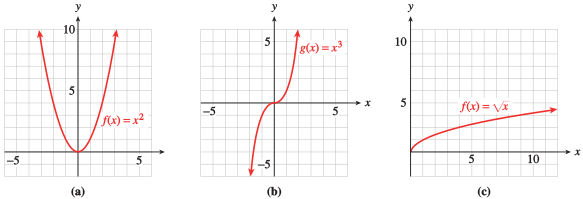
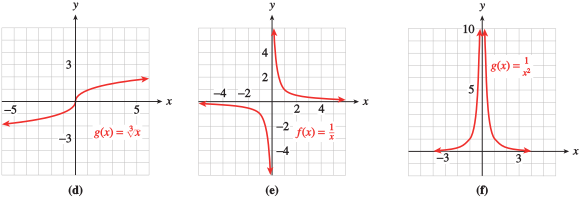
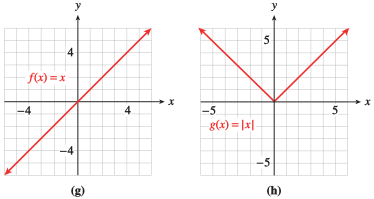
Which of the eight basic functions are undefined at ? Which are undefined for negative ? Which are always positive?
_____
Which of the eight basic functions are undefined at ? Which are undefined for negative ? Which are always positive?
Some Properties of Absolute Value
In Functions, we saw that for most functions, is not equal to . We may be able to find some values of and for which is true, but if it is not true for all values of and , we cannot claim that for that function.
For example, for the function , if we choose and , then
so we have proved that for the squaring function. (In fact, we already knew this because as long as neither nor is .)
What about multiplication? Which of the basic functions have the property that for all and ? You will consider this question in the homework problems, but in particular you will need to recall the following properties of absolute value.
Verify the multiplicative property of absolute value for the three cases in the previous example.
- Case and
Does ? _____ - Case and
Does ? _____ - Case and
Does ? _____
Verify the multiplicative property of absolute value for the three cases in the previous example.
- Case and
Does ? - Case and
Does ? - Case and
Does ?
Which of these is true for all and ?
_____
for all and .
Which of these is true for all and ?
Functions Defined Piecewise
A function may be defined by different formulas on different portions of the -axis. Such a function is said to be defined piecewise. To graph a function defined piecewise, we consider each piece of the -axis separately.
Graph the piecewise defined function
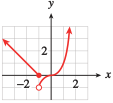
Graph the piecewise defined function
In Practice 3, what is the value of ?
- undefined
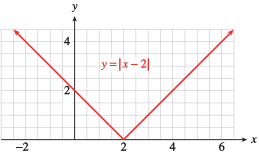
The absolute value function is an example of a function that is defined piecewise.
To sketch the absolute value function, we graph the line in the first quadrant and the line in the second quadrant.
- Use your graphing utility to graph and . Are the graphs the same? _____
- Explain why the functions and are not the same if .
_____
- No, the graphs of and are not the same.
- Because when and have opposite signs.
- Use your graphing utility to graph and . Are the graphs the same?
- Explain why the functions and are not the same if .
- No, the graphs of and are not the same.
- Because when and have opposite signs.
What relationship do you see between the graphs of and ? Between the graphs of and ?
_____
What relationship do you see between the graphs of and ? Between the graphs of and ?
Section Summary
Vocabulary
Look up the definitions of new terms in the Glossary.
- Absolute value
- Verify
- Triangle inequality
- Vertical asymptote
- Rational function
- Parabola
- Piecewise defined function
- Multiplicative property
- Guidepoints
- Horizontal asymptote
- Cubic
CONCEPTS
- The absolute value of is defined by
-
The absolute value has the following properties:
Triangle inequality Multiplicative property - Many useful functions fall into families or classes of variations on basic functions.
- We can make sketches of the eight basic functions using guidepoints.
- Functions can be defined piecewise, with different formulas on different intervals.
STUDY QUESTIONS
- Is it true that must be a negative number? Why or why not?
- Are there any numbers for which ?
- If , which is larger, or ?
- If , which is larger, or ?
- List the eight basic functions considered in this section.
- Which of the eight basic functions have a horizontal asymptote? A vertical asymptote?
- What does an open circle on a graph mean?
- For what value(s) of does ?
SKILLS
Practice each skill in the Homework problems listed.
- Simplify expressions containing absolute values: #1–10
- Sketch graphs of the basic functions by hand: #15–18
- Identify the graph of a basic function: #19–26
- Solve equations and inequalities graphically: #11–14, 27–34
- Graph functions defined piecewise: #41–58
Homework 2.2
For problems 1–10, simplify the expression according to the order of operations.
In Problems 11–14, show how to use the graphs to find the values. Estimate your answers to one decimal point. Compare your estimates to values obtained with a calculator.
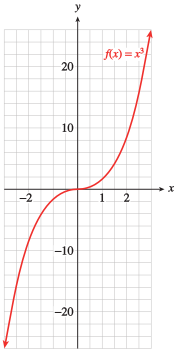
Refer to the graph of .
- Estimate the value of .
- Find all numbers whose cubes are .
- Find all solutions of the equation .
- Estimate the value of .
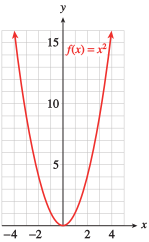
Refer to the graph of .
- Estimate the value of .
- Find all numbers whose squares are .
- Find all solutions of the equation .
- Estimate the value of .
Refer to the graph of .
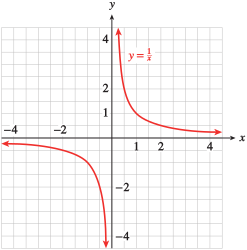
- Estimate the value of .
- Find all numbers whose reciprocals are .
- Find all solutions of the equation .
Refer to the graph of .
- Estimate the value of .
- Find all values of for which .
- Find all solutions of the equation .
For Problems 15–18,
- Sketch both functions on the same grid, paying attention to the shape of the graph. Plot at least three guidepoints for each graph to ensure accuracy.
- Use the graph to find all solutions of the equation .
- On what intervals is ?
- and
For Problems 19–24, graph each set of functions together in an appropriate window. Describe how graphs (b) and (c) are different from the basic graph.
Graph (b) is the basic graph shifted 2 units down; graph (c) is the basic graph shifted 1 unit up.
Graph (b) is the basic graph shifted 1.5 units left; graph (c) is the basic graph shifted 1 unit right.
Graph (b) is the basic graph reflected about the -axis; graph (c) is the basic graph reflected about the -axis.
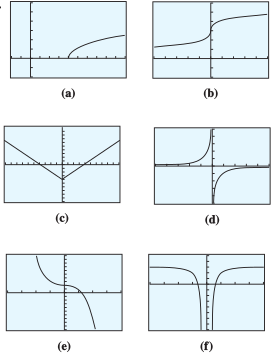
Each graph in Problems 25–26 is a variation of one of the eight basic graphs of Eight Basic Functions. Identify the basic graph for each problem.
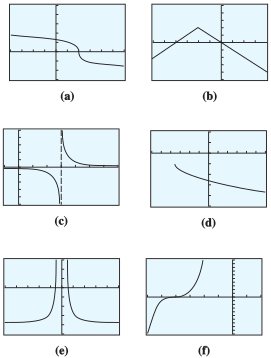
In Problems 27–30, use the graph to estimate the solution to the equation or inequality. Show the solution or solutions on the graph. Then check your answers algebraically.
The figure shows a graph of , for . Solve the following:
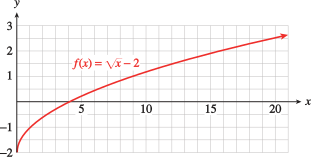
The figure shows a graph of , for . Solve the following:
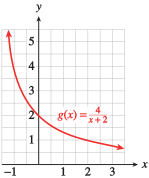
The figure shows a graph of . Solve the following:
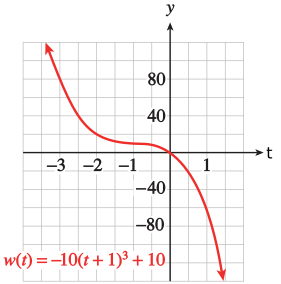
The figure shows a graph of . Solve the following:
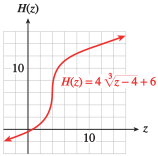
For Problems 31–34, graph the function with the ZInteger setting. Use the graph to solve each equation or inequality. Check your solutions algebraically.
Graph .
- Solve
- Solve
Graph .
- Solve
- Solve
Graph .
- Solve
- Solve
- or
Graph .
- Solve
- Solve
For Problems 35–40,
- Graph the equation by completing the table and plotting points.
- Does the equation define as a function of ? Why or why not?
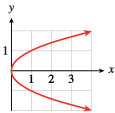
- no
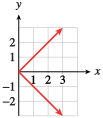
- no
undefined 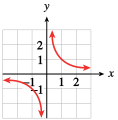
- yes
For Problems 41–52, graph the following piecewise defined functions. Indicate whether the endpoints of each piece are included on the graph.
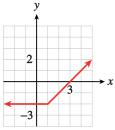
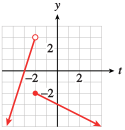
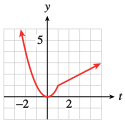
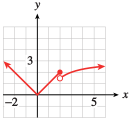
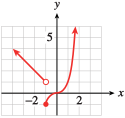
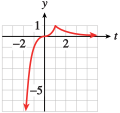
For Problems 53–58, write a piecewise definition for the function and sketch its graph.
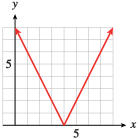
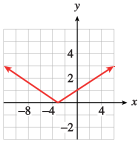
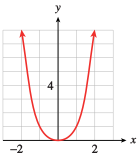
In Problems 59–64, decide whether each statement is true for all values of and . If the statement is true, give an algebraic justification. If it is false, find values of and to disprove it.
- Not always true: because .
- True:
- Not always true: because .
- True:
- Not always true (unless ): because .
- Not always true: because .
Verify that gives the distance between and on a number line.
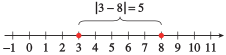
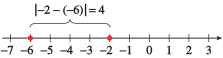
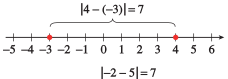
Which of the following statements is true for all values of and ?
Explain how the distributive law, , is different from the equation .
The distributive law shows a relationship between multiplication and addition that always holds. The equation is not about multiplication and may or may not be true.
For each function, decide whether for all , where is a constant.
Modeling, Functions, and Graphs by Katherine Yoshiwara (yoshiwarabooks.org), GNU Free Documentation License 1.2 or later. Adapted for the XYZ HTML edition with the authors' permission (recorded 2026-07-04). License: GFDL-1.2-or-later.