
4.5 Exponential Models
Fitting an Exponential Function through Two Points
To write a formula for an exponential function, we need to know the initial value, , and the growth or decay factor, . We can find these two parameters if we know any two function values.
However, if we already know that we are looking for an exponential function, we can follow the steps below to find its formula. This method is sometimes called the ratio method. (Of course, if one of the known function values is the initial value, we can find without resorting to the ratio method.)
Use the ratio method to find an exponential function whose graph includes the points and .
_____
Use the ratio method to find an exponential function whose graph includes the points and .
We solve the system
to find
You have written a system of equations to fit an exponential function through two points. What is the next step?
_____
Divide one equation by the other.
You have written a system of equations to fit an exponential function through two points. What is the next step?
- Calculate the slope.
- Subtract one equation from the other.
- Divide one equation by the other.
- Take the log of both sides.
We can use the ratio method to find an exponential growth or decay model if we know two function values.
The number of earthquakes that occur worldwide is a decreasing exponential function of their magnitude on the Richter scale. Between 2000 and 2005, there were 7480 earthquakes of magnitude 5 and 793 earthquakes of magnitude 6. (Source: National Earthquake Information Center, U.S. Geological Survey)
- Find a formula for the number of earthquakes, , in terms of their magnitude.
_____
Do not use any commas: For example, instead of "10,000" enter simply "10000". - It is difficult to keep an accurate count of small earthquakes. Use your formula to estimate the number of magnitude 1 earthquakes that occurred between 2000 and 2005. _____
How many earthquakes of magnitude 8 occurred? _____
- ;
The number of earthquakes that occur worldwide is a decreasing exponential function of their magnitude on the Richter scale. Between 2000 and 2005, there were 7480 earthquakes of magnitude 5 and 793 earthquakes of magnitude 6. (Source: National Earthquake Information Center, U.S. Geological Survey)
- Find a formula for the number of earthquakes, , in terms of their magnitude.
- It is difficult to keep an accurate count of small earthquakes. Use your formula to estimate the number of magnitude 1 earthquakes that occurred between 2000 and 2005. How many earthquakes of magnitude 8 occurred?
- We solve the system to find
- magnitude 1: ; magnitude 8:
Doubling Time
Instead of giving the rate of growth of a population, we can specify its rate of growth by giving the time it takes for the population to double.
In Example, it took the population years to double. Notice that the calculations in parts (a) and (b) are identical after the first step. In fact, we can start at any point, and it will take the population years to double. We say that years is the doubling time for this population. In the Homework problems, you will show that any increasing exponential function has a constant doubling time.
Which statement is true?
_____
An increasing exponential function has a constant doubling time.
Which statement is true?
- The doubling time of a population depends on its initial value.
- An increasing exponential function has a constant doubling time.
- The doubling time is twice the percent growth rate.
- The doubling time is half the percent growth rate.
In 2005, the population of Uganda was 26.9 million people and was growing by 3.2% per year.
- Write a formula for the population of Uganda as a function of years since 2005.
_____ million - How long will it take the population of Uganda to double?
_____ years - Use your formula from part (a) to verify the doubling time for three doubling periods.
- million
- We solve to find years
- million
- years
- ; , i.e., ; , i.e., ; , i.e.,
In 2005, the population of Uganda was 26.9 million people and was growing by 3.2% per year.
- Write a formula for the population of Uganda as a function of years since 2005.
- How long will it take the population of Uganda to double?
- Use your formula from part (a) to verify the doubling time for three doubling periods.
- million
- We solve to find years
- and , so ;
, so ;
, so
If we know the doubling time for a population, we can immediately write down its growth law. Because the population of Egypt doubles in 35 years, we can write
In this form, the growth factor for the population is , and you can check that, to five decimal places, .
The formula tells us that:
_____
After years, .
The formula tells us that:
- is twice the initial value.
- After 2 years, .
- After years, .
- grows by a factor of .
So, from knowing the doubling time, we can easily find the growth rate of a population.
At its current rate of growth, the population of Mexico will double in 36.8 years. What is its annual percent rate of growth?
Answer: _____%
1.9%
At its current rate of growth, the population of Mexico will double in 36.8 years. What is its annual percent rate of growth?
We use the doubling time formula with to find .
How can you find the growth factor for an exponential function when you know its doubling time?
_____
How can you find the growth factor for an exponential function when you know its doubling time?
Half-Life
The half-life of a decreasing exponential function is the time it takes for the output to decrease to half its original value. For example, the half-life of a radioactive isotope is the time it takes for half of the substance to decay. The half-life of a drug is the time it takes for half of the drug to be eliminated from the body. Like the doubling time, the half-life is constant for a particular function; no matter where you start, it takes the same amount of time to reach half that value.
The half-life of DDT is 15 years. This means that:
_____
After 30 years, 100 pounds of DDT is reduced to 25 pounds.
The half-life of DDT is 15 years. This means that:
- 30 pounds of DDT dissolve in one year.
- 100 pounds of DDT dissolve in 30 years.
- After 30 years, 100 pounds of DDT is reduced to 25 pounds.
- Each half-pound of DDT takes 15 years to dissolve.
Alcohol is eliminated from the body at a rate of 15% per hour.
- Write a decay formula for the amount of alcohol remaining in the body, using for the initial amount of alcohol. [Note: Enter "A" to get .].
_____ - What is the half-life of alcohol in the body?
_____ hours
- hours
Alcohol is eliminated from the body at a rate of 15% per hour.
- Write a decay formula for the amount of alcohol remaining in the body, using for the initial amount of alcohol.
- What is the half-life of alcohol in the body?
- hours
Just as we can write an exponential growth law in terms of its doubling time, we can use the half-life to write a formula for exponential decay. For example, the half-life of ibuprofen is hours, so every hours the amount remaining is reduced by a factor of . After hours a -mg dose will be reduced to
Once again, you can check that this formula is equivalent to the decay function given in Example.
Radioactive isotopes are molecules that decay into more stable molecules, emitting radiation in the process. Although radiation in large doses is harmful to living things, radioactive isotopes are useful as tracers in medicine and industry, and as treatment against cancer. The decay laws for radioactive isotopes are often given in terms of their half-lives.
Cesium-137, with a half-life of 30 years, is one of the most dangerous by-products of nuclear fission. What is the annual decay rate for cesium-137?
Answer: _____%
Cesium-137, with a half-life of 30 years, is one of the most dangerous by-products of nuclear fission. What is the annual decay rate for cesium-137?
We use the half-life formula with to find .
How can you use the half-life to sketch a graph of an exponential function?
_____
How can you use the half-life to sketch a graph of an exponential function?
Annuities and Amortization
An annuity is a sequence of equal payments or deposits made at equal time intervals. A retirement fund is an example of an annuity. For ordinary annuities, payments are made at the end of each compounding period. The future value of an annuity is the sum of all the payments plus all the interest earned.
Rufus is saving for a new car. He puts $2500 a year into an account that pays 4% interest compounded annually. How many years will it take him to accumulate $20,000? (Round up to the next whole year.)
Answer: _____ years
8 years
Rufus is saving for a new car. He puts $2500 a year into an account that pays 4% interest compounded annually. How many years will it take him to accumulate $20,000? (Round up to the next whole year.)
We solve the future value formula for :
to find years
In Example, we knew the monthly deposits into the annuity and calculated how much the sum of all the deposits (plus interest) would be in the future. Now imagine that you have just retired and you want to begin drawing monthly payments from your retirement fund. The total amount accumulated in your fund is now its present value, and that amount must cover your future withdrawal payments.
Payments on a loan, such as a home mortgage, are also an annuity, but in this case the monthly payments do not collect interest; instead, we must pay interest on the present value of the loan. Repaying a loan (plus interest) by making a sequence of equal payments is called amortizing the loan.
Use the formula for the present value of an annuity to calculate your monthly mortgage payment on a home loan of $250,000 amortized over 30 years at 6% interest compounded monthly.
$_____
Use the formula for the present value of an annuity to calculate your monthly mortgage payment on a home loan of $250,000 amortized over 30 years at 6% interest compounded monthly.
We solve the present value formula for :
to find
Section Summary
Vocabulary
Look up the definitions of new terms in the Glossary.
- Doubling time
- Amortization
- Half-life
- Annuity
CONCEPTS
- We can use the ratio method to fit an exponential function through two points.
- Every increasing exponential has a fixed doubling time. Every decreasing exponential function has a fixed half-life.
- If is the doubling time for a population, its growth law can be written as .
- If is the half-life for a quantity, its decay law can be written as .
STUDY QUESTIONS
- Compare the methods for fitting a line through two points and fitting an exponential function through two points.
- A population of million people has a doubling time of years. What is the population years from now? years from now? years from now?
- Francine says that because the half-life of radium-223 is days, after days it will have all decayed. Is she correct? Why or why not?
- Which is larger: the sum of all the deposits you make into your retirement fund, or the future value of the fund? Why?
- Which is larger: the sum of all the payments you make towards your mortgage, or the amount of the loan? Why?
SKILLS
Practice each skill in the Homework problems listed.
- Fit an exponential function through two points: #1–18
- Find the doubling time or half-life: #19–26
- Write an exponential function, given the doubling time or half-life: #27–34, #39–42
- Use the formula for future value of an annuity: #43 and 44
- Use the formula for present value of an annuity: #45 and 46
Homework 4.5
For Problems 1–8, find an exponential function that has the given values.
,
,
,
,
,
,
,
,
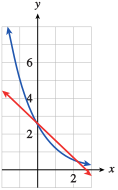
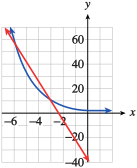
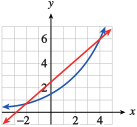
For Problems 9–12, find a formula for the exponential function shown.
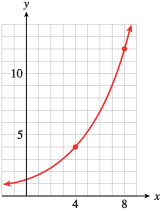
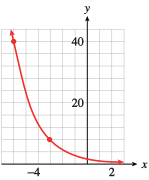
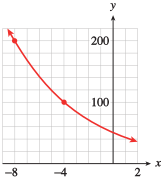
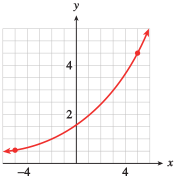
For Problems 13–18,
- Fit a linear function to the points.
- Fit an exponential function to the points.
- Graph both functions in the same window.
Nevada was the fastest growing state in the nation between and , with an annual growth rate of over .
- Write a function for the population of Nevada as a function of time. Let the initial population be .
- How long will it take for the population to double?
- In , the population of Nevada was hundred thousand. Graph your function in the window , , , .
- Use intersect to verify that the population doubles from to , from to , and from to hundred thousand people in equal periods of time.
- ; is the number of years since .
- years
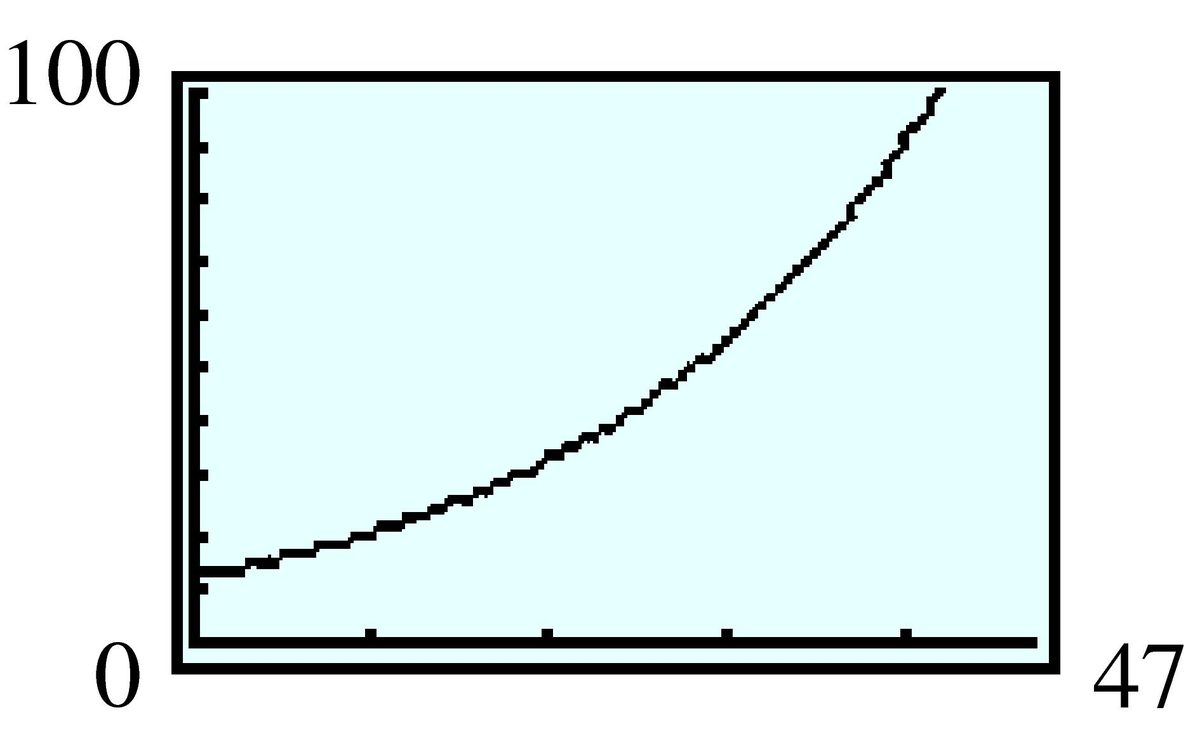
In 1986, the inflation rate in Bolivia was annually. The unit of currency in Bolivia is the boliviano.
- Write a formula for the price of an item as a function of time. Let be its initial price.
- How long did it take for prices to double? Give both an exact value and a decimal approximation rounded to two decimal places.
- Suppose bolivianos. Graph your function in the window , , , .
- Use intersect to verify that the price of the item doubles from to bolivianos, from to , and from to in equal periods of time.
The gross domestic product (GDP) of the United Kingdom was million pounds in the year and is growing at a rate of per year. (The unit of currency in the U.K. is the pound, denoted by £.)
- Write a formula for the GDP as a function of years since .
- How long will it take for the GDP to grow to million pounds? Give both an exact value and a decimal approximation rounded to two decimal places.
- How long should it take for the GDP to million pounds?
- Using your answers to (b) and (c), make a rough sketch of the function.
- million pounds
- years
- years
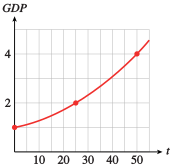
The number of phishing Web sites (fraudulent Web sites designed to trick victims into revealing personal financial information) is growing by each month. In June , there were phishing Web sites. (Source: www.itnews.com.au/newsstory)
- Write a formula for the number of phishing Web sites as a function of months since June .
- How long will it take for the number of sites to reach ? Give both an exact value and a decimal approximation rounded to two decimal places.
- How long should it take for the number of sites to reach ?
- Using your answers to (b) and (c), make a rough sketch of the function.
Radioactive potassium-42, which is used by cardiologists as a tracer, decays at a rate of per hour.
- Find the half-life of potassium-42.
- How long will it take for three-fourths of the sample to decay? For seven-eighths of the sample?
- Suppose you start with milligrams of potassium-42. Using your answers to (a) and (b), make a rough sketch of the decay function.
- hours
- hours
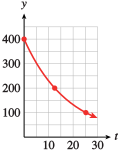
In October 2005, the Los Angeles Times published an article about efforts to save the endangered Channel Island foxes. "Their population declined by to about between and , according to the park service."
- What was the fox population in ?
- Write a formula for the fox population as a function of time since , assuming that their numbers declined exponentially.
- How long did it take for the fox population to be reduced to half its level? To one-quarter of the level?
- Using your answers to part (c), make a rough sketch of the decay function.
Caffeine leaves the body at a rate of each hour. Your first cup of coffee in the morning has mg of caffeine.
- How long will it take before you have mg of that caffeine in your body?
- How long will it take before you have mg of that caffeine in your body?
- Using your answers to (a) and (b), make a rough sketch of the decay function.
- hours
- hours
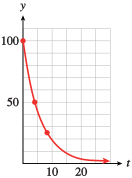
Pregnant women should monitor their intake of caffeine, because it leaves the body more slowly during pregnancy and can be absorbed by the unborn child through the bloodstream. Caffeine leaves a pregnant woman's body at a rate of each hour.
- How long will it take before the mg of caffeine in a cup of coffee is reduced to mg?
- How long will it take before the mg of caffeine in a cup of coffee is reduced to mg?
- Make a rough sketch of the decay function, and compare with the graph in Problem 25.
For Problems 27–30,
- Write a growth or decay formula for the exponential function.
- Find the percent growth or decay rate.
A population starts with and has a doubling time of years.
You have grams of a radioactive isotope whose half-life is years.
A certain medication has a half-life of hours in the body. You are given an initial dose of mg.
The doubling time of a certain financial investment is years. You invest an amount .
The half-life of radium-226 is years.
- Write a decay law for radium-226.
- What is the annual decay rate for radium-226?
Dichloro-diphenyl-trichloroethane (DDT) is a pesticide that was used in the middle decades of the twentieth century to control malaria. After 1945, it was also widely used on crops in the United States, and as much as one ton might be sprayed on a single cotton field. However, after the toxic effects of DDT on the environment began to appear, the chemical was banned in 1972.
- A common estimate for the half-life of DDT in the soil is years. Write a decay law for DDT in the soil.
- In 1970, many soil samples in the United States contained about mg of DDT per kg of soil. The NOAA (National Oceanic and Atmospheric Administration) safe level for DDT in the soil is mg/kg. When will DDT content in the soil be reduced to a safe level?
In 1798, the English political economist Thomas R. Malthus claimed that human populations, unchecked by environmental or social constraints, double every years, regardless of the initial population size.
- Write a growth law for human populations under these conditions.
- What is the growth rate in unconstrained conditions?
David Sifry observed in 2005 that over the previous two years, the number of Weblogs, or blogs, was doubling every months. (Source: www.sifry.com/alerts/archives)
- Write a formula for the number of blogs years after January 2005, assuming it continues to grow at the same rate.
- What is the growth rate for the number of blogs?
Let be an exponential growth function, with and .
- Suppose that the value of doubles from to , so that Rewrite this fact as an equation in terms of , , and .
- What does your answer to (a) tell you about the value of ?
- Use the first law of exponents and your result from (b) to rewrite in terms of .
- Explain why your result from (c) shows that the doubling time is constant.
- For any value of , after units of time, the new value of is times the old value.
Let be an exponential decay function, with and .
- Suppose that the value of is halved from to , so that Rewrite this fact as an equation in terms of , , and .
- What does your answer to (a) tell you about the value of ?
- Use the first law of exponents and your result from (b) to rewrite in terms of .
- Explain why your result from (c) shows that the half-life is constant.
Let be an exponential decay function, with and . In this problem, we will show that there is a fixed value such that is decreased by a factor of every units.
- Suppose that . Rewrite this fact as an equation in terms of , , and .
- What does your answer to (a) tell you about the value of ?
- Use the first law of exponents and your result from (b) to rewrite in terms of .
- Explain why your result from (c) shows that an exponential decay function has a constant "one-third-life."
- For any value of , after units of time, the new value of is times the old value.
Let be an exponential growth function, with and . In this problem, we will show that there is a fixed value such that triples every units.
- Suppose that . Rewrite this fact as an equation in terms of , , and .
- What does your answer to (a) tell you about the value of ?
- Use the first law of exponents and your result from (b) to rewrite in terms of .
- Explain why your result from (c) shows that an exponential decay function has a constant tripling time.
In Problems 39–42,
- Write a decay law for the isotope.
- Use the decay law to answer the question.
Carbon-14 occurs in living organisms with a fixed ratio to nonradioactive carbon-12. After a plant or animal dies, the carbon-14 decays into stable carbon with a half-life of years. When samples from the Shroud of Turin were analyzed in 1988, they were found to have of their original carbon-14. How old were those samples in 1988? Round to the nearest ten years.)
- About years old
Rubidium-strontium radioactive dating is used in geologic studies to measure the age of minerals. Rubidium-87 decays into strontium-87 with a half-life of billion years. Several meteors were found to have of their original rubidium. How old are the meteors?
Americium-241 (Am-241) is used in residential smoke detectors. Particles emitted as Am-241 decays cause the air in a smoke alarm to ionize, allowing current to flow between two electrodes. If smoke absorbs the particles, the current changes and sets off the alarm. The half-life of Am-241 is years. How long will it take for of the Am-241 to decay?
- About years
Doctors can measure the amount of blood in a patient by injecting a known volume of red blood cells tagged with chromium-51. After allowing the blood to mix, they measure the percentage of tagged cells in a sample of the patient's blood and use a proportion to compute the original blood volume. Chromium-51 has a half-life of days. How much of the original chromium-51 will still be present after days?
For Problems 43 and 44, use the formula for future value of an annuity.
You want to retire with a nest egg of one million dollars. You plan to make fixed monthly payments of $ into a savings account until then. How long will you need to make payments if the account earns interest compounded monthly? What if the annual interest rate is ?
years; years
Francine plans to make monthly payments into an account to save up for a cruise vacation. She wants to save $ for the trip. How many $ payments will she need if the account pays interest compounded monthly? What if the rate is ?
For Problems 45 and 46, use the formula for present value of an annuity.
You want to finance $ to purchase a new car, and your financing institution charges an annual interest rate of , compounded monthly. How large will your monthly payment be to pay off the loan in years? In years?
$; $
Delbert has accumulated $ in credit card debt. The account charges an annual interest rate of , compounded monthly. Delbert decides not to make any further charges to his account and to pay it off in equal monthly payments. What will the payment be if Delbert decides to pay off the entire amount in years? In years?
Moore's law predicts that the number of transistors per computer chip will continue to grow exponentially, with a doubling time of months.
- Write a formula for Moore's law, with in years and in .
- From to , the number of transistors per chip was actually modeled approximately by . How does this function compare with your answer to part (a)?
- Complete the table showing the number of transistors per chip in recent years, the number predicted by Moore's law, and the number predicted by .
Name of chip Year Moore's
lawActual
numberPentium IV Pentium M (Banias) Pentium M (Dothan) - What is the doubling time for ?
- The given model has a smaller growth factor, , than .
Name of chip Year Moore's
lawActual
numberPentium IV Pentium M (Banias) Pentium M (Dothan) - About years
If the population of a particular animal is very small, inbreeding will cause a loss of genetic diversity. In a population of individuals, the percent of the species' original genetic variation that remains after generations is given by
(Source: Chapman and Reiss, 1992)
- Assuming , graph as a function of for three different values of : , , and .
- Fill in the table to compare the values of after , , and generations.
Population size Number of generations - Studies of the cheetah have revealed variation at only of its genes. (Other species show variation at to of their genes.) The population of cheetah may be less than . Assuming the population can be maintained at its current level, how many generations will it take before the cheetah's genetic variation is reduced to ?
Modeling, Functions, and Graphs by Katherine Yoshiwara (yoshiwarabooks.org), GNU Free Documentation License 1.2 or later. Adapted for the XYZ HTML edition with the authors' permission (recorded 2026-07-04). License: GFDL-1.2-or-later.