
4.4 Properties of Logarithms
Introduction
Because logarithms are actually exponents, they have several properties that can be derived from the laws of exponents. Here are the laws we will need at present.
Each of these laws corresponds to one of three properties of logarithms.
We will consider proofs of the three properties of logarithms in the Homework problems. For now, study the examples below, keeping in mind that a logarithm is an exponent.
Which statement is true?
_____
Which statement is true?
Using the Properties of Logarithms
Of course, these properties are useful not so much for computing logs but rather for simplifying expressions that contain variables. We will use them to solve exponential equations. But first, we will practice applying the properties. In the following Example, we rewrite one log in terms of simpler logs.
Simplify .
Answer: _______________
Simplify .
We can also use the properties of logarithms to combine sums and differences of logarithms into one logarithm.
Express as a single logarithm with a coefficient of .
Answer: _____
Express as a single logarithm with a coefficient of .
Which expression is equivalent to ?
_____
Which expression is equivalent to ?
Solving Exponential Equations
By using Property (3), we can now solve exponential equations in which the base is not . For example, to solve the equation
we could rewrite the equation in logarithmic form to obtain the exact solution
However, we cannot evaluate ; there is no log base button on the calculator. If we want a decimal approximation for the solution, we begin by taking the base logarithm of both sides, even though the base of the power is not . This gives us
Then we use Property (3) to rewrite the left side as
Note how using Property (3) allows us to solve the equation: The variable, , is no longer in the exponent, and it is multiplied by a constant, . To finish the solution, we divide both sides by to get
On your calculator, enter the sequence
LOG ) ÷ LOG ) ENTER
to find that .
How can we solve ?
_____
Take log base 10 of both sides.
How can we solve ?
- Divide both sides by 4.
- Take log base 10 of both sides.
- Take the fourth root of 60.
- This equation has no solution.
We summarize our method for solving exponential equations as follows.
Solve
_____
Solve
Divide both sides by 5, then take the log of both sides. Simplify the left side and solve for to find
Explain why the distributive law does not apply to the expression .
_____
Explain why the distributive law does not apply to the expression .
Applications
By using the properties of logarithms, we can now solve equations that arise in exponential growth and decay models, no matter what base the exponential function uses.
Traffic on U.S. highways is growing by 2.7% per year. (Source: Time, Jan. 25, 1999)
- Write a formula for the volume, , of traffic as a function of time, using for the current volume. [Note: Enter "V0" to get .]
_____ - How long will it take the volume of traffic to double? Hint: Find the value of that gives .
Answer: about _____ years
- about years
Traffic on U.S. highways is growing by 2.7% per year. (Source: Time, Jan. 25, 1999)
- Write a formula for the volume, , of traffic as a function of time, using for the current volume.
- How long will it take the volume of traffic to double? Hint: Find the value of that gives .
- about years
How does Property (3) of logarithms help us solve exponential equations?
_____
How does Property (3) of logarithms help us solve exponential equations?
Compound Interest
The amount of money in an account that earns interest compounded annually grows exponentially according to the formula
(See Exponential Growth and Decay to review compound interest.) Many accounts compound interest more frequently than once a year. If the interest is compounded times per year, then in years there will be compounding periods, and in each period the account earns interest at a rate of . The amount accumulated is given by a generalization of our earlier formula.
Which formula gives the amount when interest is compounded quarterly?
_____
Which formula gives the amount when interest is compounded quarterly?
Calculate the amount in Rashad's account after 5 years if the interest is compounded daily. (See Example. There are 365 days in a year.)
Answer: $_____
$1221.39
Calculate the amount in Rashad's account after 5 years if the interest is compounded daily. (See Example. There are 365 days in a year.)
$1221.39
Solving Formulas
The techniques for solving exponential equations can also be used to solve formulas involving exponential expressions for one variable in terms of the others.
Solve for .
_____
Solve for .
Section Summary
Vocabulary
Look up the definitions of new terms in the Glossary.
- Compounding period
CONCEPTS
- We can use the properties of logarithms to solve exponential equations with any base.
- The amount in an account earning interest compounded times per year is an exponential function of time.
STUDY QUESTIONS
- The properties of logs are really another form of which familiar laws?
- Which log property allows us to solve an exponential equation whose base is not ?
- Explain why is not the same as .
- Which of the following expressions are equivalent?
- Which of the following expressions are equivalent?
- Which of the following expressions are equivalent?
SKILLS
Practice each skill in the Homework problems listed.
- Use the properties of logarithms to simplify expressions: #1–24, #45–52
- Solve exponential equations using logs base 10: #25–36
- Solve problems about exponential models: #37–44
- Solve problems about compound interest: #53–58
- Solve formulas involving exponential expressions: #59–64
Homework 4.4
- Simplify .
- Compute , , and . How are they related?
- ; ; ;
- Simplify .
- Compute , , and . How are they related?
- Simplify .
- Compute , , and . How are they related?
- ; ; ;
- Simplify .
- Compute , , and . How are they related?
- Simplify .
- Compute and . How are they related?
- ; ;
- Simplify .
- Compute and . How are they related?
For Problems 7–14, use the properties of logarithms to expand each expression in terms of simpler logarithms. Assume that all variable expressions denote positive numbers.
For Problems 15–20, combine into one logarithm and simplify. Assume all expressions are defined.
For Problems 21–24, use the three logs below to find the value of each expression.
(Hint: For example, .)
For Problems 25–36, solve the equation by using logarithms base . Round answers to four decimal places.
If raw meat is allowed to thaw at F, Salmonella grows at a rate of per hour.
- Write a formula for the amount of Salmonella present after hours, if the initial amount is .
- Health officials advise that the amount of Salmonella initially present in meat should not be allowed to increase by more than . How long can meat be left to thaw at F?
- hours
Starting in 1998, the demand for electricity in Ireland grew at a rate of per year. In 1998, gigawatts were used. (Source: Electricity Supply Board of Ireland)
- Write a formula for electricity demand in Ireland as a function of time.
- If demand continues to grow at the same rate, when would it reach gigawatts?
The concentration of a certain drug injected into the bloodstream decreases by each hour as the drug is eliminated from the body. The initial dose creates a concentration of milligrams per milliliter.
- Write a function for the concentration of the drug as a function of time.
- The minimum effective concentration of the drug is milligrams per milliliter. When should the second dose be administered?
- Verify your answer with a graph.
- After hours
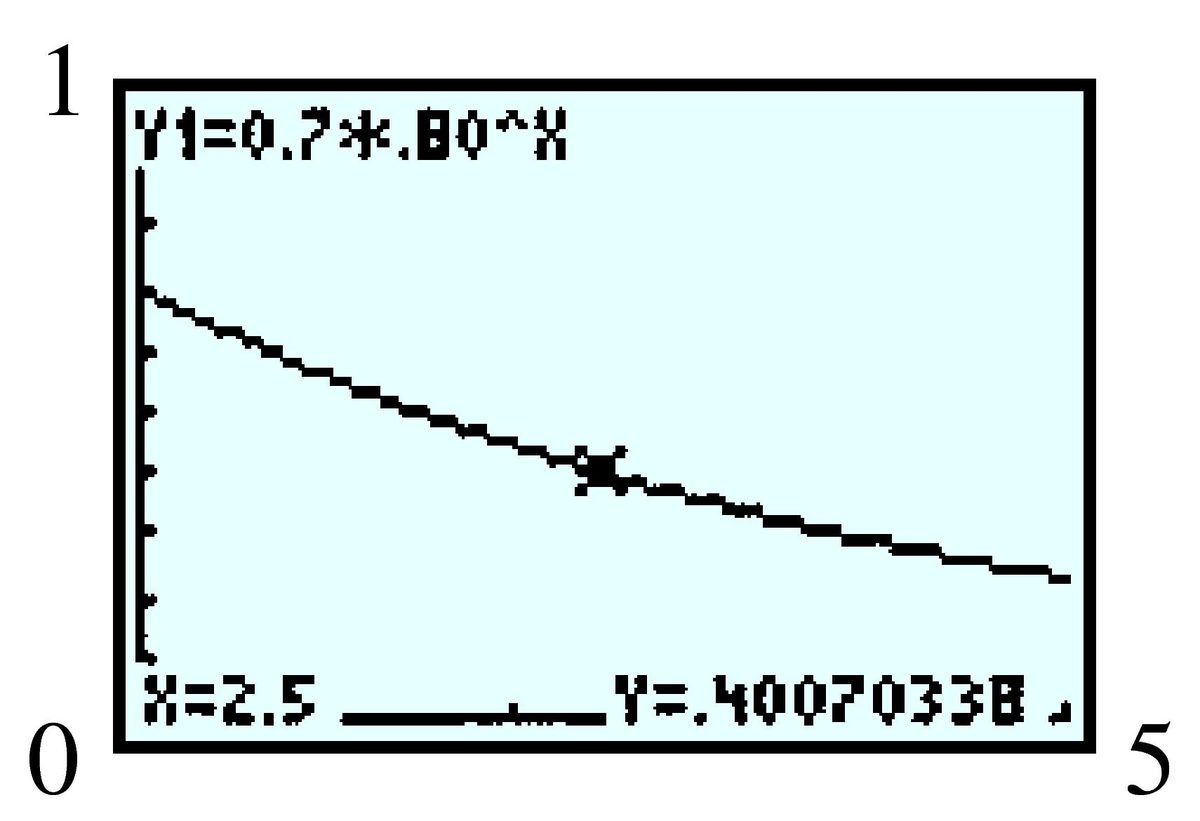
A small pond is tested for pollution, and the concentration of toxic chemicals is found to be parts per million. Clean water enters the pond from a stream, mixes with the polluted water, then leaves the pond so that the pollution level is reduced by each month.
- Write a function for the concentration of toxic chemicals as a function of time.
- How long will it be before the concentration of toxic chemicals reaches a safe level of parts per million?
- Verify your answer with a graph.
According to the National Council of Churches, the fastest growing denomination in the United States in was the Jehovah's Witnesses, with an annual growth rate of .
- The Jehovah's Witnesses had members in . Write a formula for the membership in the Jehovah's Witnesses as a function of time, assuming that the church continues to grow at the same rate.
- When will the Jehovah's Witnesses have members?
- In
In , the Presbyterian Church had members, but membership was declining by annually.
- Write a formula for the membership in the Presbyterian Church as a function of time, assuming that the membership continues to decline at the same rate.
- When will the Presbyterian Church have members?
Sodium-24 is a radioactive isotope that is used in diagnosing circulatory disease. It decays into stable isotopes of sodium at a rate of per hour.
- Technicians inject a quantity of sodium-24 into a patient's bloodstream. Write a formula for the amount of sodium-24 present in the bloodstream as a function of time.
- How long will it take for of the isotope to decay?
- hours
The population of Afghanistan is growing at per year.
- Write a formula for the population of Afghanistan as a function of time.
- In 2005, the population of Afghanistan was million. At the given rate of growth, how long would it take the population to reach million?
For Problems 46–52, evaluate each expression. Which (if any) are equal?
(a) and (c) are equal.
(a) and (c) are equal.
None are equal.
None are equal.
For Problems 53–58, use the formula for compound interest,
What rate of interest is required so that will yield after years if the interest rate is compounded monthly?
What rate of interest is required so that will yield after years if the interest rate is compounded quarterly?
How long will it take a sum of money to triple if it is invested at compounded daily?
About years
How long will it take a sum of money to increase by a factor of if it is invested at compounded quarterly?
- Suppose you invest at annual interest for years. In this problem, we will investigate how the number of compounding periods,, affects the amount, . Write as a function of , with , , and .
- Use your calculator to make a table of values for as a function of . What happens to as increases?
- What value of is necessary to produce an amount ? To produce ? To produce ?
- Graph the function in the window Describe the graph: Is it increasing or decreasing? Concave up or down? Does it appear to have an asymptote? Give your best estimate for the asymptote.
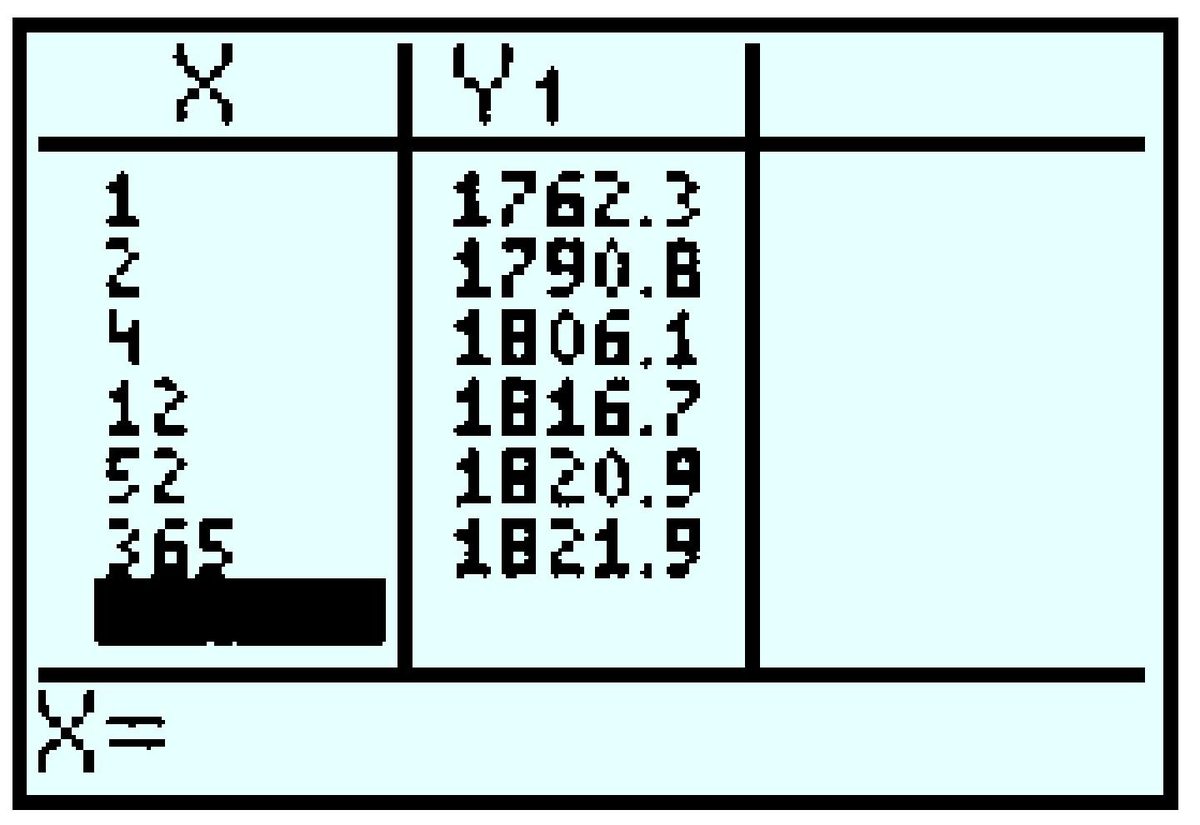
increases.- ; ;
- Increasing, concave down, asymptotically approaching
- In this problem we will repeat Problem 57 for interest. Write as a function of , with , , and .
- Use your calculator to make a table of values for as a function of . What happens to as increases?
- What value of is necessary to produce an amount ? To produce ? To produce ?
- Graph the function in the window Describe the graph: Is it increasing or decreasing? Concave up or down? Does it appear to have an asymptote? Give your best estimate for the asymptote.
For Problems 59–64, solve the formula for the specified variable.
, for
, for
, for
, for
, for
, for
In Problems 65–68 we use the laws of exponents to prove the properties of logarithms.
We will use the first law of exponents, , to prove the first property of logarithms.
- Let and . Rewrite these equations in exponential form:
- Now consider the expression . Replace and by your answers to part (a).
- Apply the first law of exponents to your expression in part (b).
- Use the definition of logarithm to simplify your answer to part (c).
- Refer to the definitions of and in part (a) to finish the proof.
- ,
We will use the second law of exponents, , to prove the second property of logarithms.
- Let and . Rewrite these equations in exponential form:
- Now consider the expression . Replace and by your answers to part (a).
- Apply the second law of exponents to your expression in part (b).
- Use the definition of logarithm to simplify your answer to part (c).
- Refer to the definitions of and in part (a) to finish the proof.
We will use the third law of exponents, , to prove the third property of logarithms.
- Let . Rewrite this equation in exponential form:
- Now consider the expression . Replace by your answers to part (a).
- Apply the third law of exponents to your expression in part (b).
- Use the definition of logarithm to simplify your answer to part (c).
- Refer to the definitions of in part (a) to finish the proof.
- Use the logarithms and exponents conversion equations to explain why .
- Use the logarithms and exponents conversion equations to explain why .
- Use the logarithms and exponents conversion equations to explain why .
Modeling, Functions, and Graphs by Katherine Yoshiwara (yoshiwarabooks.org), GNU Free Documentation License 1.2 or later. Adapted for the XYZ HTML edition with the authors' permission (recorded 2026-07-04). License: GFDL-1.2-or-later.