
4.1 Exponential Growth and Decay
Exponential Growth
The functions in Population Growth describe exponential growth. During each time interval of a fixed length, the population is multiplied by a certain constant amount. In Part A, the bacteria population grows by a factor of every day.
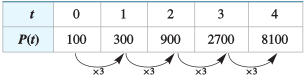
For this reason, we say that is the growth factor for the function. Functions that describe exponential growth can be expressed in a standard form.
For the bacteria population, we have
so and .
How can you tell from a table of values that a function describes exponential growth?
_____
During each equal time interval, the output increases by the same factor.
How can you tell from a table of values that a function describes exponential growth?
- During each equal time interval, the output increases by the same amount.
- During each equal time interval, the output increases by the same factor.
- During each equal time interval, the output increases as .
- During each equal time interval, the output increases towards an asymptote.
A population of 24 fruit flies triples every month.
- Write a formula for the population of fruit flies after months.
_____ - How many fruit flies will there be after 6 months? _____ Note: Enter (large) numbers without any commas. That is, enter "10000" rather than "10,000".
After 3 weeks? _____ (Assume that a month equals 4 weeks, and round your answer to the nearest whole number of flies.)
- 17,496; 55
A population of 24 fruit flies triples every month.
- Write a formula for the population of fruit flies after months.
- How many fruit flies will there be after 6 months? After 3 weeks?
- After 6 months: 17,496; after 3 weeks: 55
Is equivalent to ?
_____
No, powers are performed before products.
Is equivalent to ?
- Yes, we can simplify the product.
- Yes, it is exponential growth.
- No, powers are performed before products.
- No, it should be .
Growth Factors
In Part B of Population Growth, the rabbit population grew by a factor of every months.
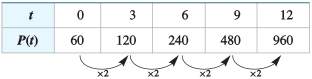
The variable is given in months, so to write the growth formula for this population, we divide the value of by The value of gives us the number of doubling periods.
Now we need some algebra to see the growth factor for the function. We use the third law of exponents to write in another form. Recall that to raise a power to a power, we multiply exponents, so
The growth law for the rabbit population is thus
The initial value of the function is , and the growth factor is , or approximately . The rabbit population grows by a factor of about every month.
A population triples every four years. What is its annual growth factor?
_____
A population triples every four years. What is its annual growth factor?
If the units are the same, a population with a larger growth factor grows faster than one with a smaller growth factor.
In 1999, analysts expected the number of Internet service providers to double in five years.
- What was the annual growth factor for the number of Internet service providers?
Answer: _____ - If there were Internet service providers in April 1999, estimate the number of providers in April 2000 and in April 2001.
April 2000: _____
April 2001: _____ - Write a formula for , the number of Internet service providers years after 1999.
_____
Source: LA Times, Sept. 6, 1999
- and
In 1999, analysts expected the number of Internet service providers to double in five years. Source: LA Times, Sept. 6, 1999
- What was the annual growth factor for the number of Internet service providers?
- If there were Internet service providers in April 1999, estimate the number of providers in April 2000 and in April 2001.
- Write a formula for , the number of Internet service providers years after 1999.
- and
Percent Increase
Exponential growth occurs in other circumstances, too. For example, if the interest on a savings account is compounded annually, the amount of money in the account grows exponentially.
Consider a principal of $100 invested at 5% interest compounded annually. At the end of year, the amount is
It will be more useful to write the formula for the amount after year in factored form.
With this version of the formula, the calculation for the amount at the end of year looks like this:
The amount, $105, becomes the new principal for the second year. To find the amount at the end of the second year, we apply the formula again, with .
Observe that to find the amount at the end of each year, we multiply the principal by a factor of . Thus, we can express the amount at the end of the second year as
and at the end of the third year as
At the end of each year, we multiply the old balance by another factor of to get the new amount. We organize our results into a table, where represents the amount of money in the account after years. For this example, a formula for the amount after years is
In general, for an initial investment of dollars at an interest rate compounded annually, we have the following formula for the amount accumulated after years.
This function describes exponential growth with an initial value of and a growth factor of .
A population grows by 4.5% per year. What is its annual growth factor?
_____
1.045
A population grows by 4.5% per year. What is its annual growth factor?
In Example, we can rewrite the formula for as follows:
Thus, the annual growth factor for the price of butter is , and the annual percent growth rate is %.
In year0, the average annual cost of attending a public college was $c0, and costs were climbing by r% per year.
- Write a formula for , the cost of one year of college years after year0.
_____ - Complete the table and sketch a graph of . Enter values without commas, rounded to the nearest whole dollar.
_____ _____ _____ _____ _____ _____ - If the percent growth rate remained steady, how much did a year of college cost in year1?
- If the percent growth rate continues to remain steady, how much will a year of college cost in year2?
cr0 cr1 cr2 cr3 cr4 cr5
A graph is below.- $cr1 per year
- $cr2
Another graph:
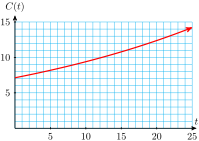
In 2010, the average annual cost of tuition and fees at an in-state public college was $7,130, and costs were climbing by 2.8% per year.
- Write a formula for , in thousands of dollars, the cost of one year of college years after 2010.
- Complete the table and sketch a graph of .
- If the percent growth rate remained steady, how much did a year of college cost in 2020?
- If the percent growth rate continues to remain steady, how much will a year of college cost in 2030?
7.130 8.186 9.398 10.789 12.387 14.221 - $9,398
- $12,387
Describe carefully the meanings of and in the formulas for exponential growth.
_____
Describe carefully the meanings of and in the formulas for exponential growth.
Exponential Decay
In the preceding examples, exponential growth was modeled by increasing functions of the form
where . The function is a decreasing function if . In this case, we say that the function describes exponential decay, and the constant is called the decay factor. In Exponential Decay, we consider two examples of exponential decay.
Decay Factors
Before Example, we noted that a percent increase of (in decimal form) corresponds to a growth factor of . A percent decrease of corresponds to a decay factor of . In Part B of Exponential Decay, each millimeter of plastic reduced the amount of light by %, so , and the decay factor for the function is
A population decreases by 12% per year. What is its annual decay factor?
_____
0.88
A population decreases by 12% per year. What is its annual decay factor?
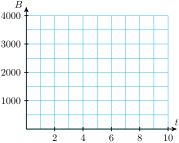
The number of butterflies visiting a nature station is declining by 18% per year. In year0, b0 butterflies visited the nature station.
- What is the decay factor in the annual butterfly count?
Answer: _____ - Write a formula for , the number of butterflies years after year0.
_____ - Complete the table and sketch a graph of . A suggested grid is above.
_____ _____ _____ _____ _____ _____
br0 br1 br2 br3 br4 br5
A graph is below.
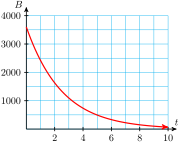
The number of butterflies visiting a nature station is declining by 18% per year. In 1998, 3600 butterflies visited the nature station.
- What is the decay factor in the annual butterfly count?
- Write a formula for , the number of butterflies years after 1998.
- Complete the table and sketch a graph of .
3600 2421 1628 1094 736 495 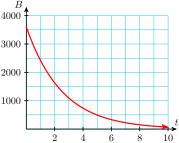
We summarize our observations about exponential growth and decay functions as follows.
The function is decreasing if
_____
The function is decreasing if
- is negative.
- is negative.
Comparing Linear Growth and Exponential Growth
It may be helpful to compare linear growth and exponential growth. Consider the two functions
whose graphs are shown below.
Slope
Growth factor
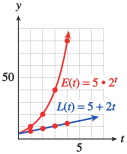
is a linear function with initial value and slope ; is an exponential function with initial value and growth factor . In a way, the growth factor of an exponential function is analogous to the slope of a linear function: Each measures how quickly the function is increasing (or decreasing).
However, for each unit increase in , units are added to the value of , whereas the value of is multiplied by . An exponential function with growth factor eventually grows much more rapidly than a linear function with slope , as you can see by comparing the graphs in the figure or the function values in the tables.
The graph of , where , , and , is always
_____
concave up
The graph of , where , , and is always
- increasing.
- concave up.
- decreasing.
- concave down.
A new car begins to depreciate in value as soon as you drive it off the lot. Some models depreciate linearly, and others depreciate exponentially. Suppose you buy a new car for $20,000, and year later its value has decreased to $17,000.
- If the value decreased linearly, what was its annual rate of decrease?
$_____ per year - If the value decreased exponentially, what was its annual decay factor? _____ What was its annual percent depreciation? _____%
- Calculate the value of your car when it is years old under each assumption, linear or exponential depreciation.
Linear: $_____
Exponential: $_____
- per year
- ;
- Linear: ; Exponential:
A new car begins to depreciate in value as soon as you drive it off the lot. Some models depreciate linearly, and others depreciate exponentially. Suppose you buy a new car for $20,000, and year later its value has decreased to $17,000.
- If the value decreased linearly, what was its annual rate of decrease?
- If the value decreased exponentially, what was its annual decay factor? What was its annual percent depreciation?
- Calculate the value of your car when it is years old under each assumption, linear or exponential depreciation.
- per year
- ;
- Linear: ; Exponential:
Explain the difference between constant slope and constant growth factor.
_____
Explain the difference between constant slope and constant growth factor.
Section Summary
Vocabulary
Look up the definitions of new terms in the Glossary.
- Exponential growth
- Initial value
- Exponential decay
- Percent increase
- Compound interest
- Growth factor
- Amount
CONCEPTS
- If a quantity is multiplied by a constant factor, , in each time period, we say that it undergoes exponential growth or decay. The constant is called the growth factor if and the decay factor if .
- Quantities that increase or decrease by a constant percent in each time period grow or decay exponentially.
- In linear growth, a constant amount is added to the output for each unit increase in the input. In exponential growth, the output is multiplied by a constant factor for each unit increase in the input.
STUDY QUESTIONS
- Is it possible for two populations with the same initial value to grow at different percent rates?
- If you know the percent growth rate, how can you find the growth factor? If you know the percent decay rate, how can you find the decay factor?
- What is the growth factor for a population that grows annually?
- What is the decay factor for a population that declines by annually?
- What is the growth factor for a population that grows by annually?
- Explain the difference between the slope in linear growth and the growth factor in exponential growth.
SKILLS
Practice each skill in the Homework problems listed.
- Calculate percent increase or decrease: #1–10–6
- Write a formula for exponential growth or decay: #11–22
- Evaluate an exponential growth or decay function: #11–22
- Simplify exponential expressions: #23–32
- Solve power equations: #33–40
- Find the growth factor or initial value: #41–58
- Solve for percent increase or decrease: #63–66
Homework 4.1
- A parking permit at Huron College cost $ last year, but this year the price increased by . What is the price this year?
- If the price of a parking permit increases by again next year, what will the price be then?
- $
- $
- The computer you want cost $ when it first came on the market, but after months the price was reduced by . What was the price then?
- If the price falls by another next month, what will the price be then?
The value of your stock portfolio fell last year, but this year it increased by . How does the current value of your portfolio compare to what it was two years ago?
It is of what it was years ago.
You got a raise in January, but then in March everyone took a pay cut of . How does your new salary compare to what it was last December?
The population of Summerville is currently hundred people.
- Write a formula for the population if it grows at a constant rate of hundred people per year. What is the population after years?
- Write a formula for the population if it has a constant growth factor of per year. What is the population after years?
- ;
- ;
Delbert's sports car was worth $ when he bought it.
- Write a formula for the value of the car if it depreciates at a constant rate of $ per year. What is the value of the car after years?
- Write a formula for the value of the car if it has a constant depreciation factor of per year. What is the value of the car after years?
Francine's truck was worth $ when she bought it.
- Write a formula for the value of the truck if it depreciates by $ per year. What is the value of the truck after years?
- Write a formula for the value of the truck if it depreciates by per year. What is the value of the truck after years?
- ; $
- ; $
The population of Lakeview is currently people.
- Write a formula for the population if it grows by people per year. What is the population after years?
- Write a formula for the population if grows by per year. What is the population after years?
The table shows the growth factor for a number of different populations. For each population, find the percent growth rate.
| Population | |||||
|---|---|---|---|---|---|
| Growth factor | |||||
| Percent growth rate |
A: ; B: ; C: ; D: ; E:
The table shows the decay factor for a number of different populations. For each population, find the percent decay rate.
| Population | |||||
|---|---|---|---|---|---|
| Decay factor | |||||
| Percent decay rate |
For Problems 11–16,
- Write a function that describes exponential growth.
- Graph the function.
- Evaluate the function at the given values.
A typical beehive contains insects. The population can increase in size by a factor of every weeks. How many bees could there be after weeks? After weeks?
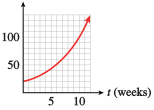
- bees; bees
A rancher who started with head of cattle finds that his herd increases by a factor of every years. How many head of cattle will he have after year? After years?
A sum of $ is invested in an account that pays interest compounded annually. How much is in the account after years? After years?
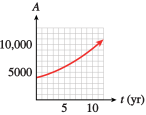
- $; $
Otto invests $ in an account that pays interest compounded annually. How much is in Otto's account after years? After years?
Paul bought a house for $ in . Since , housing prices have risen an average of per year. How much was the house worth in ? How much will it be worth in 2030?
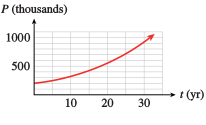
- $; $
Sales of Windsurfers have increased per year since . If Sunsails sold Windsurfers in , how many did it sell in ? How many should it expect to sell in ?
For Problems 17–22,
- Write a function that describes exponential decay.
- Graph the function.
- Evaluate the function at the given values.
During a vigorous spraying program, the mosquito population was reduced to of its previous size every weeks. If the mosquito population was originally estimated at , how many mosquitoes remained after weeks of spraying? After weeks?
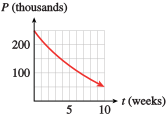
- ;
The number of perch in Hidden Lake has declined to half of its previous value every years since 1985, when the perch population was estimated at . How many perch were there in 1995? In 2013?
Scuba divers find that the water in Emerald Lake filters out of the sunlight for each feet that they descend. How much sunlight penetrates to a depth of feet? To a depth of feet?
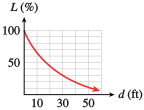
- ;
Arch's motorboat cost $ in and has depreciated by every years. How much was the boat worth in ? In ?
Plutonium-238 is a radioactive element that decays over time into a less harmful element at a rate of per year. A power plant has pounds of plutonium-238 to dispose of. How much plutonium-238 will be left after years? After years?
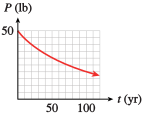
- lb; lb
Iodine-131 is a radioactive element that decays at a rate of per day. How much of a -gram sample will be left after week? After days?
In Problems 23–26, use the laws of exponents to simplify.
Let . Show that .
Let . Show that
Let . Show that .
Let . Show that
- Explain why and are not the same function.
- Complete the table of values for and , showing that their values are not the same.
- In the expression , only the is raised to a power , and the result is doubled, but if both the and the were raised to the power , the result would be .
- Explain why and are not the same function.
- Complete the table of values for and , showing that their values are not the same.
Solve the equation. (See Roots and Radicals to review solving equations involving powers of the variable.) Round your answer to two places if necessary.
- Riverside County is the fastest growing county in California. In , the population was . Write a formula for the population of Riverside County. (You do not know the value of the growth factor, , yet.)
- In , the population had grown to . Find the growth factor and the percent rate of growth, rounded to the nearest tenth of a percent.
- Estimate the population of Riverside County in .
- Growth factor ; Percent rate of growth
- In , a new Ford Focus cost . The value of a Focus decreases exponentially over time. Write a formula for the value of a Focus. (You do not know the value of the decay factor, , yet.)
- A -year old Focus cost . Find the decay factor and the percent rate of depreciation, rounded to the nearest tenth of a percent.
- About how much would a -year old Focus cost?
In the 1940s, David Lack undertook a study of the European robin. He tagged one-year-old robins and found that on average of the birds survived each year. (Source: Burton, 1998)
- According to the data, how many robins would have originally hatched to produce one-year-olds?
- Write a formula for the number of the original robins still alive after years.
- Graph your function.
- One of the original robins actually survived for years. How many robins does the model predict will survive for years?
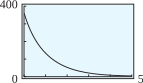
- . (Therefore, none)
Many insects grow by discrete amounts each time they shed their exoskeletons. Dyar's rule says that the size of the insect increases by a constant ratio at each stage. (Source: Burton, 1998)
- Dyar measured the width of the head of a caterpillar of a swallowtail butterfly at each stage. The caterpillar's head was initially approximately millimeters wide, and millimeters wide after its first stage. Find the growth ratio.
- Write a formula for the width of the caterpillar's head at the th stage.
- Graph your function.
- What head width does the model predict after stages?
For Problems 45–54,
- Each table describes exponential growth or decay. Find the growth or decay factor.
- Complete the table. Round values to two decimal places if necessary.
The growth factor is .
The growth factor is .
The decay factor is .
The decay factor is .
The growth factor is .
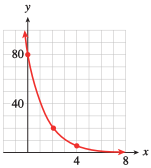
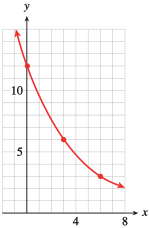
Each graph in Problems 55–58 represents exponential growth or decay.
- Find the initial value and the growth or decay factor.
- Write a formula for the function.
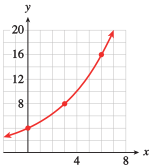
- Initial value , growth factor
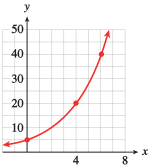
- Initial value , decay factor
If of the air leaks out of Brian's bicycle tire every day, what percent of the air will be left after days? After a week?
,
If housing prices are increasing by per year, by what percent will they increase in years? In years?
Francine says that if a population grew by in years, then it grew by per year. Is she correct? Either justify or correct her calculation.
No, an increase of in years corresponds to a growth factor of , or an annual growth rate of about .
Delbert says that if a population decreased by in 5 years, then it decreased by per year. Is he correct? Either justify or correct his calculation.
In Problems 63–66, assume that each population grows exponentially with constant annual percent increase, .
- The population of the state of Texas was in . Write a formula in terms of for the population of Texas years later.
- In , the population was . Write an equation and solve for . What was the annual percent increase to the nearest hundredth of a percent?
- The population of the state of Florida was in . Write a formula in terms of for the population of Florida years later.
- In , the population was . Write an equation and solve for . What was the annual percent increase to the nearest hundredth of a percent?
- The population of Rainville was in and doubled in years. What was the annual percent increase to the nearest hundredth percent?
- The population of Elmira was in and doubled in years. What was the annual percent increase to the nearest hundredth of a percent?
- If a population doubles in years, does the percent increase depend on the size of the original population?
- The population of Grayling doubled in years. What was the annual percent increase to the nearest hundredth of a percent?
- No
- The population of Boomtown was in and tripled in years. What was the annual percent increase to the nearest hundredth of a percent?
- The population of Fairview was in and tripled in years. What was the annual percent increase to the nearest hundredth of a percent?
- If a population triples in years, does the percent increase depend on the size of the original population?
- The population of Pleasant Lake tripled in years. What was the annual percent increase to the nearest hundredth of a percent?
A researcher starts 2 populations of fruit flies of different species, each with flies. Species A increases by in days and species B increases by in days.
- What was the population of species A after days? Find the daily growth factor for species A.
- What was the population of species B after days? Find the daily growth factor for species B.
- Which species multiplies more rapidly?
- ;
- ;
- Species B
A biologist isolates two strains of a particular virus and monitors the growth of each, starting with samples of gram. Strain A increases by in hours and strain B increases by in hours.
- How much did the sample of strain A weigh after hours? What was its hourly growth factor?
- How much did the sample of strain B weigh after hours? What was its hourly growth factor?
- Which strain of virus grows more rapidly?
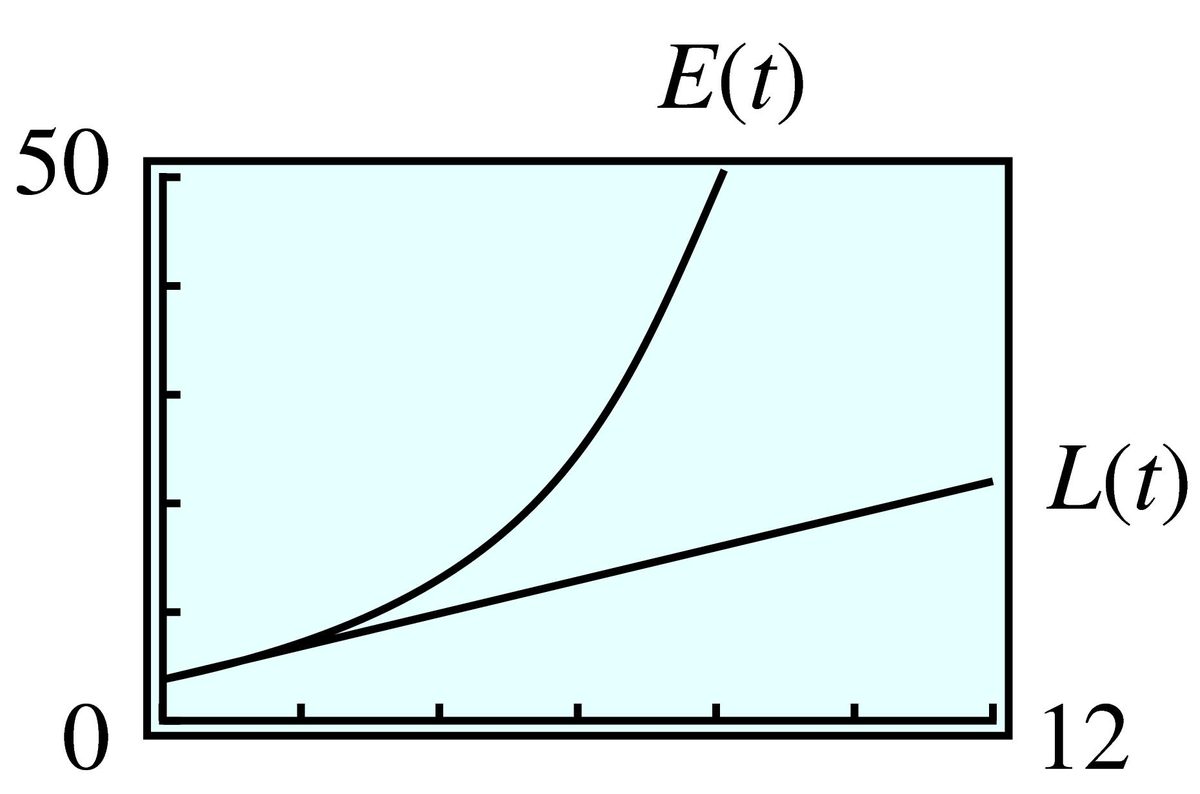
In Problems 69–72, we compare linear and exponential growth.
At a large university students start a rumor that final exams have been canceled. After hours, students (including the first ) have heard the rumor.
- Assuming that the rumor grows linearly, complete the table below for , the number of students who have heard the rumor after hours. Then write a formula for the function . Graph the function.
- Complete the table below, assuming that the rumor grows exponentially. Write a formula for the function and graph it on the same set of axes with .
Over the weekend the Midland Infirmary identifies four cases of Asian flu. Three days later it has treated a total of ten cases.
- Assuming that the number of flu cases grows linearly, complete the table below for , the number of people infected after days. Then write a formula for the function . Graph the function.
- Complete the table below, assuming that the flu grows exponentially. Write a formula for the function and graph it on the same set of axes with .
The world’s population of tigers declined from in to in .
- If the population declined linearly, what was its annual rate of decrease?
- If the population declined exponentially, what was its annual decay factor? What was its annual percent decrease?
- Predict the number of tigers in under each assumption, linear or exponential decline.
- tigers per year
- ;
- Linear: ; Exponential:
In 2003, the Center for Biological Diversity filed a lawsuit against the federal government for failing to protect Alaskan sea otters. The population of sea otters, which numbered between 150,000 and 300,000 before hunting began in 1741, declined from about 20,000 in 1992 to 6000 in 2000. (Source: Center for Biological Diversity)
- If the population declined linearly after 1992, what was its annual rate of change in population?
- If the population declined exponentially after 1992, what was its annual decay factor?
- Predict the number of sea otters in 2010 under each assumption, linear or exponential decline
Modeling, Functions, and Graphs by Katherine Yoshiwara (yoshiwarabooks.org), GNU Free Documentation License 1.2 or later. Adapted for the XYZ HTML edition with the authors' permission (recorded 2026-07-04). License: GFDL-1.2-or-later.