
4.3 Logarithms
Introduction
In this section, we introduce a new mathematical tool called a logarithm, which will help us solve exponential equations.
Suppose that a colony of bacteria doubles in size every day. If the colony starts with bacteria, how long will it be before there are bacteria? We answered questions of this type in Exponential Functions by writing and solving an exponential equation. The function
gives the number of bacteria present on day , so we must solve the equation
Dividing both sides by 50 yields
The solution of this equation is the answer to the following question:
To what power must we raise in order to get ?
The value of that solves the equation is called the base logarithm of . Because , the base logarithm of is . We write this as
In other words, we solve an exponential equation by computing a logarithm. You can check that solves the problem stated above:
Thus, the unknown exponent is called a logarithm. In general, for positive values of and , we make the following definition.
Some logarithms, like some square roots, are easy to evaluate, while others require a calculator. We will start with the easy ones.
Find each logarithm.
- _____
- _____
Find each logarithm.
A logarithm is the same as
_____
an exponent
A logarithm is the same as
- an exponent.
- a coefficient.
- a quotient.
- a radical.
From the definition of a logarithm and the examples above, we see that the following two statements are equivalent.
In other words, the logarithm, , is the same as the exponent in . We see again that a logarithm is an exponent; it is the exponent to which must be raised to yield .
These equations allow us to convert from logarithmic to exponential form, or vice versa. You should memorize the conversion equations, because we will use them frequently.
As special cases of the equivalence in (1), we can compute the following useful logarithms. For any base ,
Find each logarithm.
- _____
- _____
Find each logarithm.
because
_____
because
Using the Conversion Equations
We use logarithms to solve exponential equations, just as we use square roots to solve quadratic equations. Consider the two equations
We solve the first equation by taking a square root, and we solve the second equation by computing a logarithm:
The operation of taking a base logarithm is the inverse operation for raising the base to a power, just as extracting square roots is the inverse of squaring a number.
Every exponential equation can be rewritten in logarithmic form by using the conversion equations. Thus,
are equivalent statements, just as
are equivalent statements. Rewriting an equation in logarithmic form is a basic strategy for finding its solution.
To find means to find an exponent that satisfies the equation
_____
To find means to find an exponent that satisfies the equation
Rewrite each equation in logarithmic form.
The given equation is equivalent to one of the form , where
_____
_____, and
_____
The given equation is equivalent to one of the form , where
_____
_____, and
_____
Rewrite each equation in logarithmic form.
If is negative, what can you say about ?
_____
If is negative, what can you say about ?
Approximating Logarithms
Suppose we would like to solve the equation
The solution of this equation is , but can we find a decimal approximation for this value? There is no integer power of that equals , because
Thus, must be between and . We can use trial and error to find the value of to the nearest tenth. Use your calculator to make a table of values for , starting with and using increments of .
From the table we see that is between and , and is closer to . To the nearest tenth, .
Trial and error can be a time-consuming process. In Example 4, we illustrate a graphical method for estimating the value of a logarithm.
- Rewrite the equation in logarithmic form.
The given equation is equivalent to one of the form , where
_____
_____, and
_____ - Use a graph to approximate the solution to the equation in part (a). Round your answer to three decimal places.
_____
- Rewrite the equation in logarithmic form.
- Use a graph to approximate the solution to the equation in part (a). Round your answer to three decimal places.
Base 10 Logarithms
Some logarithms are used so frequently in applications that their values are programmed into scientific and graphing calculators. These are the base logarithms, such as
Base logarithms are called common logarithms, and the subscript is often omitted, so that (or simply ) is understood to mean .
If , what can you say about ?
_____
is between 100 and 1000
If , what can you say about ?
- is between 20 and 30.
- is between 100 and 1000.
To evaluate a base logarithm, we use the LOG key on a calculator. Many logarithms are irrational numbers, and the calculator gives as many digits as its display allows. We can then round off to the desired accuracy.
- Evaluate , and round your answer to two decimal places. Check your answer using the conversion equations.
_____ to two decimal places - Evaluate , and round your answer to four decimal places. Check your answer using the conversion equations.
_____ to four decimal places
- Evaluate , and round your answer to two decimal places. Check your answer using the conversion equations.
- Evaluate , and round your answer to four decimal places. Check your answer using the conversion equations.
Explain how to estimate between two integers.
_____
Explain how to estimate between two integers.
Solving Exponential Equations
We can now solve any exponential equation with base . For instance, to solve the equation
, we first divide both sides by to obtain
Then we convert the equation to logarithmic form and evaluate:
To decimal places, the solution is .
To solve exponential equations involving powers of 10, we can use the following steps.
What is the first step in solving the equation ?
_____
Divide both sides by 5.
What is the first step in solving the equation ?
- Multiply 5 times 10.
- Take the log of both sides.
- Get zero on one side of the equation.
- Divide both sides by 5.
Solve
_____
Solve
Application to Exponential Models
We have seen that exponential functions are used to describe some applications of growth and decay, . There are two common questions that arise in connection with exponential models:
- Given a value of , what is the corresponding value of ?
- Given a value of , what is find the corresponding value of ?
To answer the first question, we evaluate the function at the appropriate value. To answer the second question, we must solve an exponential equation, and this usually involves logarithms.
The percentage of American homes with computers grew exponentially from 1994 to 1999. For in 1994, the growth law was
[Source: Los Angeles Times, August 20, 1999]
- What percent of American homes had computers in 1994?
Answer: _____% - If the percentage of homes with computers continued to grow at the same rate, when did 90% of American homes have a computer?
Answer: _____, which was the year _____ - Do you think that the function will continue to model the percentage of American homes with computers? Why or why not?
_____
- 25.85%
- (year 2004)
- No, the percent of homes with computers cannot exceed .
The percentage of American homes with computers grew exponentially from 1994 to 1999. For in 1994, the growth law was [Source: Los Angeles Times, August 20, 1999]
- What percent of American homes had computers in 1994?
- If the percentage of homes with computers continued to grow at the same rate, when did 90% of American homes have a computer?
- Do you think that the function will continue to model the percentage of American homes with computers? Why or why not?
- 25.85%
- (year 2004)
- No, the percent of homes with computers cannot exceed .
At this stage, it seems we will only be able to solve exponential equations in which the base is . However, we will see in Properties of Logarithms how the properties of logarithms enable us to solve exponential equations with any base.
The population of rabbits on an island grows according to . Explain the difference between the two problems: (1) given find , and (2) given find .
_____
The population of rabbits on an island grows according to . Explain the difference between the two problems: (1) given find , and (2) given find .
Section Summary
Vocabulary
Look up the definitions of new terms in the Glossary.
- Logarithm
- Common logarithm
CONCEPTS
- We use logarithms to help us solve exponential equations.
- The base logarithm of , written (or written as ), is the exponent to which must be raised in order to yield .
- If and ,
- The operation of taking a base logarithm is the inverse operation for raising the base to a power.
- Base logarithms are called common logarithms, and (or ) means .
STUDY QUESTIONS
- To find means to find an exponent that satisfies the equation ____________.
- Can a logarithm be a negative number?
-
Evaluate the following logarithms:
- Guess the solution of . Now find an approximation correct to four decimal places. Was your guess too big or too small?
SKILLS
Practice each skill in the Homework problems listed.
- Compute logs base using the definition: #1–10, 59–66
- Convert from exponential to logarithmic form: #11–22
- Approximate logarithms: #23–34
- Solve exponential equations base 10: #35–48
- Solve application problems: #49–58
Homework 4.3
For Problems 1–10, find each logarithm without using a calculator.
For Problems 11–22, rewrite the equation in logarithmic form.
For Problems 23–26,
- Solve each equation, writing your answer as a logarithm.
- Use trial and error to approximate the logarithm to one decimal place.
For Problems 27–30,
- By computing successive powers of the base, trap each log between two integers.
- Use a graph to approximate each logarithm to the nearest hundredth. (Hint: Use the conversion equations to rewrite as an appropriate exponential equation.)
For Problems 31–34, use a calculator to approximate each logarithm to four decimal places. Make a conjecture about logarithms based on the results of each problem.
When the input to the common logarithm is multiplied by , the output is increased by .
When the input to the common logarithm is doubled, the output is increased by about .
For Problems 35–44, solve for . Round your answers to hundredths.
In Problems 45–48, each calculation contains an error. Find and correct it.
; the first step should be to divide both sides of the equation by ; .
; the first step should be to write ; .
The population of the state of California increased during the years 1990 to 2000 according to the formula
where is measured in years since .
- What was the population in ?
- Assuming the same rate of growth, estimate the population of California in the years , , and .
- When did the population of California reach ?
- When should the population reach ?
- Graph the function with a suitable domain and range, then verify your answers to parts (a) through (d).
- ; ;
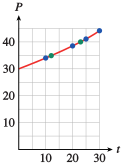
The population of the state of New York increased during the years 1990 to 2000 according to the formula
where is measured in years since .
- What was the population in ?
- Assuming the same rate of growth, estimate the population of New York in the years , , and .
- When did the population of New York reach ?
- When should the population reach ?
- Graph the function with a suitable domain and range, then verify your answers to parts (a) through (d).
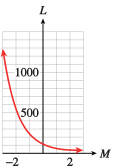
The absolute magnitude, , of a star is a measurement of its brightness. For example, our Sun, not a particularly bright star, has magnitude . The magnitude in turn is a measure of the luminosity, , or amount of light energy emitted by the star, where
- The luminosity of a star is measured in solar units, so that our Sun has luminosity . Use the values of and for the Sun to calculate a value of in the equation above.
- Is luminosity an increasing or decreasing function of magnitude? Graph the function on the domain . What is its range on that domain?
- The luminosity of Sirius is times that of the Sun, or . Calculate the magnitude of Sirius.
- If two stars differ in magnitude by , what is the ratio of their luminosities?
- A decrease in magnitude by corresponds to an increase in luminosity by what factor? Give an exact value and an approximation to four decimal places.
- Normal stars have magnitudes between and . What range of luminosities do stars exhibit?
- Decreasing; range:
- to
The loudness of a sound is a consequence of its intensity, , or the amount of energy it generates, in watts per square meter. The intensity is related to the decibel level, , which is another measure of loudness, by
- Is intensity an increasing or decreasing function of decibel level? The faintest sound a healthy human can hear is decibels. What is the intensity of a decibel sound?
- A whisper produces an energy intensity of watts per square meter. What is the decibel level of a whisper?
- If two sounds differ in loudness by decibels, what is the ratio of their intensities?
- An increase in loudness of decibel produces a just noticeable difference to the human ear. By what factor does the intensity increase?
- Sounds of decibels are at the threshold of pain for people. What is the range of the intensity function on the domain ?
The atmospheric pressure decreases with altitude above the surface of the Earth. For Problems 53–58, use the function
where altitude, , is given in miles and atmospheric pressure, , in inches of mercury. Graph this function in the window
Solve the problems below algebraically, and verify with your graph.
The elevation of Mount Everest, the highest mountain in the world, is feet. What is the atmospheric pressure at the top? Hint: mile feet
in
The elevation of Mount McKinley, the highest mountain in the United States, is feet. What is the atmospheric pressure at the top?
How high above sea level is the atmospheric pressure inches of mercury?
mi
How high above sea level is the atmospheric pressure inches of mercury?
Find the height above sea level at which the atmospheric pressure is equal to one-half the pressure at sea level. Hint: What is the altitude at sea level?
mi
Find the height above sea level at which the atmospheric pressure is equal to one-fourth the pressure at sea level. Hint: What is the altitude at sea level?
For Problems 59–66, simplify the expression.
Modeling, Functions, and Graphs by Katherine Yoshiwara (yoshiwarabooks.org), GNU Free Documentation License 1.2 or later. Adapted for the XYZ HTML edition with the authors' permission (recorded 2026-07-04). License: GFDL-1.2-or-later.