
7.5 Equations That Include Algebraic Fractions
When working with rational functions, we often need to solve equations that involve algebraic fractions.
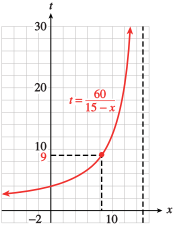
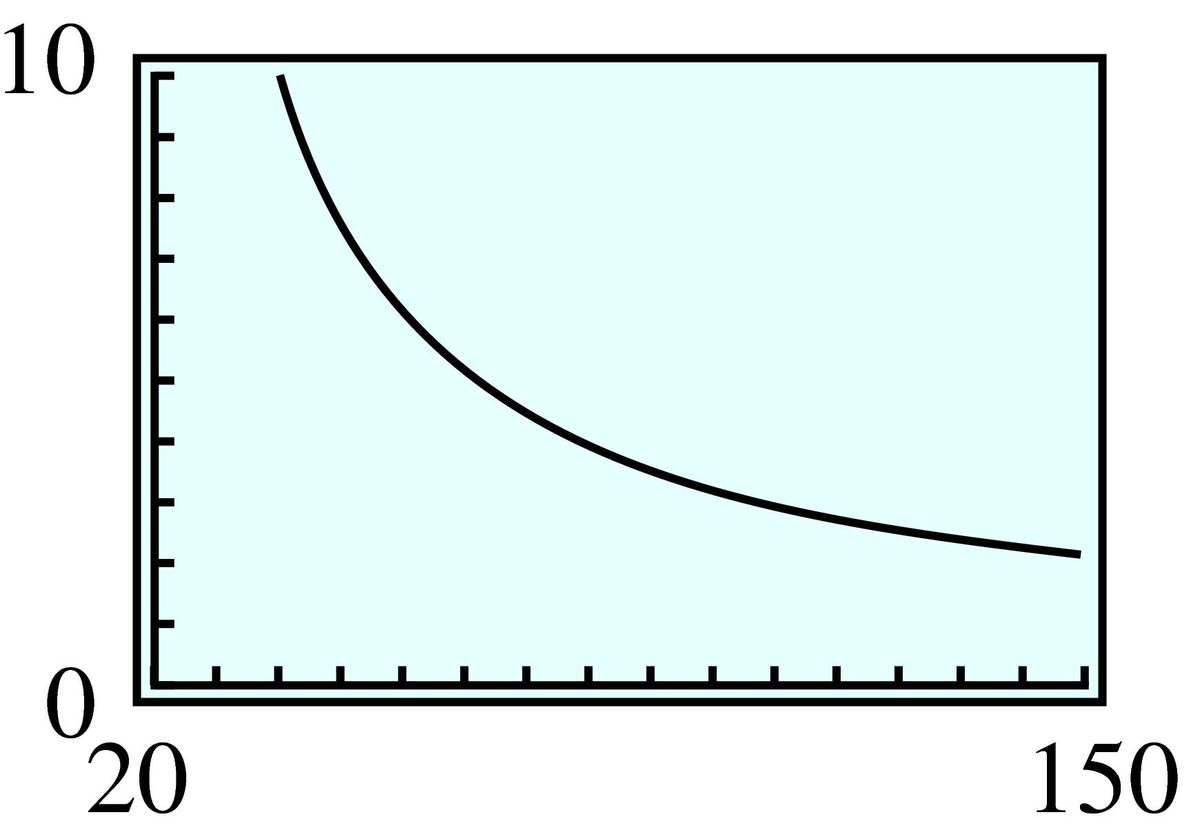
In Example of Graphing Rational Functions, we wrote a function that gave the time Francine needs for a 60-mile training run on her cycle-plane in terms of the windspeed, :
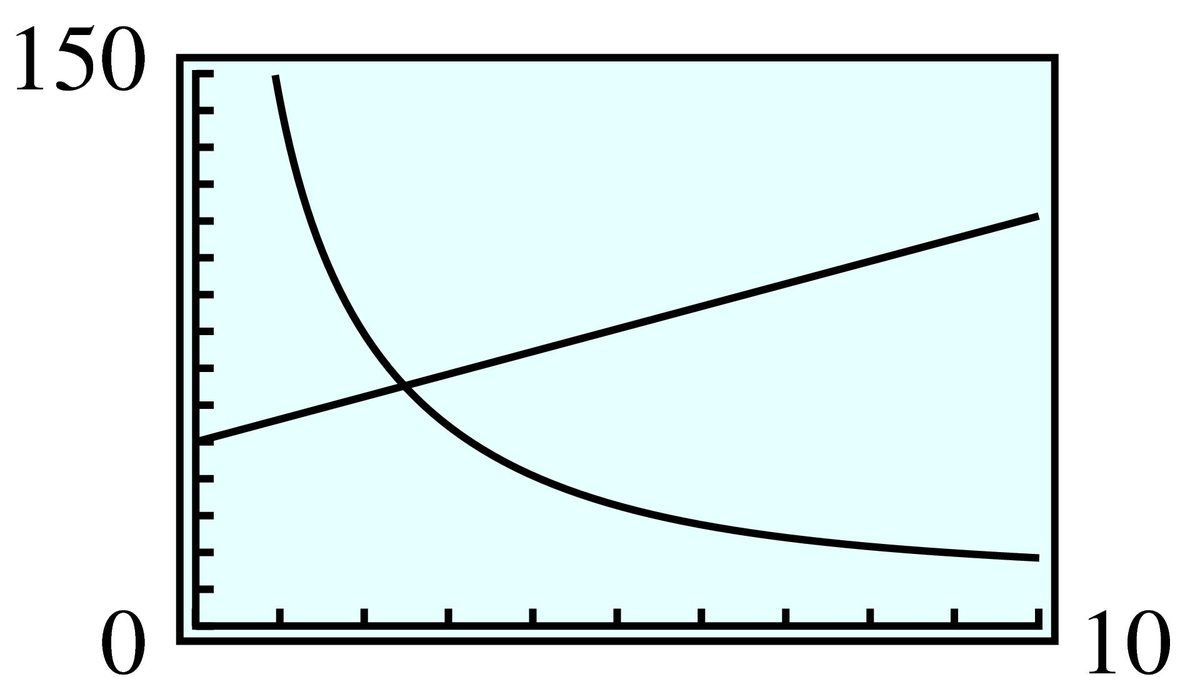
If it takes Francine hours to cover miles, what is the speed of the wind? We can answer this question by reading values from the graph of , as shown at right. When , the value of is between and , so the windspeed is between and miles per hour.
Solving Equations with Fractions Algebraically
If we need a more accurate value for the windspeed, we can solve the equation
To solve an equation involving an algebraic fraction, we multiply each side of the equation by the denominator of the fraction. This has the effect of clearing the fraction, giving us an equivalent equation without fractions.
Solve
_____
Separate different values with a comma.
Solve
If the equation contains more than one fraction, we can clear all the denominators at once by multiplying both sides by the LCD of the fractions.
Solve
_____
Separate different values with a comma.
Solve
If the variable in an equation appears in the denominator of a fraction, what should you do to solve the equation?
_____
If the variable in an equation appears in the denominator of a fraction, what should you do to solve the equation?
Extraneous Solutions
A rational function is undefined for any values of that make its denominator equal zero. These values are not in the domain of the function, and they therefore cannot be solutions to equations involving the function. Consider the equation
When we multiply both sides by the LCD, , we obtain
or
whose solution is
However, is not a solution of the original equation. Both sides of the equation are undefined at . If you graph the two functions
you will find that the graphs never intersect, which means that there is no solution to the original equation.
What went wrong with our method of solution? We multiplied both sides of the equation by , which is zero when , so we really multiplied both sides of the equation by zero. Multiplying by zero does not produce an equivalent equation, and false solutions may be introduced.
An apparent solution that does not satisfy the original equation is called an extraneous solution. Whenever we multiply an equation by an expression containing the variable, we should check that the solution obtained is not excluded from the domain of the rational functions involved.
When solving an equation with fractions algebraically, we must be careful to multiply each term of the equation by the LCD, no matter whether each term involves fractions.
Which of these is the correct first step to solve ?
_____
If we multiply both sides of the equation by the LCD , we obtain .
Which of these is the correct first step to solve ?
Solve
_____
Separate different values with a comma.
Solve
What are extraneous solutions, and when might they occur?
_____
What are extraneous solutions, and when might they occur?
Formulas
Algebraic fractions may appear in formulas that relate several variables. If we want to solve for one variable in terms of the others, we may need to clear the fractions.
Solve for :
_____
Solve for :
When you are solving a formula for , what should you do if two terms contain as a factor?
_____
When you are solving a formula for , what should you do if two terms contain as a factor?
Section Summary
Vocabulary
Look up the definitions of new terms in the Glossary.
- Extraneous solution
CONCEPTS
- To solve an equation involving an algebraic fraction, we multiply each side of the equation by the denominator of the fraction. This has the effect of clearing the fraction, giving us an equivalent equation without fractions.
- Whenever we multiply an equation by an expression containing the variable, we should check that the solutions obtained are not extraneous.
STUDY QUESTIONS
- What is the first step in solving an equation that includes algebraic fractions?
- If the equation also contains terms without fractions, should you multiply those terms by the LCD?
- What are extraneous solutions, and when might they arise?
- If you are solving a formula and two or more terms contain the variable you are solving for, what should you do?
SKILLS
Practice each skill in the Homework problems listed.
- Solve a fractional equation by clearing denominators: #1–14, 47–54
- Write and solve proportions: #25–36
- Solve equations by graphing: #15–22
- Solve formulas that involve fractions: #39–48
- Solve problems that involve algebraic fractions: #55–58
Homework 7.5
For Problems 1-8, solve the equation algebraically.
The total weight, , that a beam can support is given in pounds by
where is the width of the beam in inches, is its height in inches, and is the length of the beam in feet. A beam over the doorway in an interior wall of a house must support pounds. If the beam is inches wide and inches tall, how long can it be?
ft
If two appliances are connected in parallel in an electrical circuit, the total resistance, , in the circuit is given by
where and are the resistances of the two appliances. If one appliance has a resistance of ohms, and the total resistance in the circuit is measured at ohms, what is the resistance of the second appliance?
A flock of eider ducks is making a -mile flight at an average airspeed of miles per hour against a moderate headwind.
- Express the ducks' travel time, , as a function of the windspeed, , and graph the function in the window (See Problem Exercise of Homework Section 7.4.)
- Write and solve an equation to find the windspeed if the flock makes its trip in hours. Label the corresponding point on your graph.
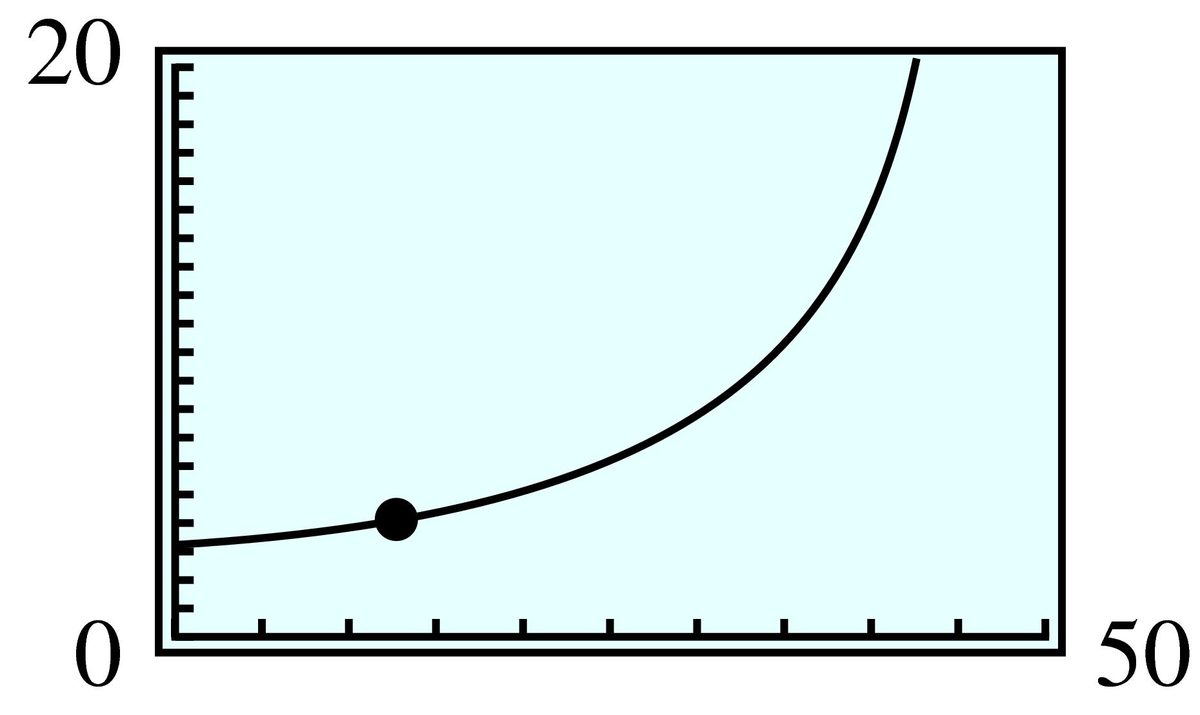
- ; mph
Bluefin tuna swim at average speed of miles per hour in still water. A school of tuna is making a -mile trip against a current.
- Express the tuna's travel time, , as a function of the current speed, , and graph the function in the window (See Problem Exercise of Homework Section 7.4.)
- Write and solve an equation to find the current speed if the school makes its trip in hours. Label the corresponding point on your graph.
The cost, in thousands of dollars, for immunizing percent of the residents of Emporia against a dangerous new disease is given by the function
Write and solve an equation to determine what percent of the population can be immunized for $.
;
The cost, in thousands of dollars, for extracting percent of a precious ore from a mine is given by the function
Write and solve an equation to determine what percentage of the ore can be extracted for $.
For Problems 15–18,
- Solve the equation graphically by graphing two functions, one for each side of the equation.
- Solve the equation algebraically.
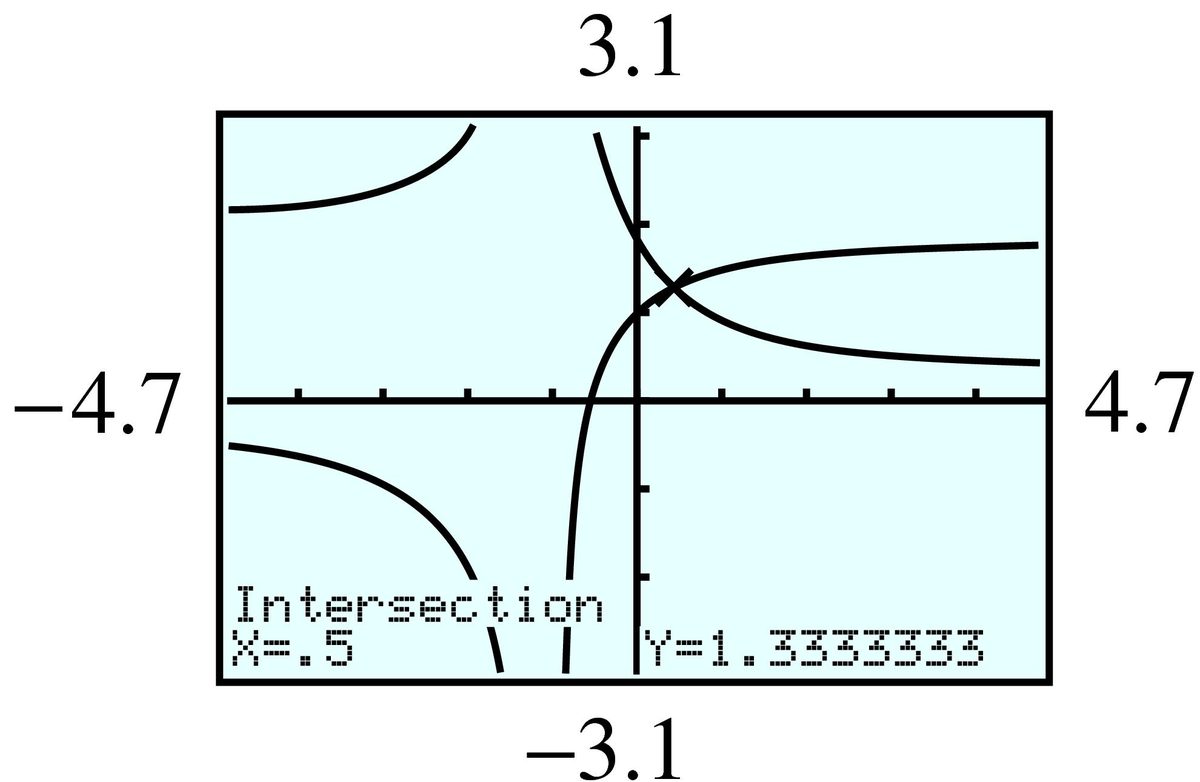
The manager of Joe's Burgers discovers that he will sell burgers per day if the price of a burger is dollars. On the other hand, he can afford to make burgers if he charges dollars apiece for them.
- Graph the demand function, , and the supply function, , in the same window. At what price does the demand for burgers equal the number that Joe can afford to supply? This value for is called the equilibrium price.
- Write and solve an equation to verify your equilibrium price.
$- ;
A florist finds that she will sell dozen roses per week if she charges dollars for a dozen. Her suppliers will sell her dozen roses if she sells them at dollars per dozen.
- Graph the demand function, , and the supply function, , in the same window. At what equilibrium price will the florist sell all the roses she purchases?
- Write and solve an equation to verify your equilibrium price.
Francine wants to fence a rectangular area of square feet to grow vegetables for her family of three.
- Express the length of the garden as a function of its width.
- Express the perimeter, , of the garden as a function of its width.
- Graph your function for perimeter and find the coordinates of the lowest point on the graph. Interpret those coordinates in the context of the problem.
- Francine has feet of chain link to make a fence for the garden, and she would like to know what the width of the garden should be. Write an equation that describes this situation.
- Solve your equation and find the dimensions of the garden.
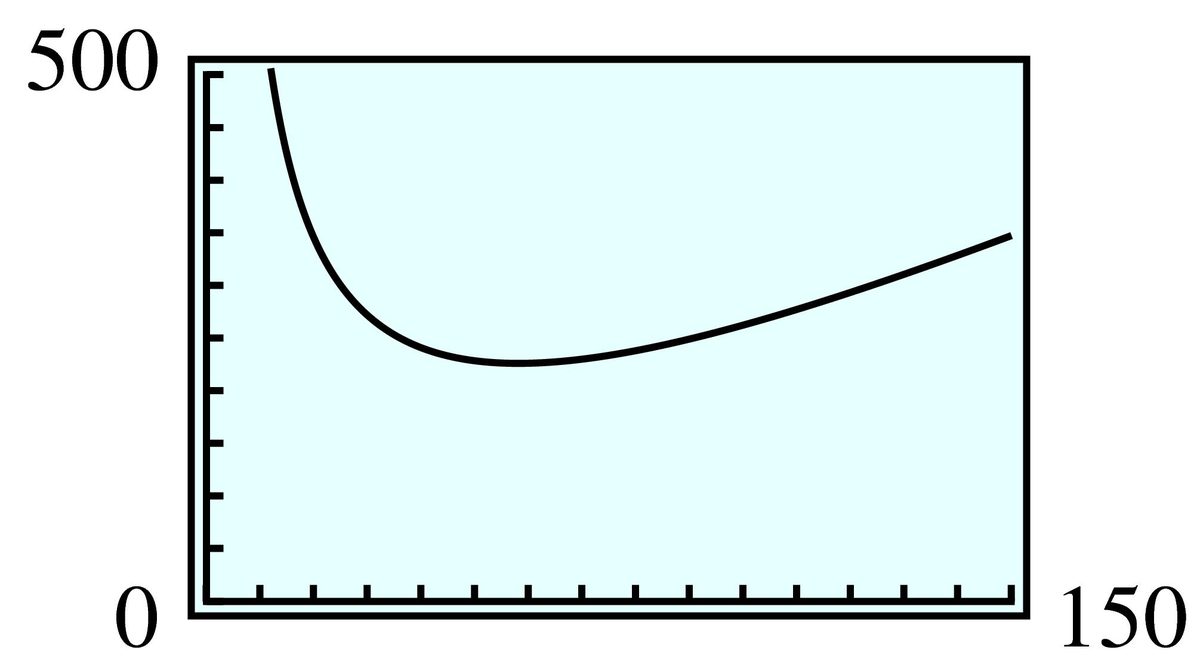
Lowest point: ; The minimum perimeter is ft for a width of ft.- ft by ft
The cost of wire fencing is $ per foot. A rancher wants to enclose a rectangular pasture of square feet with this fencing.
- Express the length of the pasture as a function of its width.
- Express the cost of the fence as a function of its width.
- Graph your function for the cost and find the coordinates of the lowest point on the graph. Interpret those coordinates in the context of the problem.
- The rancher has $ to spend on the fence, and she would like to know what the width of the pasture should be. Write an equation to describe this situation.
- Solve your equation and find the dimensions of the pasture.
A proportion is an equation in which each side is a ratio: . Show that this equation may be rewritten as .
Multiply both sides of the equation by and simplify.
Suppose that varies directly with , and and are two points on the graph of in terms of . Show that .
For Problems 25-28, solve the proportion using your result from Problem 23.
For Problems 29-36, use your result from Problem 24 to write and solve a proportion for the problem.
Property taxes on a house vary directly with the value of the house. If the taxes on a house worth $ are $, what would the taxes be on a house assessed at $?
$
The cost of electricity varies directly with the number of units (BTUs) consumed. If a typical household in the Midwest uses million BTUs of electricity annually and pays $, how much will a household that uses million BTUs annually spend for energy?
Distances on a map vary directly with actual distances. The scale on a map of Michigan uses inch to represent miles. If Isle Royale is inches long on the map, what is the actual length of the island?
mi
The dimensions of an enlargement vary directly with the dimensions of the original. A photographer plans to enlarge a photograph that measures centimeters by centimeters to produce a poster that is centimeters wide. How long will the poster be?
The Forest Service tags perch and releases them into Spirit Lake. One month later, it captures perch and finds that of them are tagged. What is the Forest Service's estimate of the original perch population of the lake?
The Wildlife Commission tags Canada geese at one of its migratory feeding grounds. When the geese return, the commission captures geese, of which are tagged. What is the commission's estimate of the number of geese that use the feeding ground?
The highest point on Earth is Mount Everest in Tibet, with an elevation of meters. The deepest part of the ocean is the Challenger Deep in the Mariana Trench, near Indonesia, meters below sea level.
- What is the total height variation in the surface of the Earth?
- What percentage of the Earth's radius, kilometers, is this variation?
- If the Earth were shrunk to the size of a basketball, with a radius of inches, what would be the corresponding height of Mount Everest?
- m
- in
Shortly after the arrival of human beings at the Hawaiian islands around 400 A.D., many species of birds became extinct. Fossils of different species have been found, but some species may have left no fossils for us to find. We can estimate the total number of extinct species using a proportion. Of species that are still alive, biologists have found fossil evidence of . (Source: Burton, 1998)
- Assuming that the same fraction of extinct species have left fossil records, calculate the total number of extinct species
- Give two reasons why this estimate may not be completely accurate.
In the figure, the rectangle is divided into a square and a smaller rectangle, . The two rectangles and are similar (their corresponding sides are proportional.) A rectangle with this property is called a golden rectangle, and the ratio of its length to its width is called the golden ratio.
The golden ratio appears frequently in art and nature, and it is considered to give the most pleasing proportions to many figures. We will compute the golden ratio as follows.
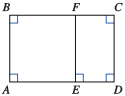
- Let and . What are the lengths of , , and ?
- Write a proportion in terms of for the similarity of rectangles and . Be careful to match up the corresponding sides.
- Solve your proportion for . Find the golden ratio, .
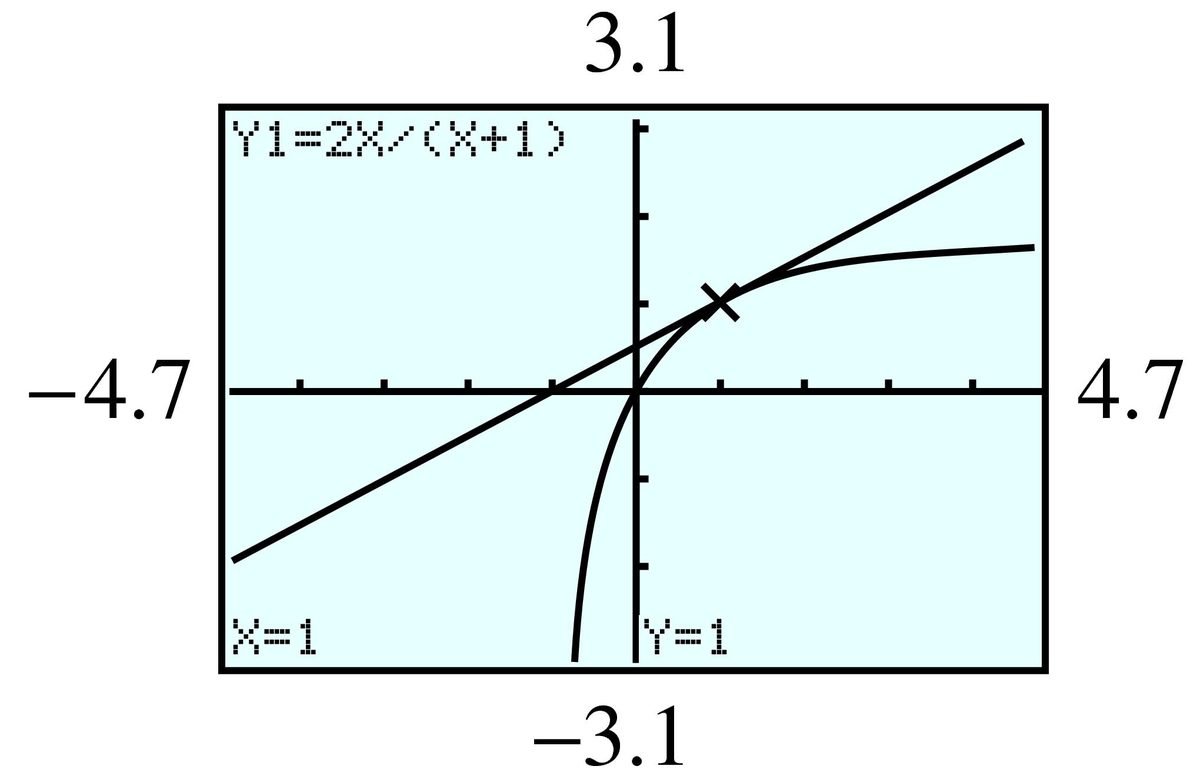
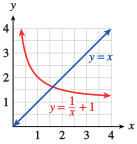
The figure shows the graphs of two equations, and .
- Find the -coordinate of the intersection point of the two graphs.
- Compare your answer to the golden ratio you computed in Problem 37.
For Problems 39-46, solve the formula for the specified variable.
, for
, for
, for
, for
, for
, for
, for
, for
The sidereal period of a planet is the time for the planet to make one trip around the Sun (as seen from the Sun itself). The synodic period is the time between two successive conjunctions of the planet and the Sun, as seen from Earth. The relationship among the sidereal period, , of a planet, the synodic period, , of the planet, and the sidereal period of Earth, , is given by
when the planet is closer to the Sun than the Earth is. Solve for in terms of and .
When a planet is farther from the Sun than Earth is,
where , , and are as defined in Problem 47. Solve for in terms of and .
For Problems 49-56, solve the equation algebraically.
A chartered sightseeing flight over the Grand Canyon is scheduled to return to its departure point in hours. The pilot would like to cover a distance of miles before turning around, and he hears on the Weather Service that there will be a headwind of miles per hour on the outward journey.
- Express the time it takes for the outward journey as a function of the airspeed of the plane.
- Express the time it takes for the return journey as a function of the speed of the plane.
- Graph the sum of the two functions and find the point on the graph with -coordinate . Interpret the coordinates of the point in the context of the problem.
- The pilot would like to know what airspeed to maintain in order to complete the tour in hours. Write an equation to describe this situation.
- Solve your equation to find the appropriate airspeed.
If the airspeed is mph, the round trip will take hours.- mph
Two student pilots leave the airport at the same time. They both fly at an airspeed of miles per hour, but one flies with the wind and the other flies against the wind.
- Express the time it takes the first pilot to travel miles as a function of the windspeed.
- Express the time it takes the second pilot to travel miles as a function of the windspeed.
- Graph the two functions in the same window, and find the coordinates of the intersection point. Interpret those coordinates in the context of the problem.
- Both pilots check in with their instructors at the same time, and the first pilot has traveled miles while the second pilot has gone miles. Write an equation to describe this situation.
- Solve your equation to find the speed of the wind.
Andy drives miles to Lake Tahoe at miles per hour and returns home at miles per hour. What is his average speed for the round trip? (It is not miles per hour!)
- Write expressions for the time it takes for each leg of the trip if Andy drives a distance, , at speed and returns at speed .
- Write expressions for the total distance and total time for the trip.
- Write an expression for the average speed for the entire trip.
- Write your answer to part (c) as a simple fraction.
- Use your formula to answer the question stated in the problem.
- Total distance is ; total time .
- mph
The owner of a print shop volunteers to produce flyers for his candidate's campaign. His large printing press can complete the job in hours, and the smaller model can finish the flyers in hours. How long will it take to print the flyers if he runs both presses simultaneously?
- Suppose that the large press can complete a job in hours and the smaller press takes hours. Write expressions for the fraction of a job that each press can complete in hour.
- Write an expression for the fraction of a job that can be completed in hour with both presses running simultaneously.
- Write an expression for the amount of time needed to complete the job with both presses running.
- Write your answer to part (c) as a simple fraction.
- Use your formula to answer the question stated in the problem.
Modeling, Functions, and Graphs by Katherine Yoshiwara (yoshiwarabooks.org), GNU Free Documentation License 1.2 or later. Adapted for the XYZ HTML edition with the authors' permission (recorded 2026-07-04). License: GFDL-1.2-or-later.