
7.1 Polynomial Functions
Introduction
We have already encountered some examples of polynomial functions. Linear functions,
and quadratic functions
are special cases of polynomial functions. In general, we make the following definition.
Some examples of polynomials are
Each of the polynomials above is written in descending powers, which means that the highest-degree term comes first, and the degrees of the terms decrease from largest to smallest. Sometimes it is useful to write a polynomial in ascending powers, so that the degrees of the terms increase. For example, the polynomial above would be written as
in ascending powers.
What is the lead coefficient of a polynomial?
_____
The coefficient of the highest power
What is the lead coefficient of a polynomial?
- The first coefficient
- The constant term
- The largest coefficient
- The coefficient of the highest power
Products of Polynomials
When we multiply two or more polynomials together, we get another polynomial of higher degree. (See Algebra Skills Refresher A.7 for the definition of degree.)
Multiply _____.
Multiply
What is the linear term of the product ?
_____
is the linear term of .
What is the linear term of the product ?
In Examplea, we multiplied a polynomial of degree 1 by a polynomial of degree 3, and the product was a polynomial of degree 4. In Exampleb, the product of three first degree polynomials is a third-degree polynomial.
Find the coefficient of the fourth-degree term of the product of and .
Answer: _____
is the coefficient of the term in the product.
To compute the fourth-degree term in the product, we multiply a term of of degree 4, 3, 2, or 0 by a term of of degree 0, 1, 2, or 4 respectively. We add those four products of terms:
So the fourth-degree term in the product is , and the coefficient is .
Find the coefficient of the fourth-degree term of the product of and .
is the coefficient of the term in the product.
To compute the fourth-degree term in the product, we multiply a term of of degree 4, 3, 2, or 0 by a term of of degree 0, 1, 2, or 4 respectively. We add those four products of terms:
So the fourth-degree term in the product is , and the coefficient is .
The degree of a product of polynomials is the same as
_____
the sum of the degrees of the factors.
The degree of a product of polynomials is the same as
- the product of the degrees of the factors.
- the number of terms in the product.
- the sum of the degrees of the factors.
- the sum of the lead coefficients.
Special Products
In the Algebra Skills Refresher Factoring Quadratic Trinomials, you can review the following special products involving quadratic expressions.
There are also special products resulting in cubic polynomials. In the Homework problems, you will be asked to verify the following products.
If you become familiar with these general forms, you can use them as patterns to find specific examples of such products.
Of course, we can also expand the product in Example simply by polynomial multiplication and arrive at the same answer.
Write as a polynomial.
Answer: _____
Write as a polynomial.
Explain the difference between the expressions and .
_____
Explain the difference between the expressions and .
Factoring Cubics
Another pair of products is useful for factoring cubic polynomials. In the Homework problems, you will be asked to verify the following products:
Viewing these products from right to left, we have the following special factorizations for the sum and difference of two cubes.
When we recognize a polynomial as a sum or difference of two perfect cubes, we then identify the two cubed expressions and apply the formula.
Which statement is true?
_____
A cubic polynomial describes as a function of .
Which statement is true?
- A cubic polynomial describes as a function of .
- We cannot factor the sum of two cubes.
- A cubic polynomial must have 4 terms.
Factor __________
Factor
Compare the formulas for factoring and .
_____
Compare the formulas for factoring and .
Modeling with Polynomials
Polynomials model many variable relationships, including volume and surface area.
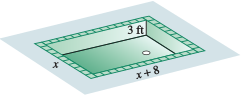
An empty reflecting pool is feet deep. It is feet longer than it is wide, as illustrated above.
- Write a polynomial function that gives the surface area of the empty pool.
_____ - Write a polynomial function for the volume of the pool.
_____
- We add the area of the bottom to the areas of each of the sides of the pool:
- We multiply depth, length, and width:
An empty reflecting pool is feet deep. It is feet longer than it is wide, as illustrated below.
- Write a polynomial function that gives the surface area of the empty pool.
- Write a polynomial function for the volume of the pool.
- We add the area of the bottom to the areas of each of the sides of the pool:
- We multiply depth, length, and width:
Explain how to find the surface area of a solid figure such as a box or a cylinder.
_____
Explain how to find the surface area of a solid figure such as a box or a cylinder.
Cubic polynomials are often used in economics to model cost functions. The cost of producing items is an increasing function of , but its rate of increase is usually not constant.
In Examplec, we solved a cubic equation graphically. There is a cubic formula, analogous to the quadratic formula, that allows us to solve cubic equations algebraically, but it is complicated and not often used. See the Projects for Chapter 7 if you would like to know more about the cubic formula.
How do we solve cubic equations in this class?
_____
By graphing.
How do we solve cubic equations in this class?
- By factoring
- By taking cube roots
- By using the quadratic formula
- By graphing
Cubic polynomials are also used to model smooth curves connecting given points. Such a curve is called a cubic spline.
Leon is flying his plane to Au Gres, Michigan. He maintains a constant altitude until he passes over a marker just outside the neighboring town of Omer, when he begins his descent for landing. During the descent, his altitude, in feet, is given by
where is the number of miles Leon has traveled since passing over the marker in Omer.
- What is Leon's altitude when he begins his descent?
_____ ft - Graph in the window
- Use the Trace feature to discover how far from Omer Leon will travel before landing. (In other words, how far is Au Gres from Omer?)
_____ mi - Verify your answer to part (c) algebraically.
_____
- ft
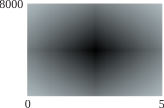
- A graph is below.
- mi
- , that is, Leon is on the ground (at altitude 0) when he is 5 miles past Omer.
Graph for part (b)
Leon is flying his plane to Au Gres, Michigan. He maintains a constant altitude until he passes over a marker just outside the neighboring town of Omer, when he begins his descent for landing. During the descent, his altitude, in feet, is given by
where is the number of miles Leon has traveled since passing over the marker in Omer.
- What is Leon's altitude when he begins his descent?
- Graph in the window
- Use the Trace feature to discover how far from Omer Leon will travel before landing. (In other words, how far is Au Gres from Omer?)
- Verify your answer to part (c) algebraically.
- ft
- mi
- , that is, Leon is on the ground (at altitude 0) when he is 5 miles past Omer.
Section Summary
Vocabulary
Look up the definitions of new terms in the Glossary.
- Polynomial function
- Degree
- Ascending powers
- Lead coefficient
- Descending powers
CONCEPTS
- The degree of a product of nonzero polynomials is the sum of the degrees of the factors.
- If we know the vertex of a parabola, we need only one other point to find its equation.
STUDY QUESTIONS
- If you add two polynomials of degree , what can you say about the degree of the sum?
- If you multiply a polynomial of degree and a polynomial of degree , what can you say about the degree of the product?
- If you multiply together what will be the degree of the product? What will be the lead coefficient?
- What are the two middle terms in the expansion of ?
- Is it possible to factor the sum of two cubes? What about the sum of two squares?
SKILLS
Practice each skill in the Homework problems listed.
- Multiply polynomials: #1–8
- Find specific terms of polynomial products: #9–22
- Use the formula for the cube of a binomial: #23–34
- Factor the sum or difference of two cubes: #35–46
- Write and analyze polynomial models: #47–64
Homework 7.1
For Problems 1–8, multiply.
For Problems 9–12, find the first three terms of the product in ascending powers. (Do not compute the entire product!)
For Problems 13–16, find the indicated term in each product. (Do not compute the entire product!)
;
;
;
;
For Problems 17–18, without performing the multiplication, give the degree of each product.
For Problems 19–22, verify the following products discussed in the text.
- As if you were addressing a classmate, explain how to remember the formula for expanding . In particular, mention the exponents on each term and the numerical coefficients.
- Explain how to remember the formula for expanding , assuming your listener already knows the formula for .
- The formula begins with and ends with . As you proceed from term to term, the exponents on decrease while the exponents on increase, and on each term the sum of the exponents is . The coefficients of the two middle terms are both .
- The formula is the same as for , except that the terms alternate in sign.
- As if you were addressing a classmate, explain how to remember the formula for factoring a sum of two cubes. Pay particular attention to the placement of the variables and the signs of the terms.
- Explain how to remember the formula for factoring a difference of two cubes, assuming your listener already knows how to factor a sum of two cubes.
For Problems 25–28, use the formulas for the cube of a binomial to expand the products.
For Problems 29–34, write each product as a polynomial and simplify.
For Problems 35–46, factor completely.
- Write a polynomial function, , that gives the area of the front face of the speaker frame (the region in color) in the figure.
- If inches, find the area of the front face of the frame.
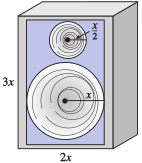
- square inches
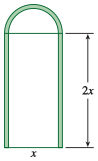
- A Norman window is shaped like a rectangle whose length is twice its width, with a semicircle at the top (see the figure). Write a polynomial, , that gives its area.
- If feet, find the area of the front face of the frame.
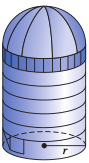
- A grain silo is built in the shape of a cylinder with a hemisphere on top (see the figure). Write an expression for the volume of the silo in terms of the radius and height of the cylindrical portion of the silo.
- If the total height of the silo is five times its radius, write a polynomial function in one variable for its volume.
A cold medication capsule is shaped like a cylinder with a hemispherical cap on each end (see the figure). Write an expression for the volume of the capsule in terms of the radius and length of the cylindrical portion.

- If the radius of the capsule is one-fourth of its overall length, write a polynomial function in one variable for its volume.
Jack invests $ in an account bearing interest rate , compounded annually. This means that each year his account balance is increased by a factor of .
- Write expressions for the amount of money in Jack's account after years, after years, and after years.
- Expand as polynomials the expressions you found in part (a).
- How much money will be in Jack's account at the end of years, years, and years if the interest rate is ?
- ; ;
- ; ;
- $583.20, $629.86, $680.24
A small company borrows $800 for start-up costs and agrees to repay the loan at interest rate , compounded annually. This means that each year the debt is increased by a factor of .
- Write expressions for the amount of money the company will owe if it repays the loan after years, after years, or after years.
- Expand as polynomials the expressions you found in part (a).
- How much money will the company owe after years, after years, or after years at an interest rate of ?
A paper company plans to make boxes without tops from sheets of cardboard inches wide and inches long. The company will cut out four squares of side inches from the corners of the sheet and fold up the edges as shown in the figure.
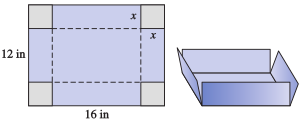
- Write expressions in terms of for the length, width, and height of the resulting box.
- Write a formula for the volume, , of the box as a function of .
- What is the domain of the function ? (What are the largest and smallest reasonable values for ?)
- Make a table of values for on its domain.
- Graph your function in a suitable window.
- Use your graph to find the value of that will yield a box with maximum possible volume. What is the maximum possible volume?
- Length: ; Width: ; Height:
- Real numbers between and
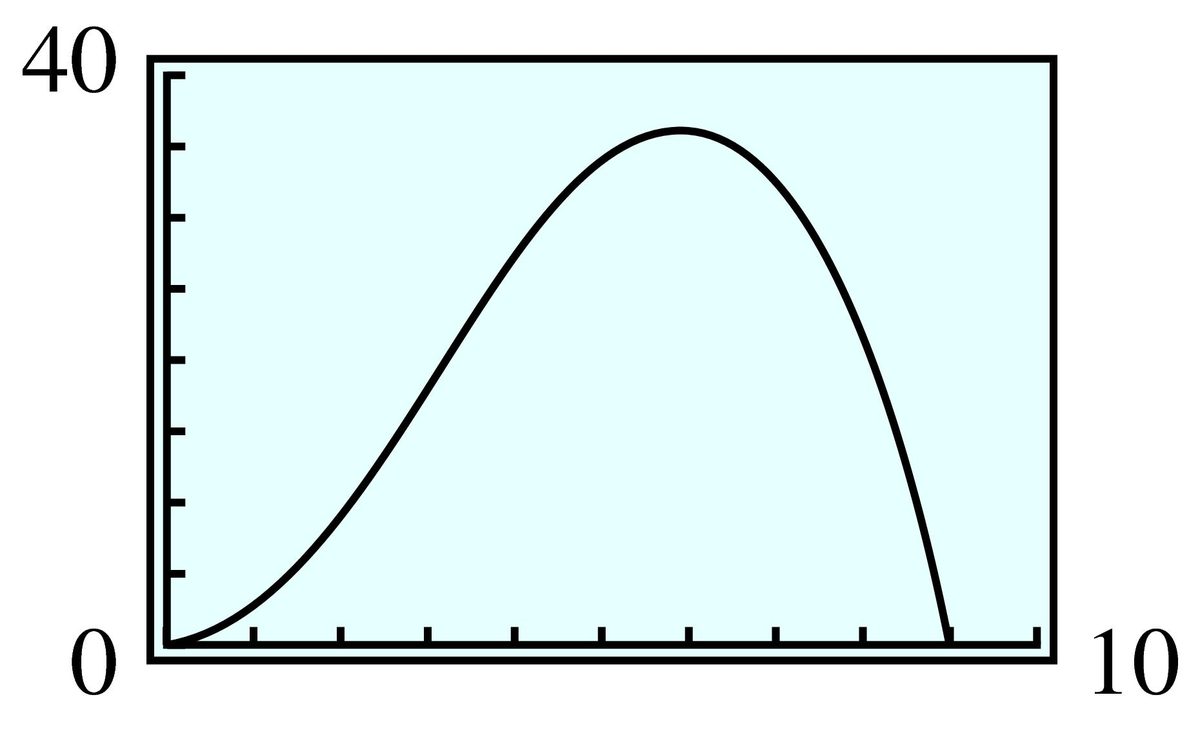
- in, cu in
The paper company also plans to make boxes with tops from -inch by -inch sheets of cardboard by cutting out the shaded areas shown in the figure and folding along the dotted lines.
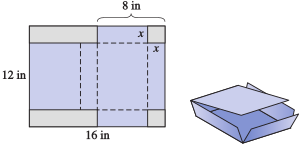
- Write expressions in terms of for the length, width, and height of the resulting box.
- Write a formula for the volume, , of the box as a function of .
- What is the domain of the function ? (What are the largest and smallest reasonable values for ?)
- Make a table of values for on its domain.
- Graph your function in a suitable window.
- Use your graph to find the value of that will yield a box with maximum possible volume. What is the maximum possible volume?
Use your graphing utility to help you answer the questions in Problems 55–62. Then verify your answers algebraically.
A doctor who is treating a heart patient wants to prescribe medication to lower the patient's blood pressure. The body's reaction to this medication is a function of the dose administered. If the patient takes milliliters of the medication, his blood pressure should decrease by points, where
- For what values of is ?
- Find a suitable domain for the function and explain why you chose this domain.
- Graph the function on its domain.
- How much should the patient's blood pressure drop if he takes milliliters of medication?
- What is the maximum drop in blood pressure that can be achieved with this medication?
- There may be risks associated with a large change in blood pressure. How many milliliters of the medication should be administered to produce half the maximum possible drop in blood pressure?
- ; for these values
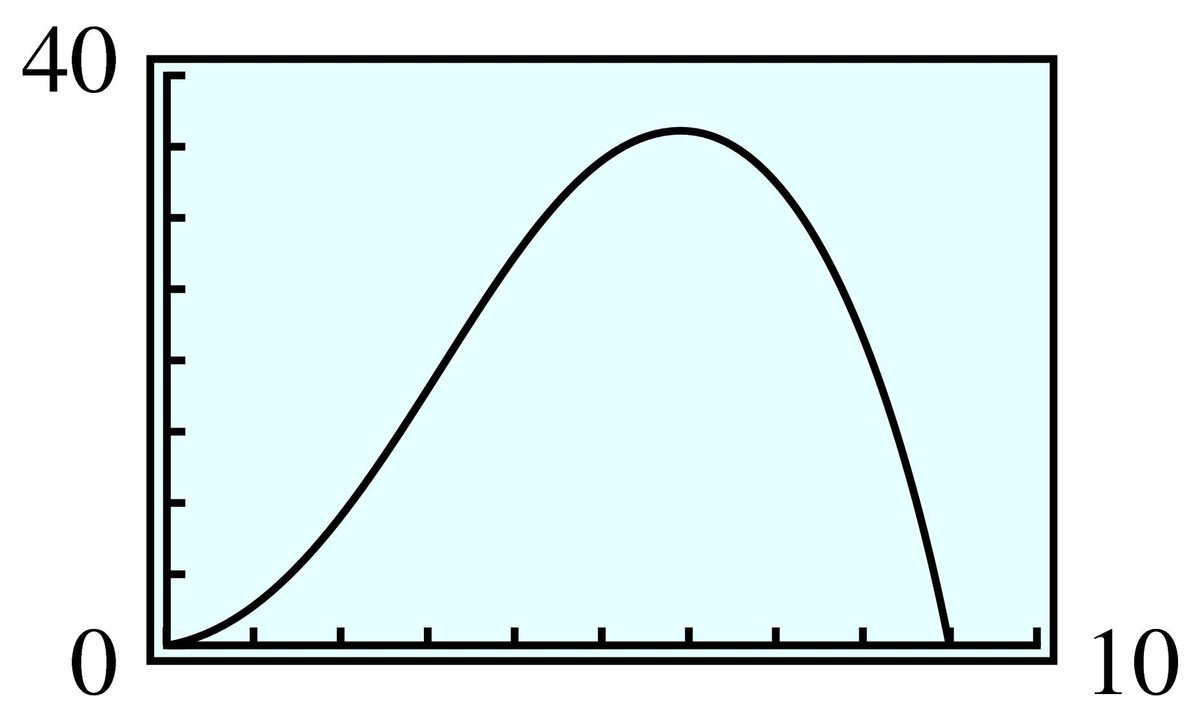
- points
- points
- ml or ml
A soup bowl has the shape of a hemisphere of radius centimeters. The volume of the soup in the bowl, , is a function of the depth, , of the soup.
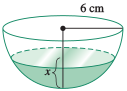
- What is the domain of ? Why?
- The function is given by Graph the function on its domain.
- What is the volume of the soup if it is centimeters deep?
- What is the maximum volume of soup that the bowl can hold?
- Find the depth of the soup (to within decimal places of accuracy) when the bowl is filled to half its capacity.
The population, , of Cyberville has been growing according to the formula
where is the number of years since 1970.
- Graph in the window
- What was the population in 1970? In 1985? In 2004?
- By how much did the population grow from 1970 to 1971? From 1985 to 1986? From 2004 to 2005?
- Approximately when was the population growing at the slowest rate, that is, when is the graph the least steep?
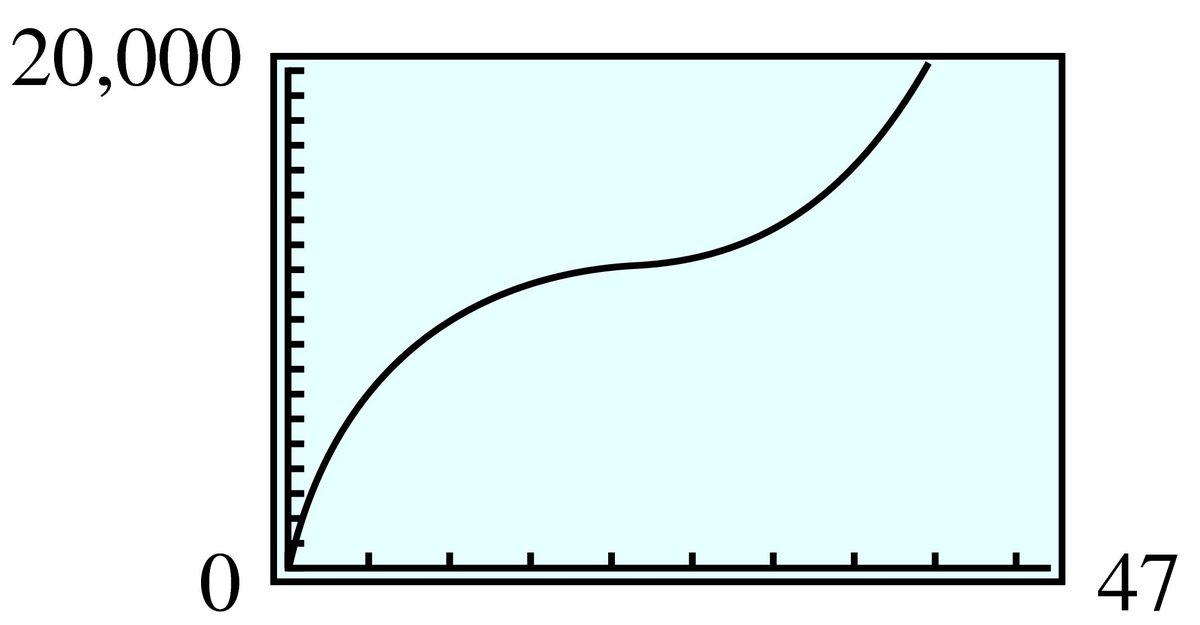
- ; ;
- ; ;
- Between 1990 and 1991
The annual profit, , of the Enviro Company, in thousands of dollars, is given by
where is the number of years since 1960, the first year that the company showed a profit.
- Graph in the window
- What was the profit in 1960? In 1980? In 2000?
- How did the profit change from 1960 to 1961? From 1980 to 1981? From 2000 to 2001?
- During which years did the profit decrease from one year to the next?
The total annual cost of educating postgraduate research students at an Australian university, in thousands of dollars, is given by the function
where is the number of students, in hundreds. (Source: Creedy, Johnson, and Valenzuela, 2002)
- Graph the function in a suitable window for up to students.
- Describe the concavity of the graph. For what value of is the cost growing at the slowest rate?
- Approximately how many students can be educated for $?
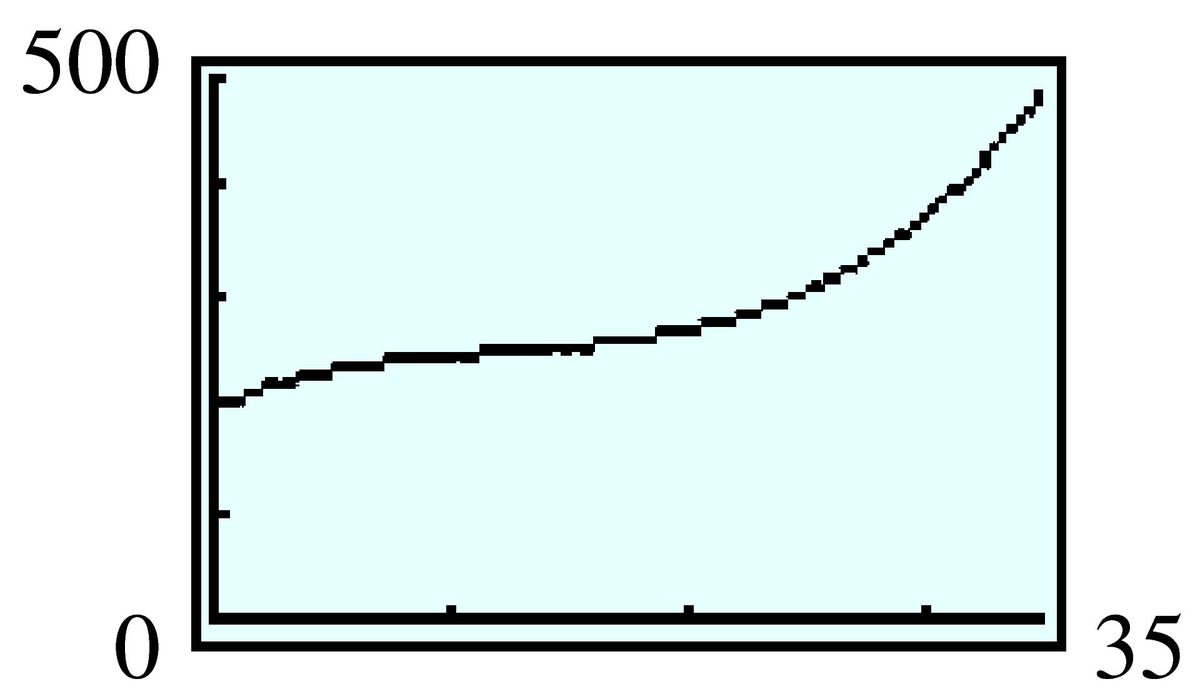
- The graph is concave down until about and is concave up afterwards. The cost is growing at the slowest rate at the inflection point at about , or students.
- About
It has been proposed that certain cubic functions model the response of wheat and barley to nitrogen fertilizer. These functions exhibit a "plateau" that fits observations better than the standard quadratic model. (See Problem of Curve Fitting.) In trials in Denmark, the yield per acre was a function of the amount of nitrogen applied. A typical response function is
where is the amount of fertilizer, in kilograms per acre.(Source: Beattie, Mortensen, and Knudsen, 2005)
- Graph the function on the domain .
- Describe the concavity of the graph. In reality, the yield does not increase after reaching its plateau. Give a suitable domain for the model in this application.
- Estimate the maximum yield attainable and the optimum application of fertilizer.
During an earthquake, Nordhoff Street split in two, and one section shifted up several centimeters. Engineers created a ramp from the lower section to the upper section. In the coordinate system shown in the figure below, the ramp is part of the graph of
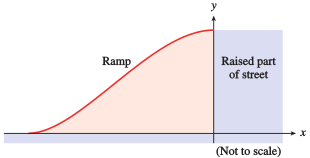
- By how much did the upper section of the street shift during the earthquake?
- What is the horizontal distance from the bottom of the ramp to the raised part of the street?
- cm
- cm
The off-ramp from a highway connects to a parallel one-way road. The accompanying figure shows the highway, the off-ramp, and the road. The road lies on the -axis, and the off-ramp begins at a point on the -axis. The offramp is part of the graph of the polynomial
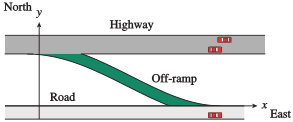
- How far east of the exit does the off-ramp meet the one-way road?
- How far apart are the highway and the road?
The number of minutes of daylight per day in Chicago is approximated by the polynomial
where is the number of days since the summer solstice. The approximation is valid for . (A negative value of corresponds to a number of days before the summer solstice.)
- Use a table of values with increments of days to estimate the range of the function on its domain.
- Graph the polynomial on its domain.
- How many minutes of daylight are there on the summer solstice?
- How much daylight is there two weeks before the solstice?
- When are the days more than hours long?
- When are the days less than hours long?
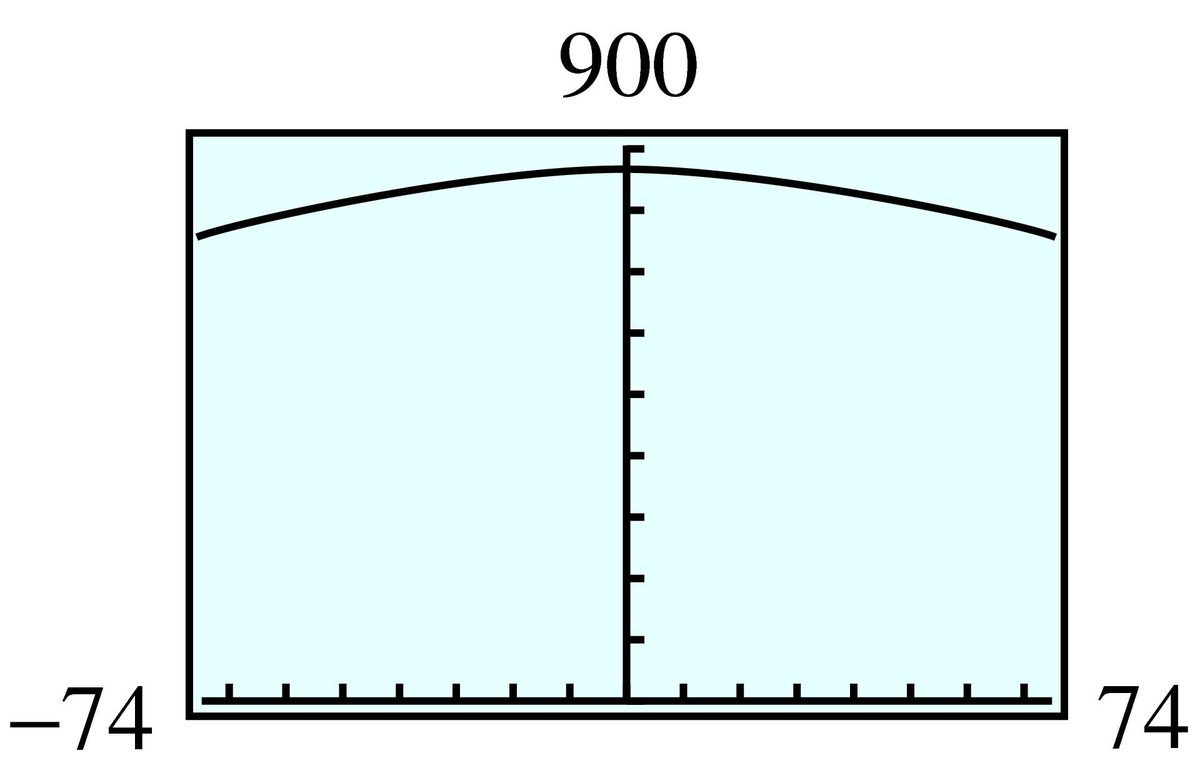
- min
- min
- Within days of the summer solstice
- More than days from the summer solstice
The water level (in feet) at a harbor is approximated by the polynomial
where is the number of hours since the high tide. The approximation is valid for . (A negative value of corresponds to a number of hours before the high tide.)
- Use a table of values to estimate the range of the function on its domain.
- Graph the polynomial on its domain.
- What is the water level at high tide?
- What is the water level hours before high tide?
- When is the water level below feet?
- When is the water level above feet?
Modeling, Functions, and Graphs by Katherine Yoshiwara (yoshiwarabooks.org), GNU Free Documentation License 1.2 or later. Adapted for the XYZ HTML edition with the authors' permission (recorded 2026-07-04). License: GFDL-1.2-or-later.