
7.3 Complex Numbers
Introduction
You know that not all quadratic equations have real solutions.
For example, the graph of
has no -intercepts (as shown at right), and the equation
has no real solutions.
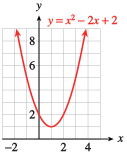
We can still use completing the square or the quadratic formula to solve the equation.
Solve the equation by using the quadratic formula.
_____
Separate different solutions with a comma.
Solve the equation by using the quadratic formula.
Imaginary Numbers
Although square roots of negative numbers such as are not real numbers, they occur often in mathematics and its applications.
Mathematicians began working with square roots of negative numbers in the sixteenth century, in their attempts to solve quadratic and cubic equations. René Descartes gave them the name imaginary numbers, which reflected the mistrust with which mathematicians regarded them at the time. Today, however, such numbers are well understood and used routinely by scientists and engineers.
We begin by defining a new number, , whose square is .
What is the imaginary unit?
_____
is the imaginary unit, denoted by .
What is the imaginary unit?
The square root of any negative number can be written as the product of a real number and . For example,
or . Any number that is the product of and a real number is called an imaginary number.
Here are some xamples of imaginary numbers.
Write each radical as an imaginary number. Use for the imaginary unit, and enter "sqrt(2)" for .
- _____
- _____
Write each radical as an imaginary number.
Complex Numbers
Consider the quadratic equation
Using the quadratic formula to solve the equation, we find
If we now replace with , we have
The two solutions are and . These numbers are examples of complex numbers.
Here are some examples of complex numbers.
In a complex number , is called the real part, and is called the imaginary part. All real numbers are also complex numbers (with the imaginary part equal to zero). A complex number whose real part equals zero is called a pure imaginary number.
Use extraction of roots to solve . Write your answers as complex numbers.
_____
Separate different solutions with a comma.
Use extraction of roots to solve . Write your answers as complex numbers.
Arithmetic of Complex Numbers
All the properties of real numbers listed in Algebra Skills Refresher The Real Number System are also true of complex numbers. We can carry out arithmetic operations with complex numbers.
Which statement about complex numbers is false?
_____
"Complex numbers cannot be combined with real numbers" is a false statement.
Which statement about complex numbers is false?
- A complex number has a real part and an imaginary part.
- We can perform all four arithmetic operations on complex numbers.
- Every quadratic equation has solutions in the complex numbers.
- Complex numbers cannot be combined with real numbers.
We add and subtract complex numbers by combining their real and imaginary parts separately. For example,
Subtract: _____
Subtract:
Products of Complex Numbers
To find the product of two imaginary numbers, we use the fact that . For example,
To find the product of two complex numbers, we use the FOIL method, as if the numbers were binomials. For example,
Because , the last term, , can be replaced by , or , to obtain
Finally, we combine the real parts and imaginary parts to obtain
Multiply _____
Multiply
You can verify that in general the following rule holds.
How is multiplying complex numbers similar to multiplying binomials?
_____
How is multiplying complex numbers similar to multiplying binomials?
Quotients of Complex Numbers
To find the quotient of two complex numbers, we use the technique of rationalizing the denominator. (See Algebra Skills Refresher Working with Radicals.)
For example, consider the quotient
Because is really a radical (remember that , we multiply the numerator and denominator of the quotient by to obtain
To write the quotient in the form , we divide into each term of the numerator to get
Divide _____
Divide
If is any nonzero complex number, then the number is called the complex conjugate of . The product of a nonzero complex number and its conjugate is always a positive real number.
We use this fact to find the quotient of complex numbers. If the divisor has both a real and an imaginary part, we multiply numerator and denominator by the conjugate of the denominator.
What is the product of with its complex conjugate?
_____
What is the product of with its complex conjugate?
Write the quotient in the form .
Answer: _____
Write the quotient in the form .
Explain how to divide one complex number by another.
_____
Explain how to divide one complex number by another.
Zeros of Polynomials
Because we can add, subtract, and multiply any two complex numbers, we can use a complex number as an input for a polynomial function. Thus, we can extend the domain of any polynomial to include all complex numbers.
If , evaluate _____
For , evaluate
In Quadratic Functions, we learned that irrational solutions of quadratic equations occur in conjugate pairs,
If the discriminant is negative, the two solutions are complex conjugates,
Thus, if we know that is a complex solution of a quadratic equation, we know that is the other solution. The quadratic equation with solutions and is
- Let . Compute _____
- Find a quadratic equation with one solution being .
Answer: _____
Use as the variable. The coefficient of should be 1.
- Let . Compute
- Find a quadratic equation with one solution being .
One of the most important results in mathematics is the fundamental theorem of algebra, which says that if we allow complex numbers as inputs, then every polynomial of degree has exactly complex number zeros.
As a result, the factor theorem tells that every polynomial of degree can be factored as the product of linear terms. For example, although the graph of shown at right has no -intercepts, the fundamental theorem tells us that there are four complex solutions to , and that can be factored.
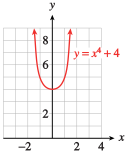
You can check that the four solutions to are , , , and . For example, if , then
and
so .
Because each zero corresponds to a factor of the polynomial, the factored form of is
If is a solution to a polynomial equation, then so is:
_____
If is a solution to a polynomial equation, then so is:
- Find the zeros of the polynomial .
_____ Separate different solutions with a comma. - Write the polynomial in factored form.
____________________
- Find the zeros of the polynomial .
- Write the polynomial in factored form.
What can you say about the graph of a quadratic function whose zeros are complex numbers?
_____
What can you say about the graph of a quadratic function whose zeros are complex numbers?
Graphing Complex Numbers
Real numbers can be plotted on a number line, but to graph a complex number we use a plane, called the complex plane. In the complex plane, the real numbers lie on the horizontal or real axis, and pure imaginary numbers lie on the vertical or imaginary axis.
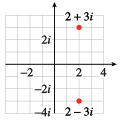
To plot a complex number a + bi, we move units from the origin in the horizontal direction and units in the vertical direction. The numbers and are plotted at left.
Plot the following numbers as points on the complex plane.
A plot is below.

Plot the following numbers as points on the complex plane.
Section Summary
Vocabulary
Look up the definitions of new terms in the Glossary.
- Imaginary unit
- Imaginary number
- Complex number
- Imaginary axis
- Complex conjugate
- Real part
- Imaginary part
- Complex plane
- Real axis
CONCEPTS
- The square root of a negative number is an imaginary number.
- A complex number is the sum of a real number and an imaginary number.
- We can perform the four arithmetic operations on complex numbers.
- The product of a nonzero complex number and its conjugate is always a positive real number.
- The nonreal zeros of a polynomial with real coefficients always occur in conjugate pairs.
- We can graph complex numbers in the complex plane.
- Multiplying a complex number by rotates its graph by around the origin.
STUDY QUESTIONS
- What are imaginary numbers, and why were they invented?
- Simplify the following powers of : What do you notice?
- Explain how the complex conjugate is used in dividing complex numbers.
- If one solution of a quadratic equation is , what is the other solution?
- If is a polynomial of degree , how many zeros does have? How many -intercepts could its graph have? How many complex zeros could have?
SKILLS
Practice each skill in the Homework problems listed.
- Write and simplify complex numbers: #1–10
- Perform arithmetic operations on complex numbers: #11–36
- Evaluate polynomials at complex numbers, expand polynomials: #37–48
- Find a polynomial with given zeros: #53–56, 59–62
- Graph complex numbers: #63–70
Homework 7.3
For Problems 1–6, write the complex number in the form , where and are real numbers.
For Problems 7–10, find the zeros of the quadratic polynomial. Write each in the form , where and are real numbers.
For Problems 11–14, add or subtract.
For Problems 15–24, multiply.
For Problems 25–36, divide.
For Problems 37–42, evaluate the polynomial for the given values of the variable.
For Problems 43–48, expand each product of polynomials.
For what values of will be real? Imaginary?
;
For what values of will be real? Imaginary?
Simplify.
Express with a positive exponent and simplify.
In Problems 53–56,
- Given one solution of a quadratic equation with rational coefficients, find the other solution.
- Write a quadratic equation that has those solutions.
Every polynomial factors into a product of a constant and linear factors of the form , where can be either real or complex. In Problems 57–58, how many linear factors are in the factored form of the given polynomial?
For Problems 59–62, find a fourth-degree polynomial with real coefficients that has the given complex numbers as two of its zeros.
For Problems 63–66, plot each number and its complex conjugate in the complex plane. What is the geometric relationship between complex conjugates?
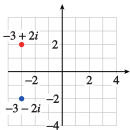
The complex conjugates are reflections of each other across the real axis.
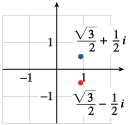
The complex conjugates are reflections of each other across the real axis.
For Problems 59–62, simplify and plot each complex number as a point on the complex plane.
and
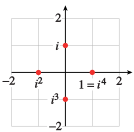
and
and
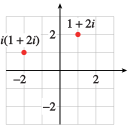
and
Problems 71–72 show that multiplication by results in a rotation of .
Suppose that and that the real numbers and are both nonzero.
- What is the slope of the segment in the complex plane joining the origin to ?
- What is the slope of the segment in the complex plane joining the origin to ?
- What is the product of the slopes of the two segments from parts (a) and (b)? What can you conclude about the angle between the two segments?
- ; The angle is .
Suppose that and that and are both real numbers.
- If and , then what is the slope of the segment in the complex plane joining the origin to ? What is the slope of the segment joining the origin to ?
- If and , then what is the slope of the segment in the complex plane joining the origin to ? What is the slope of the segment joining the origin to ?
- What can you conclude about the angle between the two segments from parts (a) and (b)?
Modeling, Functions, and Graphs by Katherine Yoshiwara (yoshiwarabooks.org), GNU Free Documentation License 1.2 or later. Adapted for the XYZ HTML edition with the authors' permission (recorded 2026-07-04). License: GFDL-1.2-or-later.