10.3 The Six Circular Functions and Fundamental Identities
In section, we defined and for angles using the coordinate values of points on the Unit Circle. As such, these functions earn the moniker circular functions.1 It turns out that cosine and sine are just two of the six commonly used circular functions which we define below.
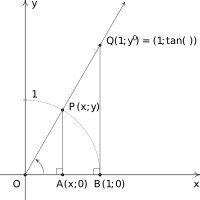
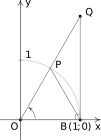
While we left the history of the name `sine' as an interesting research project in Section, the names `tangent' and `secant' can be explained using the diagram below. Consider the acute angle below in standard position. Let denote, as usual, the point on the terminal side of which lies on the Unit Circle and let denote the point on the terminal side of which lies on the vertical line .
Figure 10.111
The word `tangent' comes from the Latin meaning `to touch,' and for this reason, the line is called a tangent line to the Unit Circle since it intersects, or `touches', the circle at only one point, namely . Dropping perpendiculars from and creates a pair of similar triangles and . Thus which gives , where this last equality comes from applying Definition. We have just shown that for acute angles , is the -coordinate of the point on the terminal side of which lies on the line which is tangent to the Unit Circle. Now the word `secant' means `to cut', so a secant line is any line that `cuts through' a circle at two points.2 The line containing the terminal side of is a secant line since it intersects the Unit Circle in Quadrants I and III. With the point lying on the Unit Circle, the length of the hypotenuse of is . If we let denote the length of the hypotenuse of , we have from similar triangles that , or . Hence for an acute angle , is the length of the line segment which lies on the secant line determined by the terminal side of and `cuts off' the tangent line . Not only do these observations help explain the names of these functions, they serve as the basis for a fundamental inequality needed for Calculus which we'll explore in the Exercises.
Of the six circular functions, only cosine and sine are defined for all angles. Since and in Definition, it is customary to rephrase the remaining four circular functions in terms of cosine and sine. The following theorem is a result of simply replacing with and with in Definition.
It is high time for an example.
While the Reciprocal and Quotient Identities presented in Theorem allow us to always reduce problems involving secant, cosecant, tangent and cotangent to problems involving cosine and sine, it is not always convenient to do so.3 It is worth taking the time to memorize the tangent and cotangent values of the common angles summarized below.
Tangent and Cotangent Values of Common Angles
Coupling Theorem with the Reference Angle Theorem, Theorem, we get the following.
We put Theorem to good use in the following example.
We have already seen the importance of identities in trigonometry. Our next task is to use use the Reciprocal and Quotient Identities found in Theorem coupled with the Pythagorean Identity found in Theorem to derive new Pythagorean-like identities for the remaining four circular functions. Assuming , we may start with and divide both sides by to obtain . Using properties of exponents along with the Reciprocal and Quotient Identities, this reduces to . If , we can divide both sides of the identity by , apply Theorem once again, and obtain . These three Pythagorean Identities are worth memorizing and they, along with some of their other common forms, are summarized in the following theorem.
Trigonometric identities play an important role in not just Trigonometry, but in Calculus as well. We'll use them in this book to find the values of the circular functions of an angle and solve equations and inequalities. In Calculus, they are needed to simplify otherwise complicated expressions. In the next example, we make good use of the Theorems and.
In Example Example 3 number above, we see that multiplying by produces a difference of squares that can be simplified to one term using Theorem. This is exactly the same kind of phenomenon that occurs when we multiply expressions such as by or by . (Can you recall instances from Algebra where we did such things?) For this reason, the quantities and are called `Pythagorean Conjugates.' Below is a list of other common Pythagorean Conjugates.
Pythagorean Conjugates
and :
and :
and :
and :
and :
and :
Verifying trigonometric identities requires a healthy mix of tenacity and inspiration. You will need to spend many hours struggling with them just to become proficient in the basics. Like many things in life, there is no short-cut here – there is no complete algorithm for verifying identities. Nevertheless, a summary of some strategies which may be helpful (depending on the situation) is provided below and ample practice is provided for you in the Exercises.
Strategies for Verifying Identities
Try working on the more complicated side of the identity.
Use the Reciprocal and Quotient Identities in Theorem to write functions on one side of the identity in terms of the functions on the other side of the identity. Simplify the resulting complex fractions.
Add rational expressions with unlike denominators by obtaining common denominators.
Use the Pythagorean Identities in Theorem to `exchange' sines and cosines, secants and tangents, cosecants and cotangents, and simplify sums or differences of squares to one term.
Multiply numerator and denominator by Pythagorean Conjugates in order to take advantage of the Pythagorean Identities in Theorem.
If you find yourself stuck working with one side of the identity, try starting with the other side of the identity and see if you can find a way to bridge the two parts of your work.
Beyond the Unit Circle
In Section, we generalized the cosine and sine functions from coordinates on the Unit Circle to coordinates on circles of radius . Using Theorem in conjunction with Theorem, we generalize the remaining circular functions in kind.
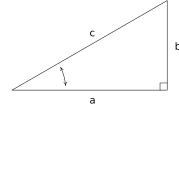
We may also specialize Theorem to the case of acute angles which reside in a right triangle, as visualized below.
Figure 10.118
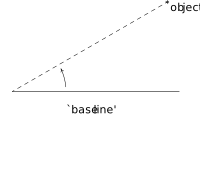
The following example uses Theorem as well as the concept of an `angle of inclination.' The angle of inclination (or angle of elevation) of an object refers to the angle whose initial side is some kind of base-line (say, the ground), and whose terminal side is the line-of-sight to an object above the base-line. This is represented schematically below.
Figure 10.119
The angle of inclination from the base line to the object is
As we did in Section, we may consider all six circular functions as functions of real numbers. At this stage, there are three equivalent ways to define the functions , , and for real numbers . First, we could go through the formality of the wrapping function on page and define these functions as the appropriate ratios of and coordinates of points on the Unit Circle; second, we could define them by associating the real number with the angle radians so that the value of the trigonometric function of coincides with that of ; lastly, we could simply define them using the Reciprocal and Quotient Identities as combinations of the functions and . Presently, we adopt the last approach. We now set about determining the domains and ranges of the remaining four circular functions. Consider the function defined as . We know is undefined whenever . From Example number, we know whenever for integers . Hence, our domain for , in set builder notation is . To get a better understanding what set of real numbers we're dealing with, it pays to write out and graph this set. Running through a few values of , we find the domain to be . Graphing this set on the number line we get
Figure 10.122
Using interval notation to describe this set, we get
This is cumbersome, to say the least! In order to write this in a more compact way, we note that from the set-builder description of the domain, the th point excluded from the domain, which we'll call , can be found by the formula . (We are using sequence notation from Chapter.) Getting a common denominator and factoring out the in the numerator, we get . The domain consists of the intervals determined by successive points : . In order to capture all of the intervals in the domain, must run through all of the integers, that is, , , , …. The way we denote taking the union of infinitely many intervals like this is to use what we call in this text extended interval notation. The domain of can now be written as
The reader should compare this notation with summation notation introduced in Section, in particular the notation used to describe geometric series in Theorem. In the same way the index in the series
can never equal the upper limit , but rather, ranges through all of the natural numbers, the index in the union
can never actually be or , but rather, this conveys the idea that ranges through all of the integers. Now that we have painstakingly determined the domain of , it is time to discuss the range. Once again, we appeal to the definition . The range of is , and since is undefined when , we split our discussion into two cases: when and when . If , then we can divide the inequality by to obtain . Moreover, using the notation introduced in Section, we have that as , . In other words, as . If, on the other hand, if , then dividing by causes a reversal of the inequality so that . In this case, as , , so that as , we get . Since admits all of the values in , the function admits all of the values in . Using set-builder notation, the range of can be written as , or, more succinctly,8 as .9 Similar arguments can be used to determine the domains and ranges of the remaining three circular functions: , and . The reader is encouraged to do so. (See the Exercises.) For now, we gather these facts into the theorem below.
We close this section with a few notes about solving equations which involve the circular functions. First, the discussion on page in Section concerning solving equations applies to all six circular functions, not just and . In particular, to solve the equation for real numbers , we can use the same thought process we used in Example Example 2, number to solve for angles in radian measure – we just need to remember to write our answers using the variable as opposed to . Next, it is critical that you know the domains and ranges of the six circular functions so that you know which equations have no solutions. For example, has no solution because is not in the range of secant. Finally, you will need to review the notions of reference angles and coterminal angles so that you can see why has an infinite set of solutions in Quadrant III and another infinite set of solutions in Quadrant IV.
Exercises
In Exercises -, find the exact value or state that it is undefined.
with in Quadrant II
with in Quadrant III
with in Quadrant I
with in Quadrant IV
with in Quadrant III
with in Quadrant II
with in Quadrant IV.
with in Quadrant II.
with in Quadrant III.
with in Quadrant I.
with .
with .
with .
with .
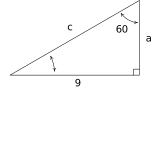
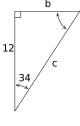
Find , , and .
Figure 10.123
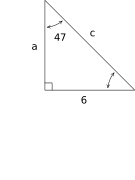
Find , , and .
Figure 10.124
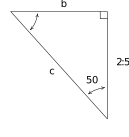
Find , , and .
Figure 10.125
Find , , and .
Figure 10.126
If and the side opposite has length , how long is the side adjacent to ?
If and the hypotenuse has length , how long is the side opposite ?
If and the side adjacent to has length , how long is the side opposite ?
If and the side opposite has lengh , how long is the hypoteneuse?
If and the hypotenuse has length , how long is the side adjacent to ?
If and the side adjacent to has length , how long is the side opposite ?
A tree standing vertically on level ground casts a 120 foot long shadow. The angle of elevation from the end of the shadow to the top of the tree is . Find the height of the tree to the nearest foot. With the help of your classmates, research the term umbra versa and see what it has to do with the shadow in this problem.
The broadcast tower for radio station WSAZ (Home of “Algebra in the Morning with Carl and Jeff”) has two enormous flashing red lights on it: one at the very top and one a few feet below the top. From a point 5000 feet away from the base of the tower on level ground the angle of elevation to the top light is and to the second light is . Find the distance between the lights to the nearest foot.
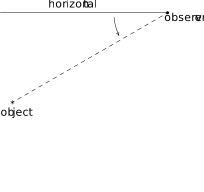
On page we defined the angle of inclination (also known as the angle of elevation) and in this exercise we introduce a related angle - the angle of depression (also known as the angle of declination). The angle of depression of an object refers to the angle whose initial side is a horizontal line above the object and whose terminal side is the line-of-sight to the object below the horizontal. This is represented schematically below.
Figure 10.127
The angle of depression from the horizontal to the object is
Show that if the horizontal is above and parallel to level ground then the angle of depression (from observer to object) and the angle of inclination (from object to observer) will be congruent because they are alternate interior angles.
From a firetower 200 feet above level ground in the Sasquatch National Forest, a ranger spots a fire off in the distance. The angle of depression to the fire is . How far away from the base of the tower is the fire?
The ranger in part sees a Sasquatch running directly from the fire towards the firetower. The ranger takes two sightings. At the first sighting, the angle of depression from the tower to the Sasquatch is . The second sighting, taken just 10 seconds later, gives the the angle of depression as . How far did the Saquatch travel in those 10 seconds? Round your answer to the nearest foot. How fast is it running in miles per hour? Round your answer to the nearest mile per hour. If the Sasquatch keeps up this pace, how long will it take for the Sasquatch to reach the firetower from his location at the second sighting? Round your answer to the nearest minute.
When I stand 30 feet away from a tree at home, the angle of elevation to the top of the tree is and the angle of depression to the base of the tree is . What is the height of the tree? Round your answer to the nearest foot.
From the observation deck of the lighthouse at Sasquatch Point 50 feet above the surface of Lake Ippizuti, a lifeguard spots a boat out on the lake sailing directly toward the lighthouse. The first sighting had an angle of depression of and the second sighting had an angle of depression of . How far had the boat traveled between the sightings?
A guy wire 1000 feet long is attached to the top of a tower. When pulled taut it makes a angle with the ground. How tall is the tower? How far away from the base of the tower does the wire hit the ground?
Verify the domains and ranges of the tangent, cosecant and cotangent functions as presented in Theorem.
As we did in Exercise in Section, let and be the two acute angles of a right triangle. (Thus and are complementary angles.) Show that and . The fact that co-functions of complementary angles are equal in this case is not an accident and a more general result will be given in Section.
We wish to establish the inequality for Use the diagram from the beginning of the section, partially reproduced below, to answer the following.
Figure 10.128
Show that triangle has area .
Show that the circular sector with central angle has area .
Show that triangle has area .
Comparing areas, show that for
Use the inequality to show that for
Use the inequality to show that for Combine this with the previous part to complete the proof.
Show that also holds for .
Explain why the fact that does not mean and ? (See the solution to number in Example Example 1.)
In Exercises -, use the given the information to find the exact values of the remaining circular functions of .
In Exercises -, use your calculator to approximate the given value to three decimal places. Make sure your calculator is in the proper angle measurement mode!
In Exercises -, find all of the angles which satisfy the equation.
In Exercises -, solve the equation for . Give exact values.
In Exercises -, use Theorem to find the requested quantities.
In Exercises -, use Theorem to answer the question. Assume that is an angle in a right triangle.
In Exercises -, verify the identity. Assume that all quantities are defined.
In Exercises -, verify the identity. You may need to consult Sections and for a review of the properties of absolute value and logarithms before proceeding.
Answers
is undefined
is undefined
is undefined
is undefined
when for any integer
when or for any integer
when for any integer .
when for any integer
when for any integer
when for any integer
when or for any integer .
when for any integer
when for any integer
never happens
never happens
when for any integer
when for any integer
when or for any integer
when for any integer
when for any integer
when for any integer
when or for any integer
never happens
when for any integer
when for any integer
when or for any integer
when or for any integer
, ,
, ,
, ,
, ,
The side adjacent to has length
The side opposite has length
The side opposite is
The hypoteneuse has length
The side adjacent to has length
The side opposite has length
The tree is about 47 feet tall.
The lights are about 75 feet apart.
The fire is about 4581 feet from the base of the tower.
The Sasquatch ran feet in those 10 seconds. This translates to miles per hour. At the scene of the second sighting, the Sasquatch was feet from the tower, which means, if it keeps up this pace, it will reach the tower in about minutes.
The tree is about 41 feet tall.
The boat has traveled about 244 feet.
The tower is about 682 feet tall. The guy wire hits the ground about 731 feet away from the base of the tower.
Adapted from Precalculus, 3rd corrected edition, by Carl Stitz and Jeff Zeager (stitz-zeager.com), licensed under CC BY-NC-SA 3.0. Changes were made: reformatted as an accessible XYZ web edition. License: CC-BY-NC-SA-3.0.