10.6 The Inverse Trigonometric Functions
As the title indicates, in this section we concern ourselves with finding inverses of the (circular) trigonometric functions. Our immediate problem is that, owing to their periodic nature, none of the six circular functions is one-to-one. To remedy this, we restrict the domains of the circular functions in the same way we restricted the domain of the quadratic function in Example 5.2.3 in Section 5.2 to obtain a one-to-one function. We first consider
f
(
x
)
=
cos
(
x
)
. Choosing the interval
[
0
,
π
]
allows us to keep the range as
[
−
1
,
1
]
as well as the properties of being smooth and continuous.
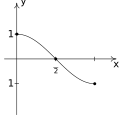
Figure 10.190 Restricting the domain of
f
(
x
)
=
cos
(
x
)
to
[
0
,
π
]
. Recall from Section 5.2 that the inverse of a function
f
is typically denoted
f
−
1
. For this reason, some textbooks use the notation
f
−
1
(
x
)
=
cos
−
1
(
x
)
for the inverse of
f
(
x
)
=
cos
(
x
)
. The obvious pitfall here is our convention of writing
(
cos
(
x
)
)
2
as
cos
2
(
x
)
,
(
cos
(
x
)
)
3
as
cos
3
(
x
)
and so on. It is far too easy to confuse
cos
−
1
(
x
)
with
1
cos
(
x
)
=
sec
(
x
)
so we will not use this notation in our text.1
f
−
1
(
x
)
=
arccos
(
x
)
, read `arc-cosine of
x
'. To understand the `arc' in `arccosine', recall that an inverse function, by definition, reverses the process of the original function. The function
f
(
t
)
=
cos
(
t
)
takes a real number input
t
, associates it with the angle
θ
=
t
radians, and returns the value
cos
(
θ
)
. Digging deeper,2
cos
(
θ
)
=
cos
(
t
)
is the
x
-coordinate of the terminal point on the Unit Circle of an oriented arc of length
|
t
|
whose initial point is
(
1
,
0
)
. Hence, we may view the inputs to
f
(
t
)
=
cos
(
t
)
as oriented arcs and the outputs as
x
-coordinates on the Unit Circle. The function
f
−
1
, then, would take
x
-coordinates on the Unit Circle and return oriented arcs, hence the `arc' in arccosine. Below are the graphs of
f
(
x
)
=
cos
(
x
)
and
f
−
1
(
x
)
=
arccos
(
x
)
, where we obtain the latter from the former by reflecting it across the line
y
=
x
, in accordance with Theorem 5.3.
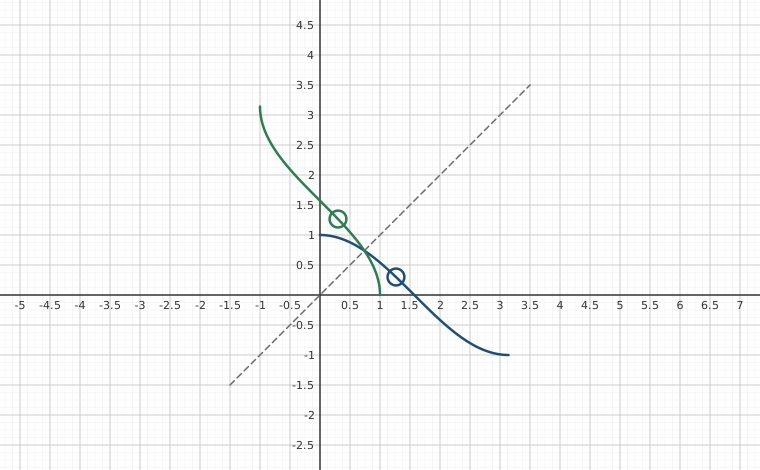
Interactive figure Arccosine as the mirror image of cosine on [0, π] Drag the Input c of arccosine slider from -1 to 1.
Cosine restricted to [0, π] is the solid falling curve; its reflection across the dashed line y = x is arccosine, falling from (−1, π) to (1, 0). The slider c chooses an input: the marked point on the arccosine curve sits at (c, arccos c), and its mirror image (arccos c, c) sits on the cosine curve, the two always reflections of each other. Arccos c is the arc — the angle between 0 and π — whose cosine is c, which is exactly the reversal the section describes. Figure 10.191
f
(
x
)
=
cos
(
x
)
,
0
≤
x
≤
π
switch
x
and
y
coordinates
→
reflect across
y
=
x
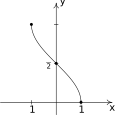
Figure 10.192
f
−
1
(
x
)
=
arccos
(
x
)
.We restrict
g
(
x
)
=
sin
(
x
)
in a similar manner, although the interval of choice is
[
−
π
2
,
π
2
]
.
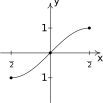
Figure 10.193 Restricting the domain of
f
(
x
)
=
sin
(
x
)
to
[
−
π
2
,
π
2
]
. It should be no surprise that we call
g
−
1
(
x
)
=
arcsin
(
x
)
, which is read `arc-sine of
x
'.
Figure 10.194
g
(
x
)
=
sin
(
x
)
,
−
π
2
≤
x
≤
π
2
.
switch
x
and
y
coordinates
→
reflect across
y
=
x
Figure 10.195
g
−
1
(
x
)
=
arcsin
(
x
)
.We list some important facts about the arccosine and arcsine functions in the following theorem.
Everything in Theorem 10.26 is a direct consequence of the facts that
f
(
x
)
=
cos
(
x
)
for
0
≤
x
≤
π
and
F
(
x
)
=
arccos
(
x
)
are inverses of each other as are
g
(
x
)
=
sin
(
x
)
for
−
π
2
≤
x
≤
π
2
and
G
(
x
)
=
arcsin
(
x
)
. It's about time for an example.
Example 1
Find the exact values of the following.
arccos
(
1
2
)
arcsin
(
2
2
)
arccos
(
−
2
2
)
arcsin
(
−
1
2
)
arccos
(
cos
(
π
6
)
)
arccos
(
cos
(
11
π
6
)
)
cos
(
arccos
(
−
3
5
)
)
sin
(
arccos
(
−
3
5
)
)
Rewrite the following as algebraic expressions of
x
and state the domain on which the equivalence is valid.
tan
(
arccos
(
x
)
)
cos
(
2
arcsin
(
x
)
)
To find
arccos
(
1
2
)
, we need to find the real number
t
(or, equivalently, an angle measuring
t
radians) which lies between
0
and
π
with
cos
(
t
)
=
1
2
. We know
t
=
π
3
meets these criteria, so
arccos
(
1
2
)
=
π
3
. The value of
arcsin
(
2
2
)
is a real number
t
between
−
π
2
and
π
2
with
sin
(
t
)
=
2
2
. The number we seek is
t
=
π
4
. Hence,
arcsin
(
2
2
)
=
π
4
. The number
t
=
arccos
(
−
2
2
)
lies in the interval
[
0
,
π
]
with
cos
(
t
)
=
−
2
2
. Our answer is
arccos
(
−
2
2
)
=
3
π
4
. To find
arcsin
(
−
1
2
)
, we seek the number
t
in the interval
[
−
π
2
,
π
2
]
with
sin
(
t
)
=
−
1
2
. The answer is
t
=
−
π
6
so that
arcsin
(
−
1
2
)
=
−
π
6
. Since
0
≤
π
6
≤
π
, we could simply invoke Theorem 10.26 to get
arccos
(
cos
(
π
6
)
)
=
π
6
. However, in order to make sure we understand why this is the case, we choose to work the example through using the definition of arccosine. Working from the inside out,
arccos
(
cos
(
π
6
)
)
=
arccos
(
3
2
)
. Now,
arccos
(
3
2
)
is the real number
t
with
0
≤
t
≤
π
and
cos
(
t
)
=
3
2
. We find
t
=
π
6
, so that
arccos
(
cos
(
π
6
)
)
=
π
6
. Since
11
π
6
does not fall between
0
and
π
, Theorem 10.26 does not apply. We are forced to work through from the inside out starting with
arccos
(
cos
(
11
π
6
)
)
=
arccos
(
3
2
)
. From the previous problem, we know
arccos
(
3
2
)
=
π
6
. Hence,
arccos
(
cos
(
11
π
6
)
)
=
π
6
. One way to simplify
cos
(
arccos
(
−
3
5
)
)
is to use Theorem 10.26 directly. Since
−
3
5
is between
−
1
and
1
, we have that
cos
(
arccos
(
−
3
5
)
)
=
−
3
5
and we are done. However, as before, to really understand why this cancellation occurs, we let
t
=
arccos
(
−
3
5
)
. Then, by definition,
cos
(
t
)
=
−
3
5
. Hence,
cos
(
arccos
(
−
3
5
)
)
=
cos
(
t
)
=
−
3
5
, and we are finished in (nearly) the same amount of time. As in the previous example, we let
t
=
arccos
(
−
3
5
)
so that
cos
(
t
)
=
−
3
5
for some
t
where
0
≤
t
≤
π
. Since
cos
(
t
)
<
0
, we can narrow this down a bit and conclude that
π
2
<
t
<
π
, so that
t
corresponds to an angle in Quadrant II. In terms of
t
, then, we need to find
sin
(
arccos
(
−
3
5
)
)
=
sin
(
t
)
. Using the Pythagorean Identity
cos
2
(
t
)
+
sin
2
(
t
)
=
1
, we get
(
−
3
5
)
2
+
sin
2
(
t
)
=
1
or
sin
(
t
)
=
±
4
5
. Since
t
corresponds to a Quadrants II angle, we choose
sin
(
t
)
=
4
5
. Hence,
sin
(
arccos
(
−
3
5
)
)
=
4
5
. We begin this problem in the same manner we began the previous two problems. To help us see the forest for the trees, we let
t
=
arccos
(
x
)
, so our goal is to find a way to express
tan
(
arccos
(
x
)
)
=
tan
(
t
)
in terms of
x
. Since
t
=
arccos
(
x
)
, we know
cos
(
t
)
=
x
where
0
≤
t
≤
π
, but since we are after an expression for
tan
(
t
)
, we know we need to throw out
t
=
π
2
from consideration. Hence, either
0
≤
t
<
π
2
or
π
2
<
t
≤
π
so that, geometrically,
t
corresponds to an angle in Quadrant I or Quadrant II. One approach3
tan
(
t
)
is to use the quotient identity
tan
(
t
)
=
sin
(
t
)
cos
(
t
)
. Substituting
cos
(
t
)
=
x
into the Pythagorean Identity
cos
2
(
t
)
+
sin
2
(
t
)
=
1
gives
x
2
+
sin
2
(
t
)
=
1
, from which we get
sin
(
t
)
=
±
1
−
x
2
. Since
t
corresponds to angles in Quadrants I and II,
sin
(
t
)
≥
0
, so we choose
sin
(
t
)
=
1
−
x
2
. Thus,
tan
(
t
)
=
sin
(
t
)
cos
(
t
)
=
1
−
x
2
x
To determine the values of
x
for which this equivalence is valid, we consider our substitution
t
=
arccos
(
x
)
. Since the domain of
arccos
(
x
)
is
[
−
1
,
1
]
, we know we must restrict
−
1
≤
x
≤
1
. Additionally, since we had to discard
t
=
π
2
, we need to discard
x
=
cos
(
π
2
)
=
0
. Hence,
tan
(
arccos
(
x
)
)
=
1
−
x
2
x
is valid for
x
in
[
−
1
,
0
)
∪
(
0
,
1
]
.
We proceed as in the previous problem by writing
t
=
arcsin
(
x
)
so that
t
lies in the interval
[
−
π
2
,
π
2
]
with
sin
(
t
)
=
x
. We aim to express
cos
(
2
arcsin
(
x
)
)
=
cos
(
2
t
)
in terms of
x
. Since
cos
(
2
t
)
is defined everywhere, we get no additional restrictions on
t
as we did in the previous problem. We have three choices for rewriting
cos
(
2
t
)
:
cos
2
(
t
)
−
sin
2
(
t
)
,
2
cos
2
(
t
)
−
1
and
1
−
2
sin
2
(
t
)
. Since we know
x
=
sin
(
t
)
, it is easiest to use the last form:
cos
(
2
arcsin
(
x
)
)
=
cos
(
2
t
)
=
1
−
2
sin
2
(
t
)
=
1
−
2
x
2
To find the restrictions on
x
, we once again appeal to our substitution
t
=
arcsin
(
x
)
. Since
arcsin
(
x
)
is defined only for
−
1
≤
x
≤
1
, the equivalence
cos
(
2
arcsin
(
x
)
)
=
1
−
2
x
2
is valid only on
[
−
1
,
1
]
.
A few remarks about Example 10.6.1 are in order. Most of the common errors encountered in dealing with the inverse circular functions come from the need to restrict the domains of the original functions so that they are one-to-one. One instance of this phenomenon is the fact that
arccos
(
cos
(
11
π
6
)
)
=
π
6
as opposed to
11
π
6
. This is the exact same phenomenon discussed in Section 5.2 when we saw
(
−
2
)
2
=
2
as opposed to
−
2
. Additionally, even though the expression we arrived at in part above, namely
1
−
2
x
2
, is defined for all real numbers, the equivalence
cos
(
2
arcsin
(
x
)
)
=
1
−
2
x
2
is valid for only
−
1
≤
x
≤
1
. This is akin to the fact that while the expression
x
is defined for all real numbers, the equivalence
(
x
)
2
=
x
is valid only for
x
≥
0
. For this reason, it pays to be careful when we determine the intervals where such equivalences are valid.
The next pair of functions we wish to discuss are the inverses of tangent and cotangent, which are named arctangent and arccotangent, respectively. First, we restrict
f
(
x
)
=
tan
(
x
)
to its fundamental cycle on
(
−
π
2
,
π
2
)
to obtain
f
−
1
(
x
)
=
arctan
(
x
)
. Among other things, note that the vertical asymptotes
x
=
−
π
2
and
x
=
π
2
of the graph of
f
(
x
)
=
tan
(
x
)
become the horizontal asymptotes
y
=
−
π
2
and
y
=
π
2
of the graph of
f
−
1
(
x
)
=
arctan
(
x
)
.
Figure 10.196
f
(
x
)
=
tan
(
x
)
,
−
π
2
<
x
<
π
2
.
switch
x
and
y
coordinates
→
reflect across
y
=
x
Figure 10.197
f
−
1
(
x
)
=
arctan
(
x
)
.Next, we restrict
g
(
x
)
=
cot
(
x
)
to its fundamental cycle on
(
0
,
π
)
to obtain
g
−
1
(
x
)
=
arccot
(
x
)
. Once again, the vertical asymptotes
x
=
0
and
x
=
π
of the graph of
g
(
x
)
=
cot
(
x
)
become the horizontal asymptotes
y
=
0
and
y
=
π
of the graph of
g
−
1
(
x
)
=
arccot
(
x
)
. We show these graphs on the next page and list some of the basic properties of the arctangent and arccotangent functions.
Figure 10.198
g
(
x
)
=
cot
(
x
)
,
0
<
x
<
π
.
switch
x
and
y
coordinates
→
reflect across
y
=
x
Figure 10.199
g
−
1
(
x
)
=
arccot
(
x
)
.Example 2
Find the exact values of the following.
arctan
(
3
)
arccot
(
−
3
)
cot
(
arccot
(
−
5
)
)
sin
(
arctan
(
−
3
4
)
)
Rewrite the following as algebraic expressions of
x
and state the domain on which the equivalence is valid.
tan
(
2
arctan
(
x
)
)
cos
(
arccot
(
2
x
)
)
We know
arctan
(
3
)
is the real number
t
between
−
π
2
and
π
2
with
tan
(
t
)
=
3
. We find
t
=
π
3
, so
arctan
(
3
)
=
π
3
. The real number
t
=
arccot
(
−
3
)
lies in the interval
(
0
,
π
)
with
cot
(
t
)
=
−
3
. We get
arccot
(
−
3
)
=
5
π
6
. We can apply Theorem 10.27 directly and obtain
cot
(
arccot
(
−
5
)
)
=
−
5
. However, working it through provides us with yet another opportunity to understand why this is the case. Letting
t
=
arccot
(
−
5
)
, we have that
t
belongs to the interval
(
0
,
π
)
and
cot
(
t
)
=
−
5
. Hence,
cot
(
arccot
(
−
5
)
)
=
cot
(
t
)
=
−
5
. We start simplifying
sin
(
arctan
(
−
3
4
)
)
by letting
t
=
arctan
(
−
3
4
)
. Then
tan
(
t
)
=
−
3
4
for some
−
π
2
<
t
<
π
2
. Since
tan
(
t
)
<
0
, we know, in fact,
−
π
2
<
t
<
0
. One way to proceed is to use The Pythagorean Identity,
1
+
cot
2
(
t
)
=
csc
2
(
t
)
, since this relates the reciprocals of
tan
(
t
)
and
sin
(
t
)
and is valid for all
t
under consideration.4
tan
(
t
)
=
−
3
4
, we get
cot
(
t
)
=
−
4
3
. Substituting, we get
1
+
(
−
4
3
)
2
=
csc
2
(
t
)
so that
csc
(
t
)
=
±
5
3
. Since
−
π
2
<
t
<
0
, we choose
csc
(
t
)
=
−
5
3
, so
sin
(
t
)
=
−
3
5
. Hence,
sin
(
arctan
(
−
3
4
)
)
=
−
3
5
. If we let
t
=
arctan
(
x
)
, then
−
π
2
<
t
<
π
2
and
tan
(
t
)
=
x
. We look for a way to express
tan
(
2
arctan
(
x
)
)
=
tan
(
2
t
)
in terms of
x
. Before we get started using identities, we note that
tan
(
2
t
)
is undefined when
2
t
=
π
2
+
π
k
for integers
k
. Dividing both sides of this equation by
2
tells us we need to exclude values of
t
where
t
=
π
4
+
π
2
k
, where
k
is an integer. The only members of this family which lie in
(
−
π
2
,
π
2
)
are
t
=
±
π
4
, which means the values of
t
under consideration are
(
−
π
2
,
−
π
4
)
∪
(
−
π
4
,
π
4
)
∪
(
π
4
,
π
2
)
. Returning to
arctan
(
2
t
)
, we note the double angle identity
tan
(
2
t
)
=
2
tan
(
t
)
1
−
tan
2
(
t
)
, is valid for all the values of
t
under consideration, hence we get
tan
(
2
arctan
(
x
)
)
=
tan
(
2
t
)
=
2
tan
(
t
)
1
−
tan
2
(
t
)
=
2
x
1
−
x
2
To find where this equivalence is valid we check back with our substitution
t
=
arctan
(
x
)
. Since the domain of
arctan
(
x
)
is all real numbers, the only exclusions come from the values of
t
we discarded earlier,
t
=
±
π
4
. Since
x
=
tan
(
t
)
, this means we exclude
x
=
tan
(
±
π
4
)
=
±
1
. Hence, the equivalence
tan
(
2
arctan
(
x
)
)
=
2
x
1
−
x
2
holds for all
x
in
(
−
∞
,
−
1
)
∪
(
−
1
,
1
)
∪
(
1
,
∞
)
.
To get started, we let
t
=
arccot
(
2
x
)
so that
cot
(
t
)
=
2
x
where
0
<
t
<
π
. In terms of
t
,
cos
(
arccot
(
2
x
)
)
=
cos
(
t
)
, and our goal is to express the latter in terms of
x
. Since
cos
(
t
)
is always defined, there are no additional restrictions on
t
, so we can begin using identities to relate
cot
(
t
)
to
cos
(
t
)
. The identity
cot
(
t
)
=
cos
(
t
)
sin
(
t
)
is valid for
t
in
(
0
,
π
)
, so our strategy is to obtain
sin
(
t
)
in terms of
x
, then write
cos
(
t
)
=
cot
(
t
)
sin
(
t
)
. The identity
1
+
cot
2
(
t
)
=
csc
2
(
t
)
holds for all
t
in
(
0
,
π
)
and relates
cot
(
t
)
and
csc
(
t
)
=
1
sin
(
t
)
. Substituting
cot
(
t
)
=
2
x
, we get
1
+
(
2
x
)
2
=
csc
2
(
t
)
, or
csc
(
t
)
=
±
4
x
2
+
1
. Since
t
is between
0
and
π
,
csc
(
t
)
>
0
, so
csc
(
t
)
=
4
x
2
+
1
which gives
sin
(
t
)
=
1
4
x
2
+
1
. Hence,
cos
(
arccot
(
2
x
)
)
=
cos
(
t
)
=
cot
(
t
)
sin
(
t
)
=
2
x
4
x
2
+
1
Since
arccot
(
2
x
)
is defined for all real numbers
x
and we encountered no additional restrictions on
t
, we have
cos
(
arccot
(
2
x
)
)
=
2
x
4
x
2
+
1
for all real numbers
x
.
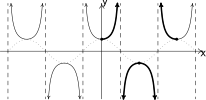
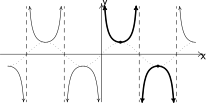
The last two functions to invert are secant and cosecant. A portion of each of their graphs, which were first discussed in Subsection 10.5.2, are given below with the fundamental cycles highlighted.
Figure 10.200 The graph of
y
=
sec
(
x
)
. Figure 10.201 The graph of
y
=
csc
(
x
)
. It is clear from the graph of secant that we cannot find one single continuous piece of its graph which covers its entire range of
(
−
∞
,
−
1
]
∪
[
1
,
∞
)
and restricts the domain of the function so that it is one-to-one. The same is true for cosecant. Thus in order to define the arcsecant and arccosecant functions, we must settle for a piecewise approach wherein we choose one piece to cover the top of the range, namely
[
1
,
∞
)
, and another piece to cover the bottom, namely
(
−
∞
,
−
1
]
. There are two generally accepted ways make these choices which restrict the domains of these functions so that they are one-to-one. One approach simplifies the Trigonometry associated with the inverse functions, but complicates the Calculus; the other makes the Calculus easier, but the Trigonometry less so. We present both points of view.
Inverses of Secant and Cosecant: Trigonometry Friendly Approach
In this subsection, we restrict the secant and cosecant functions to coincide with the restrictions on cosine and sine, respectively. For
f
(
x
)
=
sec
(
x
)
, we restrict the domain to
[
0
,
π
2
)
∪
(
π
2
,
π
]
Figure 10.202
f
(
x
)
=
sec
(
x
)
on
[
0
,
π
2
)
∪
(
π
2
,
π
]
switch
x
and
y
coordinates
→
reflect across
y
=
x
Figure 10.203
f
−
1
(
x
)
=
arcsec
(
x
)
and we restrict
g
(
x
)
=
csc
(
x
)
to
[
−
π
2
,
0
)
∪
(
0
,
π
2
]
.
Figure 10.204
g
(
x
)
=
csc
(
x
)
on
[
−
π
2
,
0
)
∪
(
0
,
π
2
]
switch
x
and
y
coordinates
→
reflect across
y
=
x
Figure 10.205
g
−
1
(
x
)
=
arccsc
(
x
)
Note that for both arcsecant and arccosecant, the domain is
(
−
∞
,
−
1
]
∪
[
1
,
∞
)
. Taking a page from Section 2.2, we can rewrite this as
{
x
:
|
x
|
≥
1
}
. This is often done in Calculus textbooks, so we include it here for completeness. Using these definitions, we get the following properties of the arcsecant and arccosecant functions.
Example 3
Find the exact values of the following.
arcsec
(
2
)
arccsc
(
−
2
)
arcsec
(
sec
(
5
π
4
)
)
cot
(
arccsc
(
−
3
)
)
Rewrite the following as algebraic expressions of
x
and state the domain on which the equivalence is valid.
tan
(
arcsec
(
x
)
)
cos
(
arccsc
(
4
x
)
)
Using Theorem 10.28, we have
arcsec
(
2
)
=
arccos
(
1
2
)
=
π
3
. Once again, Theorem 10.28 comes to our aid giving
arccsc
(
−
2
)
=
arcsin
(
−
1
2
)
=
−
π
6
. Since
5
π
4
doesn't fall between
0
and
π
2
or
π
2
and
π
, we cannot use the inverse property stated in Theorem 10.28. We can, nevertheless, begin by working `inside out' which yields
arcsec
(
sec
(
5
π
4
)
)
=
arcsec
(
−
2
)
=
arccos
(
−
2
2
)
=
3
π
4
. One way to begin to simplify
cot
(
arccsc
(
−
3
)
)
is to let
t
=
arccsc
(
−
3
)
. Then,
csc
(
t
)
=
−
3
and, since this is negative, we have that
t
lies in the interval
[
−
π
2
,
0
)
. We are after
cot
(
arccsc
(
−
3
)
)
=
cot
(
t
)
, so we use the Pythagorean Identity
1
+
cot
2
(
t
)
=
csc
2
(
t
)
. Substituting, we have
1
+
cot
2
(
t
)
=
(
−
3
)
2
, or
cot
(
t
)
=
±
8
=
±
2
2
. Since
−
π
2
≤
t
<
0
,
cot
(
t
)
<
0
, so we get
cot
(
arccsc
(
−
3
)
)
=
−
2
2
. We begin simplifying
tan
(
arcsec
(
x
)
)
by letting
t
=
arcsec
(
x
)
. Then,
sec
(
t
)
=
x
for
t
in
[
0
,
π
2
)
∪
(
π
2
,
π
]
, and we seek a formula for
tan
(
t
)
. Since
tan
(
t
)
is defined for all
t
values under consideration, we have no additional restrictions on
t
. To relate
sec
(
t
)
to
tan
(
t
)
, we use the identity
1
+
tan
2
(
t
)
=
sec
2
(
t
)
. This is valid for all values of
t
under consideration, and when we substitute
sec
(
t
)
=
x
, we get
1
+
tan
2
(
t
)
=
x
2
. Hence,
tan
(
t
)
=
±
x
2
−
1
. If
t
belongs to
[
0
,
π
2
)
then
tan
(
t
)
≥
0
; if, on the the other hand,
t
belongs to
(
π
2
,
π
]
then
tan
(
t
)
≤
0
. As a result, we get a piecewise defined function for
tan
(
t
)
tan
(
t
)
=
{
x
2
−
1
,
if
0
≤
t
<
π
2
−
x
2
−
1
,
if
π
2
<
t
≤
π
Now we need to determine what these conditions on
t
mean for
x
. Since
x
=
sec
(
t
)
, when
0
≤
t
<
π
2
,
x
≥
1
, and when
π
2
<
t
≤
π
,
x
≤
−
1
. Since we encountered no further restrictions on
t
, the equivalence below holds for all
x
in
(
−
∞
,
−
1
]
∪
[
1
,
∞
)
.
tan
(
arcsec
(
x
)
)
=
{
x
2
−
1
,
if
x
≥
1
−
x
2
−
1
,
if
x
≤
−
1
To simplify
cos
(
arccsc
(
4
x
)
)
, we start by letting
t
=
arccsc
(
4
x
)
. Then
csc
(
t
)
=
4
x
for
t
in
[
−
π
2
,
0
)
∪
(
0
,
π
2
]
, and we now set about finding an expression for
cos
(
arccsc
(
4
x
)
)
=
cos
(
t
)
. Since
cos
(
t
)
is defined for all
t
, we do not encounter any additional restrictions on
t
. From
csc
(
t
)
=
4
x
, we get
sin
(
t
)
=
1
4
x
, so to find
cos
(
t
)
, we can make use if the identity
cos
2
(
t
)
+
sin
2
(
t
)
=
1
. Substituting
sin
(
t
)
=
1
4
x
gives
cos
2
(
t
)
+
(
1
4
x
)
2
=
1
. Solving, we get
cos
(
t
)
=
±
16
x
2
−
1
16
x
2
=
±
16
x
2
−
1
4
|
x
|
Since
t
belongs to
[
−
π
2
,
0
)
∪
(
0
,
π
2
]
, we know
cos
(
t
)
≥
0
, so we choose
cos
(
t
)
=
16
−
x
2
4
|
x
|
. (The absolute values here are necessary, since
x
could be negative.) To find the values for which this equivalence is valid, we look back at our original substution,
t
=
arccsc
(
4
x
)
. Since the domain of
arccsc
(
x
)
requires its argument
x
to satisfy
|
x
|
≥
1
, the domain of
arccsc
(
4
x
)
requires
|
4
x
|
≥
1
. Using Theorem 2.4, we rewrite this inequality and solve to get
x
≤
−
1
4
or
x
≥
1
4
. Since we had no additional restrictions on
t
, the equivalence
cos
(
arccsc
(
4
x
)
)
=
16
x
2
−
1
4
|
x
|
holds for all
x
in
(
−
∞
,
−
1
4
]
∪
[
1
4
,
∞
)
.
Inverses of Secant and Cosecant: Calculus Friendly Approach
In this subsection, we restrict
f
(
x
)
=
sec
(
x
)
to
[
0
,
π
2
)
∪
[
π
,
3
π
2
)
Figure 10.206
f
(
x
)
=
sec
(
x
)
on
[
0
,
π
2
)
∪
[
π
,
3
π
2
)
switch
x
and
y
coordinates
→
reflect across
y
=
x
Figure 10.207
f
−
1
(
x
)
=
arcsec
(
x
)
and we restrict
g
(
x
)
=
csc
(
x
)
to
(
0
,
π
2
]
∪
(
π
,
3
π
2
]
.
Figure 10.208
g
(
x
)
=
csc
(
x
)
on
(
0
,
π
2
]
∪
(
π
,
3
π
2
]
switch
x
and
y
coordinates
→
reflect across
y
=
x
Figure 10.209
g
−
1
(
x
)
=
arccsc
(
x
)
Using these definitions, we get the following result.
Our next example is a duplicate of Example 10.6.3 . The interested reader is invited to compare and contrast the solution to each.
Example 4
Find the exact values of the following.
arcsec
(
2
)
arccsc
(
−
2
)
arcsec
(
sec
(
5
π
4
)
)
cot
(
arccsc
(
−
3
)
)
Rewrite the following as algebraic expressions of
x
and state the domain on which the equivalence is valid.
tan
(
arcsec
(
x
)
)
cos
(
arccsc
(
4
x
)
)
Since
2
≥
1
, we may invoke Theorem 10.29 to get
arcsec
(
2
)
=
arccos
(
1
2
)
=
π
3
. Unfortunately,
−
2
is not greater to or equal to
1
, so we cannot apply Theorem 10.29 to
arccsc
(
−
2
)
and convert this into an arcsine problem. Instead, we appeal to the definition. The real number
t
=
arccsc
(
−
2
)
lies in
(
0
,
π
2
]
∪
(
π
,
3
π
2
]
and satisfies
csc
(
t
)
=
−
2
. The
t
we're after is
t
=
7
π
6
, so
arccsc
(
−
2
)
=
7
π
6
. Since
5
π
4
lies between
π
and
3
π
2
, we may apply Theorem 10.29 directly to simplify
arcsec
(
sec
(
5
π
4
)
)
=
5
π
4
. We encourage the reader to work this through using the definition as we have done in the previous examples to see how it goes. To simplify
cot
(
arccsc
(
−
3
)
)
we let
t
=
arccsc
(
−
3
)
so that
cot
(
arccsc
(
−
3
)
)
=
cot
(
t
)
. We know
csc
(
t
)
=
−
3
, and since this is negative,
t
lies in
(
π
,
3
π
2
]
. Using the identity
1
+
cot
2
(
t
)
=
csc
2
(
t
)
, we find
1
+
cot
2
(
t
)
=
(
−
3
)
2
so that
cot
(
t
)
=
±
8
=
±
2
2
. Since
t
is in the interval
(
π
,
3
π
2
]
, we know
cot
(
t
)
>
0
. Our answer is
cot
(
arccsc
(
−
3
)
)
=
2
2
. We begin simplifying
tan
(
arcsec
(
x
)
)
by letting
t
=
arcsec
(
x
)
. Then,
sec
(
t
)
=
x
for
t
in
[
0
,
π
2
)
∪
[
π
,
3
π
2
)
, and we seek a formula for
tan
(
t
)
. Since
tan
(
t
)
is defined for all
t
values under consideration, we have no additional restrictions on
t
. To relate
sec
(
t
)
to
tan
(
t
)
, we use the identity
1
+
tan
2
(
t
)
=
sec
2
(
t
)
. This is valid for all values of
t
under consideration, and when we substitute
sec
(
t
)
=
x
, we get
1
+
tan
2
(
t
)
=
x
2
. Hence,
tan
(
t
)
=
±
x
2
−
1
. Since
t
lies in
[
0
,
π
2
)
∪
[
π
,
3
π
2
)
,
tan
(
t
)
≥
0
, so we choose
tan
(
t
)
=
x
2
−
1
. Since we found no additional restrictions on
t
, the equivalence
tan
(
arcsec
(
x
)
)
=
x
2
−
1
holds for all
x
in the domain of
t
=
arcsec
(
x
)
, namely
(
−
∞
,
−
1
]
∪
[
1
,
∞
)
. To simplify
cos
(
arccsc
(
4
x
)
)
, we start by letting
t
=
arccsc
(
4
x
)
. Then
csc
(
t
)
=
4
x
for
t
in
(
0
,
π
2
]
∪
(
π
,
3
π
2
]
, and we now set about finding an expression for
cos
(
arccsc
(
4
x
)
)
=
cos
(
t
)
. Since
cos
(
t
)
is defined for all
t
, we do not encounter any additional restrictions on
t
. From
csc
(
t
)
=
4
x
, we get
sin
(
t
)
=
1
4
x
, so to find
cos
(
t
)
, we can make use if the identity
cos
2
(
t
)
+
sin
2
(
t
)
=
1
. Substituting
sin
(
t
)
=
1
4
x
gives
cos
2
(
t
)
+
(
1
4
x
)
2
=
1
. Solving, we get
cos
(
t
)
=
±
16
x
2
−
1
16
x
2
=
±
16
x
2
−
1
4
|
x
|
If
t
lies in
(
0
,
π
2
]
, then
cos
(
t
)
≥
0
, and we choose
cos
(
t
)
=
16
x
2
−
1
4
|
x
|
. Otherwise,
t
belongs to
(
π
,
3
π
2
]
in which case
cos
(
t
)
≤
0
, so, we choose
cos
(
t
)
=
−
16
x
2
−
1
4
|
x
|
This leads us to a (momentarily) piecewise defined function for
cos
(
t
)
cos
(
t
)
=
{
16
x
2
−
1
4
|
x
|
,
if
0
≤
t
≤
π
2
−
16
x
2
−
1
4
|
x
|
,
if
π
<
t
≤
3
π
2
We now see what these restrictions mean in terms of
x
. Since
4
x
=
csc
(
t
)
, we get that for
0
≤
t
≤
π
2
,
4
x
≥
1
, or
x
≥
1
4
. In this case, we can simplify
|
x
|
=
x
so
cos
(
t
)
=
16
x
2
−
1
4
|
x
|
=
16
x
2
−
1
4
x
Similarly, for
π
<
t
≤
3
π
2
, we get
4
x
≤
−
1
, or
x
≤
−
1
4
. In this case,
|
x
|
=
−
x
, so we also get
cos
(
t
)
=
−
16
x
2
−
1
4
|
x
|
=
−
16
x
2
−
1
4
(
−
x
)
=
16
x
2
−
1
4
x
Hence, in all cases,
cos
(
arccsc
(
4
x
)
)
=
16
x
2
−
1
4
x
, and this equivalence is valid for all
x
in the domain of
t
=
arccsc
(
4
x
)
, namely
(
−
∞
,
−
1
4
]
∪
[
1
4
,
∞
)
Calculators and the Inverse Circular Functions.
In the sections to come, we will have need to approximate the values of the inverse circular functions. On most calculators, only the arcsine, arccosine and arctangent functions are available and they are usually labeled as
sin
−
1
,
cos
−
1
and
tan
−
1
, respectively. If we are asked to approximate these values, it is a simple matter to punch up the appropriate decimal on the calculator. If we are asked for an arccotangent, arcsecant or arccosecant, however, we often need to employ some ingenuity, as our next example illustrates.
Example 5
Use a calculator to approximate the following values to four decimal places.
arccot
(
2
)
arcsec
(
5
)
arccot
(
−
2
)
arccsc
(
−
3
2
)
Find the domain and range of the following functions. Check your answers using a calculator.
f
(
x
)
=
π
2
−
arccos
(
x
5
)
f
(
x
)
=
3
arctan
(
4
x
)
.
f
(
x
)
=
arccot
(
x
2
)
+
π
Since
2
>
0
, we can use the property listed in Theorem 10.27 to rewrite
arccot
(
2
)
as
arccot
(
2
)
=
arctan
(
1
2
)
. In `radian' mode, we find
arccot
(
2
)
=
arctan
(
1
2
)
≈
0.4636
. Since
5
≥
1
, we can use the property from either Theorem 10.28 or Theorem 10.29 to write
arcsec
(
5
)
=
arccos
(
1
5
)
≈
1.3694
.
Figure 10.210 Figure 10.211 Since the argument
−
2
is negative, we cannot directly apply Theorem 10.27 to help us find
arccot
(
−
2
)
. Let
t
=
arccot
(
−
2
)
. Then
t
is a real number such that
0
<
t
<
π
and
cot
(
t
)
=
−
2
. Moreover, since
cot
(
t
)
<
0
, we know
π
2
<
t
<
π
. Geometrically, this means
t
corresponds to a Quadrant II angle
θ
=
t
radians. This allows us to proceed using a `reference angle' approach. Consider
α
, the reference angle for
θ
, as pictured below. By definition,
α
is an acute angle so
0
<
α
<
π
2
, and the Reference Angle Theorem, Theorem 10.2, tells us that
cot
(
α
)
=
2
. This means
α
=
arccot
(
2
)
radians. Since the argument of arccotangent is now a positive
2
, we can use Theorem 10.27 to get
α
=
arccot
(
2
)
=
arctan
(
1
2
)
radians. Since
θ
=
π
−
α
=
π
−
arctan
(
1
2
)
≈
2.6779
radians, we get
arccot
(
−
2
)
≈
2.6779
.
Figure 10.212 Figure 10.213 Another way to attack the problem is to use
arctan
(
−
1
2
)
. By definition, the real number
t
=
arctan
(
−
1
2
)
satisfies
tan
(
t
)
=
−
1
2
with
−
π
2
<
t
<
π
2
. Since
tan
(
t
)
<
0
, we know more specifically that
−
π
2
<
t
<
0
, so
t
corresponds to an angle
β
in Quadrant IV. To find the value of
arccot
(
−
2
)
, we once again visualize the angle
θ
=
arccot
(
−
2
)
radians and note that it is a Quadrant II angle with
tan
(
θ
)
=
−
1
2
. This means it is exactly
π
units away from
β
, and we get
θ
=
π
+
β
=
π
+
arctan
(
−
1
2
)
≈
2.6779
radians. Hence, as before,
arccot
(
−
2
)
≈
2.6779
.
Figure 10.214 Figure 10.215 If the range of arccosecant is taken to be
[
−
π
2
,
0
)
∪
(
0
,
π
2
]
, we can use Theorem 10.28 to get
arccsc
(
−
3
2
)
=
arcsin
(
−
2
3
)
≈
−
0.7297
. If, on the other hand, the range of arccosecant is taken to be
(
0
,
π
2
]
∪
(
π
,
3
π
2
]
, then we proceed as in the previous problem by letting
t
=
arccsc
(
−
3
2
)
. Then
t
is a real number with
csc
(
t
)
=
−
3
2
. Since
csc
(
t
)
<
0
, we have that
π
<
θ
≤
3
π
2
, so
t
corresponds to a Quadrant III angle,
θ
. As above, we let
α
be the reference angle for
θ
. Then
0
<
α
<
π
2
and
csc
(
α
)
=
3
2
, which means
α
=
arccsc
(
3
2
)
radians. Since the argument of arccosecant is now positive, we may use Theorem 10.29 to get
α
=
arccsc
(
3
2
)
=
arcsin
(
2
3
)
radians. Since
θ
=
π
+
α
=
π
+
arcsin
(
2
3
)
≈
3.8713
radians,
arccsc
(
−
3
2
)
≈
3.8713
.
Figure 10.216 Figure 10.217 Since the domain of
F
(
x
)
=
arccos
(
x
)
is
−
1
≤
x
≤
1
, we can find the domain of
f
(
x
)
=
π
2
−
arccos
(
x
5
)
by setting the argument of the arccosine, in this case
x
5
, between
−
1
and
1
. Solving
−
1
≤
x
5
≤
1
gives
−
5
≤
x
≤
5
, so the domain is
[
−
5
,
5
]
. To determine the range of
f
, we take a cue from Section 1.7. Three `key' points on the graph of
F
(
x
)
=
arccos
(
x
)
are
(
−
1
,
π
)
,
(
0
,
π
2
)
and
(
1
,
0
)
. Following the procedure outlined in Theorem 1.7, we track these points to
(
−
5
,
−
π
2
)
,
(
0
,
0
)
and
(
5
,
π
2
)
. Plotting these values tells us that the range9
f
is
[
−
π
2
,
π
2
]
. Our graph confirms our results. To find the domain and range of
f
(
x
)
=
3
arctan
(
4
x
)
, we note that since the domain of
F
(
x
)
=
arctan
(
x
)
is all real numbers, the only restrictions, if any, on the domain of
f
(
x
)
=
3
arctan
(
4
x
)
come from the argument of the arctangent, in this case,
4
x
. Since
4
x
is defined for all real numbers, we have established that the domain of
f
is all real numbers. To determine the range of
f
, we can, once again, appeal to Theorem 1.7. Choosing our `key' point to be
(
0
,
0
)
and tracking the horizontal asymptotes
y
=
−
π
2
and
y
=
π
2
, we find that the graph of
y
=
f
(
x
)
=
3
arctan
(
4
x
)
differs from the graph of
y
=
F
(
x
)
=
arctan
(
x
)
by a horizontal compression by a factor of
4
and a vertical stretch by a factor of
3
. It is the latter which affects the range, producing a range of
(
−
3
π
2
,
3
π
2
)
. We confirm our findings on the calculator below.
Figure 10.218 Figure 10.219
y
=
f
(
x
)
=
π
2
−
arccos
(
x
5
)
y
=
f
(
x
)
=
3
arctan
(
4
x
)
To find the domain of
g
(
x
)
=
arccot
(
x
2
)
+
π
, we proceed as above. Since the domain of
G
(
x
)
=
arccot
(
x
)
is
(
−
∞
,
∞
)
, and
x
2
is defined for all
x
, we get that the domain of
g
is
(
−
∞
,
∞
)
as well. As for the range, we note that the range of
G
(
x
)
=
arccot
(
x
)
, like that of
F
(
x
)
=
arctan
(
x
)
, is limited by a pair of horizontal asymptotes, in this case
y
=
0
and
y
=
π
. Following Theorem 1.7, we graph
y
=
g
(
x
)
=
arccot
(
x
2
)
+
π
starting with
y
=
G
(
x
)
=
arccot
(
x
)
and first performing a horizontal expansion by a factor of
2
and following that with a vertical shift upwards by
π
. This latter transformation is the one which affects the range, making it now
(
π
,
2
π
)
. To check this graphically, we encounter a bit of a problem, since on many calculators, there is no shortcut button corresponding to the arccotangent function. Taking a cue from number, we attempt to rewrite
g
(
x
)
=
arccot
(
x
2
)
+
π
in terms of the arctangent function. Using Theorem 10.27, we have that
arccot
(
x
2
)
=
arctan
(
2
x
)
when
x
2
>
0
, or, in this case, when
x
>
0
. Hence, for
x
>
0
, we have
g
(
x
)
=
arctan
(
2
x
)
+
π
. When
x
2
<
0
, we can use the same argument in number that gave us
arccot
(
−
2
)
=
π
+
arctan
(
−
1
2
)
to give us
arccot
(
x
2
)
=
π
+
arctan
(
2
x
)
. Hence, for
x
<
0
,
g
(
x
)
=
π
+
arctan
(
2
x
)
+
π
=
arctan
(
2
x
)
+
2
π
. What about
x
=
0
? We know
g
(
0
)
=
arccot
(
0
)
+
π
=
π
, and neither of the formulas for
g
involving arctangent will produce this result.10
y
=
g
(
x
)
on our calculators, we need to write it as a piecewise defined function:
g
(
x
)
=
arccot
(
x
2
)
+
π
=
{
arctan
(
2
x
)
+
2
π
,
if
x
<
0
π
,
if
x
=
0
arctan
(
2
x
)
+
π
,
if
x
>
0
We show the input and the result below.
Figure 10.220 Figure 10.221
y
=
g
(
x
)
in terms of arctangent
y
=
g
(
x
)
=
arccot
(
x
2
)
+
π
The inverse trigonometric functions are typically found in applications whenever the measure of an angle is required. One such scenario is presented in the following example.
Example 6
11
6
/
12
pitch'. This means that when viewed from the side, the roof line has a rise of 6 feet over a run of 12 feet. Find the angle of inclination from the bottom of the roof to the top of the roof. Express your answer in decimal degrees, rounded to the nearest hundredth of a degree.
Figure 10.222 Figure 10.223 Front View
Side View
If we divide the side view of the house down the middle, we find that the roof line forms the hypotenuse of a right triangle with legs of length
6
feet and
12
feet. Using Theorem 10.10, we find the angle of inclination, labeled
θ
below, satisfies
tan
(
θ
)
=
6
12
=
1
2
. Since
θ
is an acute angle, we can use the arctangent function and we find
θ
=
arctan
(
1
2
)
radians
≈
26.56
∘
.
Figure 10.224 Figure 10.225
Solving Equations Using the Inverse Trigonometric Functions.
In Sections 10.2 and 10.3, we learned how to solve equations like
sin
(
θ
)
=
1
2
for angles
θ
and
tan
(
t
)
=
−
1
for real numbers
t
. In each case, we ultimately appealed to the Unit Circle and relied on the fact that the answers corresponded to a set of `common angles' listed on page Section 10.2 . If, on the other hand, we had been asked to find all angles with
sin
(
θ
)
=
1
3
or solve
tan
(
t
)
=
−
2
for real numbers
t
, we would have been hard-pressed to do so. With the introduction of the inverse trigonometric functions, however, we are now in a position to solve these equations. A good parallel to keep in mind is how the square root function can be used to solve certain quadratic equations. The equation
x
2
=
4
is a lot like
sin
(
θ
)
=
1
2
in that it has friendly, `common value' answers
x
=
±
2
. The equation
x
2
=
7
, on the other hand, is a lot like
sin
(
θ
)
=
1
3
. We know12 13
x
2
=
7
, we make use of the square root function and write
x
=
±
7
. We can certainly approximate these answers using a calculator, but as far as exact answers go, we leave them as
x
=
±
7
. In the same way, we will use the arcsine function to solve
sin
(
θ
)
=
1
3
, as seen in the following example.
The reader is encouraged to check the answers found in Example 10.6.7 - both analytically and with the calculator (see Section 10.6.3). With practice, the inverse trigonometric functions will become as familiar to you as the square root function. Speaking of practice …
Exercises
In Exercises -, find the exact value.
arcsin
(
−
1
)
arcsin
(
−
3
2
)
arcsin
(
−
2
2
)
arcsin
(
−
1
2
)
arcsin
(
0
)
arcsin
(
1
2
)
arcsin
(
2
2
)
arcsin
(
3
2
)
arcsin
(
1
)
arccos
(
−
1
)
arccos
(
−
3
2
)
arccos
(
−
2
2
)
arccos
(
−
1
2
)
arccos
(
0
)
arccos
(
1
2
)
arccos
(
2
2
)
arccos
(
3
2
)
arccos
(
1
)
arctan
(
−
3
)
arctan
(
−
1
)
arctan
(
−
3
3
)
arctan
(
0
)
arctan
(
3
3
)
arctan
(
1
)
arctan
(
3
)
arccot
(
−
3
)
arccot
(
−
1
)
arccot
(
−
3
3
)
arccot
(
0
)
arccot
(
3
3
)
arccot
(
1
)
arccot
(
3
)
arcsec
(
2
)
arccsc
(
2
)
arcsec
(
2
)
arccsc
(
2
)
arcsec
(
2
3
3
)
arccsc
(
2
3
3
)
arcsec
(
1
)
arccsc
(
1
)
In Exercises -, assume that the range of arcsecant is
[
0
,
π
2
)
∪
[
π
,
3
π
2
)
and that the range of arccosecant is
(
0
,
π
2
]
∪
(
π
,
3
π
2
]
when finding the exact value.
arcsec
(
−
2
)
arcsec
(
−
2
)
arcsec
(
−
2
3
3
)
arcsec
(
−
1
)
arccsc
(
−
2
)
arccsc
(
−
2
)
arccsc
(
−
2
3
3
)
arccsc
(
−
1
)
In Exercises -, assume that the range of arcsecant is
[
0
,
π
2
)
∪
(
π
2
,
π
]
and that the range of arccosecant is
[
−
π
2
,
0
)
∪
(
0
,
π
2
]
when finding the exact value.
arcsec
(
−
2
)
arcsec
(
−
2
)
arcsec
(
−
2
3
3
)
arcsec
(
−
1
)
arccsc
(
−
2
)
arccsc
(
−
2
)
arccsc
(
−
2
3
3
)
arccsc
(
−
1
)
In Exercises -, find the exact value or state that it is undefined.
sin
(
arcsin
(
1
2
)
)
sin
(
arcsin
(
−
2
2
)
)
sin
(
arcsin
(
3
5
)
)
sin
(
arcsin
(
−
0.42
)
)
sin
(
arcsin
(
5
4
)
)
cos
(
arccos
(
2
2
)
)
cos
(
arccos
(
−
1
2
)
)
cos
(
arccos
(
5
13
)
)
cos
(
arccos
(
−
0.998
)
)
cos
(
arccos
(
π
)
)
tan
(
arctan
(
−
1
)
)
tan
(
arctan
(
3
)
)
tan
(
arctan
(
5
12
)
)
tan
(
arctan
(
0.965
)
)
tan
(
arctan
(
3
π
)
)
cot
(
arccot
(
1
)
)
cot
(
arccot
(
−
3
)
)
cot
(
arccot
(
−
7
24
)
)
cot
(
arccot
(
−
0.001
)
)
cot
(
arccot
(
17
π
4
)
)
sec
(
arcsec
(
2
)
)
sec
(
arcsec
(
−
1
)
)
sec
(
arcsec
(
1
2
)
)
sec
(
arcsec
(
0.75
)
)
sec
(
arcsec
(
117
π
)
)
csc
(
arccsc
(
2
)
)
csc
(
arccsc
(
−
2
3
3
)
)
csc
(
arccsc
(
2
2
)
)
csc
(
arccsc
(
1.0001
)
)
csc
(
arccsc
(
π
4
)
)
In Exercises -, find the exact value or state that it is undefined.
arcsin
(
sin
(
π
6
)
)
arcsin
(
sin
(
−
π
3
)
)
arcsin
(
sin
(
3
π
4
)
)
arcsin
(
sin
(
11
π
6
)
)
arcsin
(
sin
(
4
π
3
)
)
arccos
(
cos
(
π
4
)
)
arccos
(
cos
(
2
π
3
)
)
arccos
(
cos
(
3
π
2
)
)
arccos
(
cos
(
−
π
6
)
)
arccos
(
cos
(
5
π
4
)
)
arctan
(
tan
(
π
3
)
)
arctan
(
tan
(
−
π
4
)
)
arctan
(
tan
(
π
)
)
arctan
(
tan
(
π
2
)
)
arctan
(
tan
(
2
π
3
)
)
arccot
(
cot
(
π
3
)
)
arccot
(
cot
(
−
π
4
)
)
arccot
(
cot
(
π
)
)
arccot
(
cot
(
π
2
)
)
arccot
(
cot
(
2
π
3
)
)
In Exercises -, assume that the range of arcsecant is
[
0
,
π
2
)
∪
[
π
,
3
π
2
)
and that the range of arccosecant is
(
0
,
π
2
]
∪
(
π
,
3
π
2
]
when finding the exact value.
arcsec
(
sec
(
π
4
)
)
arcsec
(
sec
(
4
π
3
)
)
arcsec
(
sec
(
5
π
6
)
)
arcsec
(
sec
(
−
π
2
)
)
arcsec
(
sec
(
5
π
3
)
)
arccsc
(
csc
(
π
6
)
)
arccsc
(
csc
(
5
π
4
)
)
arccsc
(
csc
(
2
π
3
)
)
arccsc
(
csc
(
−
π
2
)
)
arccsc
(
csc
(
11
π
6
)
)
arcsec
(
sec
(
11
π
12
)
)
arccsc
(
csc
(
9
π
8
)
)
In Exercises -, assume that the range of arcsecant is
[
0
,
π
2
)
∪
(
π
2
,
π
]
and that the range of arccosecant is
[
−
π
2
,
0
)
∪
(
0
,
π
2
]
when finding the exact value.
arcsec
(
sec
(
π
4
)
)
arcsec
(
sec
(
4
π
3
)
)
arcsec
(
sec
(
5
π
6
)
)
arcsec
(
sec
(
−
π
2
)
)
arcsec
(
sec
(
5
π
3
)
)
arccsc
(
csc
(
π
6
)
)
arccsc
(
csc
(
5
π
4
)
)
arccsc
(
csc
(
2
π
3
)
)
arccsc
(
csc
(
−
π
2
)
)
arccsc
(
csc
(
11
π
6
)
)
arcsec
(
sec
(
11
π
12
)
)
arccsc
(
csc
(
9
π
8
)
)
In Exercises -, find the exact value or state that it is undefined.
sin
(
arccos
(
−
1
2
)
)
sin
(
arccos
(
3
5
)
)
sin
(
arctan
(
−
2
)
)
sin
(
arccot
(
5
)
)
sin
(
arccsc
(
−
3
)
)
cos
(
arcsin
(
−
5
13
)
)
cos
(
arctan
(
7
)
)
cos
(
arccot
(
3
)
)
cos
(
arcsec
(
5
)
)
tan
(
arcsin
(
−
2
5
5
)
)
tan
(
arccos
(
−
1
2
)
)
tan
(
arcsec
(
5
3
)
)
tan
(
arccot
(
12
)
)
cot
(
arcsin
(
12
13
)
)
cot
(
arccos
(
3
2
)
)
cot
(
arccsc
(
5
)
)
cot
(
arctan
(
0.25
)
)
sec
(
arccos
(
3
2
)
)
sec
(
arcsin
(
−
12
13
)
)
sec
(
arctan
(
10
)
)
sec
(
arccot
(
−
10
10
)
)
csc
(
arccot
(
9
)
)
csc
(
arcsin
(
3
5
)
)
csc
(
arctan
(
−
2
3
)
)
In Exercises -, find the exact value or state that it is undefined.
sin
(
arcsin
(
5
13
)
+
π
4
)
cos
(
arcsec
(
3
)
+
arctan
(
2
)
)
tan
(
arctan
(
3
)
+
arccos
(
−
3
5
)
)
sin
(
2
arcsin
(
−
4
5
)
)
sin
(
2
arccsc
(
13
5
)
)
sin
(
2
arctan
(
2
)
)
cos
(
2
arcsin
(
3
5
)
)
cos
(
2
arcsec
(
25
7
)
)
cos
(
2
arccot
(
−
5
)
)
sin
(
arctan
(
2
)
2
)
In Exercises -, rewrite the quantity as algebraic expressions of
x
and state the domain on which the equivalence is valid.
sin
(
arccos
(
x
)
)
cos
(
arctan
(
x
)
)
tan
(
arcsin
(
x
)
)
sec
(
arctan
(
x
)
)
csc
(
arccos
(
x
)
)
sin
(
2
arctan
(
x
)
)
sin
(
2
arccos
(
x
)
)
cos
(
2
arctan
(
x
)
)
sin
(
arccos
(
2
x
)
)
sin
(
arccos
(
x
5
)
)
cos
(
arcsin
(
x
2
)
)
cos
(
arctan
(
3
x
)
)
sin
(
2
arcsin
(
7
x
)
)
sin
(
2
arcsin
(
x
3
3
)
)
cos
(
2
arcsin
(
4
x
)
)
sec
(
arctan
(
2
x
)
)
tan
(
arctan
(
2
x
)
)
sin
(
arcsin
(
x
)
+
arccos
(
x
)
)
cos
(
arcsin
(
x
)
+
arctan
(
x
)
)
tan
(
2
arcsin
(
x
)
)
sin
(
1
2
arctan
(
x
)
)
If
sin
(
θ
)
=
x
2
for
−
π
2
<
θ
<
π
2
, find an expression for
θ
+
sin
(
2
θ
)
in terms of
x
. If
tan
(
θ
)
=
x
7
for
−
π
2
<
θ
<
π
2
, find an expression for
1
2
θ
−
1
2
sin
(
2
θ
)
in terms of
x
. If
sec
(
θ
)
=
x
4
for
0
<
θ
<
π
2
, find an expression for
4
tan
(
θ
)
−
4
θ
in terms of
x
. In Exercises -, solve the equation using the techniques discussed in Example 10.6.7 then approximate the solutions which lie in the interval
[
0
,
2
π
)
to four decimal places.
sin
(
x
)
=
7
11
cos
(
x
)
=
−
2
9
sin
(
x
)
=
−
0.569
cos
(
x
)
=
0.117
sin
(
x
)
=
0.008
cos
(
x
)
=
359
360
tan
(
x
)
=
117
cot
(
x
)
=
−
12
sec
(
x
)
=
3
2
csc
(
x
)
=
−
90
17
tan
(
x
)
=
−
10
sin
(
x
)
=
3
8
cos
(
x
)
=
−
7
16
tan
(
x
)
=
0.03
sin
(
x
)
=
0.3502
sin
(
x
)
=
−
0.721
cos
(
x
)
=
0.9824
cos
(
x
)
=
−
0.5637
cot
(
x
)
=
1
117
tan
(
x
)
=
−
0.6109
In Exercises -, find the two acute angles in the right triangle whose sides have the given lengths. Express your answers using degree measure rounded to two decimal places.
3, 4 and 5 5, 12 and 13 336, 527 and 625 A guy wire 1000 feet long is attached to the top of a tower. When pulled taut it touches level ground 360 feet from the base of the tower. What angle does the wire make with the ground? Express your answer using degree measure rounded to one decimal place. At Cliffs of Insanity Point, The Great Sasquatch Canyon is 7117 feet deep. From that point, a fire is seen at a location known to be 10 miles away from the base of the sheer canyon wall. What angle of depression is made by the line of sight from the canyon edge to the fire? Express your answer using degree measure rounded to one decimal place. Shelving is being built at the Utility Muffin Research Library which is to be 14 inches deep. An 18-inch rod will be attached to the wall and the underside of the shelf at its edge away from the wall, forming a right triangle under the shelf to support it. What angle, to the nearest degree, will the rod make with the wall? A parasailor is being pulled by a boat on Lake Ippizuti. The cable is 300 feet long and the parasailor is 100 feet above the surface of the water. What is the angle of elevation from the boat to the parasailor? Express your answer using degree measure rounded to one decimal place. A tag-and-release program to study the Sasquatch population of the eponymous Sasquatch National Park is begun. From a 200 foot tall tower, a ranger spots a Sasquatch lumbering through the wilderness directly towards the tower. Let
θ
denote the angle of depression from the top of the tower to a point on the ground. If the range of the rifle with a tranquilizer dart is 300 feet, find the smallest value of
θ
for which the corresponding point on the ground is in range of the rifle. Round your answer to the nearest hundreth of a degree. In Exercises -, rewrite the given function as a sinusoid of the form
S
(
x
)
=
A
sin
(
ω
x
+
ϕ
)
using Exercises and in Section 10.5 for reference. Approximate the value of
ϕ
(which is in radians, of course) to four decimal places.
f
(
x
)
=
5
sin
(
3
x
)
+
12
cos
(
3
x
)
f
(
x
)
=
3
cos
(
2
x
)
+
4
sin
(
2
x
)
f
(
x
)
=
cos
(
x
)
−
3
sin
(
x
)
f
(
x
)
=
7
sin
(
10
x
)
−
24
cos
(
10
x
)
f
(
x
)
=
−
cos
(
x
)
−
2
2
sin
(
x
)
f
(
x
)
=
2
sin
(
x
)
−
cos
(
x
)
In Exercises -, find the domain of the given function. Write your answers in interval notation.
f
(
x
)
=
arcsin
(
5
x
)
f
(
x
)
=
arccos
(
3
x
−
1
2
)
f
(
x
)
=
arcsin
(
2
x
2
)
f
(
x
)
=
arccos
(
1
x
2
−
4
)
f
(
x
)
=
arctan
(
4
x
)
f
(
x
)
=
arccot
(
2
x
x
2
−
9
)
f
(
x
)
=
arctan
(
ln
(
2
x
−
1
)
)
f
(
x
)
=
arccot
(
2
x
−
1
)
f
(
x
)
=
arcsec
(
12
x
)
f
(
x
)
=
arccsc
(
x
+
5
)
f
(
x
)
=
arcsec
(
x
3
8
)
f
(
x
)
=
arccsc
(
e
2
x
)
Show that
arcsec
(
x
)
=
arccos
(
1
x
)
for
|
x
|
≥
1
as long as we use
[
0
,
π
2
)
∪
(
π
2
,
π
]
as the range of
f
(
x
)
=
arcsec
(
x
)
. Show that
arccsc
(
x
)
=
arcsin
(
1
x
)
for
|
x
|
≥
1
as long as we use
[
−
π
2
,
0
)
∪
(
0
,
π
2
]
as the range of
f
(
x
)
=
arccsc
(
x
)
. Show that
arcsin
(
x
)
+
arccos
(
x
)
=
π
2
for
−
1
≤
x
≤
1
. Discuss with your classmates why
arcsin
(
1
2
)
≠
30
∘
. Use the following picture and the series of exercises on the next page to show that
arctan
(
1
)
+
arctan
(
2
)
+
arctan
(
3
)
=
π
Figure 10.232 Clearly
△
A
O
B
and
△
B
C
D
are right triangles because the line through
O
and
A
and the line through
C
and
D
are perpendicular to the
x
-axis. Use the distance formula to show that
△
B
A
D
is also a right triangle (with
∠
B
A
D
being the right angle) by showing that the sides of the triangle satisfy the Pythagorean Theorem. Use
△
A
O
B
to show that
α
=
arctan
(
1
)
Use
△
B
A
D
to show that
β
=
arctan
(
2
)
Use
△
B
C
D
to show that
γ
=
arctan
(
3
)
Use the fact that
O
,
B
and
C
all lie on the
x
-axis to conclude that
α
+
β
+
γ
=
π
. Thus
arctan
(
1
)
+
arctan
(
2
)
+
arctan
(
3
)
=
π
.
Answers
arcsin
(
−
1
)
=
−
π
2
arcsin
(
−
3
2
)
=
−
π
3
arcsin
(
−
2
2
)
=
−
π
4
arcsin
(
−
1
2
)
=
−
π
6
arcsin
(
0
)
=
0
arcsin
(
1
2
)
=
π
6
arcsin
(
2
2
)
=
π
4
arcsin
(
3
2
)
=
π
3
arcsin
(
1
)
=
π
2
arccos
(
−
1
)
=
π
arccos
(
−
3
2
)
=
5
π
6
arccos
(
−
2
2
)
=
3
π
4
arccos
(
−
1
2
)
=
2
π
3
arccos
(
0
)
=
π
2
arccos
(
1
2
)
=
π
3
arccos
(
2
2
)
=
π
4
arccos
(
3
2
)
=
π
6
arccos
(
1
)
=
0
arctan
(
−
3
)
=
−
π
3
arctan
(
−
1
)
=
−
π
4
arctan
(
−
3
3
)
=
−
π
6
arctan
(
0
)
=
0
arctan
(
3
3
)
=
π
6
arctan
(
1
)
=
π
4
arctan
(
3
)
=
π
3
arccot
(
−
3
)
=
5
π
6
arccot
(
−
1
)
=
3
π
4
arccot
(
−
3
3
)
=
2
π
3
arccot
(
0
)
=
π
2
arccot
(
3
3
)
=
π
3
arccot
(
1
)
=
π
4
arccot
(
3
)
=
π
6
arcsec
(
2
)
=
π
3
arccsc
(
2
)
=
π
6
arcsec
(
2
)
=
π
4
arccsc
(
2
)
=
π
4
arcsec
(
2
3
3
)
=
π
6
arccsc
(
2
3
3
)
=
π
3
arcsec
(
1
)
=
0
arccsc
(
1
)
=
π
2
arcsec
(
−
2
)
=
4
π
3
arcsec
(
−
2
)
=
5
π
4
arcsec
(
−
2
3
3
)
=
7
π
6
arcsec
(
−
1
)
=
π
arccsc
(
−
2
)
=
7
π
6
arccsc
(
−
2
)
=
5
π
4
arccsc
(
−
2
3
3
)
=
4
π
3
arccsc
(
−
1
)
=
3
π
2
arcsec
(
−
2
)
=
2
π
3
arcsec
(
−
2
)
=
3
π
4
arcsec
(
−
2
3
3
)
=
5
π
6
arcsec
(
−
1
)
=
π
arccsc
(
−
2
)
=
−
π
6
arccsc
(
−
2
)
=
−
π
4
arccsc
(
−
2
3
3
)
=
−
π
3
arccsc
(
−
1
)
=
−
π
2
sin
(
arcsin
(
1
2
)
)
=
1
2
sin
(
arcsin
(
−
2
2
)
)
=
−
2
2
sin
(
arcsin
(
3
5
)
)
=
3
5
sin
(
arcsin
(
−
0.42
)
)
=
−
0.42
sin
(
arcsin
(
5
4
)
)
is undefined.
cos
(
arccos
(
2
2
)
)
=
2
2
cos
(
arccos
(
−
1
2
)
)
=
−
1
2
cos
(
arccos
(
5
13
)
)
=
5
13
cos
(
arccos
(
−
0.998
)
)
=
−
0.998
cos
(
arccos
(
π
)
)
is undefined.
tan
(
arctan
(
−
1
)
)
=
−
1
tan
(
arctan
(
3
)
)
=
3
tan
(
arctan
(
5
12
)
)
=
5
12
tan
(
arctan
(
0.965
)
)
=
0.965
tan
(
arctan
(
3
π
)
)
=
3
π
cot
(
arccot
(
1
)
)
=
1
cot
(
arccot
(
−
3
)
)
=
−
3
cot
(
arccot
(
−
7
24
)
)
=
−
7
24
cot
(
arccot
(
−
0.001
)
)
=
−
0.001
cot
(
arccot
(
17
π
4
)
)
=
17
π
4
sec
(
arcsec
(
2
)
)
=
2
sec
(
arcsec
(
−
1
)
)
=
−
1
sec
(
arcsec
(
1
2
)
)
is undefined.
sec
(
arcsec
(
0.75
)
)
is undefined.
sec
(
arcsec
(
117
π
)
)
=
117
π
csc
(
arccsc
(
2
)
)
=
2
csc
(
arccsc
(
−
2
3
3
)
)
=
−
2
3
3
csc
(
arccsc
(
2
2
)
)
is undefined.
csc
(
arccsc
(
1.0001
)
)
=
1.0001
csc
(
arccsc
(
π
4
)
)
is undefined.
arcsin
(
sin
(
π
6
)
)
=
π
6
arcsin
(
sin
(
−
π
3
)
)
=
−
π
3
arcsin
(
sin
(
3
π
4
)
)
=
π
4
arcsin
(
sin
(
11
π
6
)
)
=
−
π
6
arcsin
(
sin
(
4
π
3
)
)
=
−
π
3
arccos
(
cos
(
π
4
)
)
=
π
4
arccos
(
cos
(
2
π
3
)
)
=
2
π
3
arccos
(
cos
(
3
π
2
)
)
=
π
2
arccos
(
cos
(
−
π
6
)
)
=
π
6
arccos
(
cos
(
5
π
4
)
)
=
3
π
4
arctan
(
tan
(
π
3
)
)
=
π
3
arctan
(
tan
(
−
π
4
)
)
=
−
π
4
arctan
(
tan
(
π
)
)
=
0
arctan
(
tan
(
π
2
)
)
is undefined
arctan
(
tan
(
2
π
3
)
)
=
−
π
3
arccot
(
cot
(
π
3
)
)
=
π
3
arccot
(
cot
(
−
π
4
)
)
=
3
π
4
arccot
(
cot
(
π
)
)
is undefined
arccot
(
cot
(
3
π
2
)
)
=
π
2
arccot
(
cot
(
2
π
3
)
)
=
2
π
3
arcsec
(
sec
(
π
4
)
)
=
π
4
arcsec
(
sec
(
4
π
3
)
)
=
4
π
3
arcsec
(
sec
(
5
π
6
)
)
=
7
π
6
arcsec
(
sec
(
−
π
2
)
)
is undefined.
arcsec
(
sec
(
5
π
3
)
)
=
π
3
arccsc
(
csc
(
π
6
)
)
=
π
6
arccsc
(
csc
(
5
π
4
)
)
=
5
π
4
arccsc
(
csc
(
2
π
3
)
)
=
π
3
arccsc
(
csc
(
−
π
2
)
)
=
3
π
2
arccsc
(
csc
(
11
π
6
)
)
=
7
π
6
arcsec
(
sec
(
11
π
12
)
)
=
13
π
12
arccsc
(
csc
(
9
π
8
)
)
=
9
π
8
arcsec
(
sec
(
π
4
)
)
=
π
4
arcsec
(
sec
(
4
π
3
)
)
=
2
π
3
arcsec
(
sec
(
5
π
6
)
)
=
5
π
6
arcsec
(
sec
(
−
π
2
)
)
is undefined.
arcsec
(
sec
(
5
π
3
)
)
=
π
3
arccsc
(
csc
(
π
6
)
)
=
π
6
arccsc
(
csc
(
5
π
4
)
)
=
−
π
4
arccsc
(
csc
(
2
π
3
)
)
=
π
3
arccsc
(
csc
(
−
π
2
)
)
=
−
π
2
arccsc
(
csc
(
11
π
6
)
)
=
−
π
6
arcsec
(
sec
(
11
π
12
)
)
=
11
π
12
arccsc
(
csc
(
9
π
8
)
)
=
−
π
8
sin
(
arccos
(
−
1
2
)
)
=
3
2
sin
(
arccos
(
3
5
)
)
=
4
5
sin
(
arctan
(
−
2
)
)
=
−
2
5
5
sin
(
arccot
(
5
)
)
=
6
6
sin
(
arccsc
(
−
3
)
)
=
−
1
3
cos
(
arcsin
(
−
5
13
)
)
=
12
13
cos
(
arctan
(
7
)
)
=
2
4
cos
(
arccot
(
3
)
)
=
3
10
10
cos
(
arcsec
(
5
)
)
=
1
5
tan
(
arcsin
(
−
2
5
5
)
)
=
−
2
tan
(
arccos
(
−
1
2
)
)
=
−
3
tan
(
arcsec
(
5
3
)
)
=
4
3
tan
(
arccot
(
12
)
)
=
1
12
cot
(
arcsin
(
12
13
)
)
=
5
12
cot
(
arccos
(
3
2
)
)
=
3
cot
(
arccsc
(
5
)
)
=
2
cot
(
arctan
(
0.25
)
)
=
4
sec
(
arccos
(
3
2
)
)
=
2
3
3
sec
(
arcsin
(
−
12
13
)
)
=
13
5
sec
(
arctan
(
10
)
)
=
101
sec
(
arccot
(
−
10
10
)
)
=
−
11
csc
(
arccot
(
9
)
)
=
82
csc
(
arcsin
(
3
5
)
)
=
5
3
csc
(
arctan
(
−
2
3
)
)
=
−
13
2
sin
(
arcsin
(
5
13
)
+
π
4
)
=
17
2
26
cos
(
arcsec
(
3
)
+
arctan
(
2
)
)
=
5
−
4
10
15
tan
(
arctan
(
3
)
+
arccos
(
−
3
5
)
)
=
1
3
sin
(
2
arcsin
(
−
4
5
)
)
=
−
24
25
sin
(
2
arccsc
(
13
5
)
)
=
120
169
sin
(
2
arctan
(
2
)
)
=
4
5
cos
(
2
arcsin
(
3
5
)
)
=
7
25
cos
(
2
arcsec
(
25
7
)
)
=
−
527
625
cos
(
2
arccot
(
−
5
)
)
=
2
3
sin
(
arctan
(
2
)
2
)
=
5
−
5
10
sin
(
arccos
(
x
)
)
=
1
−
x
2
for
−
1
≤
x
≤
1
cos
(
arctan
(
x
)
)
=
1
1
+
x
2
for all
x
tan
(
arcsin
(
x
)
)
=
x
1
−
x
2
for
−
1
<
x
<
1
sec
(
arctan
(
x
)
)
=
1
+
x
2
for all
x
csc
(
arccos
(
x
)
)
=
1
1
−
x
2
for
−
1
<
x
<
1
sin
(
2
arctan
(
x
)
)
=
2
x
x
2
+
1
for all
x
sin
(
2
arccos
(
x
)
)
=
2
x
1
−
x
2
for
−
1
≤
x
≤
1
cos
(
2
arctan
(
x
)
)
=
1
−
x
2
1
+
x
2
for all
x
sin
(
arccos
(
2
x
)
)
=
1
−
4
x
2
for
−
1
2
≤
x
≤
1
2
sin
(
arccos
(
x
5
)
)
=
25
−
x
2
5
for
−
5
≤
x
≤
5
cos
(
arcsin
(
x
2
)
)
=
4
−
x
2
2
for
−
2
≤
x
≤
2
cos
(
arctan
(
3
x
)
)
=
1
1
+
9
x
2
for all
x
sin
(
2
arcsin
(
7
x
)
)
=
14
x
1
−
49
x
2
for
−
1
7
≤
x
≤
1
7
sin
(
2
arcsin
(
x
3
3
)
)
=
2
x
3
−
x
2
3
for
−
3
≤
x
≤
3
cos
(
2
arcsin
(
4
x
)
)
=
1
−
32
x
2
for
−
1
4
≤
x
≤
1
4
sec
(
arctan
(
2
x
)
)
tan
(
arctan
(
2
x
)
)
=
2
x
1
+
4
x
2
for all
x
sin
(
arcsin
(
x
)
+
arccos
(
x
)
)
=
1
for
−
1
≤
x
≤
1
cos
(
arcsin
(
x
)
+
arctan
(
x
)
)
=
1
−
x
2
−
x
2
1
+
x
2
for
−
1
≤
x
≤
1
14
tan
(
2
arcsin
(
x
)
)
=
2
x
1
−
x
2
1
−
2
x
2
for
x
in
(
−
1
,
−
2
2
)
∪
(
−
2
2
,
2
2
)
∪
(
2
2
,
1
)
sin
(
1
2
arctan
(
x
)
)
=
{
x
2
+
1
−
1
2
x
2
+
1
for
x
≥
0
−
x
2
+
1
−
1
2
x
2
+
1
for
x
<
0
If
sin
(
θ
)
=
x
2
for
−
π
2
<
θ
<
π
2
, then
θ
+
sin
(
2
θ
)
=
arcsin
(
x
2
)
+
x
4
−
x
2
2
If
tan
(
θ
)
=
x
7
for
−
π
2
<
θ
<
π
2
, then
1
2
θ
−
1
2
sin
(
2
θ
)
=
1
2
arctan
(
x
7
)
−
7
x
x
2
+
49
If
sec
(
θ
)
=
x
4
for
0
<
θ
<
π
2
, then
4
tan
(
θ
)
−
4
θ
=
x
2
−
16
−
4
arcsec
(
x
4
)
x
=
arcsin
(
7
11
)
+
2
π
k
or
x
=
π
−
arcsin
(
7
11
)
+
2
π
k
, in
[
0
,
2
π
)
,
x
≈
0.6898
,
2.4518
x
=
arccos
(
−
2
9
)
+
2
π
k
or
x
=
−
arccos
(
−
2
9
)
+
2
π
k
, in
[
0
,
2
π
)
,
x
≈
1.7949
,
4.4883
x
=
π
+
arcsin
(
0.569
)
+
2
π
k
or
x
=
2
π
−
arcsin
(
0.569
)
+
2
π
k
, in
[
0
,
2
π
)
,
x
≈
3.7469
,
5.6779
x
=
arccos
(
0.117
)
+
2
π
k
or
x
=
2
π
−
arccos
(
0.117
)
+
2
π
k
, in
[
0
,
2
π
)
,
x
≈
1.4535
,
4.8297
x
=
arcsin
(
0.008
)
+
2
π
k
or
x
=
π
−
arcsin
(
0.008
)
+
2
π
k
, in
[
0
,
2
π
)
,
x
≈
0.0080
,
3.1336
x
=
arccos
(
359
360
)
+
2
π
k
or
x
=
2
π
−
arccos
(
359
360
)
+
2
π
k
, in
[
0
,
2
π
)
,
x
≈
0.0746
,
6.2086
x
=
arctan
(
117
)
+
π
k
, in
[
0
,
2
π
)
,
x
≈
1.56225
,
4.70384
x
=
arctan
(
−
1
12
)
+
π
k
, in
[
0
,
2
π
)
,
x
≈
3.0585
,
6.2000
x
=
arccos
(
2
3
)
+
2
π
k
or
x
=
2
π
−
arccos
(
2
3
)
+
2
π
k
, in
[
0
,
2
π
)
,
x
≈
0.8411
,
5.4422
x
=
π
+
arcsin
(
17
90
)
+
2
π
k
or
x
=
2
π
−
arcsin
(
17
90
)
+
2
π
k
, in
[
0
,
2
π
)
,
x
≈
3.3316
,
6.0932
x
=
arctan
(
−
10
)
+
π
k
, in
[
0
,
2
π
)
,
x
≈
1.8771
,
5.0187
x
=
arcsin
(
3
8
)
+
2
π
k
or
x
=
π
−
arcsin
(
3
8
)
+
2
π
k
, in
[
0
,
2
π
)
,
x
≈
0.3844
,
2.7572
x
=
arccos
(
−
7
16
)
+
2
π
k
or
x
=
−
arccos
(
−
7
16
)
+
2
π
k
, in
[
0
,
2
π
)
,
x
≈
2.0236
,
4.2596
x
=
arctan
(
0.03
)
+
π
k
, in
[
0
,
2
π
)
,
x
≈
0.0300
,
3.1716
x
=
arcsin
(
0.3502
)
+
2
π
k
or
x
=
π
−
arcsin
(
0.3502
)
+
2
π
k
, in
[
0
,
2
π
)
,
x
≈
0.3578
,
2.784
x
=
π
+
arcsin
(
0.721
)
+
2
π
k
or
x
=
2
π
−
arcsin
(
0.721
)
+
2
π
k
, in
[
0
,
2
π
)
,
x
≈
3.9468
,
5.4780
x
=
arccos
(
0.9824
)
+
2
π
k
or
x
=
2
π
−
arccos
(
0.9824
)
+
2
π
k
, in
[
0
,
2
π
)
,
x
≈
0.1879
,
6.0953
x
=
arccos
(
−
0.5637
)
+
2
π
k
or
x
=
−
arccos
(
−
0.5637
)
+
2
π
k
, in
[
0
,
2
π
)
,
x
≈
2.1697
,
4.1135
x
=
arctan
(
117
)
+
π
k
, in
[
0
,
2
π
)
,
x
≈
1.5622
,
4.7038
x
=
arctan
(
−
0.6109
)
+
π
k
, in
[
0
,
2
π
)
,
x
≈
2.5932
,
5.7348
36.87
∘
and
53.13
∘
22.62
∘
and
67.38
∘
32.52
∘
and
57.48
∘
68.9
∘
7.7
∘
51
∘
19.5
∘
41.81
∘
f
(
x
)
=
5
sin
(
3
x
)
+
12
cos
(
3
x
)
=
13
sin
(
3
x
+
arcsin
(
12
13
)
)
≈
13
sin
(
3
x
+
1.1760
)
f
(
x
)
=
3
cos
(
2
x
)
+
4
sin
(
2
x
)
=
5
sin
(
2
x
+
arcsin
(
3
5
)
)
≈
5
sin
(
2
x
+
0.6435
)
f
(
x
)
=
cos
(
x
)
−
3
sin
(
x
)
=
10
sin
(
x
+
arccos
(
−
3
10
10
)
)
≈
10
sin
(
x
+
2.8198
)
f
(
x
)
=
7
sin
(
10
x
)
−
24
cos
(
10
x
)
=
25
sin
(
10
x
+
arcsin
(
−
24
25
)
)
≈
25
sin
(
10
x
−
1.2870
)
f
(
x
)
=
−
cos
(
x
)
−
2
2
sin
(
x
)
=
3
sin
(
x
+
π
+
arcsin
(
1
3
)
)
≈
3
sin
(
x
+
3.4814
)
f
(
x
)
=
2
sin
(
x
)
−
cos
(
x
)
=
5
sin
(
x
+
arcsin
(
−
5
5
)
)
≈
5
sin
(
x
−
0.4636
)
[
−
1
5
,
1
5
]
[
−
1
3
,
1
]
[
−
2
2
,
2
2
]
(
−
∞
,
−
5
]
∪
[
−
3
,
3
]
∪
[
5
,
∞
)
(
−
∞
,
∞
)
(
−
∞
,
−
3
)
∪
(
−
3
,
3
)
∪
(
3
,
∞
)
(
1
2
,
∞
)
[
1
2
,
∞
)
(
−
∞
,
−
1
12
]
∪
[
1
12
,
∞
)
(
−
∞
,
−
6
]
∪
[
−
4
,
∞
)
(
−
∞
,
−
2
]
∪
[
2
,
∞
)
[
0
,
∞
)
Adapted from Precalculus, 3rd corrected edition, by Carl Stitz and Jeff Zeager (stitz-zeager.com), licensed under CC BY-NC-SA 3.0. Changes were made: reformatted as an accessible XYZ web edition. License: CC-BY-NC-SA-3.0 .