In Section 10.3, we saw the utility of the Pythagorean Identities in Theorem 10.8 along with the Quotient and Reciprocal Identities in Theorem 10.6. Not only did these identities help us compute the values of the circular functions for angles, they were also useful in simplifying expressions involving the circular functions. In this section, we introduce several collections of identities which have uses in this course and beyond. Our first set of identities is the `Even / Odd' identities.1
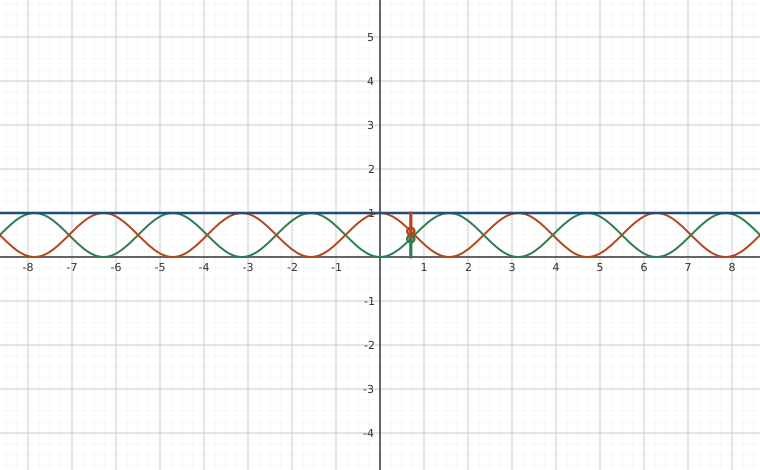
Interactive figuresin²x + cos²x = 1 seen as two heights that always stack to oneDrag the Input a slider from -6.3 to 6.3.
XYZ Graph · viewer build 5edf91b
The green curve is sin²x, the rust curve is cos²x, and the navy line is their sum, which is the constant 1 for every x: that flat line is the Pythagorean Identity drawn. At the input a chosen by the slider, the green segment rises from the axis to height sin²a and the rust segment continues from there to height 1, so the two squares are stacked into the unit exactly. Slide a and the two segments trade length, one growing as the other shrinks, while their total never moves.
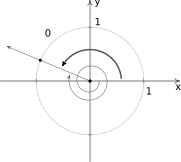
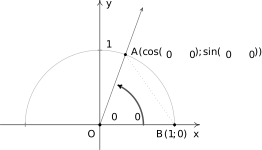
In light of the Quotient and Reciprocal Identities, Theorem 10.6, it suffices to show and . The remaining four circular functions can be expressed in terms of and so the proofs of their Even / Odd Identities are left as exercises. Consider an angle plotted in standard position. Let be the angle coterminal with with . (We can construct the angle by rotating counter-clockwise from the positive -axis to the terminal side of as pictured below.) Since and are coterminal, and .
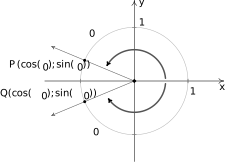
Figure 10.139Figure 10.140
We now consider the angles and . Since is coterminal with , there is some integer so that . Therefore, . Since is an integer, so is , which means is coterminal with . Hence, and . Let and denote the points on the terminal sides of and , respectively, which lie on the Unit Circle. By definition, the coordinates of are and the coordinates of are . Since and sweep out congruent central sectors of the Unit Circle, it follows that the points and are symmetric about the -axis. Thus, and . Since the cosines and sines of and are the same as those for and , respectively, we get and , as required. The Even / Odd Identities are readily demonstrated using any of the `common angles' noted in Section 10.2. Their true utility, however, lies not in computation, but in simplifying expressions involving the circular functions. In fact, our next batch of identities makes heavy use of the Even / Odd Identities.
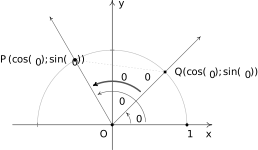
We first prove the result for differences. As in the proof of the Even / Odd Identities, we can reduce the proof for general angles and to angles and , coterminal with and , respectively, each of which measure between and radians. Since and are coterminal, as are and , it follows that is coterminal with . Consider the case below where .
Figure 10.141Figure 10.142
Since the angles and are congruent, the distance between and is equal to the distance between and .2 The distance formula, Equation 1.1, yields
Squaring both sides, we expand the left hand side of this equation as
From the Pythagorean Identities, and , so
Turning our attention to the right hand side of our equation, we find
Once again, we simplify , so that
Putting it all together, we get , which simplifies to: . Since and , and and and are all coterminal pairs of angles, we have . For the case where , we can apply the above argument to the angle to obtain the identity . Applying the Even Identity of cosine, we get , and we get the identity in this case, too.
To get the sum identity for cosine, we use the difference formula along with the Even/Odd Identities
We put these newfound identities to good use in the following example.
The identity verified in Example 10.4.1, namely, , is the first of the celebrated `cofunction' identities. These identities were first hinted at in Exercise in Section 10.2. From , we get:
which says, in words, that the `co'sine of an angle is the sine of its `co'mplement. Now that these identities have been established for cosine and sine, the remaining circular functions follow suit. The remaining proofs are left as exercises.
With the Cofunction Identities in place, we are now in the position to derive the sum and difference formulas for sine. To derive the sum formula for sine, we convert to cosines using a cofunction identity, then expand using the difference formula for cosine
We can derive the difference formula for sine by rewriting as and using the sum formula and the Even / Odd Identities. Again, we leave the details to the reader.
The formula developed in Exercise 10.4.2 for can be used to find a formula for by rewriting the difference as a sum, , and the reader is encouraged to fill in the details. Below we summarize all of the sum and difference formulas for cosine, sine and tangent.
In the statement of Theorem 10.16, we have combined the cases for the sum `' and difference `' of angles into one formula. The convention here is that if you want the formula for the sum `' of two angles, you use the top sign in the formula; for the difference, `', use the bottom sign. For example,
If we specialize the sum formulas in Theorem 10.16 to the case when , we obtain the following `Double Angle' Identities.
The three different forms for can be explained by our ability to `exchange' squares of cosine and sine via the Pythagorean Identity and we leave the details to the reader. It is interesting to note that to determine the value of , only one piece of information is required: either or . To determine , however, it appears that we must know both and . In the next example, we show how we can find knowing just one piece of information, namely .
In the last problem in Example 10.4.3, we saw how we could rewrite as sums of powers of . In Calculus, we have occasion to do the reverse; that is, reduce the power of cosine and sine. Solving the identity for and the identity for results in the aptly-named `Power Reduction' formulas below.
Another application of the Power Reduction Formulas is the Half Angle Formulas. To start, we apply the Power Reduction Formula to
We can obtain a formula for by extracting square roots. In a similar fashion, we may obtain a half angle formula for sine, and by using a quotient formula, obtain a half angle formula for tangent. We summarize these formulas below.
Our next batch of identities, the Product to Sum Formulas,3 are easily verified by expanding each of the right hand sides in accordance with Theorem 10.16 and as you should expect by now we leave the details as exercises. They are of particular use in Calculus, and we list them here for reference.
Related to the Product to Sum Formulas are the Sum to Product Formulas, which we will have need of in Section 10.7. These are easily verified using the Product to Sum Formulas, and as such, their proofs are left as exercises.
The reader is reminded that all of the identities presented in this section which regard the circular functions as functions of angles (in radian measure) apply equally well to the circular (trigonometric) functions regarded as functions of real numbers. In Exercises - in Section 10.5, we see how some of these identities manifest themselves geometrically as we study the graphs of the these functions. In the upcoming Exercises, however, you need to do all of your work analytically without graphs.
Exercises
In Exercises -, use the Even / Odd Identities to verify the identity. Assume all quantities are defined.
In Exercises -, use the Sum and Difference Identities to find the exact value. You may have need of the Quotient, Reciprocal or Even / Odd Identities as well.
If is a Quadrant IV angle with , and , where , find
If , where , and is a Quadrant II angle with , find
If , where , and where , find
If , where , and , where , find
In Exercises -, verify the identity.
In Exercises -, use the Half Angle Formulas to find the exact value. You may have need of the Quotient, Reciprocal or Even / Odd Identities as well.
(compare with Exercise )
(compare with Exercise )
(compare with Exercise )
(compare with Exercise )
In Exercises -, use the given information about to find the exact values of
where
where
where
where
where
where
where
where
where
where
In Exercises -, verify the identity. Assume all quantities are defined.
(HINT: Use the result to.)
In Exercises -, write the given product as a sum. You may need to use an Even/Odd Identity.
In Exercises -, write the given sum as a product. You may need to use an Even/Odd or Cofunction Identity.
Suppose is a Quadrant I angle with . Verify the following formulas
Discuss with your classmates how each of the formulas, if any, in Exercise change if we change assume is a Quadrant II, III, or IV angle.
Suppose is a Quadrant I angle with . Verify the following formulas
Discuss with your classmates how each of the formulas, if any, in Exercise change if we change assume is a Quadrant II, III, or IV angle.
If for , find an expression for in terms of .
If for , find an expression for in terms of .
If for , find an expression for in terms of .
Show that for all .
Let be a Quadrant III angle with . Show that this is not enough information to determine the sign of by first assuming and then assuming and computing in both cases.
Without using your calculator, show that
In part of Example 10.4.3, we wrote as a polynomial in terms of . In Exercise, we had you verify an identity which expresses as a polynomial in terms of . Can you find a polynomial in terms of for ? ? Can you find a pattern so that could be written as a polynomial in cosine for any natural number ?
In Exercise, we has you verify an identity which expresses as a polynomial in terms of . Can you do the same for ? What about for ? If not, what goes wrong?
Verify the Even / Odd Identities for tangent, secant, cosecant and cotangent.
Verify the Cofunction Identities for tangent, secant, cosecant and cotangent.
Verify the Difference Identities for sine and tangent.
Verify the Product to Sum Identities.
Verify the Sum to Product Identities.
Answers
Adapted from Precalculus, 3rd corrected edition, by Carl Stitz and Jeff Zeager (stitz-zeager.com), licensed under CC BY-NC-SA 3.0. Changes were made: reformatted as an accessible XYZ web edition. License: CC-BY-NC-SA-3.0.
These eBooks are a prerelease and are not yet certified conformant with WCAG 2.1 AA or ADA Title II. Every page is built against an automated accessibility gate, and the published editions will meet ADA Title II requirements when they release in late September 2026. If something is unusable, please tell us.