
10.2 The Unit Circle: Cosine and Sine
In Section 10.1.1, we introduced circular motion and derived a formula which describes the linear velocity of an object moving on a circular path at a constant angular velocity. One of the goals of this section is describe the position of such an object. To that end, consider an angle in standard position and let denote the point where the terminal side of intersects the Unit Circle. By associating the point with the angle , we are assigning a position on the Unit Circle to the angle . The -coordinate of is called the cosine of , written , while the -coordinate of is called the sine of , written .1 The reader is encouraged to verify that these rules used to match an angle with its cosine and sine do, in fact, satisfy the definition of a function. That is, for each angle , there is only one associated value of and only one associated value of .
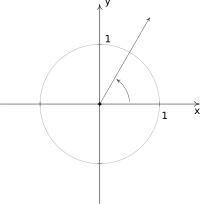
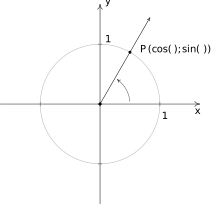
In Example 10.2.1, it was quite easy to find the cosine and sine of the quadrantal angles, but for non-quadrantal angles, the task was much more involved. In these latter cases, we made good use of the fact that the point lies on the Unit Circle, . If we substitute and into , we get . An unfortunate4 convention, which the authors are compelled to perpetuate, is to write as and as . Rewriting the identity using this convention results in the following theorem, which is without a doubt one of the most important results in Trigonometry.
The moniker `Pythagorean' brings to mind the Pythagorean Theorem, from which both the Distance Formula and the equation for a circle are ultimately derived.5 The word `Identity' reminds us that, regardless of the angle , the equation in Theorem 10.1 is always true. If one of or is known, Theorem 10.1 can be used to determine the other, up to a () sign. If, in addition, we know where the terminal side of lies when in standard position, then we can remove the ambiguity of the () and completely determine the missing value as the next example illustrates.
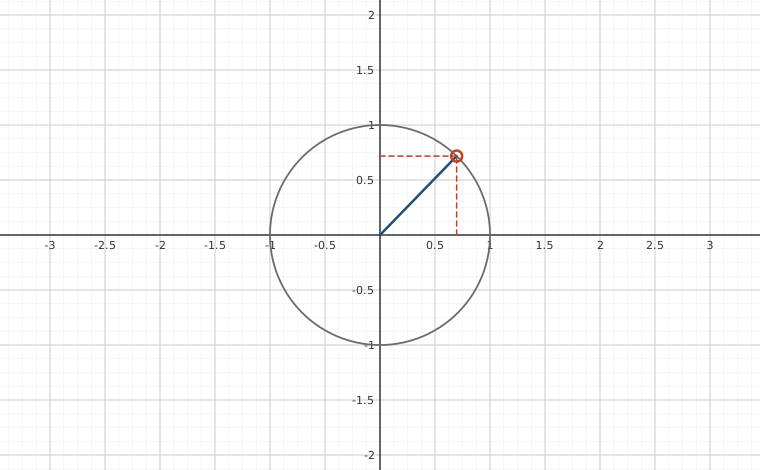
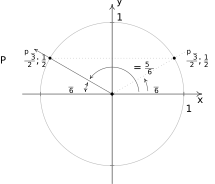
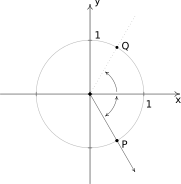
Another tool which helps immensely in determining cosines and sines of angles is the symmetry inherent in the Unit Circle. Suppose, for instance, we wish to know the cosine and sine of . We plot in standard position below and, as usual, let denote the point on the terminal side of which lies on the Unit Circle. Note that the terminal side of lies radians short of one half revolution. In Example 10.2.1, we determined that and . This means that the point on the terminal side of the angle , when plotted in standard position, is . From the figure below, it is clear that the point we seek can be obtained by reflecting that point about the -axis. Hence, and .
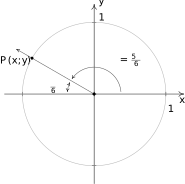
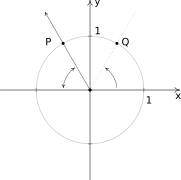
In the above scenario, the angle is called the reference angle for the angle . In general, for a non-quadrantal angle , the reference angle for (usually denoted ) is the acute angle made between the terminal side of and the -axis. If is a Quadrant I or IV angle, is the angle between the terminal side of and the positive -axis; if is a Quadrant II or III angle, is the angle between the terminal side of and the negative -axis. If we let denote the point , then lies on the Unit Circle. Since the Unit Circle possesses symmetry with respect to the -axis, -axis and origin, regardless of where the terminal side of lies, there is a point symmetric with which determines 's reference angle, as seen below.
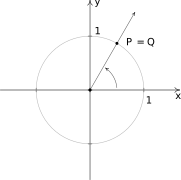
Reference angle for a Quadrant I angle
Reference angle for a Quadrant II angle
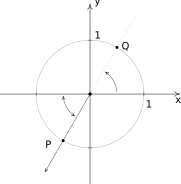
Reference angle for a Quadrant III angle
Reference angle for a Quadrant IV angle
We have just outlined the proof of the following theorem.
In light of Theorem 10.2, it pays to know the cosine and sine values for certain common angles. In the table below, we summarize the values which we consider essential and must be memorized.
Cosine and Sine Values of Common Angles
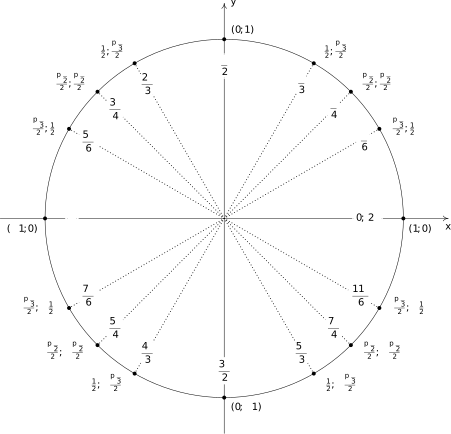
The reader may have noticed that when expressed in radian measure, the reference angle for a non-quadrantal angle is easy to spot. Reduced fraction multiples of with a denominator of have as a reference angle, those with a denominator of have as their reference angle, and those with a denominator of have as their reference angle.6 The Reference Angle Theorem in conjunction with the table of cosine and sine values on Page Section 10.2 can be used to generate the following figure, which the authors feel should be committed to memory.
The next example summarizes all of the important ideas discussed thus far in the section.
Our next example asks us to solve some very basic trigonometric equations.8
One of the key items to take from Example 10.2.5 is that, in general, solutions to trigonometric equations consist of infinitely many answers. To get a feel for these answers, the reader is encouraged to follow our mantra from Chapter 9 - that is, `When in doubt, write it out!' This is especially important when checking answers to the exercises. For example, another Quadrant IV solution to is . Hence, the family of Quadrant IV answers to number above could just have easily been written for integers . While on the surface, this family may look different than the stated solution of for integers , we leave it to the reader to show they represent the same list of angles.
Beyond the Unit Circle
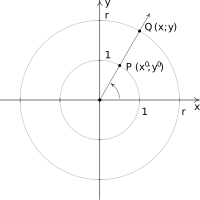
We began the section with a quest to describe the position of a particle experiencing circular motion. In defining the cosine and sine functions, we assigned to each angle a position on the Unit Circle. In this subsection, we broaden our scope to include circles of radius centered at the origin. Consider for the moment the acute angle drawn below in standard position. Let be the point on the terminal side of which lies on the circle , and let be the point on the terminal side of which lies on the Unit Circle. Now consider dropping perpendiculars from and to create two right triangles, and . These triangles are similar,10 thus it follows that , so and, similarly, we find . Since, by definition, and , we get the coordinates of to be and . By reflecting these points through the -axis, -axis and origin, we obtain the result for all non-quadrantal angles , and we leave it to the reader to verify these formulas hold for the quadrantal angles.
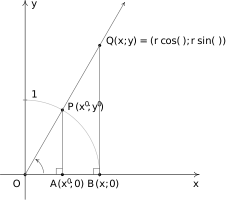
Not only can we describe the coordinates of in terms of and but since the radius of the circle is , we can also express and in terms of the coordinates of . These results are summarized in the following theorem.
Note that in the case of the Unit Circle we have , so Theorem 10.3 reduces to our definitions of and .
Theorem 10.3 gives us what we need to describe the position of an object traveling in a circular path of radius with constant angular velocity . Suppose that at time , the object has swept out an angle measuring radians. If we assume that the object is at the point when , the angle is in standard position. By definition, which we rewrite as . According to Theorem 10.3, the location of the object on the circle is found using the equations and . Hence, at time , the object is at the point . We have just argued the following.
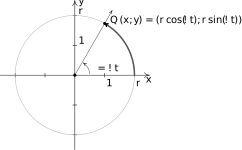
Equations for Circular Motion
In addition to circular motion, Theorem 10.3 is also the key to developing what is usually called `right triangle' trigonometry.11 As we shall see in the sections to come, many applications in trigonometry involve finding the measures of the angles in, and lengths of the sides of, right triangles. Indeed, we made good use of some properties of right triangles to find the exact values of the cosine and sine of many of the angles in Example 10.2.1, so the following development shouldn't be that much of a surprise. Consider the generic right triangle below with corresponding acute angle . The side with length is called the side of the triangle adjacent to ; the side with length is called the side of the triangle opposite ; and the remaining side of length (the side opposite the right angle) is called the hypotenuse. We now imagine drawing this triangle in Quadrant I so that the angle is in standard position with the adjacent side to lying along the positive -axis.
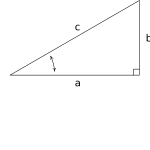
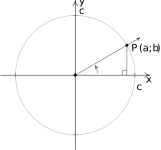
According to the Pythagorean Theorem, , so that the point lies on a circle of radius . Theorem 10.3 tells us that and , so we have determined the cosine and sine of in terms of the lengths of the sides of the right triangle. Thus we have the following theorem.
We close this section by noting that we can easily extend the functions cosine and sine to real numbers by identifying a real number with the angle radians. Using this identification, we define and . In practice this means expressions like and can be found by regarding the inputs as angles in radian measure or real numbers; the choice is the reader's. If we trace the identification of real numbers with angles in radian measure to its roots on page Section 10.1, we can spell out this correspondence more precisely. For each real number , we associate an oriented arc units in length with initial point and endpoint .
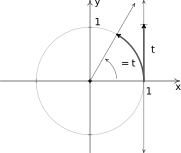
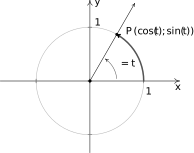
In the same way we studied polynomial, rational, exponential, and logarithmic functions, we will study the trigonometric functions and . The first order of business is to find the domains and ranges of these functions. Whether we think of identifying the real number with the angle radians, or think of wrapping an oriented arc around the Unit Circle to find coordinates on the Unit Circle, it should be clear that both the cosine and sine functions are defined for all real numbers . In other words, the domain of and of is . Since and represent - and -coordinates, respectively, of points on the Unit Circle, they both take on all of the values between an , inclusive. In other words, the range of and of is the interval . To summarize:
Suppose, as in the Exercises, we are asked to solve an equation such as . As we have already mentioned, the distinction between as a real number and as an angle radians is often blurred. Indeed, we solve in the exact same manner12 as we did in Example 10.2.5 number. Our solution is only cosmetically different in that the variable used is rather than : or for integers, . We will study the cosine and sine functions in greater detail in Section 10.5. Until then, keep in mind that any properties of cosine and sine developed in the following sections which regard them as functions of angles in radian measure apply equally well if the inputs are regarded as real numbers.
Exercises
In Exercises -, find the exact value of the cosine and sine of the given angle.
In Exercises -, use the results developed throughout the section to find the requested value.
- If with in Quadrant IV, what is ?
- If with in Quadrant I, what is ?
- If with in Quadrant II, what is ?
- If with in Quadrant III, what is ?
- If with in Quadrant III, what is ?
- If with in Quadrant IV, what is ?
- If and , what is ?
- If and , what is ?
- If and , what is ?
- If and , what is ?
In Exercises -, find all of the angles which satisfy the given equation.
In Exercises -, solve the equation for . (See the comments following Theorem 10.5.)
In Exercises -, use your calculator to approximate the given value to three decimal places. Make sure your calculator is in the proper angle measurement mode!
In Exercises -, find the measurement of the missing angle and the lengths of the missing sides. (See Example 10.2.8)
Find , , and .
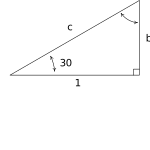
Figure 10.117 Find , , and .
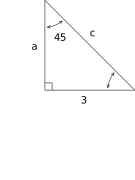
Figure 10.118 Find , , and .
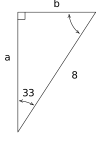
Figure 10.119 Find , , and .
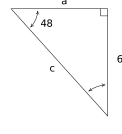
Figure 10.120
In Exercises -, assume that is an acute angle in a right triangle and use Theorem 10.4 to find the requested side.
- If and the side adjacent to has length 4, how long is the hypotenuse?
- If and the hypotenuse has length 5280, how long is the side adjacent to ?
- If and the side opposite has length 117.42, how long is the hypotenuse?
- If and the hypotenuse has length 10, how long is the side opposite ?
- If and the hypotenuse has length 10, how long is the side adjacent to ?
- If and the side opposite has length 306, how long is the side adjacent to ?
In Exercises -, let be the angle in standard position whose terminal side contains the given point then compute and .
In Exercises -, find the equations of motion for the given scenario. Assume that the center of the motion is the origin, the motion is counter-clockwise and that corresponds to a position along the positive -axis. (See Equation 10.3 and Example 10.1.5.)
A point on the edge of the spinning yo-yo in Exercise from Section 10.1.
Recall: The diameter of the yo-yo is 2.25 inches and it spins at 4500 revolutions per minute.
The yo-yo in exercise from Section 10.1.
Recall: The radius of the circle is 28 inches and it completes one revolution in 3 seconds.
A point on the edge of the hard drive in Exercise from Section 10.1.
Recall: The diameter of the hard disk is 2.5 inches and it spins at 7200 revolutions per minute.
A passenger on the Big Wheel in Exercise from Section 10.1.
Recall: The diameter is 128 feet and completes 2 revolutions in 2 minutes, 7 seconds.
- Consider the numbers: , , , , . Take the square root of each of these numbers, then divide each by . The resulting numbers should look hauntingly familiar. (See the values in the table on Section 10.2.)
- Let and be the two acute angles of a right triangle. (Thus and are complementary angles.) Show that and . The fact that co-functions of complementary angles are equal in this case is not an accident and a more general result will be given in Section 10.4.
- In the scenario of Equation 10.3, we assumed that at , the object was at the point . If this is not the case, we can adjust the equations of motion by introducing a `time delay.' If is the first time the object passes through the point , show, with the help of your classmates, the equations of motion are and .
Answers
- ,
- ,
- ,
- ,
- ,
- ,
- ,
- ,
- ,
- ,
- ,
- ,
- ,
- ,
- ,
- ,
- ,
- ,
- ,
- ,
- If with in Quadrant IV, then .
- If with in Quadrant I, then .
- If with in Quadrant II, then .
- If with in Quadrant III, then .
- If with in Quadrant III, then .
- If with in Quadrant IV, then .
- If and , then .
- If and , then .
- If and , then .
- If and , then .
- when or for any integer .
- when or for any integer .
- when for any integer .
- when or for any integer .
- when or for any integer .
- when for any integer .
- when for any integer .
- when or for any integer .
- never happens
- when for any integer .
- when or for any integer .
- never happens.
- when or for any integer .
- when or for any integer .
- never happens
- when for any integer .
- when for any integer .
- when or for any integer .
- , ,
- , ,
- , ,
- , ,
- The hypotenuse has length .
- The side adjacent to has length .
- The hypotenuse has length .
- The side opposite has length .
- The side adjacent to has length .
- The hypotenuse has length , so the side adjacent to has length .
- inches, , , . Here and are measured in inches and is measured in minutes.
- inches, , , . Here and are measured in inches and is measured in seconds.
- inches, , , . Here and are measured in inches and is measured in minutes.
- feet, , , . Here and are measured in feet and is measured in seconds
Adapted from Precalculus, 3rd corrected edition, by Carl Stitz and Jeff Zeager (stitz-zeager.com), licensed under CC BY-NC-SA 3.0. Changes were made: reformatted as an accessible XYZ web edition. License: CC-BY-NC-SA-3.0.