The Poisson discrete probability distribution finds the probability of an event over some unit of time or space. A Poisson probability distribution may be used when a random experiment meets all of the following requirements.
Events occur independently.
The discrete random variable X is the number of occurrences over an interval of time, volume, space, area, etc.
The mean number of successes μ over time, volume, space, area, etc. is given. (Note some textbooks and calculators use lambda = λ instead of mu = μ for the mean).
The value of x has no stopping point since there is no set sample size like the binomial distribution. Note that e is not a variable, it is a constant number. Use the ex button on your calculator.
Mean, Variance & Standard Deviation of a Poisson Distribution
For a Poisson distribution, μ, the expected number of successes, and the variance σ2 are equal to one another.
Sometimes the question will ask for a probability over a different unit of time, space or area than originally given in the problem. Always change the mean to fit the new units in the question.
TI-84: Press [2nd] [DISTR]. This will get you a menu of probability distributions. Press [ALPHA] B or arrow down to B:poissonpdf( and press [ENTER]. This puts poissonpdf( on the home screen. Enter the values for μ and x with a comma between each. Press [ENTER]. This is the probability density function and will return you the probability of exactly x successes. Press [ALPHA] C or arrow down to C:poissoncdf( and press [ENTER]. This puts poissoncdf( on the home screen. Enter the values for μ and x with a comma between each. Press [ENTER]. This is the cumulative distribution function and will return you the probability of at most x successes.
TI-89: Go to the [Apps] Stat/List Editor, then select F5 [DISTR]. This will get you a menu of probability distributions. Arrow down to Poisson Pdf and press [ENTER]. Enter the values for μ and x into each cell. Press [ENTER]. This is the probability density function and will return you the probability of exactly x successes. Arrow down to Poisson Cdf and press [ENTER]. Enter the values for μ and the lower and upper values of x into each cell. Press [ENTER]. This is the cumulative distribution function and will return you the probability between the lower and upper x-values, inclusive.
Excel: Use the formula =POISSON.DIST(x,mean,false) for P(X = x). Use the formula =POISSON.DIST(x,mean,true) for P(X ≤ x).
d) The time-period is half an hour = 30 minutes. The mean from part c would be μ = 5. To find “less than” 2 we would have zero or one customer.
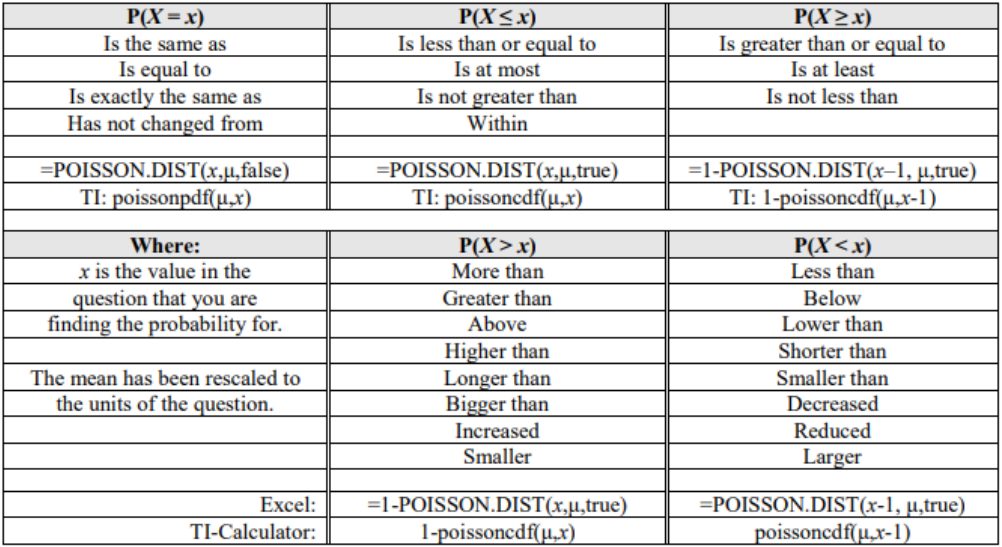
So far, most of the examples for the Poisson distribution were for exactly x successes. If we want to find the probability of accumulation of x values then we would use the cumulative distribution function (cdf) instead of the pdf. As you read through a problem look for some of the following key phrases in Figure 5-9. Once you find the phrase then match up to what sign you would use and then use the table to walk you through the computer or calculator formula.
Figure 5-9
The last ever dolphin message was misinterpreted as a surprisingly sophisticated attempt to do a double--‐ backwards – somersault through a hoop whilst whistling the "Star Sprangled Banner," but in fact the message was this: So long and thanks for all the fish.
These eBooks are a prerelease and are not yet certified conformant with WCAG 2.1 AA or ADA Title II. Every page is built against an automated accessibility gate, and the published editions will meet ADA Title II requirements when they release in late September 2026. If something is unusable, please tell us.