
5.5 Hypergeometric Distribution
The hypergeometric distribution is a discrete probability distribution used to find the probability of success when there are two outcomes to each trial, and there are a set number of dependent trials. A hypergeometric probability distribution results from a random experiment that meets all of the following requirements. 12
- The procedure has a fixed sample size n taken from a population N.
- The trials are taken without replacement (dependent).
- Each trial has exactly two outcomes, the number of successes = a and the number of failures = b. Note a + b = N.
If a random experiment satisfies all of the above, the distribution of the random variable X, where X counts the number of successes, is called a hypergeometric distribution, we write X ~ H(n, a, N).
Note: the calculator does not have the hypergeometric distribution shortcut. The following online calculator will calculate the probability: https://homepage.divms.uiowa.edu/~mbognar/applets/hg.html. The M = a is the number of successes a from our example, or use Excel.
Figure 5-7 may help you decide when to use the “True” for cumulative in Excel.
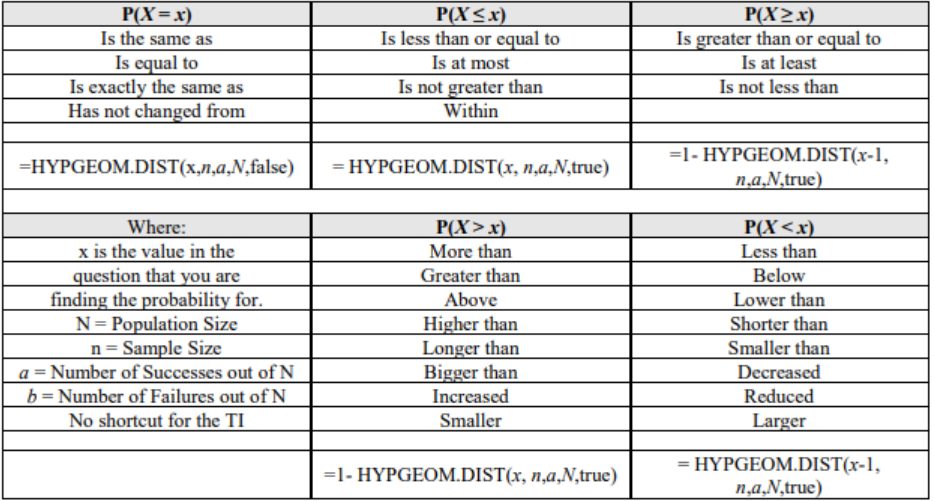 Figure 5-7
A bookstore owner examines 5 books from each lot of 25 to check for missing pages. If they find at least 2 books with missing pages, the entire lot is returned. If, indeed, there are 4 books with missing pages, find the probability that the lot will be returned.
Solution
Sometimes the hardest part is determining which of the numbers goes in the right place in the formula. The population size is always the largest number, N = 25. A success is what you are trying to find the probability for, which is getting a book with a missing page. The number of successes out of the population is a = 4 (the 4 books with the missing pages). This means b = 25 – 4 = 21 (the number of books without missing pages). Note a + b = N. The sample size is the n = 5 is the number of books the owner examines. The owner will send the lot back if X is at least 2 missing pages.
We can stop at X = 4 since there are only 4 books with missing pages. Your stopping point will be the smaller of n or a. P(X ≥ 2) = P(X = 2) + P(X = 3) + P(X = 4) = .
In Excel use the formula: =1- HYPGEOM.DIST(1,5,4,25,TRUE).
Figure 5-8 shows the online calculator at https://homepage.divms.uiowa.edu/~mbognar/applets/hg.html.
Figure 5-7
A bookstore owner examines 5 books from each lot of 25 to check for missing pages. If they find at least 2 books with missing pages, the entire lot is returned. If, indeed, there are 4 books with missing pages, find the probability that the lot will be returned.
Solution
Sometimes the hardest part is determining which of the numbers goes in the right place in the formula. The population size is always the largest number, N = 25. A success is what you are trying to find the probability for, which is getting a book with a missing page. The number of successes out of the population is a = 4 (the 4 books with the missing pages). This means b = 25 – 4 = 21 (the number of books without missing pages). Note a + b = N. The sample size is the n = 5 is the number of books the owner examines. The owner will send the lot back if X is at least 2 missing pages.
We can stop at X = 4 since there are only 4 books with missing pages. Your stopping point will be the smaller of n or a. P(X ≥ 2) = P(X = 2) + P(X = 3) + P(X = 4) = .
In Excel use the formula: =1- HYPGEOM.DIST(1,5,4,25,TRUE).
Figure 5-8 shows the online calculator at https://homepage.divms.uiowa.edu/~mbognar/applets/hg.html.
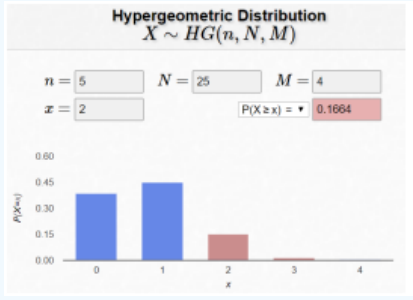 Figure 5-8
Adapted from Mostly Harmless Statistics by Rachel Webb (Portland State University, https://mostlyharmlessstat.wixsite.com/webpage), © Rachel Webb, licensed under CC BY-SA 4.0. Changes were made. License: CC-BY-SA-4.0.