
2.8 Rank and Nullity
Two subspaces have been shadowing the whole chapter. One is what a matrix can reach — the span of its columns, which section 2.4 called its reach and which is properly named the column space. The other is what a matrix destroys: the set of inputs sent to , called the null space. Both are subspaces, but not for the same reason. The column space is literally a span, so it inherits the chapter's usual argument. The null space is defined by a condition, , and passes the test because the condition survives adding and scaling: if and then , and likewise for multiples.
This section takes one matrix and measures both at once. Let
Its columns are , and , and the third is the sum of the first two — a dependency of exactly the kind the last three sections have been training you to spot. So the third column contributes nothing new, the column space is the plane spanned by and , and that plane works out to . Check it on the columns: and , both matching their third coordinates.
 Explore in 3D (opens in a new tab)
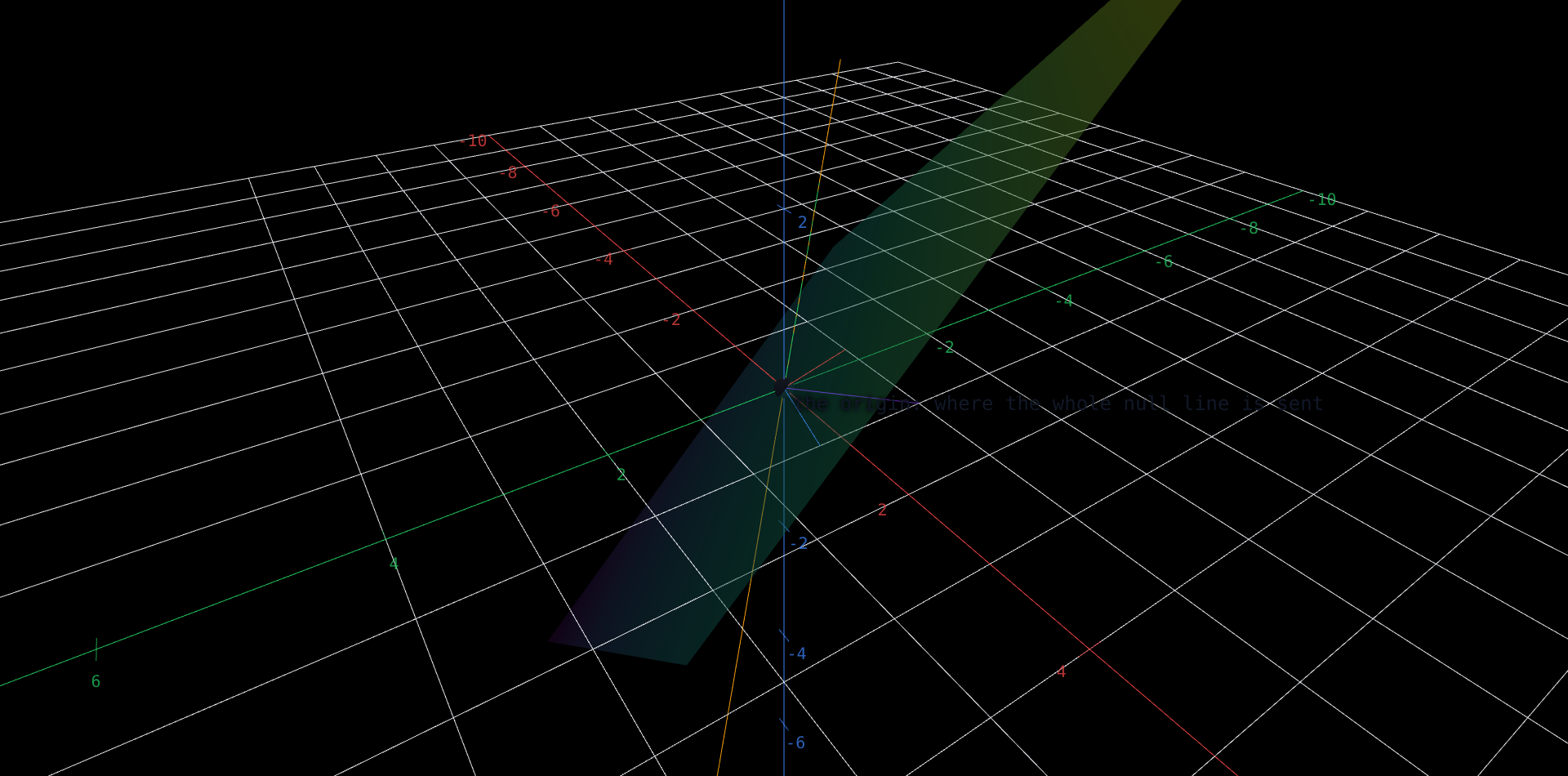
A semi-transparent tilted plane through the origin, holding three segments from the origin that all lie flat in it: a red one to (1, 0, 1), a blue one to (2, 1, 1), and a violet one to (3, 1, 2), which is visibly the diagonal of the parallelogram the first two make. A separate amber line runs through the origin in the direction (-1, -1, 1), clearly not lying in the plane and clearly not perpendicular to it either. A green segment from the origin slides up and down that amber line as a slider is dragged, and a white dot sits at the origin, marking the single output that every position of the green segment is sent to. The plane is two-dimensional and the amber line one-dimensional, and those two counts add to the matrix's three columns - though the two live in different places, the plane among the outputs and the line among the inputs, so the picture shows a sum of dimensions rather than one space cut in two.
Explore the figure
- Confirm the dependency by eye. The violet arrow is not a new direction: it ends where you arrive by travelling along the red arrow and then along the blue one. Three columns, but only two directions' worth of reach.
- Look at the amber line. It passes through the origin but does not lie in the plane — it leaves the sheet, which is why it is a genuinely different subspace and not a line you could have drawn inside the column space.
- Drag from to . The green input arrow grows, shrinks, and reverses, and at every setting sends it to the white dot at the origin. An entire line of distinct inputs collapses to one output.
- Now check something the picture invites you to get wrong: is the amber line perpendicular to the plane? Orbit until you can judge the angle. It is not — the plane's normal direction is and the amber line runs along , which is a different direction. The null space is not the perpendicular complement of the column space; what it is perpendicular to is named at the end of this section.
Counting what survives and what dies
Both measurements come from one reduction.
The reduced form of . Two pivots, in columns one and two; one column without a pivot, the third. The pivot count is the rank, and it counts independent columns — two, matching the plane. The pivot-free count is the number of free variables in , which is the nullity — one, matching the line. The bottom row of zeros is the third equation announcing that it followed from the other two all along.
Read the null space off the reduced matrix directly. The reduced rows say and , so with free we get and : every solution is . That is a line through the origin, its single basis vector is , and its dimension — the nullity — is .
Now put the two numbers side by side. The rank is , the nullity is , and has columns:
This is the rank theorem, and it is not a coincidence of this example. Every column of either holds a pivot or does not. The columns sitting in pivot positions — here and of the original , not the reduced matrix's columns — are a basis of the column space, so they are counted by the rank. The pivot-free positions pick out which variables are free in — here the third, — and each free variable contributes one direction to the null space, so those positions are counted by the nullity. Every column is counted once by one of the two, so the two counts add to the number of columns. There is nothing deeper to it than that bookkeeping — but the bookkeeping is forced, which is what makes it a theorem.
The geometric reading is a conservation law. The input space has three dimensions to spend. Whatever the matrix crushes to zero is spent on the null space, and what is left over is what survives into the output. Crush more and you reach less; reach more and you crush less. You cannot have both.
The determinant of is zero — the test that section 2.5 met as the vanishing factor . A nonzero determinant would mean three independent columns, rank , nullity , and no collapse at all. Here the collapse is real, and the determinant is how you detect it without drawing anything.
One warning, which is the content of exploration step 4. The null space is not generally perpendicular to the column space; and the plane's normal are plainly different directions. What the null space is perpendicular to is the row space, the span of the rows — and that is easy to verify here, since dotted with each of , and gives , and . That is no accident either: says that has zero dot product with every row. Chapter 6 builds on this.
An original work of XYZ Homework, built around interactive XYZ 3D figures. Chapters 1–6 follow the topic sequence of Interactive Linear Algebra (Margalit & Rabinoff, Georgia Tech, GNU FDL). Chapter 0's scope (its topics, their order, and the idea each figure shows) follows the Vectors chapter of Ximera's Linear Algebra: An Interactive Introduction. The prose, worked examples and figures were written for this book, which is not affiliated with or endorsed by the authors of either work. License: CC-BY-NC-SA-4.0.