
2.3 Subspace or Not
The last two sections kept meeting the same kind of shape. Spans were flat, passed through the origin, and combining two of their points always produced another of their points; the red line of solutions in the previous section was flat but missed the origin, and adding two of its points threw you off it. It is time to name the property. A subspace of is a set of vectors that contains the zero vector and is closed under the two operations that build spans: adding any two of its vectors lands back in the set, and scaling any of its vectors lands back in the set.
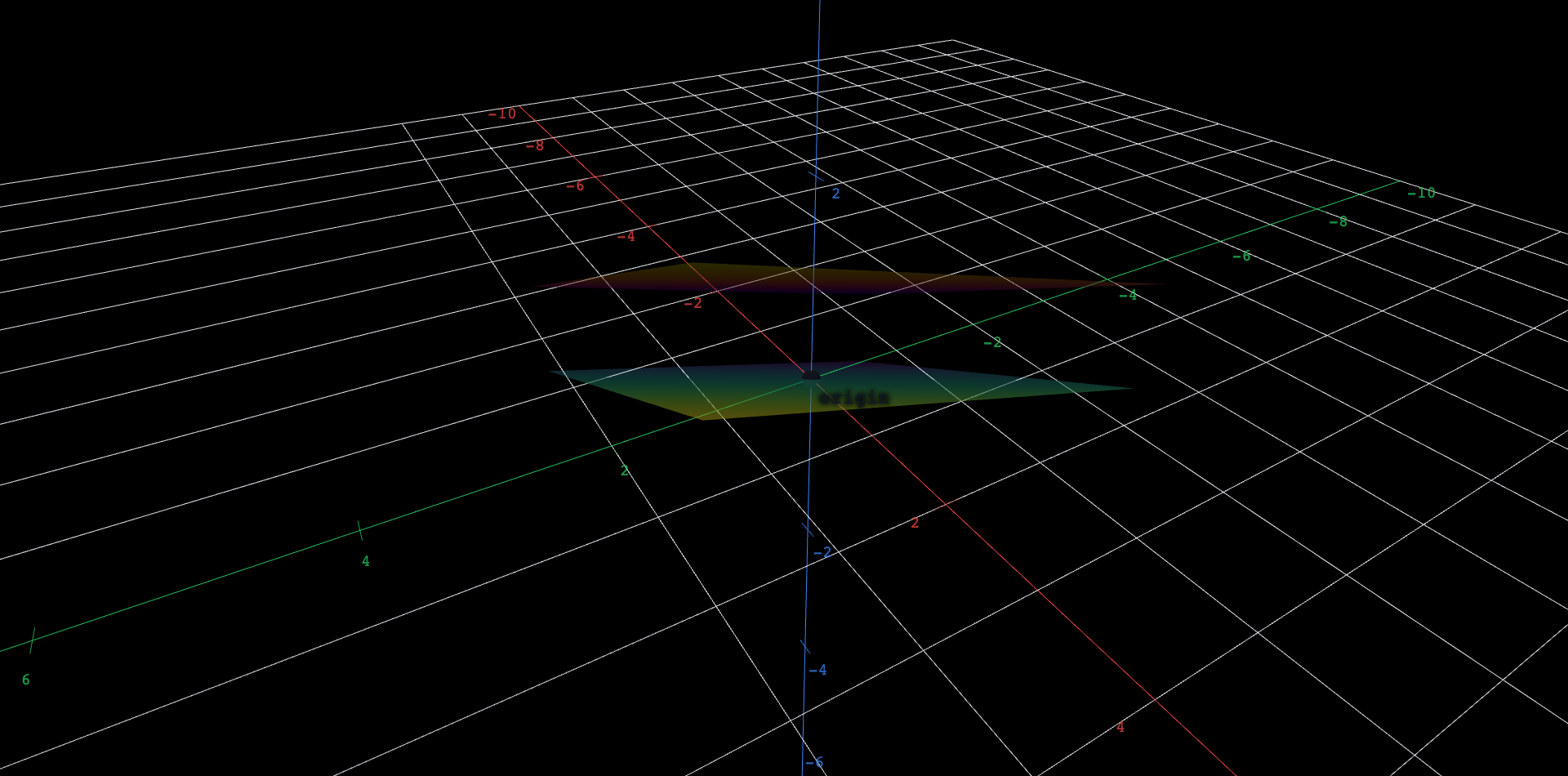
The definition sounds algebraic, but it is a test you can run by eye. The figure below offers three candidates. The first is the plane , which passes through the marked origin. The second is its translate , floating above or below on the slider . The third, hidden until you reveal it, is the curved surface — and it is the trap, because it does pass through the origin.
 Explore in 3D (opens in a new tab)
Explore the figure
- At the default , orbit the two planes. Only the lower one contains the origin point — the translate already fails the easiest part of the test. Does any point of the translate look "reachable" by scaling another of its points down toward zero?
- Drag to and watch the translate drop onto the origin plane. Among all values of the slider, exactly one produces a subspace. Which failure returns the instant leaves ?
- Reveal the hidden surface labeled curved surface: . Check by orbiting that it genuinely contains the origin. If containing the origin were the whole test, it would pass.
- Now test closure on the curved surface by eye: find the points above and — both sit at height — and locate their sum . Does the surface pass through it?
Running the test
The origin plane passes in full generality. If and both satisfy , then their sum satisfies — the same equation again, because the equation is linear with zero constant term. Scaling works the same way. In fact this plane is a span: every point of it is , so it is the span of two vectors, and every span passes the subspace test for exactly the reason above.
The translate fails at , and not only because it misses the origin. Take : the points and both lie on it, but their sum needs , not . Closure fails because adding two points doubles the constant . A flat sheet in the wrong place is not a subspace — it is a subspace's translate, the shape solution sets of inhomogeneous systems take.
The three verdicts assemble into a picture worth keeping: the subspaces of are exactly the origin alone, the lines through the origin, the planes through the origin, and all of . Flat, through the origin, closed under the span-building operations — any curvature or any offset breaks the test somewhere.
An original work of XYZ Homework, built around interactive XYZ 3D figures. Its chapter sequence is aligned to Interactive Linear Algebra (Margalit & Rabinoff, Georgia Tech, GNU FDL); this work is original, copies nothing from it, and is not affiliated with or endorsed by its authors. License: CC-BY-NC-SA-4.0.