
2.6 Basis and Dimension
Two demands have now been placed on a set of vectors, and they pull against each other. A set should span the subspace you care about — reach every one of its points — and the last section added that it should be independent, so that nothing in it is a passenger. Adding vectors helps the first demand and hurts the second; removing them does the reverse. A set that satisfies both at once is called a basis of the subspace, and it is the smallest honest description of that subspace.
Work in the plane the chapter keeps returning to:
The pair and is a basis of . It spans, because a point of with first two coordinates and is — and that really is a point of , since its third coordinate comes out as required. It is independent, because a combination has first coordinate and second coordinate , so making it zero forces both coefficients to zero with nothing left to check.
But that pair is not special, and the figure exists to make the point unmissable.
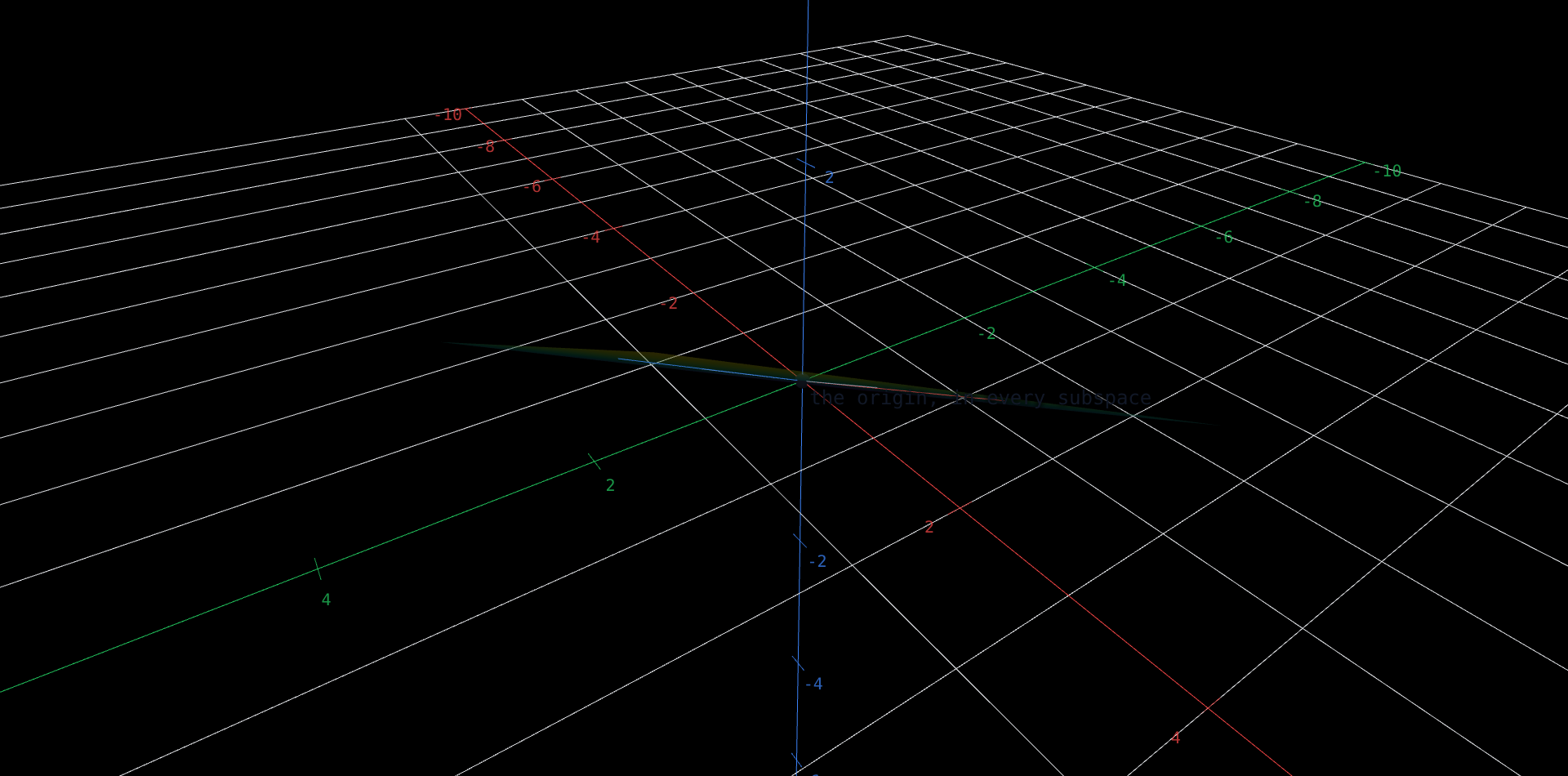 Explore in 3D (opens in a new tab)
A semi-transparent tilted plane through a marked origin. Two gray segments from the origin lie in the plane: a fixed reference basis, (1, 0, 0.5) and (0, 1, 0.5). A red segment and a blue segment, also from the origin and lying in the plane, stand at right angles to each other; a slider a rotates the pair together, like the hands of a clock pinned to the sheet. However far the slider is dragged, the red and blue segments stay inside the plane, stay perpendicular to one another, and stay two in number - a different basis of the same plane at every angle.
Explore the figure
- Orbit until you are looking nearly along the sheet, edge-on. Both the red and the blue arrow lie in it, at every slider setting — they never lift off, because they were built out of vectors of and is closed under adding and scaling.
- Drag slowly from towards . The red and blue arrows sweep around, staying rigidly at right angles to one another. At every instant you are looking at a different pair of vectors, and every one of those pairs is a basis of the same plane.
- Compare a rotated pair with the gray reference pair underneath. The gray pair is not perpendicular and the red-and-blue pair is; both describe perfectly well. Being a basis says nothing about angles or lengths.
- Count. However far you drag, there are two rotating arrows — never three, never one. Try to imagine a slider setting that would give a third arrow's worth of new direction inside the sheet; the sheet is flat, so there is nowhere for it to point.
Why the count cannot change
Step 4 is the substance of this section, and it deserves an argument rather than a picture. Suppose you tried to build a basis of from three vectors. All three lie in the plane, and the previous section's test settles their fate: three vectors of can never be independent. Suppose they were. Then each of them is built from the two coordinates a point of carries, so the three sit inside a two-coordinate system, and three independent vectors need three coordinates' worth of room. Some nontrivial combination must therefore vanish — though which vector the relation exposes as redundant is not fixed in advance, and need not be the third. A dependent set is not a basis. Try one vector instead, and it spans only the line through it, missing almost all of . Two is forced, and the number is a property of rather than of any particular attempt to describe it.
That number is the dimension, written . Here , matching the two coordinates each basis assigns a point of and the two free variables of the parametric form back in Chapter 1. A line through the origin has dimension , all of has dimension , and the subspace has dimension — its basis is the empty set, since any vector at all would be a passenger.
The independence half of the reference pair is worth confirming by machine, because it is the half a picture argues least well.
The two vectors and stacked as columns and reduced by a computer algebra system. Both columns carry a pivot, which is the matrix statement of independence: the homogeneous system has no free variable, so no coefficient is free to be nonzero, so no dependency relation exists. Two independent vectors spanning is precisely a basis of , and the pivot count is .
Any basis is a full set of instructions
The reason a basis is worth isolating is that it determines everything else with no slack. Because the vectors span, every point of can be written as a combination of them; because they are independent, it can be written that way in only one manner. Two different combinations producing the same point would subtract to give a nontrivial combination producing , and independence has just outlawed that.
So each of the infinitely many bases in the figure converts into a faithful copy of : hand over two coefficients, get back exactly one point of the plane, and every point arises from exactly one pair. Choosing which basis to use is choosing which coordinate system to describe in — and that choice, and what it costs to change it, is the next section.
An original work of XYZ Homework, built around interactive XYZ 3D figures. Chapters 1–6 follow the topic sequence of Interactive Linear Algebra (Margalit & Rabinoff, Georgia Tech, GNU FDL). Chapter 0's scope (its topics, their order, and the idea each figure shows) follows the Vectors chapter of Ximera's Linear Algebra: An Interactive Introduction. The prose, worked examples and figures were written for this book, which is not affiliated with or endorsed by the authors of either work. License: CC-BY-NC-SA-4.0.