
2.7 Coordinates in a New Basis
If a subspace has infinitely many bases and no reason to prefer one, then naming a point of it is a two-part act: you choose a basis, and only then can you say which combination of it you mean. That second part is what coordinates are, and the previous section quietly established that they always exist and are always unique — spanning gives existence, independence gives uniqueness.
Make the choice deliberately awkward, so that nothing can be read off by habit. In the plane , take
Both lie in — check the third coordinates against : and . Neither is a multiple of the other, so by the previous section's counting argument they are a basis of . They are also at an oblique angle and of different lengths, which is the point: a basis owes you nothing but spanning and independence.
Given coefficients and , the point they name is
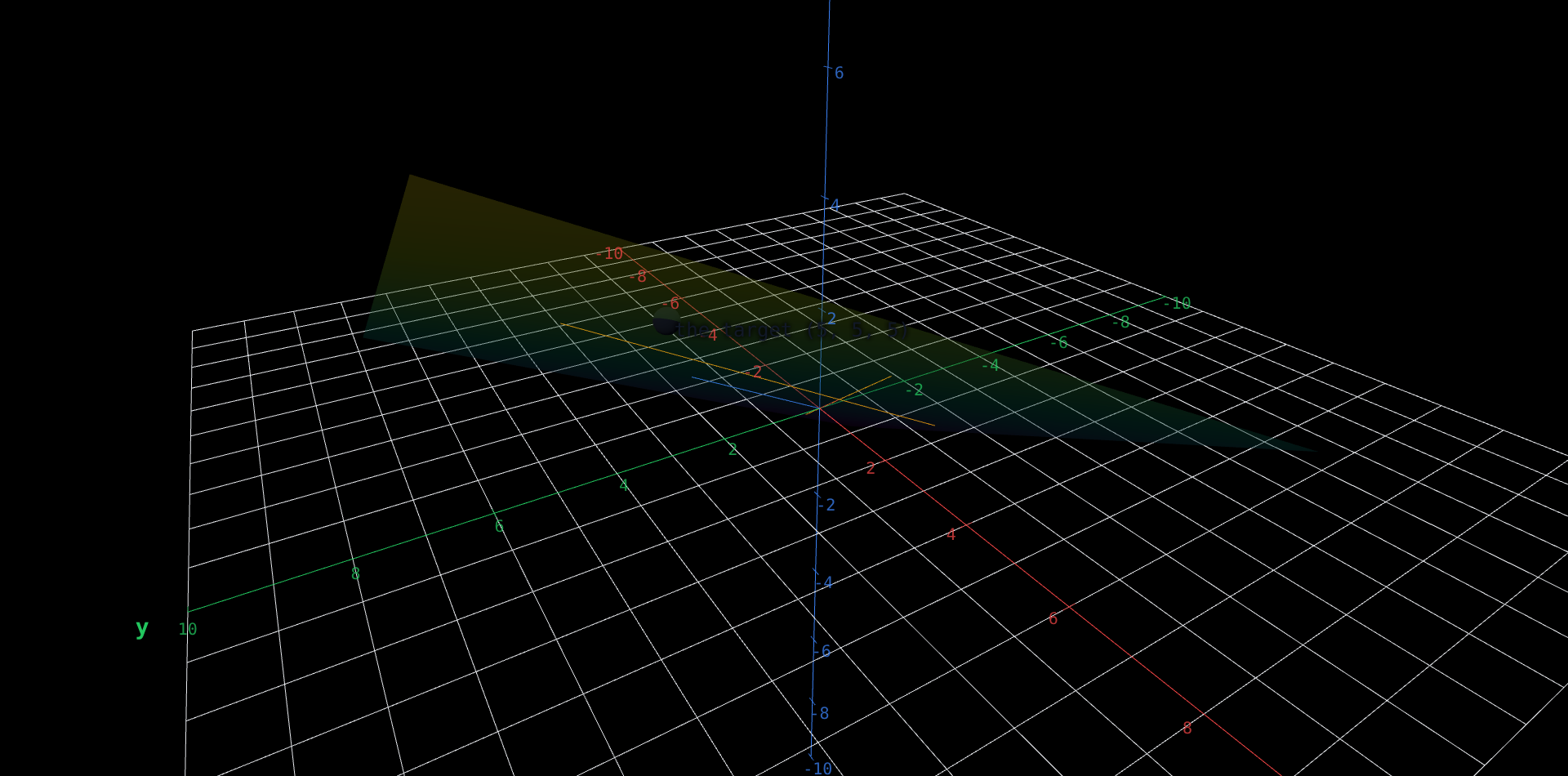
and we write to say that is the point with those coordinates in the basis . The figure turns that formula into a pair of dials.
 Explore in 3D (opens in a new tab)
A large semi-transparent tilted plane through the origin. A short red segment and a short blue segment run from the origin inside it, meeting there at an oblique angle rather than a right angle - the skewed basis. Two amber lines, one parallel to the red segment and one parallel to the blue, also lie in the plane and cross at a single point; two sliders slide them across the sheet, so their crossing is the point with the chosen pair of coordinates. The figure opens with both sliders at 0.5, so neither amber line lies on a basis segment. A white dot further out on the sheet marks the target (5, 5, 5); setting the sliders to 2 and 1 slides the crossing exactly onto it, which is what it means for that point to have coordinates 2 and 1 in this basis.
Explore the figure
- The figure opens at , , with both amber lines clear of the arrows. Set , : the crossing moves onto the tip of the red arrow. Of course it does — coordinates mean one and no , so the basis vectors are the points with coordinates and , exactly as and are in the standard grid.
- Set , . The crossing collapses onto the origin. Every basis puts its origin in the same place, because whatever the basis is.
- Now hunt the white dot. Drag and until the crossing lands on ; you should find it at , . Those two numbers are the target's coordinates in this basis, and reading them off the sliders is reading them off the figure.
- Watch the amber lines rather than the crossing as you drag one slider. They stay parallel to the basis directions and slide, never rotating. The two families of amber lines are a grid on the plane — a skewed one, but a perfectly good one.
Finding coordinates is solving a system
Step 3 was a search. Doing it properly means solving for and , and the equation is . Since a point of is determined by its first two coordinates — the third is forced by the plane — only two equations carry information:
Solve however you like: the first gives , and substituting into the second gives , so and , whence . The coordinates of are , agreeing with the sliders. Confirm it forwards: .
Doing that from scratch for every point is wasteful, because the left-hand side never changes. Collect the basis vectors' first two coordinates into the coordinate matrix
whose columns are and as seen in the standard grid. Then , and the coordinates come from inverting once and reusing forever.
The inverse of the coordinate matrix, computed symbolically. Multiplying the first two standard coordinates of a point of by this matrix returns its -coordinates in one step. On the target: and , which is the pair the sliders found. An inverse exists here for the same reason the basis is a basis — the columns are independent — and the next chapter makes that equivalence official.
The two matrices are a translation pair. takes coordinates and returns the point's first two entries; takes those two entries and returns the coordinates. The third entry is never needed in either direction, because is a graph over the -plane: is determined by the other two. That is what makes a matrix enough here, and it is worth noticing as a condition rather than a habit. It fails for a subspace that is not a graph over the -plane: in the plane , the points and share the pair , so dropping the third coordinate would confuse them and no matrix could tell them apart. Neither direction is more fundamental than the other, which is worth insisting on, because the standard grid feels like the truth and a skewed basis feels like a description of it. It is not so: are themselves a basis chosen for convenience, and the entries of any vector you have ever written down were already coordinates with respect to it.
An original work of XYZ Homework, built around interactive XYZ 3D figures. Chapters 1–6 follow the topic sequence of Interactive Linear Algebra (Margalit & Rabinoff, Georgia Tech, GNU FDL). Chapter 0's scope (its topics, their order, and the idea each figure shows) follows the Vectors chapter of Ximera's Linear Algebra: An Interactive Introduction. The prose, worked examples and figures were written for this book, which is not affiliated with or endorsed by the authors of either work. License: CC-BY-NC-SA-4.0.