
2.2 Homogeneous and Particular
Consider the system of two equations and . Chapter 1 tells us what to expect: two independent conditions on three unknowns leave a line of solutions. This section is about the structure of that line — a structure shared by the solution set of every linear system, of any size.
First replace the right-hand sides by zeros: and . This is the homogeneous version of the system. It is guaranteed to be consistent, since works, and a short elimination shows its solutions are all multiples of a single vector: . In the language of the previous section, the homogeneous solution set is a span — here, a line through the origin.
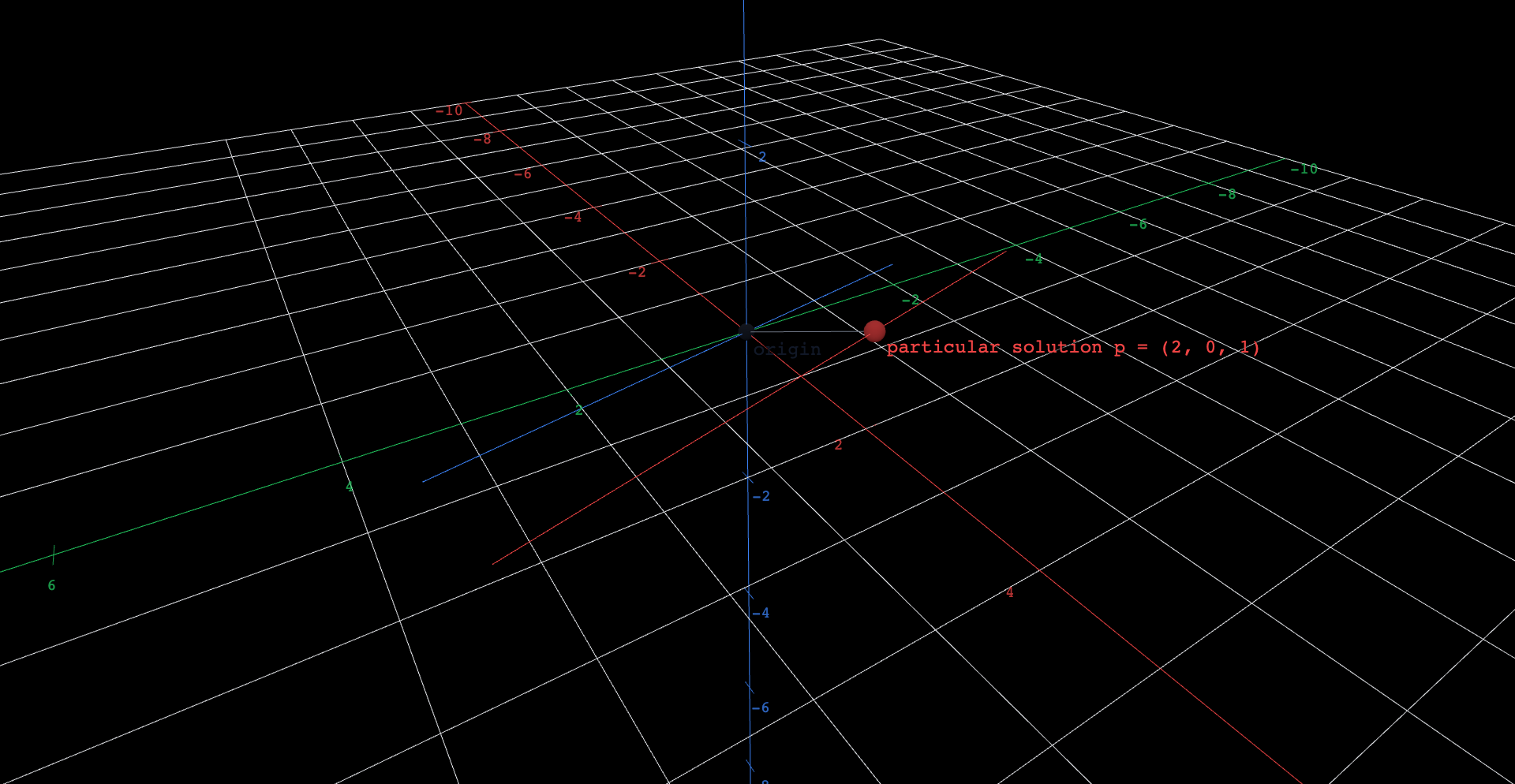
Now return to the original right-hand sides. One solution can be found by trial: satisfies both equations (check: and ). We call it a particular solution — nothing special about it, just some point that works. The figure below shows both solution sets at once.
 Explore in 3D (opens in a new tab)
Explore the figure
- Orbit until both lines are clearly visible. Confirm they are parallel — same direction vector, different anchor points.
- The blue line passes through the origin; the red line does not. Which of the two systems could you have guessed is the homogeneous one, from the picture alone?
- Follow the dashed segment from the origin to the red point. Every point of the red line is reached the same way: start on the blue line, then add .
- Would a different particular solution — any other point of the red line — have served equally well as the anchor?
One solution plus all homogeneous solutions
Here is the reasoning, and it never uses the specific numbers. Suppose solves the system and solves the homogeneous system . Then , so is again a solution. Conversely, if is any solution, then , so differs from by a homogeneous solution. Both directions together say:
Geometrically: the solution set of a consistent system is a translated copy of the homogeneous solution set — the same span, picked up and carried to , exactly as the dashed segment in the figure shows. The homogeneous system contributes the shape and direction; the particular solution contributes only the location.
"A short elimination shows its solutions are all multiples of a single vector" is the one step above that the section asks you to take on faith. Here it is, done by machine: the null space of the coefficient matrix, which is precisely the solution set of .
Worth noticing what the check had to tolerate. The engine returns the basis vector ; the text states . Those are different vectors spanning the same line. The null space itself is a fact — one definite subspace, here that line — but a basis for it is a choice, and the two choices differ. The comparison is therefore made by span rather than entry-by-entry, so the text keeps the scaling it chose for readability and still gets a certificate. An entrywise check would have called a correct book wrong.
An original work of XYZ Homework, built around interactive XYZ 3D figures. Its chapter sequence is aligned to Interactive Linear Algebra (Margalit & Rabinoff, Georgia Tech, GNU FDL); this work is original, copies nothing from it, and is not affiliated with or endorsed by its authors. License: CC-BY-NC-SA-4.0.