
2.1 The Span Collapses
Take two vectors in space, and . From them you can build new vectors by scaling and adding: for any numbers and . The collection of everything you can build this way is called the span of and . Span is the reachable set: if you are allowed to walk any distance along the direction and any distance along the direction, span is every place you can end up.
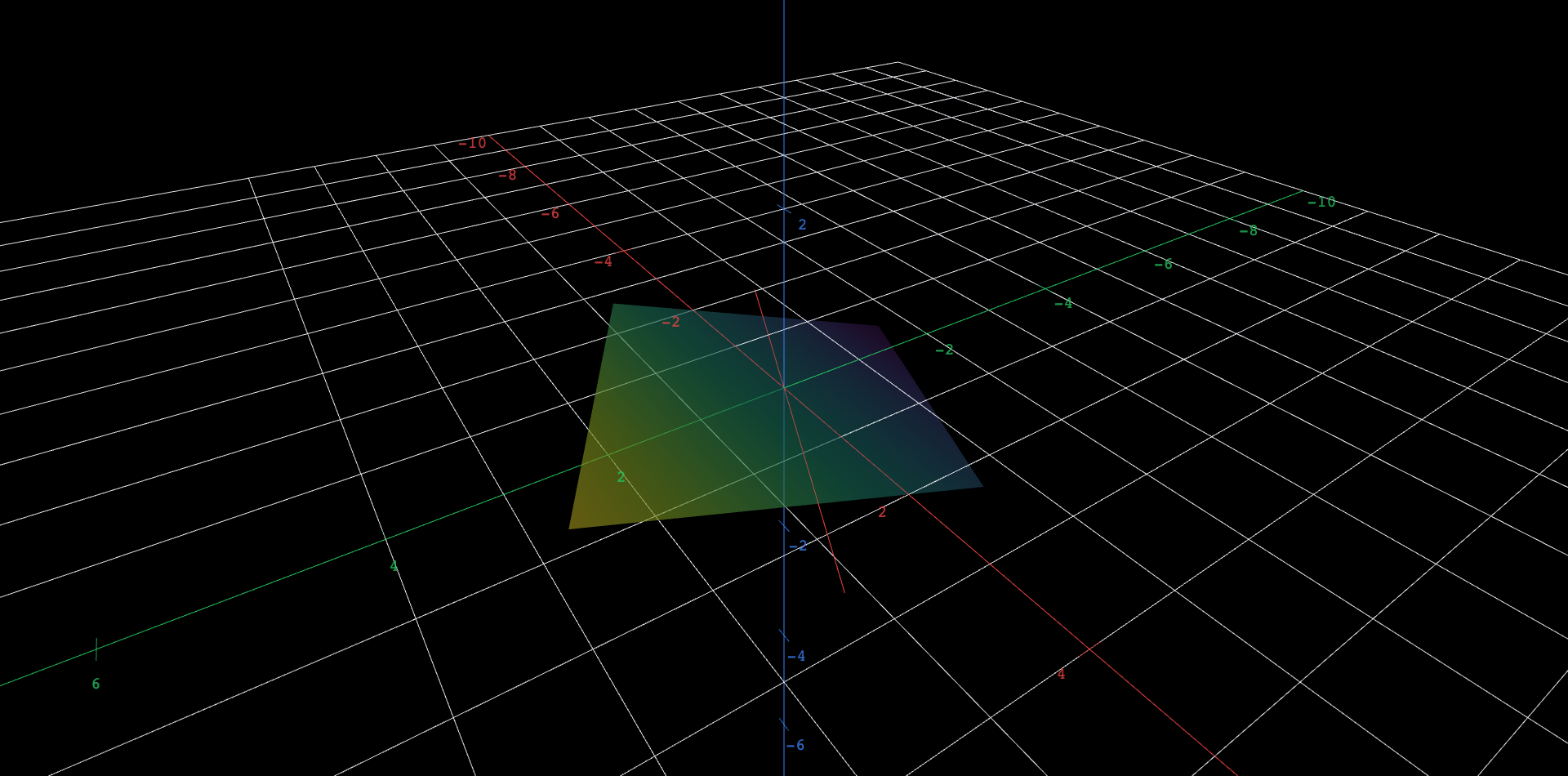
For most pairs of vectors the span of two vectors is a plane through the origin — two independent directions of travel sweep out a flat two-dimensional sheet. But the word "independent" is carrying weight. The figure below spans a surface by and a second vector that moves: the slider carries from at steadily toward itself at .
 Explore in 3D (opens in a new tab)
Explore the figure
- At , orbit the plane. Confirm it passes through the origin — the combination with , is always reachable.
- Find the red line in the plane. Every point of it is a multiple of : the span of one vector, sitting inside the span of two.
- Drag slowly toward . Describe what happens to the sheet. At what slider value do you first notice it thinning?
- Park at exactly . How much of space is reachable now? What was lost, and what remained?
What collapsed, exactly
At the second vector equals the first, so the combination is just — a multiple of a single direction. Two vectors, but only one direction of travel: the span is the red line. We say the pair has become linearly dependent: one of the vectors contributes nothing that the other did not already provide. For every strictly less than the two vectors point in genuinely different directions, and the span is a full plane; the size of a span is governed not by how many vectors you list but by how many independent directions they contain.
Notice also what never changed during the collapse. At every value of the span contained the origin, and at every value it was closed under adding and scaling: combine two reachable points and you get a reachable point. Spans are flat things through the origin — this observation becomes the definition of a subspace two sections from now.
The parallelism condition from the worked example, handed to a computer algebra system: one equation, one root, one collapse. Dependence really is a single-slider-value event.
The section's title claims a collapse, and a collapse is a change in something. That something is rank: the number of independent directions the pair actually contains, as opposed to the number of vectors listed. Park the slider at and the answer is — the sheet in the figure is honestly two-dimensional.
The same pair at , where has arrived at . Still two vectors; now one direction. Two computations, and , are the collapse the whole section describes — and they are what the phrase "the size of a span is governed not by how many vectors you list but by how many independent directions they contain" means, stated as a number a machine can check.
An original work of XYZ Homework, built around interactive XYZ 3D figures. Its chapter sequence is aligned to Interactive Linear Algebra (Margalit & Rabinoff, Georgia Tech, GNU FDL); this work is original, copies nothing from it, and is not affiliated with or endorsed by its authors. License: CC-BY-NC-SA-4.0.