
2.5 When a Third Vector Is Redundant
The previous section left a matrix with two columns and a plane's worth of reach, and closed on an obvious idea for enlarging it: add another column. Keep and , and bring in a third vector
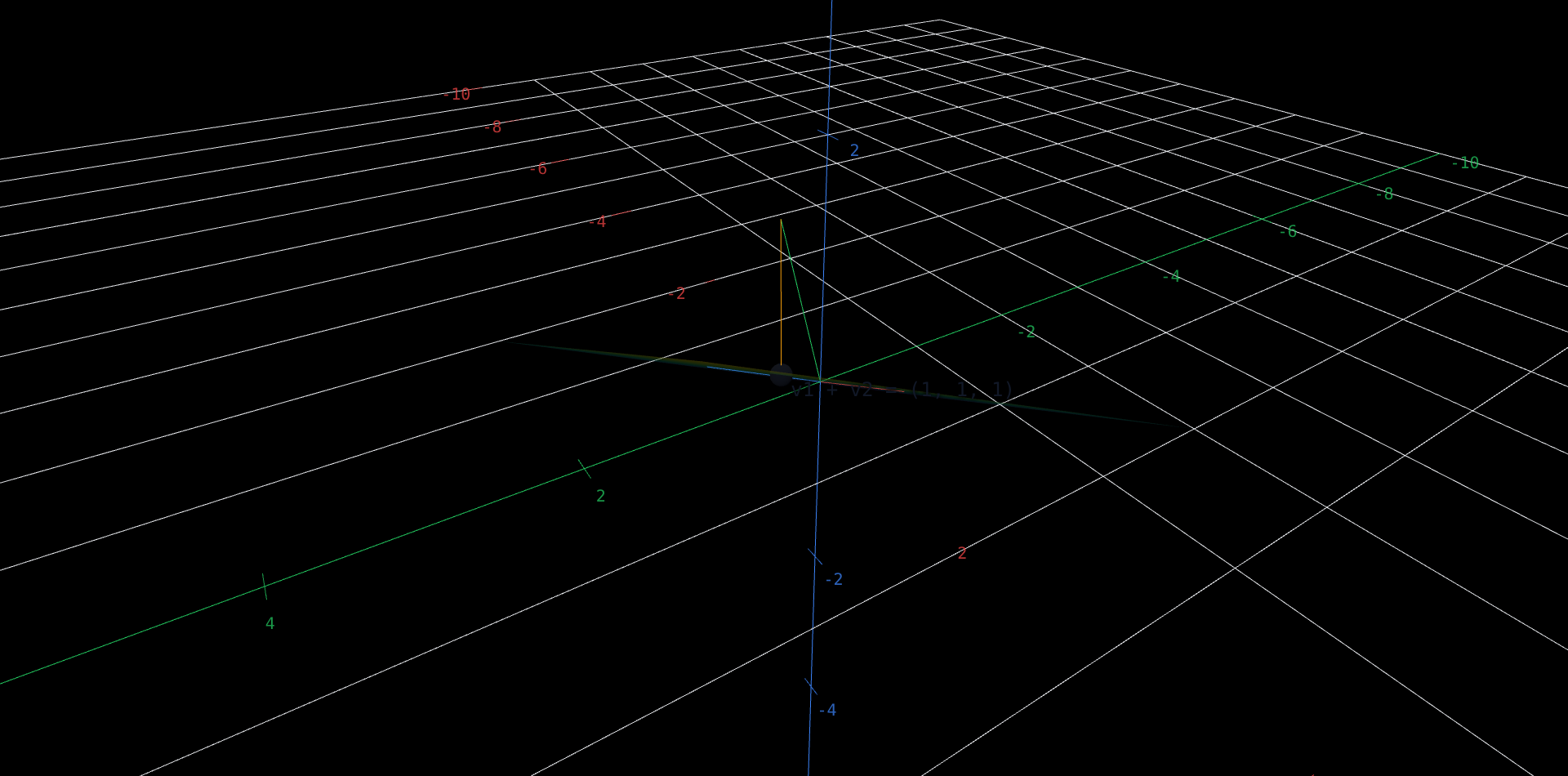
whose tip sits above or below the point at a height you control. The first two vectors span the plane , and the question is whether buys anything. It does exactly when it escapes that plane — a vector already lying in the sheet adds only combinations the sheet already contained. The figure below hangs the third vector on a slider so you can watch it escape, land, and escape again.
 Explore in 3D (opens in a new tab)
A semi-transparent tilted plane through the origin, the span of a red vector (1, 0, 0.5) and a blue vector (0, 1, 0.5) that both lie flat inside it. A green vector runs from the origin to (1, 1, h), and an amber segment drops from its tip to a white dot marking the point (1, 1, 1) on the plane, measuring how far the green vector stands out of the sheet. A slider h moves the green tip up and down. When h is 1 the amber segment closes to nothing, the green vector lies in the plane, and it equals the red plus the blue; at every other h the green vector escapes the plane and the three vectors together reach all of space.
Explore the figure
- At the default the green vector stands clear of the sheet and the amber gap is one unit long. Orbit until you are convinced that no amount of red and blue — stretched, flipped, added — could ever reach that tip, because every combination of them stays in the plane.
- Drag down to . The gap closes, the white dot swallows the green tip, and the green vector lies flat in the sheet. It has arrived at , which is : the third vector has become a combination of the first two.
- Keep dragging to . The green vector escapes again, now leaving the plane on the underside. Escape is the ordinary situation; the landing at was the accident.
- Sweep across the whole slider and count the settings at which the green vector lies in the plane. As in the last section, the plane is a graph , so the vertical line through meets it exactly once — so among all the heights, exactly one makes the third vector redundant.
The test, and what it measures
The definition names what you watched. Vectors are linearly independent when the only combination of them equal to the zero vector is the one with all coefficients zero. If some combination with a coefficient that is not zero produces , they are dependent, and that combination is called a dependency relation.
Run the test. We need every with , which is three equations, one per coordinate:
The first two hand over and immediately. Substituting both into the third leaves
and now everything hinges on the factor . If it is nonzero, forcing , hence : only the trivial combination works, and the three vectors are independent. If the factor dies, is free, and taking gives the dependency relation
which is step 2 of your exploration, written algebraically.
The quantity that decided everything has a name you have already met in a different costume. Arrange the three vectors as the columns of a matrix and take its determinant.
The three vectors stacked as columns and handed to a computer algebra system: the determinant is exactly the factor that the elimination produced. It is nonzero for every but one, and it vanishes at — the single slider setting at which the green vector lands in the plane. Chapter 4 explains why a determinant knows this: it is measuring the volume of the box the three vectors build, and a box whose three edges lie in one plane has no volume at all.
Independence is about spans, not about vectors
Dependence is not a defect of any one vector; it is a statement about the set. At the relation can be solved for any of the three, so each is a combination of the other two and no one of them is the redundant one. What is true is that the set carries a passenger: some vector can be dropped without shrinking the span, which is why "redundant" describes the situation better than it describes any member of it.
That is also the practical payoff. When the three are independent — every but one — their span is all of , so the equation from the last section becomes solvable for every target , and solvable in exactly one way. When the span stays the plane it was, most targets remain out of reach, and the ones in reach are now reachable in infinitely many ways: adding any multiple of to a solution gives another solution, since that combination contributes nothing.
An original work of XYZ Homework, built around interactive XYZ 3D figures. Chapters 1–6 follow the topic sequence of Interactive Linear Algebra (Margalit & Rabinoff, Georgia Tech, GNU FDL). Chapter 0's scope (its topics, their order, and the idea each figure shows) follows the Vectors chapter of Ximera's Linear Algebra: An Interactive Introduction. The prose, worked examples and figures were written for this book, which is not affiliated with or endorsed by the authors of either work. License: CC-BY-NC-SA-4.0.