
2.4 Is the Target in the Span?
The previous section closed with a promise: everything a matrix produces is automatically a subspace, since it is assembled by adding and scaling and the subspace test asks for nothing else. Cashing the promise takes one piece of notation. Let be the matrix whose columns are and , and let . The matrix–vector product is defined to be the combination of the columns weighted by the entries of :
That is the whole definition, and it is the operation you have run since this chapter's first section. Letting range over produces every scaled sum of and — their span, nothing more. Writing and , the third coordinate is always , so what can produce is the plane through the origin. Section 2.8 will call it the column space of ; for now, call it what can reach.
Now run the question backwards. Given a target in , is there an with ? The definition answers geometrically before any arithmetic starts: has a solution exactly when lies in the span of the columns of . Consistency is not an accident discovered at the bottom of an elimination; it is the question of whether one point sits on one plane. The figure below puts a target on a vertical track through that plane so you can watch consistency come and go.
 Explore in 3D (opens in a new tab)
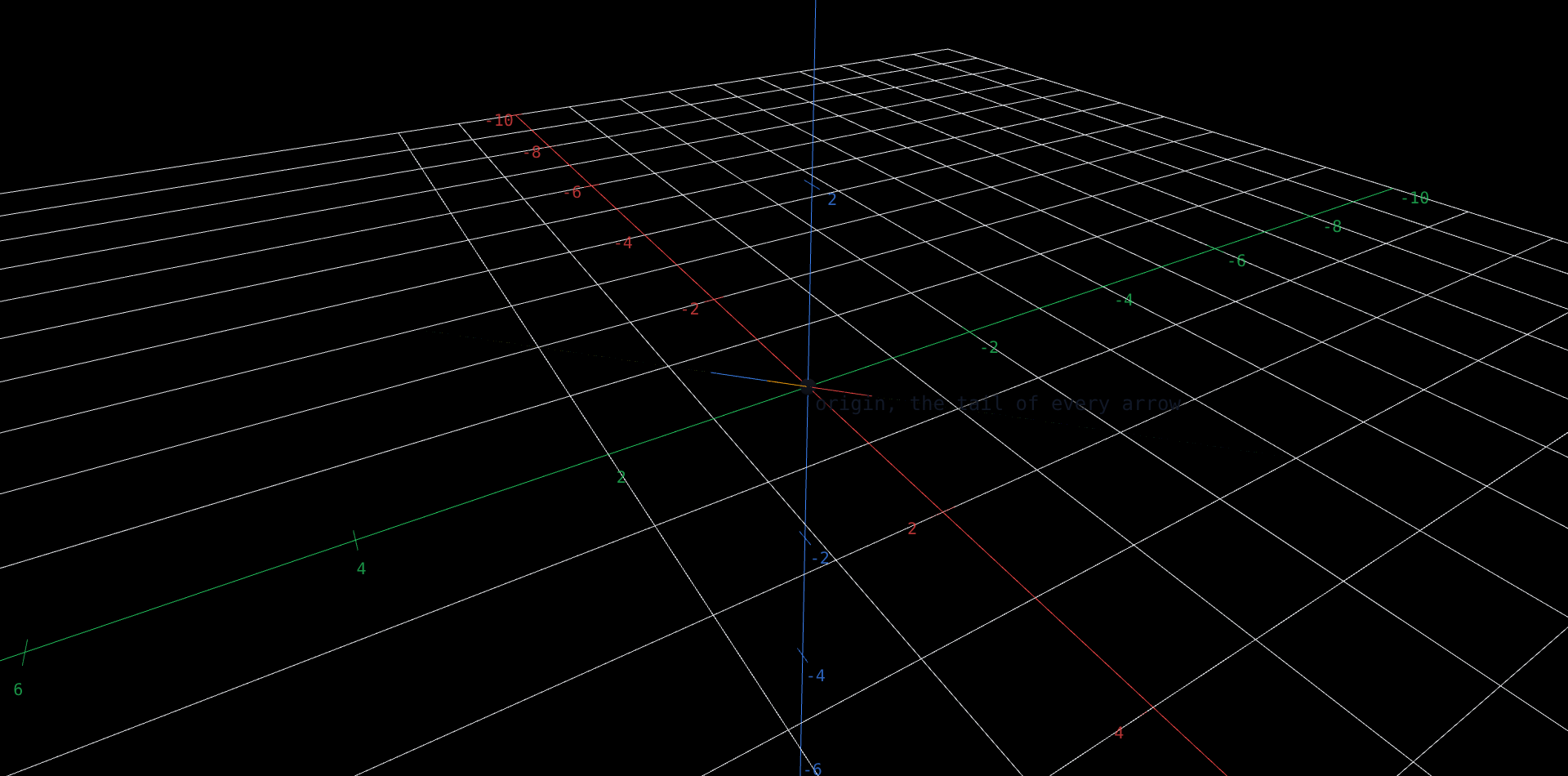
A semi-transparent tilted plane through a marked origin: the set of all vectors A times x, spanned by a short red segment from the origin to (1, 0, 0.5) and a short blue segment from the origin to (0, 1, 0.5), both lying flat in it. A third, amber segment runs from the origin to the target b, the point (1, 1, c), whose height is set by a slider c. A pink segment rises vertically from the point (1, 1, 1) on the plane to the amber segment's tip, measuring how far b misses the plane. The figure opens with c at 1, where the pink segment has zero length and the amber segment lies flat in the plane, exactly on the diagonal of the parallelogram the red and blue segments make; at every other c the amber tip floats off the plane and the pink miss reappears.
Explore the figure
- At the default the pink segment has vanished and the amber arrow lies flat in the plane. Orbit until you see its tip close the parallelogram built on the red and blue arrows: , so .
- Drag up to . The tip lifts to while the plane above stays at height , and a pink segment one unit long opens up. No combination of the red and blue arrows can climb it — both are stuck in the sheet.
- Drag down to . The miss is three units and hangs below the plane, but nothing has changed in kind: unreachable is unreachable, above or below.
- Sweep and count the values that make the system solvable. This plane is a graph , so it has exactly one height above and the vertical line meets it exactly once: the answer is one value, not an interval. Where would the crossing sit if the second column were ?
Where the miss becomes a number
Elimination says the same thing arithmetically. The augmented matrix for has rows , and . The first two are already pivots, so clear the third with them: subtract times row one and times row two from row three. Its coefficients die, its augmented entry becomes , and the last row is left reading
which is the pink segment written as an equation — its length was all along. At that row is , a true statement constraining nothing, and the two pivot rows hand over the unique solution .
The augmented matrix for , reduced by a computer algebra system. The bottom row is all zeros: the third equation followed from the first two, no pivot lands in the augmented column, and the coefficient pivots read off .
At any other the last row reads a nonzero number, and no choice of repairs it; reduced form scales that bad row to , a pivot in the augmented column. That is the general test: a system is inconsistent exactly when its reduced augmented matrix has a pivot in the last column, because such a pivot is a row asserting .
The same computation for . The identity matrix is bad news here, not good: the pivot in the third column is the row — elimination finding, from the numbers alone, the vertical miss of one unit visible in the figure.
Two consequences. has only two columns, so its reach is at most a plane and most vectors of are unreachable. And a reachable target is reachable in exactly one way, since both coefficient columns hold pivots and no free variable is left to vary.
An original work of XYZ Homework, built around interactive XYZ 3D figures. Chapters 1–6 follow the topic sequence of Interactive Linear Algebra (Margalit & Rabinoff, Georgia Tech, GNU FDL). Chapter 0's scope (its topics, their order, and the idea each figure shows) follows the Vectors chapter of Ximera's Linear Algebra: An Interactive Introduction. The prose, worked examples and figures were written for this book, which is not affiliated with or endorsed by the authors of either work. License: CC-BY-NC-SA-4.0.