

3.9 Combinations
XYZ Crunch demonstration: Counting ordered and unordered selections
Synthetic narration with English captions, a transcript, and time to think before checking the answer.
Read the transcriptDownload the videoNarration credits and licences
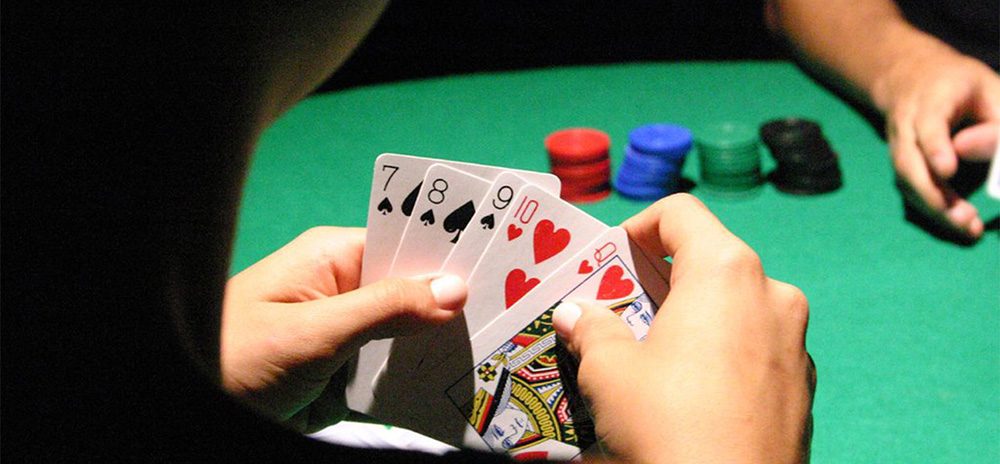
Earlier, we studied permutations, which we use to count the number of ways to generate an ordered list of a given length from a group of objects. An important property of permutations is that the order of the list matters: The results of a race and the selection of club officers are examples of lists where the order is important. In other situations, the order is not important. For example, in most card games where a player receives a hand of cards, the order in which the cards are received is irrelevant; in fact, players often rearrange the cards in a way that helps them keep the cards organized.
Combinations: When Order Doesn’t Matter
In situations in which the order of a list of objects doesn’t matter, the lists are no longer permutations. Instead, we call them combinations.
Counting Combinations
Permutations and combinations are certainly related, because they both involve choosing a subset of a large group. Let’s explore that connection, so that we can figure out how to use what we know about permutations to help us count combinations. We’ll take a basic example. How many ways can we select 3 letters from the group A, B, C, D, and E? If order matters, that number is . That’s small enough that we can list them all out in the table below.
| ABC | ABD | ABE | ACB | ACD | ACE |
|---|---|---|---|---|---|
| ADB | ADC | ADE | AEB | AEC | AED |
| BAC | BAD | BAE | BCA | BCD | BCE |
| BDA | BDC | BDE | BEA | BEC | BED |
| CAB | CAD | CAE | CBA | CBD | CBE |
| CDA | CDB | CDE | CEA | CEB | CED |
| DAB | DAC | DAE | DBA | DBC | DBE |
| DCA | DCB | DCE | DEA | DEB | DEC |
| EAB | EAC | EAD | EBA | EBC | EBD |
| ECA | ECB | ECD | EDA | EDB | EDC |
Now, let’s look back at that list and color-code it so that groupings of the same 3 letters get the same color, as shown in Figure 3.11:
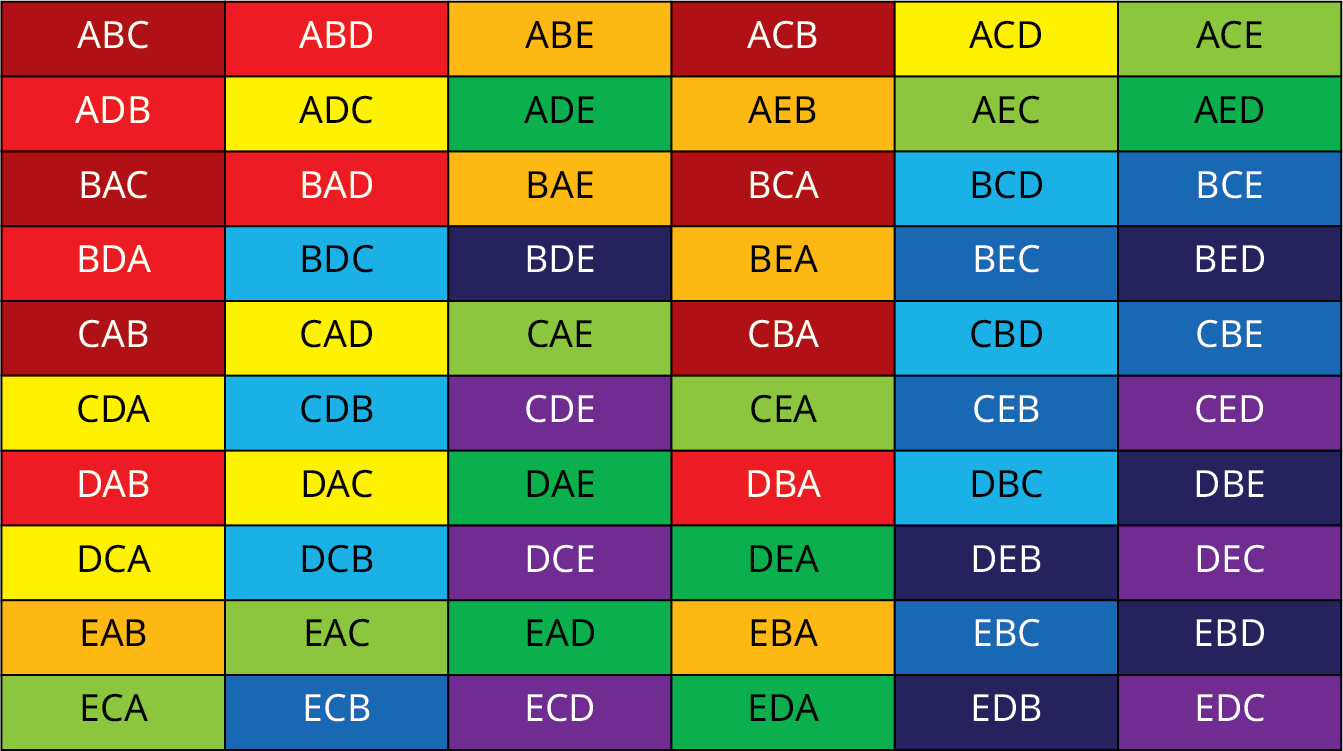
After color-coding, we see that the 60 cells can be seen as 10 groups (colors) of 6. That’s no coincidence! We’ve already seen how to compute the number of permutations using the formula To compute the number of combinations, let’s count them another way using the Multiplication Rule for Counting. We’ll do this in two steps:
Step 1: Choose 3 letters (paying no attention to order).
Step 2: Put those letters in order.
The number of ways to choose 3 letters from this group of 5 (A, B, C, D, E) is the number of combinations we’re looking for; let’s call that number (read “the number of combinations of 5 objects taken 3 at a time”). We can see from our chart that this is ten (the number of colors used). We can generalize our findings this way: remember that the number of permutations of things taken at a time is . That number is also equal to , and so it must be the case that . Dividing both sides of that equation by gives us the formula below.
For the following exercises, decide whether the situation describes a permutation or a combination.
You’re packing for vacation, and you need to pick 5 shirts.
You and your friends are about to play a game, and you need to decide who will have the first turn, second turn, and so on.
You are watching your favorite reality show, and you want to know how many possibilities there are for the order of finish for the top three.
You are going to be working in groups of 4 with your classmates, and you want to know how many possibilities there are for the composition of your group.
For the following exercises, express your answers as whole numbers.
In most variations of the card game poker, a hand consists of 5 cards, where the order doesn’t matter. How many different poker hands are there?
A professor starts each class by choosing 3 students to present solutions to homework problems to the class. If there are 41 students in the class, in how many different ways can the professor make those selections?
An election for at-large members of a school board has 7 candidates; 3 will be elected. How many different ways can those 3 seats be filled?
There are 20 contestants on a reality TV show; at the end of the first episode, 10 are eliminated. How many different groups of eliminated contestants are possible?
At a horse race, bettors can place a bet called an exacta box. For this bet, the player chooses 2 horses; if those horses finish first and second (in either order), the player wins. In a race with 12 horses in the field, how many possible exacta box bets are there?
The following exercises are about the card game euchre, which uses a partial standard deck of cards: it only has the cards with ranks 9, 10, J, Q, K, and A (for a total of 24 cards). Some variations of the game use the 8s or the 7s and 8s, but we’ll stick with the 24-card version.
A euchre hand contains 5 cards. How many ways are there to receive a 5-card hand (where the order in which the cards are received doesn’t matter, i.e., 9, J, , , is the same as , J, 9, , )?
After all 4 players get their hands, the remaining 4 cards are placed face down in the center of the table. Across all possible deals, how many different unordered groups of 4 cards can remain from the 24-card deck? Do not fix one particular deal.
Euchre is played with partners. How many ways are there for 2 partners to receive 5-card hands (where, as above, the order doesn’t matter)? Hint: After the first person gets their cards, there are cards left for the second person.
You and 5 of your friends are at an amusement park, and are about to ride a roller coaster. The cars have room for 6 people arranged in 3 rows of 2, so you and your friends will perfectly fill one car.
How many ways are there to choose the 2 people in the front row?
Assuming the front row has been selected, how many ways are there to choose the 2 people in the middle row?
Assuming the first 2 rows have been selected, how many ways are there to choose the 2 people in the back row?
Using the Multiplication Rule for Counting and your answers to the earlier parts of this exercise, how many ways are there for your friends to sort yourselves into rows to board the roller coaster?
The University Combinatorics Club has 18 members. Four of them will be selected to form a committee.
How many different committees of 4 are possible, assuming all of the duties are shared equally?
Instead of sharing responsibility equally, one person will be chosen to be the committee chair. How many different committees are possible? Count these by selecting a chair first, then selecting the remaining 3 members of the committee from the remaining club members and use the Multiplication Rule for Counting. Show your work.
Let’s count the number of committees with chairs a different way: First, choose 4 people for the committee (as in the first question), then choose 1 of the 4 to be chair. Show your work. Do you get the same number?
For the following Powerball® exercises, use a counting model in which a ticket contains 5 distinct white-ball numbers from 1 to 69 and one red Powerball number from 1 to 26. The white-ball numbers form an unordered group; the red number is a separate choice.
How many different ways are there to choose the 5 white-ball numbers in this model?
How many ways are there to choose the red Powerball number in this model?
How many different tickets can be formed by combining a white-ball group with a separate red Powerball choice?
You are in charge of programming for a music festival. The festival has a main stage, a secondary stage, and several smaller stages. There are 40 bands confirmed for the festival. Five of those will play the main stage, and 8 will play the secondary stage. How many ways are there for you to allocate bands to these 2 stages?
Corequisite Skills for Introductory Statistics is a custom course edition compiled for Introductory Statistics corequisite courses from OpenStax Contemporary Mathematics, Elementary Algebra 2e, Intermediate Algebra 2e, Prealgebra 2e. Content by OpenStax is reproduced as published, apart from any corrections recorded for this edition. Sections are renumbered to follow the course outline. The course outline is adapted from Larry Green's Support Course for Elementary Statistics (LibreTexts, https://stats.libretexts.org/Bookshelves/Introductory_Statistics/Support_Course_for_Elementary_Statistics), used under CC BY 4.0 (https://creativecommons.org/licenses/by/4.0/). Lessons 2.4 and 6.7 are written for this edition by XYZ Homework. Every OpenStax lesson is abridged to the subsections and practice exercises this course uses. Lessons are headed with their course titles, not the source section titles. Access the complete originals free at openstax.org. License: CC-BY-NC-SA-4.0.