

3.10 Area of Rectangles and Triangles
Area of Rectangles and Triangles
A source-bound narrated opening with a worked example, an eight-second thinking pause, a checked result, English captions, and a transcript.
Read the transcriptDownload the videoNarration credits and licences
Area measures the size of a two-dimensional region, while perimeter measures the length of its boundary. We use lengths and area formulas to compare regions and to plan quantities such as flooring. In this lesson, the examples use triangles and rectangles with stated dimensions.
Area refers to a region measured in square units, like a square mile or a square foot. For example, to purchase tile for a kitchen floor, you would need to know how many square feet are needed because tile is sold by the square foot. Carpeting is sold by the square yard. Perimeter is measured in linear units. For example, fencing is sold in linear units, a linear foot or yard. Linear dimensions refer to an outline or a boundary. Square units refer to the area within that boundary. Different items may have different units, but either way, you must know the linear dimensions to calculate the area.
Many geometric shapes have formulas for calculating areas, such as triangles, regular polygons, and circles. To calculate areas for many irregular curves or shapes, we need calculus. However, in this section, we will only look at geometric shapes that have known area formulas. The notation for area, as mentioned, is in square units and we write sq in or sq cm, or use an exponent, such as or Note that linear measurements have no exponent above the units or we can say that the exponent is 1.
Area of Triangles
The formula for the area of a triangle is given as follows.
For example, consider the triangle in Figure 3.13.
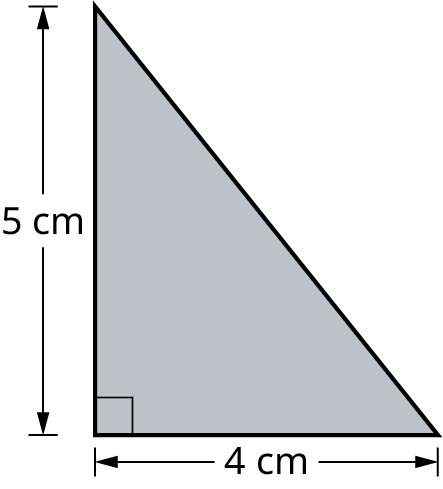
The base measures 4 cm and the height measures 5 cm. Using the formula, we can calculate the area:
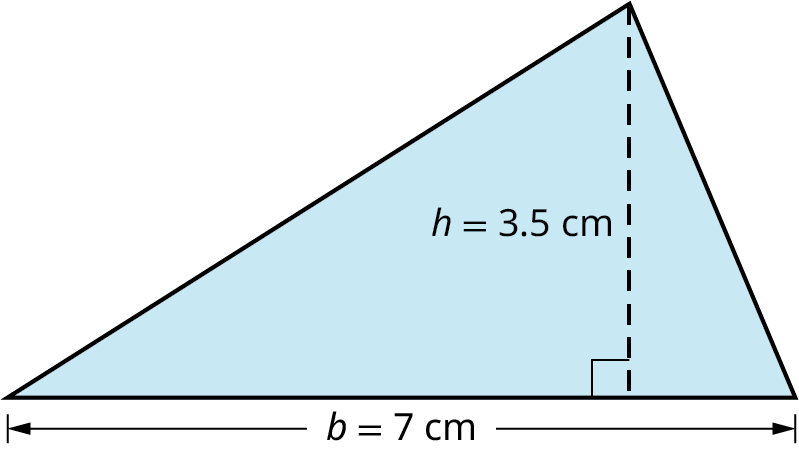
In Figure 3.14, the triangle has a base equal to 7 cm and a height equal to 3.5 cm. Notice that we can only find the height by dropping a perpendicular to the base. The area is then
Rectangle
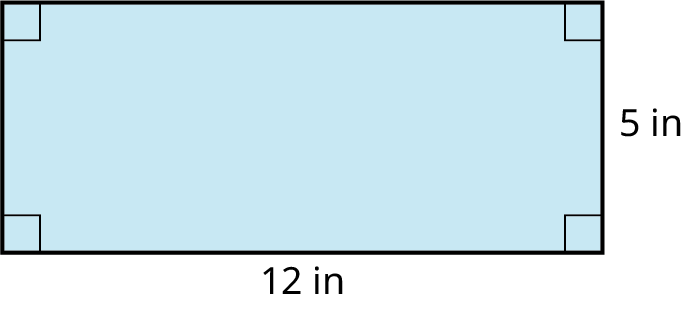
Similarly, the area for a rectangle is found by multiplying length times width. The rectangle in Figure 3.16 has width equal to 5 in and length equal to 12 in. The area is
Many everyday applications require the use of the perimeter and area formulas. Suppose you are remodeling your home and you want to replace all the flooring. You need to know how to calculate the area of the floor to purchase the correct amount of tile, or hardwood, or carpet. If you want to paint the rooms, you need to calculate the area of the walls and the ceiling to know how much paint to buy, and the list goes on. Can you think of other situations where you might need to calculate area?
Corequisite Skills for Introductory Statistics is a custom course edition compiled for Introductory Statistics corequisite courses from OpenStax Contemporary Mathematics, Elementary Algebra 2e, Intermediate Algebra 2e, Prealgebra 2e. Content by OpenStax is reproduced as published, apart from any corrections recorded for this edition. Sections are renumbered to follow the course outline. The course outline is adapted from Larry Green's Support Course for Elementary Statistics (LibreTexts, https://stats.libretexts.org/Bookshelves/Introductory_Statistics/Support_Course_for_Elementary_Statistics), used under CC BY 4.0 (https://creativecommons.org/licenses/by/4.0/). Lessons 2.4 and 6.7 are written for this edition by XYZ Homework. Every OpenStax lesson is abridged to the subsections and practice exercises this course uses. Lessons are headed with their course titles, not the source section titles. Access the complete originals free at openstax.org. License: CC-BY-NC-SA-4.0.