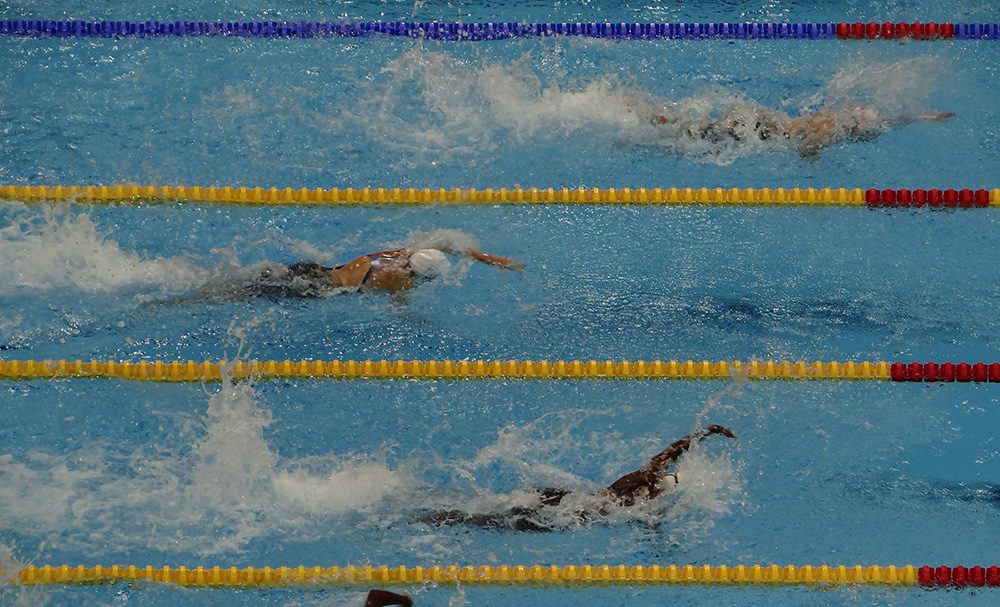
Figure 3.9We can use permutations to calculate the number of different orders of finish in an Olympic swimming heat.We can use permutations to calculate the number of different orders of finish in an Olympic swimming heat. (credit: “London 2012 Olympics Park Stratford London” by Gary Bembridge/Flickr, CC BY 2.0)
Swimming events are some of the most popular events at the summer Olympic Games. In the finals of each event, 8 swimmers compete at the same time, making for some exciting finishes. How many different orders of finish are possible in these events? In this section, we’ll extend the Multiplication Rule for Counting to help answer questions like this one, which relate to permutations. A permutation is an ordered list of objects taken from a given population. The length of the list is given, and the list cannot contain any repeated items.
Applying the Multiplication Rule for Counting to Permutations
In the case of the swimming finals, one possible permutation of length 3 would be the list of medal winners (first, second, and third place finishers). A permutation of length 8 would be the full order of finish (first place through eighth place). Let’s use the Multiplication Rule for Counting to figure out how many of each of these permutations there are.
Factorials
The pattern we see in Example 1 occurs commonly enough that we have a name for it: factorial. For any positive whole number , we define the factorial of (denoted and read " factorial") to be the product of every positive whole number less than or equal to . We also define 0! to be equal to one. We will use factorials in a couple of different contexts, so let's get some practice doing computations with them.
Permutations
As we’ve seen, factorials can pop up when we’re computing permutations. In fact, there is a formula that we can use to make that connection explicit. Let’s define some notation first. If we have a collection of objects and we wish to create an ordered list of of the objects (where ), we’ll call the number of those permutations (read “the number of permutations of objects taken at a time”). We formalize the formula we'll use to compute permutations below.
If you wondered why we defined earlier, it was to make formulas like this one work; if we have objects and want to order all of them (so, we want the number of permutations of objects taken at a time), we get . Next, we’ll get some practice computing these permutations.
For the following exercises, give a whole number that’s equal to the given expression.
3!
9!
The following exercises are about the card game euchre, which uses a partial standard deck of cards: It only has the cards with ranks 9, 10, J, Q, K, and A for a total of 24 cards. Some variations of the game use the 8s or the 7s and 8s, but we’ll stick with the 24-card version.
A euchre hand contains 5 cards. How many ways are there to receive a 5-card hand (where the order in which the cards are received matters, i.e., 9, J, , , is different from , J, 9, , )?
After all 4 players get their hands, the remaining 4 cards are placed facedown in the center of the table. For this question, keep the dealt hands fixed. How many different orders are possible for the four specific remaining cards?
Euchre is played with partners. How many ways are there for 2 partners to receive 5-card hands (where the order in which the cards are received matters)?
How many different arrangements of the full euchre deck are possible (i.e., how many different shuffles are there)?
The following exercises involve a horse race with 13 entrants.
How many possible complete orders of finish are there?
An exacta bet is one where the player tries to predict the top two finishers in order. How many possible exacta bets are there for this race?
A trifecta bet is one where the player tries to predict the top three finishers in order. How many possible trifecta bets are there for this race?
A superfecta bet is one where the player tries to predict the top four finishers in order. How many possible superfecta bets are there for this race?
Corequisite Skills for Introductory Statistics is a custom course edition compiled for Introductory Statistics corequisite courses from OpenStax Contemporary Mathematics, Elementary Algebra 2e, Intermediate Algebra 2e, Prealgebra 2e. Content by OpenStax is reproduced as published, apart from any corrections recorded for this edition. Sections are renumbered to follow the course outline. The course outline is adapted from Larry Green's Support Course for Elementary Statistics (LibreTexts, https://stats.libretexts.org/Bookshelves/Introductory_Statistics/Support_Course_for_Elementary_Statistics), used under CC BY 4.0 (https://creativecommons.org/licenses/by/4.0/). Lessons 2.4 and 6.7 are written for this edition by XYZ Homework. Every OpenStax lesson is abridged to the subsections and practice exercises this course uses. Lessons are headed with their course titles, not the source section titles. Access the complete originals free at openstax.org. License: CC-BY-NC-SA-4.0.
These eBooks are a prerelease and are not yet certified conformant with WCAG 2.1 AA or any other accessibility standard. Every page is built against an automated accessibility gate, and our target for the published editions is WCAG 2.2 Level AA. If something is unusable, please tell us.