

3.5 Square Roots
Narrated lesson: Square Roots
Synthetic narration with English captions, a transcript, and time to think before checking the answer.
Read the transcriptDownload the videoNarration credits and licences
Simplify Expressions with Square Roots
To start this section, we need to review some important vocabulary and notation.
Remember that when a number is multiplied by itself, we can write this as which we read aloud as For example, is read as
We call the square of because Similarly, is the square of because
Modeling Squares
Do you know why we use the word square? If we construct a square with three tiles on each side, the total number of tiles would be nine.

This is why we say that the square of three is nine.
The number is called a perfect square because it is the square of a whole number.
The chart shows the squares of the counting numbers through You can refer to it to help you identify the perfect squares.

What happens when you square a negative number?
When we multiply two negative numbers, the product is always positive. So, the square of a negative number is always positive.
The chart shows the squares of the negative integers from to

Did you notice that these squares are the same as the squares of the positive numbers?
Square Roots
Sometimes we will need to look at the relationship between numbers and their squares in reverse. Because we say is the square of We can also say that is a square root of
Notice also, so is also a square root of Therefore, both and are square roots of
So, every positive number has two square roots: one positive and one negative.
What if we only want the positive square root of a positive number? The radical sign, stands for the positive square root. The positive square root is also called the principal square root.
We can also use the radical sign for the square root of zero. Because Notice that zero has only one square root.
The chart shows the square roots of the first positive perfect square numbers.

Every positive number has two square roots and the radical sign indicates the positive one. We write If we want to find the negative square root of a number, we place a negative in front of the radical sign. For example,
Square Root of a Negative Number
Can we simplify Is there a number whose square is
None of the numbers that we have dealt with so far have a square that is Why? Any positive number squared is positive, and any negative number squared is also positive. All the numbers we work with are called the real numbers. So we say there is no real number equal to If we are asked to find the square root of any negative number, we say that the solution is not a real number.
Square Roots and the Order of Operations
When using the order of operations to simplify an expression that has square roots, we treat the radical sign as a grouping symbol. We simplify any expressions under the radical sign before performing other operations.
Notice the different answers in parts ⓐ and ⓑ of Example 4. It is important to follow the order of operations correctly. In ⓐ, we took each square root first and then added them. In ⓑ, we added under the radical sign first and then found the square root.
Estimate Square Roots
So far we have only worked with square roots of perfect squares. The square roots of other numbers are not whole numbers.
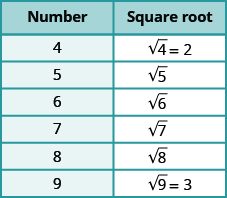
We might conclude that the square roots of numbers between and will be between and and they will not be whole numbers. Based on the pattern in the table above, we could say that is between and Using inequality symbols, we write
Approximate Square Roots with a Calculator
There are mathematical methods to approximate square roots, but it is much more convenient to use a calculator to find square roots. Find the or key on your calculator. You will need to use this key to approximate square roots. When you use your calculator to find the square root of a number that is not a perfect square, the answer that you see is not the exact number. It is an approximation, to the number of digits shown on your calculator’s display. The symbol for an approximation is and it is read approximately.
Suppose your calculator has a display. Using it to find the square root of will give This is the approximate square root of When we report the answer, we should use the “approximately equal to” sign instead of an equal sign.
You will seldom use this many digits for applications in algebra. So, if you wanted to round to two decimal places, you would write
How do we know these values are approximations and not the exact values? Look at what happens when we square them.
The squares are close, but not exactly equal, to
Section Exercises
Practice Makes Perfect
Simplify Expressions with Square Roots
In the following exercises, simplify.
Show solution
6
Show solution
8
Show solution
−2
Show solution
−1
Show solution
not a real number
Show solution
not a real number
Show solution
5
Show solution
7
Estimate Square Roots
In the following exercises, estimate each square root between two consecutive whole numbers.
Show solution
Show solution
Approximate Square Roots with a Calculator
In the following exercises, use a calculator to approximate each square root and round to two decimal places.
Show solution
4.36
Show solution
7.28
Corequisite Skills for Introductory Statistics is a custom course edition compiled for Introductory Statistics corequisite courses from OpenStax Contemporary Mathematics, Elementary Algebra 2e, Intermediate Algebra 2e, Prealgebra 2e. Content by OpenStax is reproduced as published, apart from any corrections recorded for this edition. Sections are renumbered to follow the course outline. The course outline is adapted from Larry Green's Support Course for Elementary Statistics (LibreTexts, https://stats.libretexts.org/Bookshelves/Introductory_Statistics/Support_Course_for_Elementary_Statistics), used under CC BY 4.0 (https://creativecommons.org/licenses/by/4.0/). Lessons 2.4 and 6.7 are written for this edition by XYZ Homework. Every OpenStax lesson is abridged to the subsections and practice exercises this course uses. Lessons are headed with their course titles, not the source section titles. Access the complete originals free at openstax.org. License: CC-BY-NC-SA-4.0.