
9.4 Infinite Geometric Series
Summation Notation
There is a convenient notation for representing a series. For example, consider the sum of the first fifteen terms of the sequence
To find the terms of the series we replace in the general term by the numbers 1 through 15. So, instead of writing out all the terms, we might express the sum as
We use the Greek letter (called "sigma") to stand for "the sum," and we show the first and last values of below and above the summation symbol , like this:
Writing such an expression is sometimes called "using sigma notation." The letter is called the index of summation; it is like a variable because it represents numerical values.
Use sigma notation to represent the sum of the first 20 terms of the sequence
where _____ and _____
Use sigma notation to represent the sum of the first 20 terms of the sequence
What does the notation mean?
_____
Add the reciprocals of the numbers from 1 to 8.
What does the notation mean?
- List 8 terms of the sequence .
- Add the numbers from 1 to 8 and take the reciprocal of the sum.
- Add the reciprocals of the numbers from 1 to 8.
- Add the first and eighth term of the sequence described.
The expanded form of a series written in sigma notation is obtained by writing out all the terms of the series. For example,
Recall that the general term of an arithmetic series is a linear function of the index, and the general term of a geometric series is an exponential function. If we recognize a given series as one of these two types, we can use the formulas developed in the last section to evaluate the sum.
Compute the value of each series.
- _____
- _____
Do not use any commas. For example, use "10000" rather than "10,000".
- 3925
- 111,111,110
Compute the value of each series.
- 3925
- 111,111,110
If the series is not arithmetic or geometric, we don't have a formula for the sum, so we must compute the sum directly.
Compute the value of each series.
- _____
- _____
- 7
Compute the value of each series.
Which of these series is neither arithmetic nor geometric?
_____
is neither arithmetic nor geometric. (The first series is arithmetic; the second and fourth series are both geometric.
Which of these series is neither arithmetic nor geometric?
`
Infinite Series
A series with infinitely many terms is called an infinite series. Is it possible to add infinitely many terms and arrive at a finite sum? In some cases, if the terms added are small enough, the answer is yes.
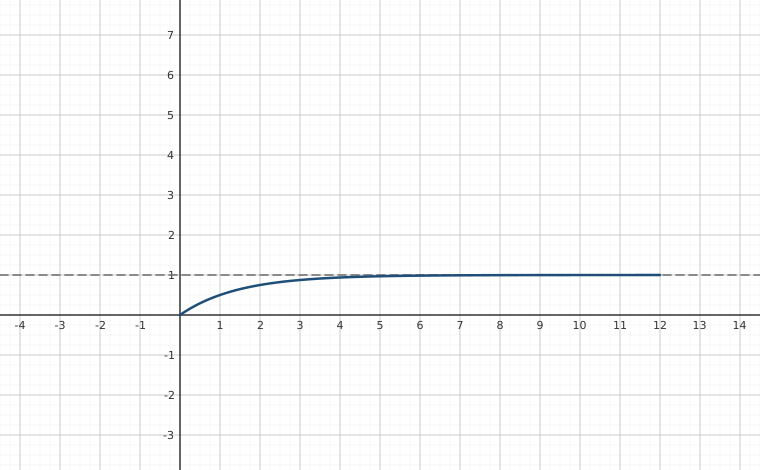
Consider the infinite geometric series
The partial sum of the series is the sum of its first terms, and is denoted by . Thus,
Notice that for each partial sum, the new term added gets smaller and smaller: , , , and so on. You can also see that as increases and we add more and more terms of the series, the partial sums are getting closer to 1. In fact, as becomes very large, gets very close to 1. It seems reasonable that the sum of all the terms of the series is 1.
We can make this conjecture more plausible by examining the formula for the partial sum of a geometric series,
Look at the second term of the numerator, . This term is the only part of the formula that depends on . What happens to as increases? Consider two examples:
- If , then and so on, with becoming smaller and smaller for larger values of . Each time we multiply by another factor of , the product gets smaller, because .
- On the other hand, if , multiplying by makes the product larger. If for example, then and so on. In this case the powers of are increasing.
In general, we have the following result.
Now let's return to the formula for and write it in the form
where we have factored from the numerator. There are two cases to consider. If , then approaches 0, and the factor gets closer and closer to 1 as grows larger. Consequently, if we compute for larger and larger values of , the sum approaches the value
This analysis motivates us to define the sum of an infinite geometric series as follows.
In the second case, if , as in the infinite series
where , the terms become larger as increases, and the sum of the series is not a finite number. In this case the series does not have a sum.
Under what circumstances does the series have a finite sum?
_____
If
Under what circumstances does the series have a finite sum?
- If
- If
- If
- If
Find the sum, if it exists. If the series does not have a sum, enter "no sum".
- _____
- _____
- No sum
- 59
Find the sum, if it exists.
- No sum
- 59
Repeating Decimals
An interesting application of geometric series involves repeating decimals. Recall that the decimal representation of a rational number either terminates, as does or repeats a pattern of digits. For example, you probably recognize as the decimal representation of . It is easy to find the decimal form of a fraction: we just divide the denominator into the numerator. Is there a way to find the fractional form of a repeating decimal?
Consider the repeating decimal
We can write this number as an infinite geometric series:
The first term of this series is , or , and its common ratio is , or . Because , the series has a sum given by
Thus, the decimal number is equal to the fraction .
Find a common fraction equivalent to : _____
Find a common fraction equivalent to .
Section Summary
Vocabulary
- Sigma notation
- Index of summation
- Infinite series
- Partial sum
CONCEPTS
- We can use sigma notation to denote a series.
- It is possible to add infinitely many terms and arrive at a finite sum if the terms are small enough.
- The sum of an infinite geometric series is
- If in an infinite geometric series, the series does not have a sum.
STUDY QUESTIONS
- Explain how to use sigma notation to define a series.
- What is an infinite series?
- What is a partial sum of an infinite series?
- State a formula for evaluating an infinite geometric series. Under what conditions is the formula valid?
- A repeating decimal can be rewritten as what kind of series?
SKILLS
Practice each skill in the Homework Problems listed.
- Express sigma notation in expanded form: #1-8
- Write a series in sigma notation: #12-20
- Identify a series as arithmetic, geometric, or neither and evaluate: #21-40
- Evaluate an infinite geometric series: #41-48, #57-60
- Write a repeating decimal as a common fraction: #49-56
Homework 9.4
For Problems 1–8, write the sum in expanded form.
For Problems 9–20, write the series using sigma notation.
For Problems 21–40, identify the series as arithmetic, geometric or neither, then evaluate it.
Neither; 97
Neither;
Neither; 100
Geometric;
Atithmetic;
Neither; 441
Arithemetic; 1364
Arithmetic;
Geometric;
Geometric;
For Problems 41–48,
- Make a table of values showing the first five partial sums of the series.
- Evaluate the series algebraically.
For Problems 49–56, find a fraction equivalent to the repeating decimal.
The arc length through which the bob of a pendulum moves is nine-tenths of its preceding arc length. Approximately how far will the bob move before coming to rest if the first arc length is inches?
120 in
A force is applied to a particle moving in a straight line in such a fashion that each second it moves only one-half of the distance it moved the preceding second. If the particle moves centimeters the first second, approximately how far will it move before coming to rest?
A ball returns two-thirds of its preceding height on each bounce. If the ball is dropped from a height of feet, approximately what is the total distance the ball travels before coming to rest? (Hint: Compute separately the total distance the ball falls from the total distance it moves upwards.)
30 ft
If a ball is dropped from a height of feet and returns three-fifths of its preceding height on each bounce, approximately what is the total distance the ball travels before coming to rest? (See the Hint for Problem 59.)
Modeling, Functions, and Graphs by Katherine Yoshiwara (yoshiwarabooks.org), GNU Free Documentation License 1.2 or later. Adapted for the XYZ HTML edition with the authors' permission (recorded 2026-07-04). License: GFDL-1.2-or-later.