
9.2 Arithmetic and Geometric Sequences
Arithmetic Sequences
A charter tour bus service charges $50 plus $15 for each passenger. The cost of a tour is then a function of the number of passengers. Because the number of passengers, , can only be a positive integer, the function is a sequence. If represents the cost of a tour for passengers, then
and in general
Each term of this sequence can be obtained from the previous one by adding 15. A sequence in which each term can be obtained from the previous term by adding a fixed amount is called an arithmetic sequence.
The fixed amount that we add to each term is the difference between two successive terms and is called the common difference. In the example above the common difference is 15. If we denote the first term of an arithmetic sequence by and the common difference by , then the sequence can be defined recursively by
Find the first four terms of an arithmetic sequence with first term and common difference .
Answer: _____ (List the terms in order; separate terms with a comma.
100, 70, 40, 10
Find the first four terms of an arithmetic sequence with first term and common difference .
100, 70, 40, 10
An arithmetic sequence defines a linear function of . In the figure below, compare the graph of the linear function , whose domain is the set of all real numbers, and the graph of the arithmetic sequence , whose domain is the set of positive integers.
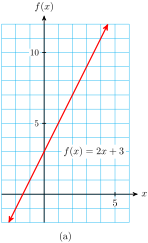
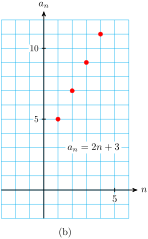
Fill in the blanks.
- To find the next term of an arithmetic sequence, we _____ a fixed amount.
- The fixed amount is called the _____.
- An arithmetic sequence defines _____ function of .
- add
- common difference
- a linear
Fill in the blanks.
- To find the next term of an arithmetic sequence, we __________ a fixed amount.
- The fixed amount is called the __________.
- An arithmetic sequence defines __________ function of .
The General Term of an Arithmetic Sequence
We have found a recursive definition for an arithmetic sequence, but we can also find a non-recursive definition. That is, we can find a formula for the general term. Consider an arithmetic sequence with first term and common difference . The
Thus, we have the following property.
We can use this formula to find a particular term of an arithmetic sequence if we know the first term and the common difference.
Find the 100th term of the arithmetic sequence .
Answer: _____
Find the 100th term of the arithmetic sequence .
Find the th term of an arithmetic sequence whose first term is and whose common difference is .
Answer: _____
Find the th term of an arithmetic sequence whose first term is and whose common difference is .
Geometric Sequences
A national junior chess tournament starts with 1024 invited contestants. At the end of each round, the winners move on to the next level. Thus, after each round there are half as many contestants as before, and the number of remaining contestants is a function of the number of rounds completed. Because the number of rounds is a positive integer, the function is a sequence.
If represents the number of contestants after rounds of competition, then
In general
Each term of the sequence defined above can be obtained from the previous one by multiplying by . A sequence in which each term can be obtained from the previous term by multiplying by a fixed amount is called a geometric sequence.
The fixed amount we multiply each term by is the ratio of two successive terms and is called the common ratio. In the example above the common ratio is . If we denote the first term of a geometric sequence by and the common ratio by , then the sequence can be defined recursively by
Find the first four terms of a geometric sequence whose first term is 5 and whose common ratio is 2.
Answer: _____ (List the terms in order; separate terms with a comma.
5, 10, 20, 40
Find the first four terms of a geometric sequence whose first term is 5 and whose common ratio is 2.
5, 10, 20, 40
A geometric sequence defines an exponential function of . In the figure below, compare the graphs of the exponential function , whose domain is the set of real numbers, and the geometric sequence , whose domain is the set of positive integers.
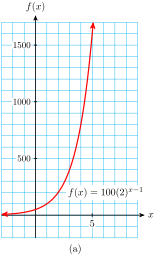
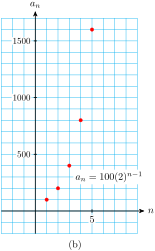
Recall that an arithmetic sequence defines a linear function whose slope corresponds to the common difference. Just as an exponential function grows much faster in the long run than a linear function, so does a geometric sequence grow much faster than an arithmetic sequence.
Fill in the blanks.
- To find the next term of a geometric sequence, we _____ a fixed amount.
- The fixed amount is called the _____.
- A geometric sequence defines _____ function of .
- multiply by
- common ratio
- an exponential
Fill in the blanks.
- To find the next term of a geometric sequence, we __________
- The fixed amount is called the __________.
- A geometric sequence defines __________ function of .
Identify each of the following sequences as arithmetic, geometric, or neither.
- _____
- _____
- _____
- Neither
- Geometric
- Arithmetic
Identify each of the following sequences as arithmetic, geometric, or neither.
The General Term of a Geometric Sequence
We can now find a non-recursive formula for the general term of a geometric sequence. If we denote the first term of the geometric sequence by , then the
In general we have the following property.
We can use the formula to find a particular term of a geometric sequence if we know the first term and the common ratio.
Find the 12th term of the arithmetic sequence , , ,
Answer: _____
192
Find the 12th term of the arithmetic sequence , , ,
192
Fill in the blanks.
Use for the first term of the sequence; use for the common difference; use for the common ratio.
- The formula for the th term of an arithmetic sequence is
_____ - The formula for the th term of a geometric sequence is
_____
Fill in the blanks.
- The formula for the th term of an arithmetic sequence is __________
- The formula for the th term of a geometric sequence is __________
Find a recursive definition for the sequence in the previous example.
_____, _____ [Note: Enter "cn" to get .]
,
Find a recursive definition for the sequence in the previous example, .
,
Find a nonrecursive definition for each sequence.
- ,
_____ - ,
_____
S
Find a nonrecursive definition for each sequence.
- ,
- ,
Section Summary
Vocabulary
- Arithmetic sequence
- Common difference
- General term
- Geometric sequence
- Common ratio
- Recursive sequence
CONCEPTS
- A sequence in which each term can be obtained from the previous term by adding a fixed amount is called an arithmetic sequence.
- The fixed amount between two successive terms of an arithmetic sequence is called the common difference.
- An arithmetic sequence defines a linear function of .
- The term of an arithmetic sequence is .
- A sequence in which each term can be obtained from the previous term by multiplying by a fixed amount is called a geometric sequence.
- The ratio of two successive terms of a geometridc sequence is called the common ratio.
- A geometric sequence defines an exponential function of .
- The term of a geometric sequence is .
STUDY QUESTIONS
- What is an arithmetic sequence? What is the common difference?
- State a formula for the general term of an arithemetic sequence.
- An arithmetic sequence defines what kind of function of ?
- What is a geometric sequence? What is the common ratio?
- State a formula for the general term of a geometric sequence.
- A geometric sequence defines what kind of function of ?
SKILLS
Practice each skill in the Homework Problems listed.
- Identify arithmetic and geometric sequences: #1–10
- Evaluate the general term of an arithmetic or geometric sequence: #13–24, #33–36,
- Write an expression for the general term: #25–38
- Find the general term from a recursive definition: #41–48
- Use a sequence as a model: #49–56
Homework 9.2
For Problems 1–12, identify the sequence as arithmetic, geometric, or neither.
Geometric
Arithmetic
Geometric
Neither
Geometric
Geometric
For Problems 13–24, find the first four terms of the sequence.
For Problems 25–32, find the next three terms, and an expression for the general term.
Find the twelfth term in the arithmetic sequence
Find the tenth term in the arithmetic sequence
Find the eighth term in the geometric sequence
Find the sixth term in the geometric sequence
Find the first term of a geometric sequence with fifth term and common ratio .
Find the first term of a geometric sequence with fifth term and common ratio .
How many terms are in the sequence ?
How many terms are in the sequence ?
For Problems 41–48, find a nonrecursive definition for the sequence.
For Problems 49–56,
- Write a formula for the general term of the sequence.
- Answer the question in the problem.
An outdoor theater has 30 seats in the first row, 32 seats in the second row, 34 seats in the third row, and so on, with two more seats in any one row than in the previous. Let be the number of seats in the row of the theater. How many seats are there in the fiftieth row?
- 128
Gwynn is training for a triathlon. In her first week of training, she bicycled a total of 20 miles, then increased to 24 miles in her second week, 28 miles in her third week, and so on, increasing her mileage by 4 miles per week. Let be Gwynn's mileage in her week of training. How many miles will she bicycle in her eighteenth week of training?
The cost of drilling a well increases the deeper you drill. Mel's Wells charges $50 for the first five feet, $55 for the second five feet, $60 for the third five feet, and so on. Let be the cost of drilling the five feet. How much does Mel charge to drill from a depth of 65 feet to a depth of 70 feet?
- $115
The cost of having the windows washed in a high-rise office building depends on the height of the window. We Do Windows charges $0.50 per square yard of glass below 10 feet high, $0.60 per square yard for windows between 10 and 20 feet above the ground, $0.70 per square yard for windows between 20 and 30 feet above the ground, and so on. Let be the cost of washing windows on the floor if each floor is 10 feet high. How much does We Do Windows charge to wash 100 square yards of windows on the twenty-third floor?
Valerie's grandmother deposited $500 into a college fund for Valerie on the day she was born. The fund earns 5% interest compounded annually. Let be the value of the deposit, including interest, years later. How much will the deposit be worth on Valerie's eighteenth birthday?
- $1203.31
When he was 25 years old, Bruce won $2000 on the lottery and deposited the money into a retirement fund. The fund earns 6% interest compounded annually. Let be the value of the deposit, including interest, years later. How much will the deposit be worth when Bruce turns 65 years old?
One hundred kilograms of a toxic chemical was dumped illegally into a clean reservoir. A filter can remove 20% of the chemical still present each week (so that 80% of the previous amount remains.) Let be the amount of the chemical remaining after weeks. How much of the chemical will remain in the water after 20 weeks?
- 1.15 kg
A heart patient is given 40 milliliters of a medication by injection. Each hour, 15% of the medicine still present is eliminated from the body (so that 85% of the previous amount remains.) Let be the amount of medicine remaining in the patient's body after hours. How much of the medication is left in the patient's body after 10 hours?
Modeling, Functions, and Graphs by Katherine Yoshiwara (yoshiwarabooks.org), GNU Free Documentation License 1.2 or later. Adapted for the XYZ HTML edition with the authors' permission (recorded 2026-07-04). License: GFDL-1.2-or-later.