
15.7 Absolute Value Equations and Inequalities
In this section, we review some of the basic concepts involving the absolute value of a real number . There are a few different ways to define absolute value and in this section we choose the following definition. (Absolute value will be revisited in much greater depth in Section 1.3 where we present what one can think of as the “precise” definition.)
For example, and , since each is units from on the number line:
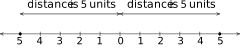
Graphically why and
Computationally, the absolute value `makes negative numbers positive', though we need to be a little cautious with this description. While , . The absolute value acts as a grouping symbol, so , which makes sense since and are two units away from each other on the number line:
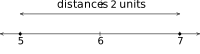
Graphically why
We list some of the operational properties of absolute value below.
The proof of Theorem A.4 is difficult, but not impossible, using the distance definition of absolute value or even the `it makes negatives positive' notion. It is, however, much easier if one uses the “precise” definition given in Section 1.3 so we will revisit the proof then. For now, let's focus on how to solve basic equations and inequalities involving the absolute value.
Absolute Value Equations
Thinking of absolute value in terms of distance gives us a geometric way to interpret equations. For example, to solve , we are looking for all real numbers whose distance from is units. If we move three units to the right of , we end up at . If we move three units to the left, we end up at . Thus the solutions to are .
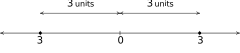
The solutions to are .
Thinking this way gives us the following.
Theorem A.5 is our main tool in solving equations involving the absolute value, since it allows us a way to rewrite such equations as compound linear equations.
Strategy for Solving Equations Involving Absolute Value
In order to solve an equation involving the absolute value of a quantity :
- Isolate the absolute value on one side of the equation so it has the form .
- Apply Theorem A.5.
The techniques we use to `isolate the absolute value' are precisely those we used in Section A.4 to isolate the variable when solving linear equations. Time for some practice.
Absolute Value Inequalities
We now turn our attention to solving some basic inequalities involving the absolute value. Suppose we wished to solve . Geometrically, we are looking for all of the real numbers whose distance from is less than units. We get , or in interval notation, . Suppose we are asked to solve instead. Now we want the distance between and to be greater than units. Moving in the positive direction, this means . In the negative direction, this puts . Our solutions would then satisfy or . In interval notation, we express this as .
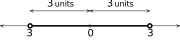
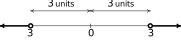
The solution to is
The solution to is
Generalizing this notion, we get the following:
If the inequality we're faced with involves `' or `,' we can combine the results of Theorem A.6 with Theorem A.5 as needed.
Strategy for Solving Inequalities Involving Absolute Value
In order to solve an inequality involving the absolute value of a quantity :
- Isolate the absolute value on one side of the inequality.
- Apply Theorem A.6.
The astute reader will have noticed by now that the authors have done nothing in the way of explaining why anyone would ever need to know this stuff. Go back and read the New Preface and the introduction to the Appendix. These sections are designed to review skills and concepts that you've already learned. Thus the deeper applications are in the main body of the text as opposed to here in the Appendix.
We close this section with an example of how the properties in Theorem A.4 are used in Calculus. Here, `' is the Greek letter `epsilon' and it represents a positive real number. Those of you who will be taking Calculus in the future should become very familiar with this type of algebraic manipulation.
Exercises
In Exercises -, solve the equation.
-
Answer
or
-
Answer
or
-
Answer
or
-
Answer
or
-
Answer
or
-
Answer
No solution
-
Answer
or
-
Answer
or
-
Answer
-
Answer
or
-
Answer
No solution
-
Answer
-
Answer
or
-
Answer
or
-
Answer
or
-
Answer
-
Answer
In Exercises -, solve the inequality. Write your answer using interval notation.
-
Answer
-
Answer
-
Answer
-
Answer
-
Answer
No solution
-
Answer
-
Answer
-
Answer
-
Answer
No solution
-
Answer
-
Answer
-
Answer
With help from your classmates, solve:
Answer
- , or , or , or
Adapted from Precalculus with Integrated Calculus, edition 4i, by Carl Stitz and Jeff Zeager (stitz-zeager.com), licensed under CC BY-NC-SA 3.0. Changes were made: reformatted as an accessible XYZ web edition. License: CC-BY-NC-SA-3.0.