
15.6 Systems of Two Linear Equations in Two Unknowns
This section of the Appendix combines ideas from Section A.4 and A.5 so that we can start to solve systems of linear equations. Before we get ahead of ourselves, let's review a few definitions.
For reasons which will become clear when you study Chapter 9, we are using subscripts in Definition A.13 to indicate different, but fixed, real numbers and those subscripts have no mathematical meaning beyond that. For example, is a linear equation in two variables with , and . We can also consider to be a linear equation in two variables1 by identifying , , and .
If and are both , then depending on , we get either an equation which is always true, called an identity, or an equation which is never true, called a contradiction. (If , then we get , which is always true. If , then we'd have , which is never true.) Even though identities and contradictions have a large role to play throughout Chapter 9, we do not consider them linear equations. The key to identifying linear equations is to note that the variables involved are to the first power and that the coefficients of the variables are numbers. Some examples of equations which are non-linear are , and . The reader should consider why these do not satisfy Definition A.13.
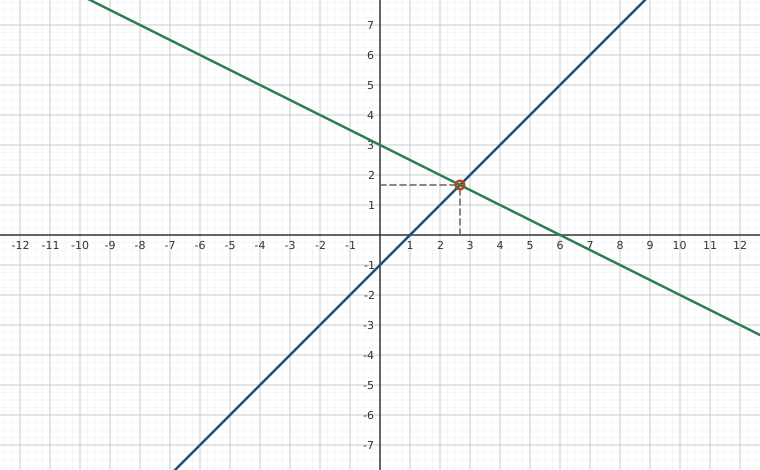
We know from our work is Sections A.5 that the graphs of linear equations are lines. If we couple two or more linear equations together, in effect to find the points of intersection of two or more lines, we obtain a system of linear equations in two variables. Our first example explores the basic techniques for solving these systems. Remember - if we are looking for points in the plane, then both the and values are important. This is a key distinction between solving one equation and solving a system of equations.
A few remarks about Example A.6.1 are in order. Notice that some of the systems of linear equations had solutions while others did not. Those which have solutions are called consistent, those with no solution are called inconsistent. We also distinguish between the two different types of behavior among consistent systems. Those which admit free variables are called dependent and those with no free variables are called independent.4
Using this new vocabulary, we classify numbers 1, 2 and 3 in Example A.6.1 as consistent independent systems, number 4 is consistent dependent, and numbers 5 and 6 are inconsistent.5 The system in 6 above is called overdetermined, since we have more equations than variables.6 Not surprisingly, a system with more variables than equations is called underdetermined. While the system in number 6 above is overdetermined and inconsistent, there exist overdetermined consistent systems (both dependent and independent) and we leave it to the reader to think about what is happening algebraically and geometrically in these cases. Likewise, there are both consistent and inconsistent underdetermined systems,7 but a consistent underdetermined system of linear equations is necessarily dependent.8
We end this section with a story problem. It is an example of a classic “mixture” problem and should be familiar to most readers. The basic goal here is to create two equations: one which represents
and the other which represents
Exercises
In Exercises -, solve the given system using substitution and/or elimination. Classify each system as consistent independent, consistent dependent, or inconsistent. Check your answers both algebraically and graphically.
- A local buffet charges per person for the basic buffet and for the deluxe buffet (which includes crab legs.) If 27 diners went out to eat and the total bill was before taxes, how many chose the basic buffet and how many chose the deluxe buffet?
- At The Old Home Fill'er Up and Keep on a-Truckin' Cafe, Mavis mixes two different types of coffee beans to produce a house blend. The first type costs $3 per pound and the second costs $8 per pound. How much of each type does Mavis use to make 50 pounds of a blend which costs $6 per pound?
- Skippy has a total of 10,000 to split between two investments. One account offers simple interest, and the other account offers simple interest. For tax reasons, he can only earn in interest the entire year. How much money should Skippy invest in each account to earn in interest for the year?
- A salt solution is to be mixed with pure water to produce 75 gallons of a salt solution. How much of each are needed?
- This exercise is a follow-up to Example A.6.2. Work with your classmates to explain why mixing 4 gallons of Sasquatch SweatTM Energy Drink and 1 gallon of Frooty Giggle DelightTM would also produce a mixture that was “close enough for the Dude-Bros”.
Answers
- Consistent independent Solution
- Consistent independent Solution
- Consistent independent Solution
- Consistent independent Solution
- Consistent dependent Solution for all real numbers
- Consistent dependent Solution for all real numbers
- Inconsistent No solution
- Inconsistent No solution
- chose the basic buffet and chose the deluxe buffet.
- Mavis needs 20 pounds of $3 per pound coffee and 30 pounds of $8 per pound coffee.
- Skippy needs to invest 6000 in the account and 4000 in the account.
- gallons of the solution and gallons of pure water.
Adapted from Precalculus with Integrated Calculus, edition 4i, by Carl Stitz and Jeff Zeager (stitz-zeager.com), licensed under CC BY-NC-SA 3.0. Changes were made: reformatted as an accessible XYZ web edition. License: CC-BY-NC-SA-3.0.