
15.3 The Cartesian Plane
The Cartesian Coordinate Plane
In order to visualize the pure excitement that is Precalculus, we need to unite Algebra and Geometry. Simply put, we must find a way to draw algebraic things. Let's start with possibly the greatest mathematical achievement of all time: the Cartesian Coordinate Plane.1 Imagine two real number lines crossing at a right angle at as drawn below.
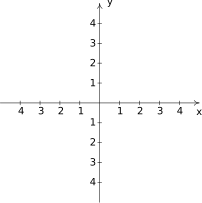
The horizontal number line is usually called the -axis while the vertical number line is usually called the -axis. As with things in the `real' world, however, it's best not to get too caught up with labels. Think of and as generic label placeholders, in much the same way as the variables and are placeholders for real numbers. The letters we choose to identify with the axes depend on the context. For example, if we were plotting the relationship between time and the number of Sasquatch sightings, we might label the horizontal axis as the -axis (for `time') and the vertical axis the -axis (for `number' of sightings.) As with the usual number line, we imagine these axes extending off indefinitely in both directions.2 Having two number lines allows us to locate the positions of points off of the number lines as well as points on the lines themselves.
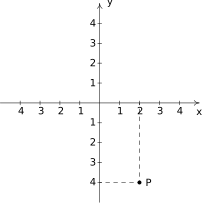
For example, consider the point on the next page. To use the numbers on the axes to label this point, we imagine dropping a vertical line from the -axis to and extending a horizontal line from the -axis to . This process is sometimes called `projecting' the point to the - (respectively -) axis. We then describe the point using the ordered pair . The first number in the ordered pair is called the abscissa or -coordinate and the second is called the ordinate or -coordinate. Again, the names of the coordinates can vary depending on the context of the application. If, as in the previous paragraph, the horizontal axis represented time and the vertical axis represented the number of Sasquatch sightings, the first coordinate would be called the -coordinate and the second coordinate would be the -coordinate. What's important is that we maintain the convention that the abscissa (first coordinate) always corresponds to the horizontal position, while the ordinate (second coordinate) always corresponds to the vertical position. Taken together, the ordered pair comprise the Cartesian coordinates 3 of the point .
In practice, the distinction between a point and its coordinates is blurred; for example, we often speak of `the point '. We can think of as instructions on how to reach from the origin by moving units to the right and units downwards. Notice that the order in the ordered pair is important, as are the signs of the numbers in the pair. If we wish to plot the point , we would move to the left units from the origin and then move upwards units, as below on the right.
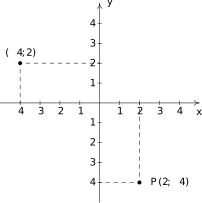
When we speak of the Cartesian Coordinate Plane, we mean the set of all possible ordered pairs as and take values from the real numbers. Below is a summary of some basic, but nonetheless important, facts about Cartesian coordinates.
Important Facts about the Cartesian Coordinate Plane
- and represent the same point in the plane if and only if and .
- lies on the -axis if and only if .
- lies on the -axis if and only if .
- The origin is the point . It is the only point common to both axes.
The axes divide the plane into four regions called quadrants. They are labeled with Roman numerals and proceed counterclockwise around the plane:
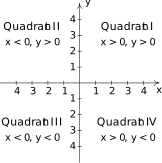
For example, lies in Quadrant I, in Quadrant II, in Quadrant III and in Quadrant IV. If a point other than the origin happens to lie on the axes, we typically refer to that point as lying on the positive or negative -axis (if ) or on the positive or negative -axis (if ). For example, lies on the positive -axis whereas lies on the negative -axis. Such points do not belong to any of the four quadrants.
One of the most important concepts in all of Mathematics is symmetry.4 There are many types of symmetry in Mathematics, but three of them can be discussed easily using Cartesian Coordinates.
Schematically,
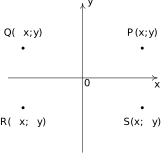
In the above figure, and are symmetric about the -axis, as are and ; and are symmetric about the -axis, as are and ; and and are symmetric about the origin, as are and .
One way to visualize the processes in the previous example is with the concept of a reflection. If we start with our point and pretend that the -axis is a mirror, then the reflection of across the -axis would lie at . If we pretend that the -axis is a mirror, the reflection of across that axis would be . If we reflect across the -axis and then the -axis, we would go from to then to , and so we would end up at the point symmetric to about the origin. We summarize and generalize this process below.
Reflections
To reflect a point about the:
- -axis, replace with .
- -axis, replace with .
- origin, replace with and with .
Distance in the Plane
Another fundamental concept in Geometry is the notion of length. If we are going to unite Algebra and Geometry using the Cartesian Plane, then we need to develop an algebraic understanding of what distance in the plane means. Before we can do that, we need to state what we believe is the most important theorem in all of Geometry: The Pythagorean Theorem.
A proof of this theorem will be given in Section. The theorem actually says two different things. If we know that then the angle must be a right angle. If we know geometrically that is already a right angle then we have that . We need the latter statement in the discussion which follows.
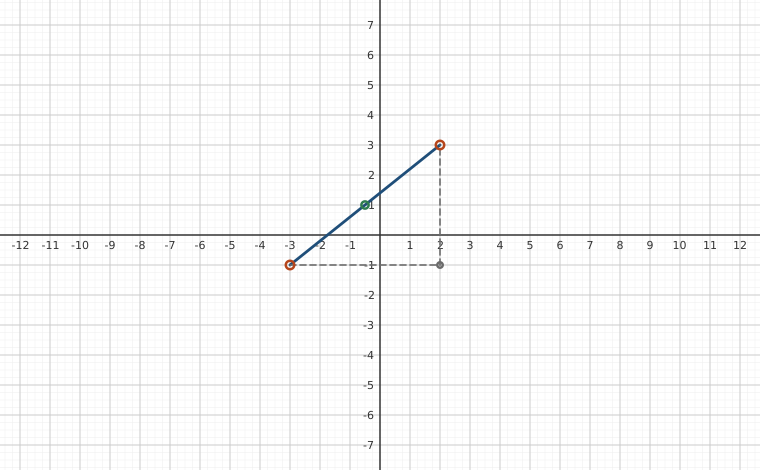
Suppose we have two points, and in the plane. By the distance between and , we mean the length of the line segment joining with . (Remember, given any two distinct points in the plane, there is a unique line containing both points.) Our goal now is to create an algebraic formula to compute the distance between these two points. Consider the generic situation below on the left.
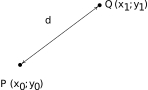
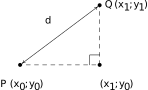
With a little more imagination, we can envision a right triangle whose hypotenuse has length as drawn above on the right. From the latter figure, we see that the lengths of the legs of the triangle are and so the Pythagorean Theorem gives us
(Do you remember why we can replace the absolute value notation with parentheses?) By extracting the square root of both sides of the second equation and using the fact that distance is never negative, we get
A couple of remarks about Equation A.1 are in order. First, it is not always the case that the points and lend themselves to constructing such a triangle. If the points and are arranged vertically or horizontally, or describe the exact same point, we cannot use the above geometric argument to derive the distance formula. It is left to the reader in Exercise to verify Equation A.1 for these cases. Second, distance is a `length'. So, technically, the number we obtain from the distance formula has some attached units of length. In this text, we'll adopt the convention that the phrase `units' refers to some generic units of length.5 Our next example gives us an opportunity to test drive the distance formula as well as brush up on some arithmetic and prerequisite algebra.
Related to finding the distance between two points is the problem of finding the midpoint of the line segment connecting two points. Given two points, and , the midpoint of and is defined to be the point on the line segment connecting and whose distance from is equal to its distance from .
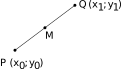
If we think of reaching by going `halfway over' and `halfway up' we get the following formula.
If we let denote the distance between and , we leave it as Exercise to show that the distance between and is which is the same as the distance between and . This suffices to show that Equation A.2 gives the coordinates of the midpoint.
We close with a more abstract application of the Midpoint Formula. We will expand upon this example in Example A.5.5 in Section A.5.
Exercises
Plot and label the points , , , , , , and in the Cartesian Coordinate Plane given below.
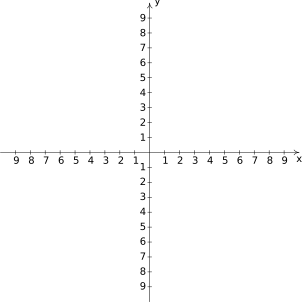
Figure 15.58 For each point given in Exercise above
- Identify the quadrant or axis in/on which the point lies.
- Find the point symmetric to the given point about the -axis.
- Find the point symmetric to the given point about the -axis.
- Find the point symmetric to the given point about the origin.
In Exercises -, find the distance between the points and the midpoint of the line segment which connects them.
- ,
- ,
- ,
- ,
- , .
- ,
- , .
- ,
- Let's assume that we are standing at the origin and the positive -axis points due North while the positive -axis points due East. Our Sasquatch-o-meter tells us that Sasquatch is 3 miles West and 4 miles South of our current position. What are the coordinates of his position? How far away is he from us? If he runs 7 miles due East what would his new position be?
Verify the Distance Formula A.1 for the cases when:
- The points are arranged vertically. (Hint: Use and .)
- The points are arranged horizontally. (Hint: Use and .)
- The points are actually the same point. (You shouldn't need a hint for this one.)
- Verify the Midpoint Formula by showing the distance between and and the distance between and are both half of the distance between and .
Show that the points , and below are the vertices of a right triangle.
- , , and
- , and
- Find a point such that the points and are the corners of a square. Justify your answer.
Suppose the distance between and is . Use the distance formula to show
We will see this formula (and its cousins) in Chapter 8.
- Let be a point in the plane and let be the result of reflecting about the -axis, -axis, or origin. Show the distance from the origin to is the same as the distance from the origin to .
Let (that is, is the origin), , , and .
- Find the distance from to and from to . What do you notice?
- Find the distance from to and from to . What do you notice?
- For a generic point , let be the point obtained from by multiplying both the and coordinates of by the same number, . Show the distance from to is exactly times the distance from to . Explain what these results mean geometrically. (We'll revisit this in Theorem 13.8 in Section 13.3.)
In this exercise, we explore some of the properties of distance. For brevity, we'll adopt the notation `' to denote the distance between points and .
- (Non-negative Property) Explain why for any two points in the plane.
- (Symmetric Property) Explain why for any two points in the plane.
(Identity Property) Show that if and only if and are the same point.
NOTE: The phrase `if and only if' means you need to show two things:
- If and are the same point, then .
- If , then and are the same point.
(Triangle Inequality) The Triangle Inequality says that for any triangle, the sum of the lengths of two sides of a triangle always exceeds the length of the third. Use the Triangle Inequality to show that for any three points , , and ,
Under what conditions does ?
(Another way to measure distance.) In this text, we defined the distance between two points as the length of the line segment connecting the two points. Depending on the situation, however, there may be better ways to describe how far one location is from another. Consider the situation below on the left. Suppose and are locations on a city grid, and a taxi is hailed at point to travel to point . In this situation, diagonal movement is impossible,8 so the taxi is limited to traveling horizontally and vertically.
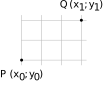
Figure 15.59 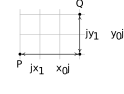
Figure 15.60 From the diagram, we see the horizontal distance is and the vertical distance is , so the total distance the taxi needs to travel to get from to is given by:
We call the `taxi distance' from to .
- Let and . Find the distance, from to and the taxi distance, from to . Repeat this exercise with several points of your own choosing. Which is larger, or ?
- Using the notation of Exercise, show that for any two points and in the plane. (The Triangle Inequality is useful once again here.) Under what conditions is ?
- Repeat Exercise with the taxi distance, . (You may need to skip ahead to Exercise in Section 1.3 to verify the Triangle Inequality piece.)
- Think about ways to define a `midpoint' using the taxi distance. What would your formula be? To help you get started, play around with the origin as one point and the point as the other.
- The world is not flat.9 Thus the Cartesian Plane cannot possibly be the end of the story. Discuss with your classmates how you would extend Cartesian Coordinates to represent the three dimensional world. What would the Distance and Midpoint formulas look like, assuming those concepts make sense at all?
Answers
The required points , , , , , , , and are plotted in the Cartesian Coordinate Plane below.
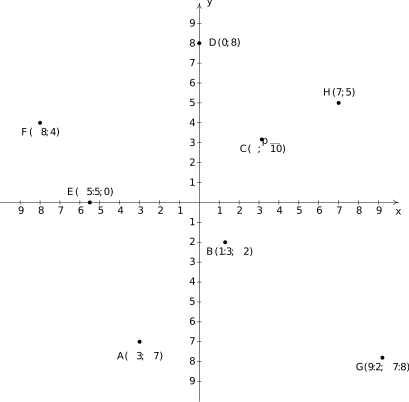
Figure 15.61 The point is
- in Quadrant III
- symmetric about -axis with
- symmetric about -axis with
- symmetric about origin with
The point is
- in Quadrant IV
- symmetric about -axis with
- symmetric about -axis with
- symmetric about origin with
The point is
- in Quadrant I
- symmetric about -axis with
- symmetric about -axis with
- symmetric about origin with
The point is
- on the positive -axis
- symmetric about -axis with
- symmetric about -axis with
- symmetric about origin with
The point is
- on the negative -axis
- symmetric about -axis with
- symmetric about -axis with
- symmetric about origin with
The point is
- in Quadrant II
- symmetric about -axis with
- symmetric about -axis with
- symmetric about origin with
The point is
- in Quadrant IV
- symmetric about -axis with
- symmetric about -axis with
- symmetric about origin with
The point is
- in Quadrant I
- symmetric about -axis with
- symmetric about -axis with
- symmetric about origin with
- units,
- units,
- units,
- units,
- units,
- units,
- units,
- units,
- , miles,
- The distance from to is , the distance from to is , and the distance from to is . Since , we are guaranteed by the converse of the Pythagorean Theorem that the triangle is a right triangle.
- Show that
Adapted from Precalculus with Integrated Calculus, edition 4i, by Carl Stitz and Jeff Zeager (stitz-zeager.com), licensed under CC BY-NC-SA 3.0. Changes were made: reformatted as an accessible XYZ web edition. License: CC-BY-NC-SA-3.0.