
1.4 Function Notation
In Definition 1.6, we described a function as a special kind of relation one in which each -coordinate is matched with only one -coordinate. In this section, we focus more on the process by which the is matched with the . If we think of the domain of a function as a set of inputs and the range as a set of outputs, we can think of a function as a process by which each input is matched with only one output . Since the output is completely determined by the input and the process , we symbolize the output with function notation: `', read ` of .' In other words, is the output which results by applying the process to the input . In this case, the parentheses here do not indicate multiplication, as they do elsewhere in Algebra. This can cause confusion if the context is not clear, so you must read carefully. This relationship is typically visualized using a diagram similar to the one below.
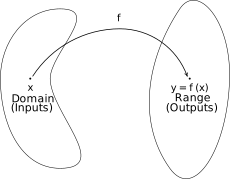
The value of is completely dependent on the choice of . For this reason, is often called the independent variable, or argument of , whereas is often called the dependent variable.
As we shall see, the process of a function is usually described using an algebraic formula. For example, suppose a function takes a real number and performs the following two steps, in sequence
- multiply by 3
- add 4
If we choose as our input, in step 1 we multiply by to get . In step 2, we add 4 to our result from step 1 which yields . Using function notation, we would write to indicate that the result of applying the process to the input gives the output . In general, if we use for the input, applying step 1 produces . Following with step 2 produces as our final output. Hence for an input , we get the output . Notice that to check our formula for the case , we replace the occurrence of in the formula for with to get , as required.
Most of the functions we will encounter in College Algebra will be described using formulas like the ones we developed for and above. Evaluating formulas using this function notation is a key skill for success in this and many other Math courses.
A few notes about Example 1.4.2 are in order. First note the difference between the answers for and . For , we are multiplying the input by ; for , we are multiplying the output by . As we see, we get entirely different results. Along these lines, note that , and are three different expressions as well. Even though function notation uses parentheses, as does multiplication, there is no general `distributive property' of function notation. Finally, note the practice of using parentheses when substituting one algebraic expression into another; we highly recommend this practice as it will reduce careless errors.
Suppose now we wish to find for . Substitution gives
which is undefined. (Why is this, again?) The number is not an allowable input to the function ; in other words, is not in the domain of . Which other real numbers are forbidden in this formula? We think back to arithmetic. The reason is undefined is because substitution results in a division by . To determine which other numbers result in such a transgression, we set the denominator equal to and solve
As long as we substitute numbers other than and , the expression is a real number. Hence, we write our domain in interval notation1 as . When a formula for a function is given, we assume that the function is valid for all real numbers which make arithmetic sense when substituted into the formula. This set of numbers is often called the implied domain 2 of the function. At this stage, there are only two mathematical sins we need to avoid: division by and extracting even roots of negative numbers. The following example illustrates these concepts.
It is worth reiterating the importance of finding the domain of a function before simplifying, as evidenced by the function in the previous example. Even though the formula simplifies to , it would be inaccurate to write without adding the stipulation that . It would be analogous to not reporting taxable income or some other sin of omission.
Modeling with Functions
The importance of Mathematics to our society lies in its value to approximate, or model real-world phenomenon. Whether it be used to predict the high temperature on a given day, determine the hours of daylight on a given day, or predict population trends of various and sundry real and mythical beasts,7 Mathematics is second only to literacy in the importance humanity's development.8
It is important to keep in mind that anytime Mathematics is used to approximate reality, there are always limitations to the model. For example, suppose grapes are on sale at the local market for per pound. Then one pound of grapes costs , two pounds of grapes cost , and so forth. Suppose we want to develop a formula which relates the cost of buying grapes to the amount of grapes being purchased. Since these two quantities vary from situation to situation, we assign them variables. Let denote the cost of the grapes and let denote the amount of grapes purchased. To find the cost of the grapes, we multiply the amount of grapes by the price dollars per pound to get
In order for the units to be correct in the formula, must be measured in pounds of grapes in which case the computed value of is measured in dollars. Since we're interested in finding the cost given an amount , we think of as the independent variable and as the dependent variable. Using the language of function notation, we write
where is the amount of grapes purchased (in pounds) and is the cost (in dollars). For example, represents the cost, in dollars, to purchase pounds of grapes. In this case, , so it would cost . If, on the other hand, we wanted to find the amount of grapes we can purchase for , we would need to set and solve for . In this case, , so solving is equivalent to solving Doing so gives . This means we can purchase exactly pounds of grapes for . Of course, you would be hard-pressed to buy exactly pounds of grapes,9 and this leads us to our next topic of discussion, the applied domain 10 of a function.
Even though, mathematically, has no domain restrictions (there are no denominators and no even-indexed radicals), there are certain values of that don't make any physical sense. For example, corresponds to `purchasing' pounds of grapes.11 Also, unless the `local market' mentioned is the State of California (or some other exporter of grapes), it also doesn't make much sense for , either. So the reality of the situation limits what can be, and these limits determine the applied domain of . Typically, an applied domain is stated explicitly. In this case, it would be common to see something like , , meaning the number of pounds of grapes purchased is limited from up to . The upper bound here, may represent the inventory of the market, or some other limit as set by local policy or law. Even with this restriction, our model has its limitations. As we saw above, it is virtually impossible to buy exactly pounds of grapes so that our cost is exactly . In this case, being sensible shoppers, we would most likely `round down' and purchase pounds of grapes or however close the market scale can read to without being over. It is time for a more sophisticated example.
The type of function in the previous example is called a piecewise-defined function, or `piecewise' function for short. Many real-world phenomena, income tax formulas13 for example, are modeled by such functions.
By the way, if we wanted to avoid using a piecewise function in Example 1.4.4, we could have used on the explicit domain because after 20 seconds, the rocket is on the ground and stops moving. In many cases, though, piecewise functions are your only choice, so it's best to understand them well.
Mathematical modeling is not a one-section topic. It's not even a one-course topic as is evidenced by undergraduate and graduate courses in mathematical modeling being offered at many universities. Thus our goal in this section cannot possibly be to tell you the whole story. What we can do is get you started. As we study new classes of functions, we will see what phenomena they can be used to model. In that respect, mathematical modeling cannot be a topic in a book, but rather, must be a theme of the book. For now, we have you explore some very basic models in the Exercises because you need to crawl to walk to run. As we learn more about functions, we'll help you build your own models and get you on your way to applying Mathematics to your world.
Exercises
In Exercises -, find an expression for and state its domain.
- is a function that takes a real number and performs the following three steps in the order given: (1) multiply by 2; (2) add 3; (3) divide by 4.
- is a function that takes a real number and performs the following three steps in the order given: (1) add 3; (2) multiply by 2; (3) divide by 4.
- is a function that takes a real number and performs the following three steps in the order given: (1) divide by 4; (2) add 3; (3) multiply by 2.
- is a function that takes a real number and performs the following three steps in the order given: (1) multiply by 2; (2) add 3; (3) take the square root.
- is a function that takes a real number and performs the following three steps in the order given: (1) add 3; (2) multiply by 2; (3) take the square root.
- is a function that takes a real number and performs the following three steps in the order given: (1) add 3; (2) take the square root; (3) multiply by 2.
- is a function that takes a real number and performs the following three steps in the order given: (1) take the square root; (2) subtract 13; (3) make the quantity the denominator of a fraction with numerator 4.
- is a function that takes a real number and performs the following three steps in the order given: (1) subtract 13; (2) take the square root; (3) make the quantity the denominator of a fraction with numerator 4.
- is a function that takes a real number and performs the following three steps in the order given: (1) take the square root; (2) make the quantity the denominator of a fraction with numerator 4; (3) subtract 13.
- is a function that takes a real number and performs the following three steps in the order given: (1) make the quantity the denominator of a fraction with numerator 4; (2) take the square root; (3) subtract 13.
In Exercises -, use the given function to find and simplify the following:
In Exercises -, use the given function to find and simplify the following:
In Exercises -, use the given function to find and solve
Let Compute the following function values.
Let Compute the following function values.
In Exercises -, find the (implied) domain of the function.
- The area enclosed by a square, in square inches, is a function of the length of one of its sides , when measured in inches. This relation is expressed by the formula for . Find and solve . Interpret your answers to each. Why is restricted to ?
- The area enclosed by a circle, in square meters, is a function of its radius , when measured in meters. This relation is expressed by the formula for . Find and solve . Interpret your answers to each. Why is restricted to ?
- The volume enclosed by a cube, in cubic centimeters, is a function of the length of one of its sides , when measured in centimeters. This relation is expressed by the formula for . Find and solve . Interpret your answers to each. Why is restricted to ?
- The volume enclosed by a sphere, in cubic feet, is a function of the radius of the sphere , when measured in feet. This relation is expressed by the formula for . Find and solve . Interpret your answers to each. Why is restricted to ?
- The height of an object dropped from the roof of an eight story building is modeled by: , . Here, is the height of the object off the ground, in feet, seconds after the object is dropped. Find and solve . Interpret your answers to each. Why is restricted to ?
- The temperature in degrees Fahrenheit hours after 6 AM is given by for . Find and interpret , and .
- The function models the cost, in hundreds of dollars, to produce thousand pens. Find and interpret , and .
- Using data from the Bureau of Transportation Statistics , the average fuel economy in miles per gallon for passenger cars in the US can be modeled by , , where is the number of years since . Use your calculator to find , and . Round your answers to two decimal places and interpret your answers to each.
- The population of Sasquatch in Portage County can be modeled by the function , where represents the number of years since 1803. Find and interpret and . Discuss with your classmates what the applied domain and range of should be.
For copies of the book Me and my Sasquatch, a print on-demand company charges dollars, where is determined by the formula
- Find and interpret .
- How much does it cost to order 50 copies of the book? What about 51 copies?
- Your answer to should get you thinking. Suppose a bookstore estimates it will sell 50 copies of the book. How many books can, in fact, be ordered for the same price as those 50 copies? (Round your answer to a whole number of books.)
An on-line comic book retailer charges shipping costs according to the following formula
where is the number of comic books purchased and is the shipping cost in dollars.
- What is the cost to ship 10 comic books?
- What is the significance of the formula for ?
The cost (in dollars) to talk minutes a month on a mobile phone plan is modeled by
- How much does it cost to talk minutes per month with this plan?
- How much does it cost to talk hours a month with this plan?
- Explain the terms of the plan verbally.
In Section 1.1.1 we defined the set of integers as .14 The greatest integer of , denoted by , is defined to be the largest integer with .
- Find , , , and
Discuss with your classmates how may be described as a piecewise defined function.
HINT: There are infinitely many pieces!
- Is always true? What if or is an integer? Test some values, make a conjecture, and explain your result.
We have through our examples tried to convince you that, in general, . It has been our experience that students refuse to believe us so we'll try again with a different approach. With the help of your classmates, find a function for which the following properties are always true.
- regardless of what two numbers we give you for and .
How many functions did you find that failed to satisfy the conditions above? Did work? What about or or ? Did you find an attribute common to those functions that did succeed? You should have, because there is only one extremely special family of functions that actually works here. Thus we return to our previous statement, in general, .
Answers
- Domain:
- Domain:
- Domain:
- Domain:
- Domain:
- Domain:
- Domain:
- Domain:
- Domain:
- Domain:
For
For
For
For
For
For
For
For
For
For
For
For
For
- is not real
For
For
For
- For , and when
- For , and when
- For , and when
- For , and when or
- For , and when
- For , and when
- For , and is never equal to
- For , and when or
- , so the area enclosed by a square with a side of length inches is square inches. The solutions to are . Since is restricted to , we only keep . This means for the area enclosed by the square to be square inches, the length of the side needs to be inches. Since represents a length, .
- , so the area enclosed by a circle with radius meters is square meters. The solutions to are . Since is restricted to , we only keep . This means for the area enclosed by the circle to be square meters, the radius needs to be meters. Since represents a radius (length), .
- , so the volume enclosed by a cube with a side of length centimeters is cubic centimeters. The solution to is . This means for the volume enclosed by the cube to be cubic centimeters, the length of the side needs to centimeters. Since represents a length, .
- , so the volume enclosed by a sphere with radius feet is cubic feet. The solution to is . This means for the volume enclosed by the sphere to be cubic feet, the radius needs to feet. Since represents a radius (length), .
- , so at the moment the object is dropped off the building, the object is feet off of the ground. The solutions to are . Since we restrict , we only keep . This means seconds after the object is dropped off the building, it is feet off the ground. Said differently, the object hits the ground after seconds. The restriction restricts the time to be between the moment the object is released and the moment it hits the ground.
- , so at 6 AM ( hours after 6 AM), it is Fahrenheit. , so at noon ( hours after 6 AM), the temperature is Fahrenheit. , so at 6 PM ( hours after 6 AM), it is Fahrenheit.
- , so to make pens, it costs15 . , so to make pens, it costs . , so to make pens, it costs .
- , so in 1980 ( years after 1980), the average fuel economy of passenger cars in the US was miles per gallon. , so in 1994 ( years after 1980), the average fuel economy of passenger cars in the US was miles per gallon. , so in 2008 ( years after 1980), the average fuel economy of passenger cars in the US was miles per gallon.
- which means in 1803 ( years after 1803), there are no Sasquatch in Portage County. , so in 2008 ( years after 1803), there were between 139 and 140 Sasquatch in Portage County.
- . It costs for 20 copies of the book.
- , so it costs for 50 copies of the book. , so it costs for 51 copies of the book.
- books.
- , so it costs to ship 10 comic books.
- There is free shipping on orders of or more comic books.
- , so it costs to talk 750 minutes per month with this plan.
- Since , we substitute and get . It costs to talk 20 hours per month with this plan.
- It costs for up to minutes and cents per minute for each minute over minutes.
- , , , and
Adapted from Precalculus, 3rd corrected edition, by Carl Stitz and Jeff Zeager (stitz-zeager.com), licensed under CC BY-NC-SA 3.0. Changes were made: reformatted as an accessible XYZ web edition. License: CC-BY-NC-SA-3.0.