One of the core concepts in College Algebra is the function. There are many ways to describe a function and we begin by defining a function as a special kind of relation.
Note that in the previous example, the relation contained two different points with the same -coordinates, namely and . Remember, in order to say is a function of , we just need to ensure the same -coordinate isn't used in more than one point.1
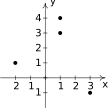
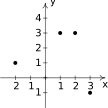
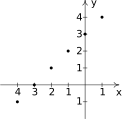
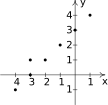
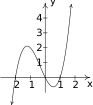
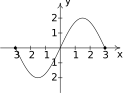
To see what the function concept means geometrically, we graph and in the plane.
Figure 1.109The graph of Figure 1.110The graph of
The fact that the -coordinate is matched with two different -coordinates in presents itself graphically as the points and lying on the same vertical line, . If we turn our attention to the graph of , we see that no two points of the relation lie on the same vertical line. We can generalize this idea as follows
It is worth taking some time to meditate on the Vertical Line Test; it will check to see how well you understand the concept of `function' as well as the concept of `graph'.
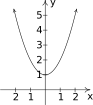
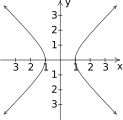
In the previous test, we say that the graph of the relation
fails the Vertical Line Test, whereas the graph of
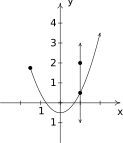
passes the Vertical Line Test. Note that in the graph of there are infinitely many vertical lines which cross the graph more than once. However, to fail the Vertical Line Test, all you need is one vertical line that fits the bill, as the next example illustrates.
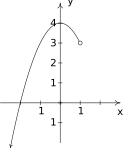
Figure 1.115 and the line Figure 1.116The graph of for Ex. 1.3.4
Suppose a relation describes as a function of . The sets of - and -coordinates are given special names which we define below.
We demonstrate finding the domain and range of functions given to us either graphically or via the roster method in the following example.
All functions are relations, but not all relations are functions. Thus the equations which described the relations in Section 1.2 may or may not describe as a function of . The algebraic representation of functions is possibly the most important way to view them so we need a process for determining whether or not an equation of a relation represents a function. (We delay the discussion of finding the domain of a function given algebraically until Section 1.4.)
Exercises
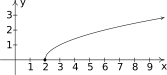
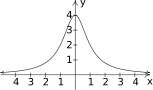
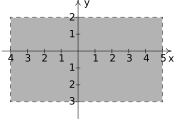
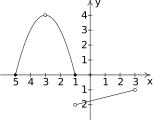
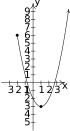
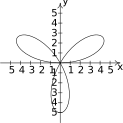
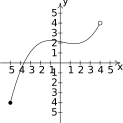
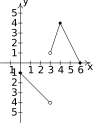
In Exercises -, determine whether or not the relation represents as a function of . Find the domain and range of those relations which are functions.
{, , , , , ,
{( is an odd integer, and is an even integer}
{ is an irrational number}
{, , , , , …}
{, , , , , , …}
In Exercises -, determine whether or not the relation represents as a function of . Find the domain and range of those relations which are functions.
Figure 1.123
Figure 1.124
Figure 1.125
Figure 1.126
Figure 1.127
Figure 1.128
Figure 1.129
Figure 1.130
Figure 1.131
Figure 1.132
Figure 1.133
Figure 1.134
Figure 1.135
Figure 1.136
Figure 1.137
Figure 1.138
Figure 1.139
Figure 1.140
Figure 1.141
Figure 1.142
In Exercises -, determine whether or not the equation represents as a function of .
Explain why the population of Sasquatch in a given area is a function of time . What would be the range of this function?
Explain why the relation between your classmates and their email addresses may not be a function. What about phone numbers and Social Security Numbers?
The process given in Example 1.3.5 for determining whether an equation of a relation represents as a function of breaks down if we cannot solve the equation for in terms of . However, that does not prevent us from proving that an equation fails to represent as a function of . What we really need is two points with the same -coordinate and different -coordinates which both satisfy the equation so that the graph of the relation would fail the Vertical Line Test 1.1. Discuss with your classmates how you might find such points for the relations given in Exercises -.
Answers
Function domain = {, , , , , ,} range = {, , , }
Not a function
Function domain = range =
Function domain = range =
Not a function
Function domain = range = {}
Function domain = range =
Function domain = range =
Not a function
Function domain = , range = {}
Function domain = range =
Not a function
Function domain = {, , , , , } range = {, , , , , }
Not a function
Function domain = range =
Not a function
Function domain = range =
Function domain = range =
Not a function
Function domain = range =
Function domain = range =
Not a function
Function domain = range =
Function domain = range =
Function domain = range =
Function domain = range =
Function domain = range =
Function domain = range =
Function domain = range =
Function domain = range =
Not a function
Function domain = range =
Function
Function
Function
Not a function
Function
Not a function
Not a function
Function
Not a function
Function
Not a function
Function
Function
Function
Not a function
Adapted from Precalculus, 3rd corrected edition, by Carl Stitz and Jeff Zeager (stitz-zeager.com), licensed under CC BY-NC-SA 3.0. Changes were made: reformatted as an accessible XYZ web edition. License: CC-BY-NC-SA-3.0.
These eBooks are a prerelease and are not yet certified conformant with WCAG 2.1 AA or ADA Title II. Every page is built against an automated accessibility gate, and the published editions will meet ADA Title II requirements when they release in late September 2026. If something is unusable, please tell us.