Suppose you want to estimate the mean weight of newborn infants, or you want to estimate the mean salary of college graduates. A confidence interval for the mean would be the way to estimate these means.
The point estimate for μ is , and the margin of error is .
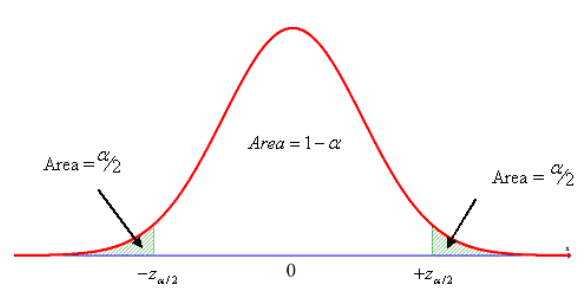
Where is the value on the standard normal curve with area 1 – between the critical values –z/2 and +z/2, as shown below in Figure 7-2.
Figure 7-2
Note: In the notation, z/2 the /2 represents the area in each of the tails, see Figure 7-2.
Assumptions:
1. If the sample size is small (n < 30), the population we are sampling from must be normally distributed. If the sample size is “large” (n ≥ 30) the Central Limit Theorem guarantees that the sampling distribution of the mean will be normally distributed no matter how the population distribution is distributed.
2. The population standard deviation σ must be known. Most of the time we are using σ from a similar study or a prior year’s data. If you have a sample standard deviation then we will use a different method introduced in a later section.
These assumptions must be addressed before using these statistical inferences. In most cases, we do not know the population standard deviation so will not use the z-interval. Instead, we will use a different sampling distribution called the Student’s t-distribution or t-distribution for short.
These eBooks are a prerelease and are not yet certified conformant with WCAG 2.1 AA or ADA Title II. Every page is built against an automated accessibility gate, and the published editions will meet ADA Title II requirements when they release in late September 2026. If something is unusable, please tell us.