There are times when the sample space is very large and is not feasible to write out. In that case, it helps to have mathematical tools for counting the size of the sample space. These tools are known as counting techniques or counting rules.
If we have 10 different letters for, say, a password, the tree diagram would be very time-consuming to make because of the length of options and tasks, so we have some shortcut formulas that help count these arrangements.
Many counting problems involve multiplying a list of decreasing numbers, which is called a factorial. The factorial is represented mathematically by the starting number followed by an exclamation point, in this case 3! = 3·2·1 = 6. There is a special symbol for this and a special button on your calculator or computer.
TI-84: On the home screen, enter the number of which you would like to find the factorial. Press [MATH]. Use cursor keys to move to the PRB menu. Press 4 (4:!) Press [ENTER] to calculate.
TI-89: On the home screen, enter the number of which you would like to find the factorial. Press [2nd] [Math] > 7:Probability > 1:!. Press [ENTER] to calculate.
Excel: In an empty cell type in =FACT(n) where n is the number so 4! would be =FACT(4).
Sometimes we do not want to select the entire group but only select r objects from n total objects. The number of ways to do this depends on if the order you choose the r objects matters or if it does not matter. As an example, if you are trying to call a person on the phone, you have to have the digits of their number in the correct order. In this case, the order of the numbers matters. If you were picking random numbers for the lottery, it does not matter which number you pick first since they always arrange the numbers from the smallest to largest once the numbers are drawn. As long as you have the same numbers that the lottery officials pick, you win. In this case, the order does not matter.
A permutation is an arrangement of items with a specific order. You use permutations to count items when the order matters.
When the order does not matter, you use combinations. A combination is an arrangement of items when order is not important. When you do a counting problem, the first thing you should ask yourself is “are repeats allowed,” then ask yourself “does order matter?”
TI-84: Enter the number “trials” (n) on the home screen. Press [MATH]. Use cursor keys to move to the PRB menu. Press 2 for permutation (2: nPr), 3 for combination (3: nCr). Enter the number of “successes” (r). Press [ENTER] to calculate.
TI-89: Press [2nd] Math > 7:Probability > Press 2 for permutation (2: nPr), 3 for combination (3: nCr). Enter the sample size on the home screen, then a comma, then enter the number of “successes,” then end the parenthesis. Press [ENTER] to calculate.
Excel: In a blank cell type in the formula =COMBIN(n, r) or =PERMUT(n, r) where n is the total number of objects and r is the smaller number of objects that you are selecting out of n. For example =COMBIN(8, 3).
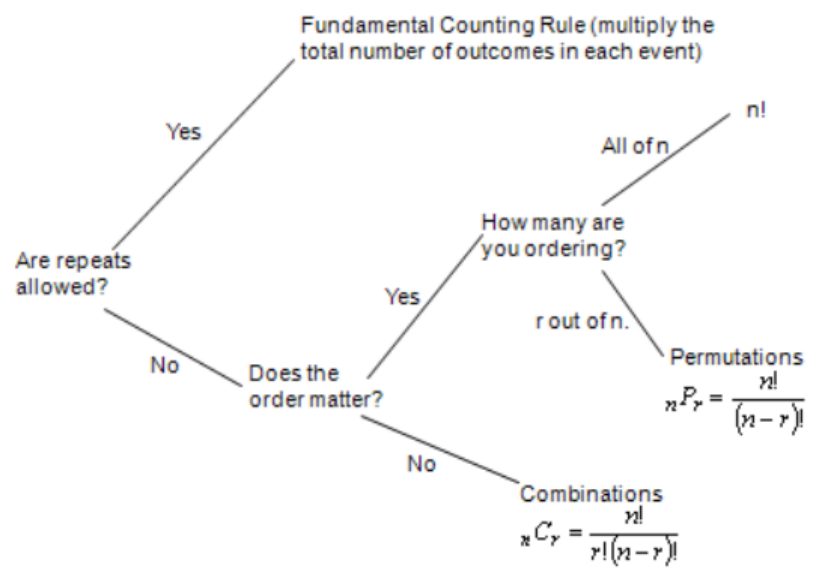
The following flow chart in Figure 4-18 may help with deciding which counting rule to use.
Start on the left; ask yourself if the same item can be repeated. For instance, a person on a committee cannot be counted as two distinct people; however, a number on a car license plate may be used twice. If repeats are not allowed, then ask, does the order in which the item is chosen matter? If it does not then we use the combinations, if it does then ask are you ordering the entire group, use factorial, or just some of the group, use permutation.
These eBooks are a prerelease and are not yet certified conformant with WCAG 2.1 AA or ADA Title II. Every page is built against an automated accessibility gate, and the published editions will meet ADA Title II requirements when they release in late September 2026. If something is unusable, please tell us.