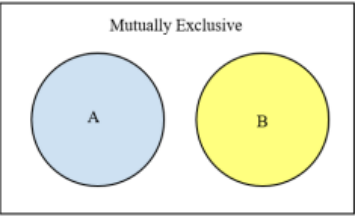
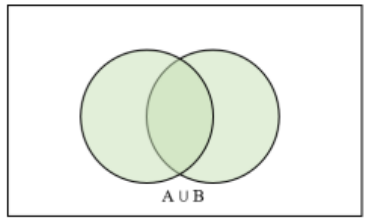
When two events cannot happen at the same time, they are called mutually exclusive or disjoint events.
Figure 4-7
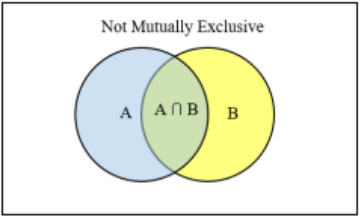
Figure 4-8
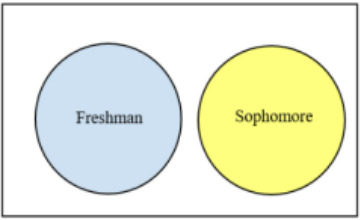
Figure 4-9
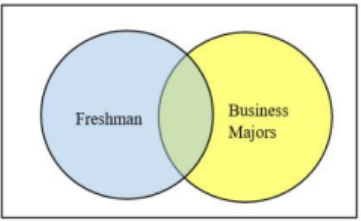
Figure 4-10
For example, a student cannot be a freshman and a sophomore at the same time, see Figure 4-9. These are mutually exclusive events. A student could be freshman and a business major at the same time so the event freshman and the event business major are not mutually exclusive see Figure 4-10.
Intersection
When we are finding the probability of both A and B happening at the same time we denote this as P(A ∩ B). This overlap is called the intersection.
Union
When either event A, event B, or both occur then we call this the union of A or B, which is denoted as (A U B). When finding the probability of A or B we denote this as P(A U B). When we write “or” in statistics, we mean “and/or” unless we explicitly state otherwise. Thus, A or B occurs means A, B, or both A and B occur.
Figure 4-11 is a Venn diagram for the union rule.
Figure 4-11
If two events are mutually exclusive, then the probability of them occurring at the same time is P(A ∩ B) = 0. So, if A and B are mutually exclusive then the P(A U B) = P(A) + P(B) as shown in Figure 4-7. It is best to write out the rule with the intersection so that you do not forget to subtract any overlapping intersection.
“‘It's... well, it's a long story,’ he said, ‘but the Question I would like to know is the Ultimate Question of Life, the Universe and Everything. All we know is that the Answer is Forty-two, which is a little aggravating.’
Prak nodded again.
‘Forty-two,’ he said. ‘Yes, that's right.’
He paused. Shadows of thought and memory crossed his face like the shadows of clouds crossing the land.
‘I'm afraid,’ he said at last, ‘that the Question and the Answer are mutually exclusive. Knowledge of one logically precludes knowledge of the other. It is impossible that both can ever be known about the same universe.’”
(Adams, 2002)
Words Are Important!
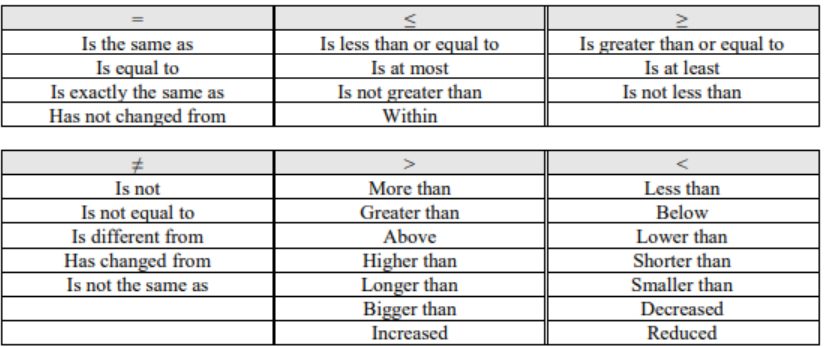
When working with probability, words such as “more than” or “less than” can drastically change the answer. Figure 4-14 shows some of the common phrases you may run into while reading a problem. It will be essential later in the course that you can correctly match these phrases with their correct symbol.
These eBooks are a prerelease and are not yet certified conformant with WCAG 2.1 AA or ADA Title II. Every page is built against an automated accessibility gate, and the published editions will meet ADA Title II requirements when they release in late September 2026. If something is unusable, please tell us.