
0.9 Lines in Space
In the plane a line is : a slope and an intercept. In space there is no slope — a line can lean in two independent ways at once — and no single equation of the form describes a line, because such an equation describes a whole plane. What a line has, in any dimension, is a point on it and a direction along it. Start at the point , walk any multiple of the direction vector , and you trace the line:
The number is a parameter: each value of names one point of the line, names itself, and negative values run backward through to the other side. Adding a point and a vector means adding coordinates to components, and the result is a point, so the equation splits into one parametric equation per coordinate.
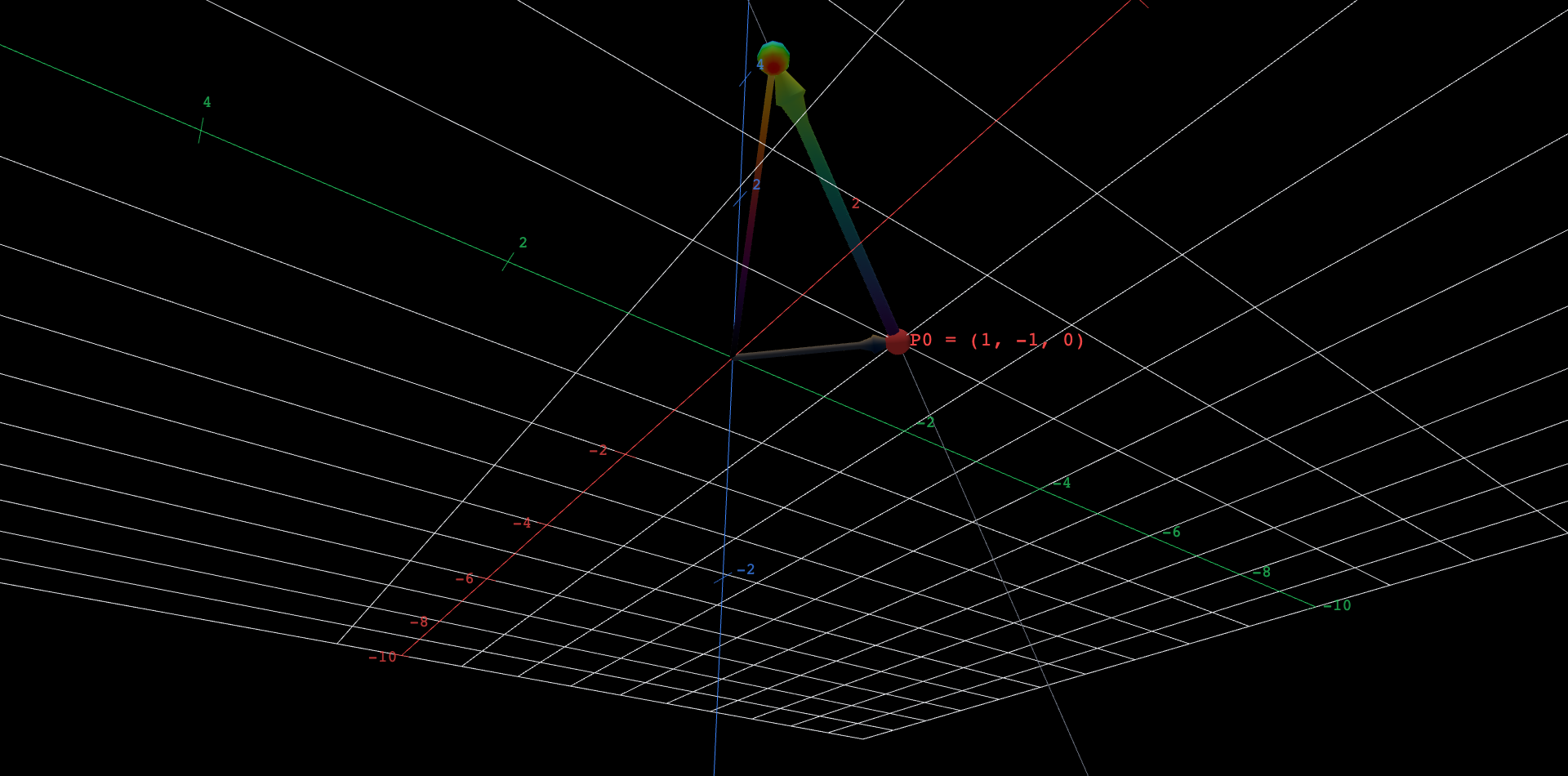
The figure takes and , and puts the parameter on a slider.
 Explore in 3D (opens in a new tab)
A thin gray line crossing the scene, passing through a red point P0 at (1, -1, 0) on the floor and rising toward the back. A thick shaded arrow from P0 to (2, 1, 1) is the direction vector d = (1, 2, 1), drawn with its tail at P0. A slider s, starting at 1, puts a small bright ball on the line at the point P of s, with coordinates 1 plus s, minus 1 plus 2s, and s, which at the starting value is exactly the tip of that arrow, and joins the ball to P0 by a thin rod s copies of d long. Two more objects start at the origin: a thin arrow to P0, and a thinner rod to the ball, so the position of P(s) is visibly the origin-to-P0 arrow followed by the rod along the line. Dragging s slides the ball along the gray line, out past the tip of the direction arrow for s above 1 and back through P0 to the far side for negative s, with the rod from the origin swinging to follow it. Two more points are marked: a green point Q at (4, 5, 3), which the ball reaches exactly at s = 3, and a purple point R at (2, 0, 2), which the ball passes near but never touches.
Explore the figure
- At the starting value the ball sits exactly at the tip of : . One copy of the direction vector, laid from .
- Drag to . The ball lands exactly on the green point : , so is on the line, three direction vectors along from .
- Drag to . The ball has passed back through to : the line does not stop at , and negative parameters reach the other half of it.
- Now try to reach the purple point with the slider. Its first coordinate would need , but is not . No value of works, so is not on the line — it only looks close from some viewpoints.
- Watch the rod from the origin as you sweep . It always ends at the ball, and it is always the arrow to followed by the rod along the line: the position of , read as a vector from the origin, is . That is the vector equation of the line, and it is the parametric equations written as one line.
Reading the equations
With and , the vector equation says, coordinate by coordinate,
The coefficients of are the components of the direction, and the constants are the coordinates of the point at . In there are such equations; in the plane, two — and eliminating between them (when ) gives , the familiar slope form with slope , so nothing has been lost.
A line has many descriptions. Any other point of the line will serve as , and any nonzero multiple of will serve as the direction: the point with direction describes the figure's line as well as with does, only with the parameter running twice as fast and starting one step along. Two points also determine the line through them: use one as and their difference, head minus tail, as .
Whether a point lies on a line is a question about a single parameter value: does one satisfy all the coordinate equations at once? That is a small system of equations in the one unknown , consistent when the point is on the line and inconsistent when it is not — a preview of Chapter 1, where systems like this are the subject.
The three coordinate equations for reaching from — , , — as an augmented matrix with the direction's components on the left and the displacement to on the right, reduced by a computer algebra system. One pivot, one solution: , and the two zero rows say the other two equations agreed with it.
The same system for , whose displacement from is . The reduced form has a pivot in the right-hand column — the row that reads — so the three equations contradict one another and no parameter value reaches .
The direction and the displacement to , stacked as rows. Rank means the displacement is a multiple of the direction — the same test as Section 0.4's parallel vectors — so lies on the line.
For the displacement is , and the two rows have rank : not parallel, so is off the line.
An original work of XYZ Homework, built around interactive XYZ 3D figures. Chapters 1–6 follow the topic sequence of Interactive Linear Algebra (Margalit & Rabinoff, Georgia Tech, GNU FDL). Chapter 0's scope (its topics, their order, and the idea each figure shows) follows the Vectors chapter of Ximera's Linear Algebra: An Interactive Introduction. The prose, worked examples and figures were written for this book, which is not affiliated with or endorsed by the authors of either work. License: CC-BY-NC-SA-4.0.