
0.1 Points and Distance in Space
A point on a line is a number. A point in the plane is a pair : walk units along the first axis, then units parallel to the second. A point in space is a triple — the same two walks, then a climb of . The three axes meet at the origin , and each pair of axes spans a coordinate plane: the -plane is the floor , the -plane and -plane are two walls. The three planes cut space into eight rooms, the octants; the point sits in the room where all three coordinates are positive, and sits in the room next door.
The set of all triples is written , and nothing about the notation stops at three. The set of all lists of real numbers, , is , with origin . We cannot draw , but every formula in this chapter is written so that it does not care — and the first of them is the distance between two points.
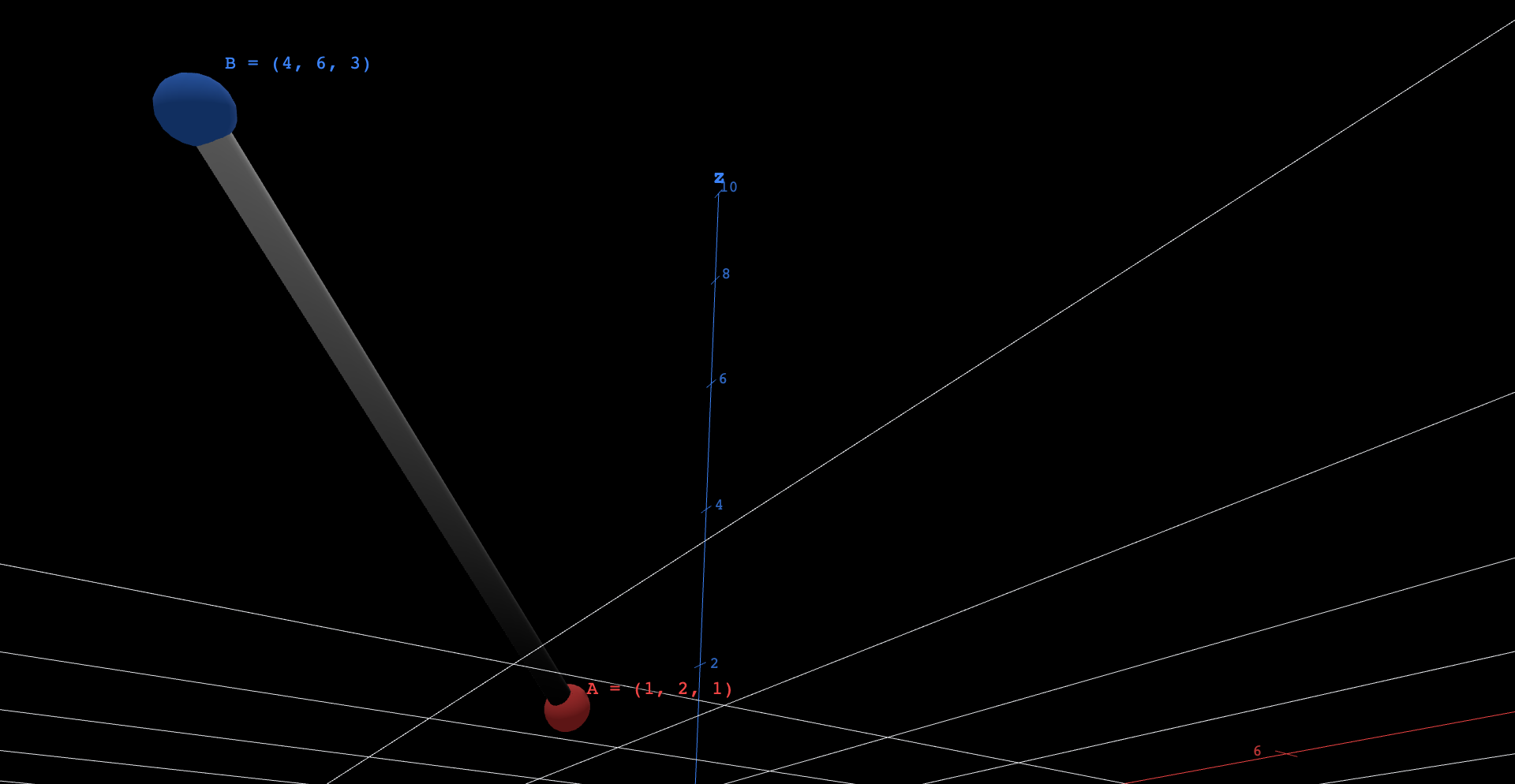
The figure below holds two points, and , the segment between them, and three groups of objects built around that segment. The three groups are the proof; the steps below take them one at a time.
 Explore in 3D (opens in a new tab)
Two labeled points above a horizontal grid, a red point A at (1, 2, 1) and a blue point B at (4, 6, 3), joined by a rainbow-shaded rod. There are no sliders. The rest of the construction is drawn as well, in three groups. Gray plumb lines drop from A and B to their shadows A' and B', two gray points on the floor, and a thinner gray rod lies along the floor between the shadows. That floor rod has two legs, a red line 3 units along the x direction and a green line 4 units along the y direction, so the floor rod is the hypotenuse of a right triangle with sides 3, 4 and 5. A purple corner point C at (4, 6, 1), level with A and directly below B, is joined to A by a gray rod of length 5 and to B by a shorter, vertical gray rod of length 2, making a right triangle whose hypotenuse is the original rod AB, of length the square root of 29.
Explore the figure
- Orbit until you are looking straight down, and read each point's first two coordinates off the grid: sits above and above . Orbit back to a side view and read the heights, and . Three numbers locate a point completely.
- Find the two shadows and , the gray points on the floor, the gray plumb lines that drop to them from and , and the thinner gray rod lying along the floor between the shadows. The floor segment is the rod with its height forgotten — a problem in the plane, where you already know how to measure.
- Find the two floor legs: the red one, units along the direction, and the green one, along the direction. They meet at a right angle on the floor, so is the hypotenuse of a –– triangle: its length is .
- Find the purple corner and the two gray legs and . The leg is level, so it is a copy of and has length ; the leg is vertical, of length ; and they meet at a right angle. The rod is the hypotenuse: , so .
- Predict before you check: if were lowered to height , level with , the vertical leg would vanish and the distance would drop to exactly . If instead were raised to height , the vertical leg would be and the distance .
Two right triangles
Nothing in the figure depended on the particular numbers. Take any two points and . Their shadows on the floor are and , and the distance between shadows is a plane problem, settled by Pythagoras in the floor:
Now let be the point directly below at the height of . The leg is horizontal and is a copy of , so it has the length just computed; the leg is vertical, of length ; and the two legs are perpendicular, because one lies in a horizontal plane and the other runs straight up. Pythagoras once more, in the vertical triangle :
That is the distance formula in : the distance between two points is the square root of the sum of the squared coordinate differences. The absolute value on the vertical leg was harmless to drop, since squaring forgets a sign anyway.
Look at the shape of the answer rather than its derivation. In the distance is , which is . In it is the sum of two squared differences under a root; in , three. The pattern is the formula, and it is the pattern we keep when the picture runs out: for and in , we define
There is no fourth axis to drop a plumb line along. But every property of distance that we will ever use — that it is never negative, that it is zero only between a point and itself, that it is the same measured from either end — follows from this formula directly, without a picture.
The three coordinate differences between and , handed to a computer algebra system as one vector. Its length comes back as — exactly, not as a decimal — which is what the two right triangles claimed.
The same differences with the vertical one left out: the floor rod between the shadows has length exactly , the –– triangle of step 3. The engine returns the whole number rather than .
The distance from to , recomputed from the same head-minus-tail differences: .
The second half of the worked example, where no picture is available: the four coordinate differences between and in . The op does not care how many components it is given, which is the section's point — the pattern is the definition.
An original work of XYZ Homework, built around interactive XYZ 3D figures. Chapters 1–6 follow the topic sequence of Interactive Linear Algebra (Margalit & Rabinoff, Georgia Tech, GNU FDL). Chapter 0's scope (its topics, their order, and the idea each figure shows) follows the Vectors chapter of Ximera's Linear Algebra: An Interactive Introduction. The prose, worked examples and figures were written for this book, which is not affiliated with or endorsed by the authors of either work. License: CC-BY-NC-SA-4.0.